DJI Lito 1 vs Neo 2: Two Completely Different Drones (So Which One Makes More Sense?)
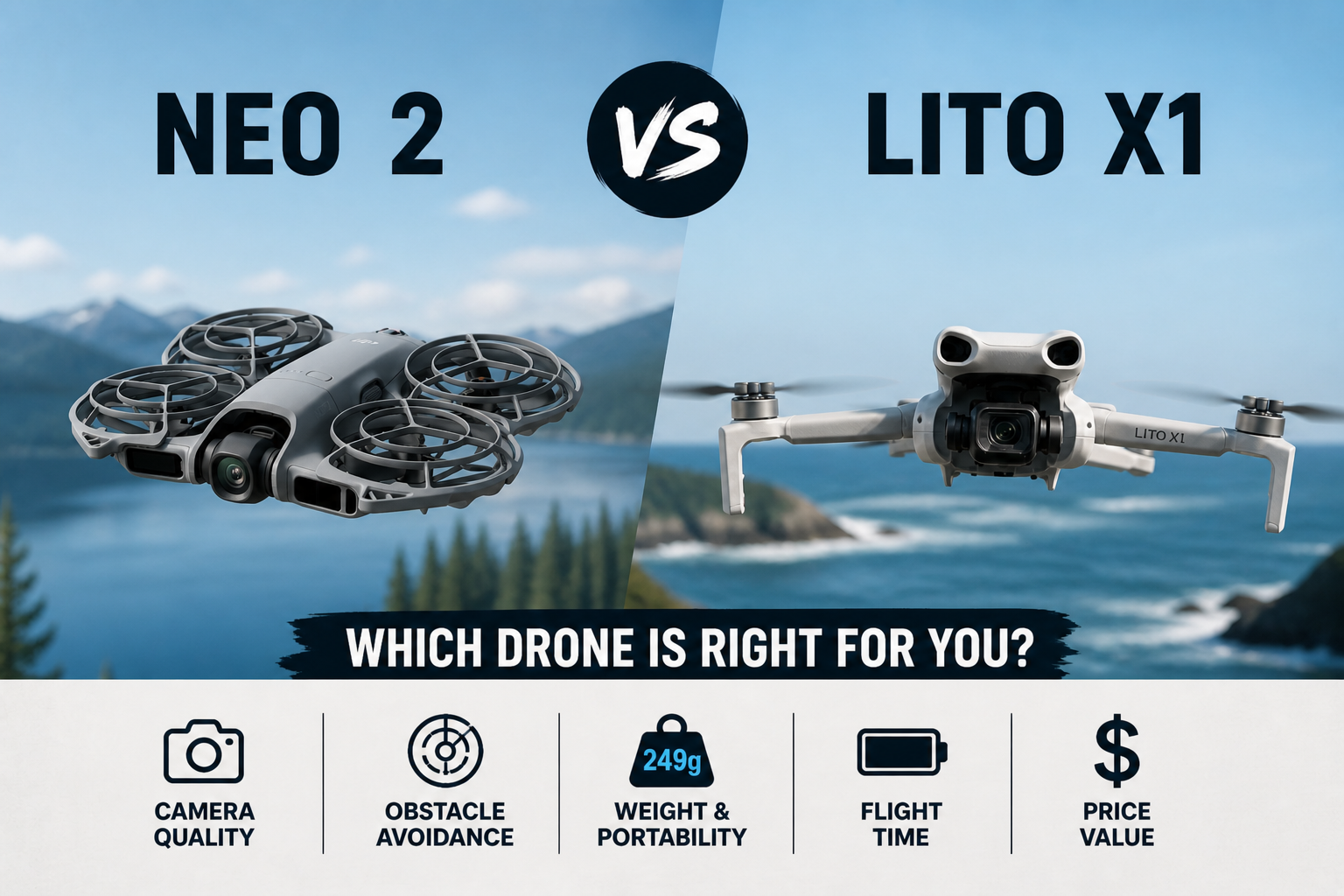
DJI’s made this confusing again, and not in a bad way. Just in that way where you look at two drones that cost roughly the same and go, “okay… what am I actually supposed to buy here?”
Because on paper, the Lito 1 and the Neo 2 end up in the same conversation.
In real life, they’re not even trying to do the same thing.
Before anything else, I’ll just say it—I love the Neo 2. Way more than I expected to. So yeah, there’s some bias here, but I’ll call it out where it matters.
The Neo 2 is basically a flying GoPro that doesn’t care about your plans. It’s the kind of drone you don’t baby. You crash it, you pick it up, you send it again. You bump into something, whatever. It’s fine. That changes how you use it. You stop flying like everything is fragile and expensive, and you start actually using the thing.
Where it really shines is follow-me stuff. That’s its lane. It’s great at tracking people, staying low, moving quickly, and capturing stuff that actually feels like something is happening. If you’re chasing your kid, riding a bike, messing around with a truck, whatever—it just works.
That’s why I keep grabbing it.
But yeah, it’s got limits. Wind pushes it around pretty easily. It’s not something I’m sending up high trying to get some perfect cinematic shot. You’re not hovering over a property thinking about composition and lighting with this thing. It lives low, it moves fast, and it captures action. That’s the job.
The Lito 1 is a completely different mindset.
I haven’t flown it yet, so I’m not going to pretend I know exactly how it feels, but it’s pretty obvious what it’s trying to be. It’s stepping into that old Mini 3 role—the “this is my first real drone” category.
Controller in your hands, thinking about your shots, actually flying with intention instead of just sending it and seeing what happens.
And honestly, for the price, what it looks like you get is pretty impressive compared to what that entry-level category used to be. If you were looking at a Mini 3 a while ago, this is basically the new version of that idea.
It’s going to be more stable, more controlled, and better suited to slower, cleaner footage. If your goal is to learn how to actually fly a drone properly and get something that looks a bit more polished, this is clearly the direction you go.
But it’s not competing with the Neo 2 on fun or ease.
That’s the part people are going to mix up.
The Neo 2 is the one you grab without thinking. The Lito 1 is the one you take out when you’ve decided you’re going to go fly.
Even though they’re both “micro” drones, they’re going to feel completely different. The Neo 2 is light, twitchy, and gets pushed around. The Lito 1 is going to feel more planted, more predictable, more like something you actually control instead of something you kind of just let loose.
So the decision really comes down to what kind of person you are, not what the spec sheet says.
If you just want something fun that you’ll actually use all the time, it’s the Neo 2. No question. It’s easy, it’s forgiving, and you won’t hesitate to take it with you.
If you want to learn drones properly, slow things down a bit, and get cleaner-looking footage, then yeah—the Lito 1 makes more sense.
And if you’re already leaning that way, you’re probably going to start looking at the Lito X1 anyway, because that seems to be where DJI is putting the more serious features now.
For me, I still lean Neo 2 most of the time.
Not because it’s “better,” but because it actually gets used. It leaves the house, it gets thrown in a bag, it gets handed to a five-year-old, it gets suction-cupped to the side of a truck, and it just keeps going.
The Lito 1 is the better drone.
The Neo 2 is the one you’ll probably use more.
And if you’re being honest about how you actually live with this stuff, that usually ends up being the decision that matters.
This is also where checking the current pricing helps, because these two are close enough that the better choice really depends on what you want it for.
If you want the more traditional “first real drone” experience, check the latest DJI Lito 1 pricing on Amazon
If you want the fun little flying camera you’ll probably throw in a bag and use constantly, check the latest DJI Neo 2 pricing on Amazon
And if you’re already looking at the Lito 1 and thinking, “yeah, but what about the better one?” — check the latest DJI Lito X1 pricing on Amazon
Because that’s usually how this goes.
You start by comparing two sensible little drones.
Then five minutes later you’re justifying the upgrade like it was your idea all along.
Related Reads
Hiring a Drone Pilot in Victoria, BC — What It Costs and What You Get
Straightforward pricing, what’s included, and what the process looks like if you need aerial photos, video, inspections, or a better look at something from above.
DJI Air 3S vs Mini 5 Pro in Canada: When Bigger Still Makes Sense
The Mini 5 Pro is seriously capable, but if it’s not comfortably a micro drone in Canada, the Air 3S starts looking a lot more interesting — especially with dual cameras, bigger battery life, and real confidence in coastal wind.
DJI Neo 2 Review: The Best First Drone for Kids, Creators, and Wannabe Jedi
A tiny follow-me drone with palm launch, gesture control, prop guards, and just enough weird DJI wizardry to make you feel like you’re using the Force. Great for kids, creators, hikers, bikers, and anyone who wants a drone they’ll actually use.
