DJI Lito X1 vs Mini 5 Pro — Are You Paying Double for Stuff You’ll Actually Notice?
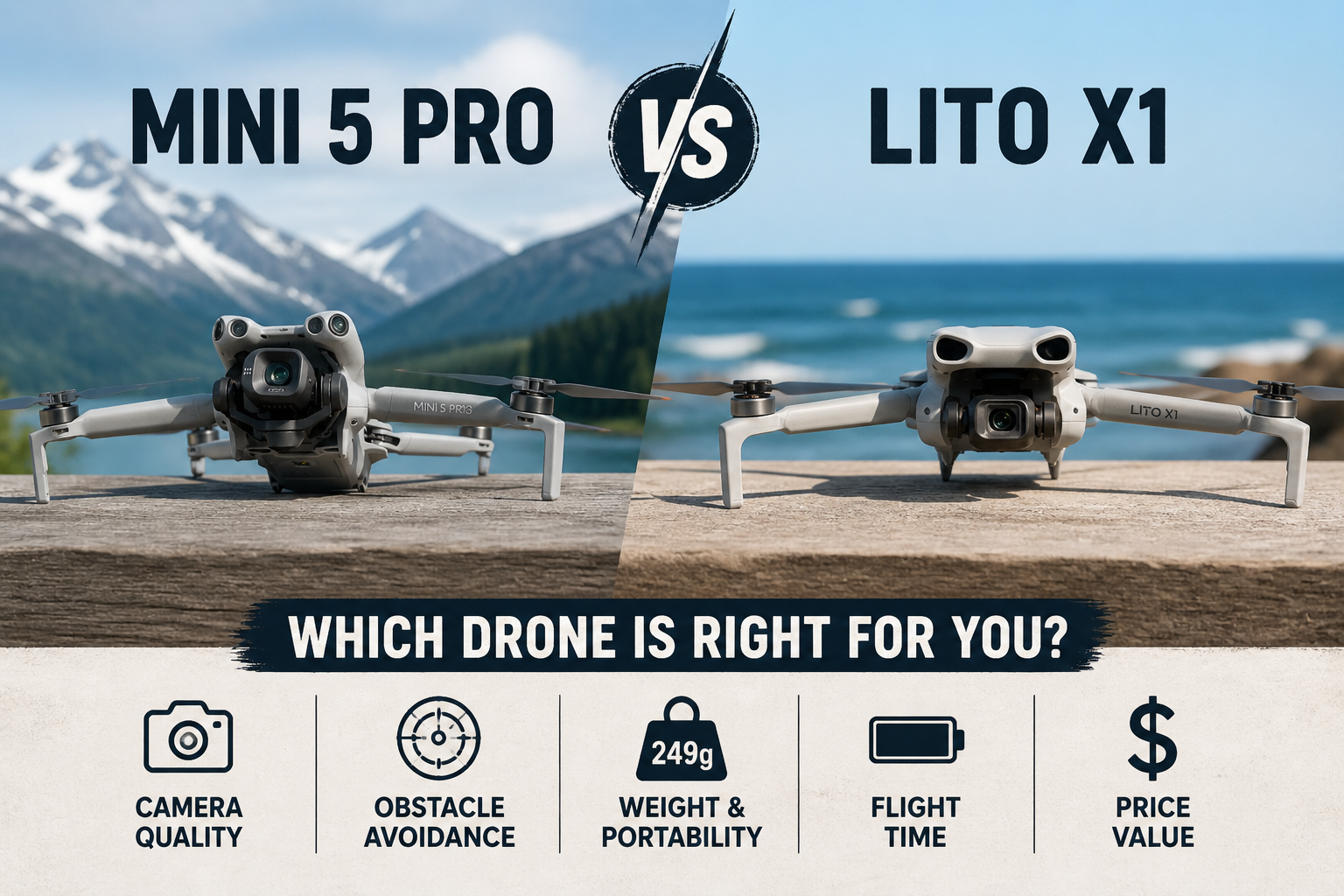
On paper, the DJI Mini 5 Pro is the better drone.
It has the bigger camera sensor, more polished “Pro” features and enough impressive numbers to keep spec-sheet enthusiasts occupied through an entire rainy Vancouver Island weekend.
That part isn’t really up for debate.
But it also isn’t the question most people should be asking.
The real question is whether those improvements will matter enough in normal use to justify spending considerably more—especially in Canada, where staying below 250 grams can dramatically simplify where and how often you fly.
That’s where the DJI Lito X1 becomes very difficult to ignore.
First, This Isn’t a Hands-On Comparison
I haven’t flown the Lito X1 or Mini 5 Pro side by side, so I’m not going to pretend this is some elaborate flight test.
It isn’t.
I’ve handled the X1, followed both drones closely and spent plenty of time flying DJI equipment, including the Air 3S I use for commercial work. I have a fairly good idea which features people genuinely use and which ones mostly help justify another increasingly irresponsible DJI purchase.
This is a buying comparison.
And if somebody asked me which of these two drones they should buy with their own money, I’d point most people toward the Lito X1.
The Mini 5 Pro Has the Better Camera
The Mini 5 Pro uses a 1-inch sensor. The Lito X1 uses a 1/1.3-inch sensor.
The Mini wins.
If you’re chasing the best possible image quality from a small drone, shooting in difficult light, grading footage heavily or trying to squeeze every last bit of detail from the camera, the Mini 5 Pro gives you more to work with.
That larger sensor is a real advantage. I’m not going to wave my hands around and pretend most people’s phones have made sensor size irrelevant.
Physics remains annoyingly undefeated.
But the Lito X1 still gives you a very capable 1/1.3-inch camera with 48-megapixel photos, 4K/60fps HDR video, 4K/100fps slow motion and 10-bit D-Log M.
That is not a sad little beginner camera.
For travel, camping, family trips, social media, YouTube and generally making your friends jealous of where you live, the X1’s camera is likely more than enough.
The Mini 5 Pro produces better footage.
The question is whether most people will see enough difference after that footage has been compressed, uploaded and watched on a phone to feel good about the extra money.
Some will.
A lot probably won’t.
The X1 Already Has the Fancy Stuff
The Lito X1 doesn’t beat the Mini 5 Pro by stripping everything useful away and winning on price.
That’s what makes it interesting.
You still get ActiveTrack, QuickShots, MasterShots, Hyperlapse, omnidirectional obstacle sensing and forward-facing LiDAR. You also get 42GB of internal storage.
In normal-person language, it can follow subjects, perform automated camera moves, help avoid obstacles and continue recording when you inevitably discover that your SD card is sitting at home in the card reader.
That last feature deserves more attention than it gets.
Sooner or later, you will wake up early, grab a coffee, drive somewhere beautiful and unfold your expensive flying camera while feeling unusually competent.
Then you’ll realize you forgot the damn SD card.
Forty-two gigabytes of internal storage turns that from a completely wasted morning into a mildly embarrassing inconvenience.
Every drone should have useful onboard storage.
Somehow, they still don’t.
The Mini 5 Pro also has 42GB of internal storage and a more advanced overall camera system. But the important point is that the X1 doesn’t leave you staring upward at the Mini because you’re missing all the fun features.
Most of the good stuff is already there.
Then There’s the Weight Problem
This is where the Canadian side of the comparison becomes awkward.
DJI lists the Mini 5 Pro at approximately 249.9 grams, with actual weight potentially varying by four grams in either direction because of materials and manufacturing differences.
That is uncomfortably close to one of the most important dividing lines in Canadian drone regulations.
Under 250 grams, you’re operating a microdrone. At 250 grams or above, the regulatory requirements change considerably.
The number that matters is the aircraft’s actual takeoff weight, not the optimism printed on the box.
The Lito X1 is listed at approximately 249 grams with its standard battery. That still means owners should understand their exact setup, especially before adding accessories, but its entire reason for existing fits much more cleanly into the lightweight-drone category.
That matters.
A drone that’s easier to bring and easier to fly legally is a drone you’re more likely to use.
The best camera in the world isn’t particularly useful when the aircraft stays home because flying it feels like paperwork.
The Lito X1 Is the Better Decision for Most People
The Mini 5 Pro is the better drone.
The Lito X1 is probably the better decision.
That isn’t because the X1 secretly beats the Mini at everything. It doesn’t.
It’s because the X1 reaches the point where most recreational pilots may stop caring that something better exists.
You already have:
A genuinely capable camera
ActiveTrack
Automated shooting modes
Omnidirectional obstacle sensing
Forward-facing LiDAR
42GB of onboard storage
Proper battery life
A sub-249g aircraft
The option of DJI’s excellent RC 2 screen controller
What exactly are you going to upgrade for?
Better low-light footage? More dynamic range? A larger sensor? Those are legitimate reasons if you’re serious about photography or video.
But if you’re filming camping trips, coastlines, family adventures, hikes, road trips and the occasional cinematic pass over your truck, the X1 already does nearly everything you bought a drone to do.
Buy the Proper Package
At the time of writing, the DJI Lito X1 Fly More Combo with the RC 2 controller is about $879 CAD before tax on Amazon Canada.
That’s the package I would buy.
Get the extra batteries.
Get the controller with the built-in screen.
Don’t save a little money and spend the next year wishing you had bought the better controller or the better drone.
A phone-based controller works. It also means mounting your phone, connecting a cable and surrendering your phone every time you fly.
The RC 2 makes the drone feel like a complete piece of equipment. Turn on the controller, turn on the aircraft and go fly.
The extra batteries matter for equally obvious reasons.
One battery is enough to launch, find your shot and receive a low-battery warning just as things become interesting. Three batteries let you settle down, get the safe footage and then try something creative without immediately calculating whether the drone can still make it home.
Buy once. Cry once. Fly three times.
Who Should Still Buy the Mini 5 Pro?
If image quality is the priority and you specifically want the strongest camera DJI can fit into this class, buy the Mini 5 Pro.
If you shoot frequently in low light, care about the larger sensor or expect to push the footage harder during editing, the Mini makes sense.
It’s also the drone for somebody who simply wants the more advanced option and doesn’t mind paying for it.
There’s nothing wrong with that.
I own an Air 3S partly because I knew I would keep looking upward if I bought something less capable. Sometimes buying the better tool is the smarter financial decision because it stops you from buying twice.
But I don’t think that argument automatically leads from the X1 to the Mini 5 Pro.
The X1 already includes enough camera performance, sensing, tracking, storage and general DJI wizardry that most owners aren’t going to feel deprived.
They’re just going to own a very good drone and have several hundred dollars left for camping, fuel or the next questionable hobby.
The Bottom Line
The Mini 5 Pro is the better drone.
It has the better camera and more high-end capability.
But for most people looking for a capable sub-249g drone in Canada, I’d buy the Lito X1 Fly More Combo with the RC 2.
It gives you the features people actually want, a camera that should be more than good enough for most uses, useful internal storage, obstacle sensing, intelligent tracking, extra batteries and the controller you won’t immediately want to replace.
You can spend more.
You will always be able to spend more.
DJI has built a remarkably successful business around making sure we’re all aware of that.
But the Lito X1 feels like the point where spending more stops being necessary and starts becoming a personal problem.
Check the current DJI Lito X1 Fly More Combo price on Amazon Canada.
Check the current DJI Mini 5 Pro price on Amazon Canada.
As an Amazon Associate, Vancouver Island Drones may earn a commission from qualifying purchases made through links on this page. It doesn’t change what you pay, but it may help offset our ongoing DJI addiction.
Related Reads
The DJI Lito X1 Is the Drone I’d Recommend Right Now
Done comparing and just want the answer? Here’s why I’d buy the Lito X1 Fly More Combo with the RC 2—and avoid immediately wishing I’d bought the better one.
Which DJI Drone Should You Buy First: Neo 2, Lito 1, or Lito X1?
A practical, slightly biased look at the Neo 2, Lito 1 and Lito X1—from the flying yellow Labrador to the first proper camera drone and the one you’re least likely to outgrow.
Drone Accessories I Actually Recommend in Canada
You do not need 47 drone accessories. Just the practical stuff that keeps you flying longer, protects your gear and saves you from ruining a flight before it even starts.
