DJI’s Drone Lineup in 2026 (And Why It Feels So Weird Right Now)
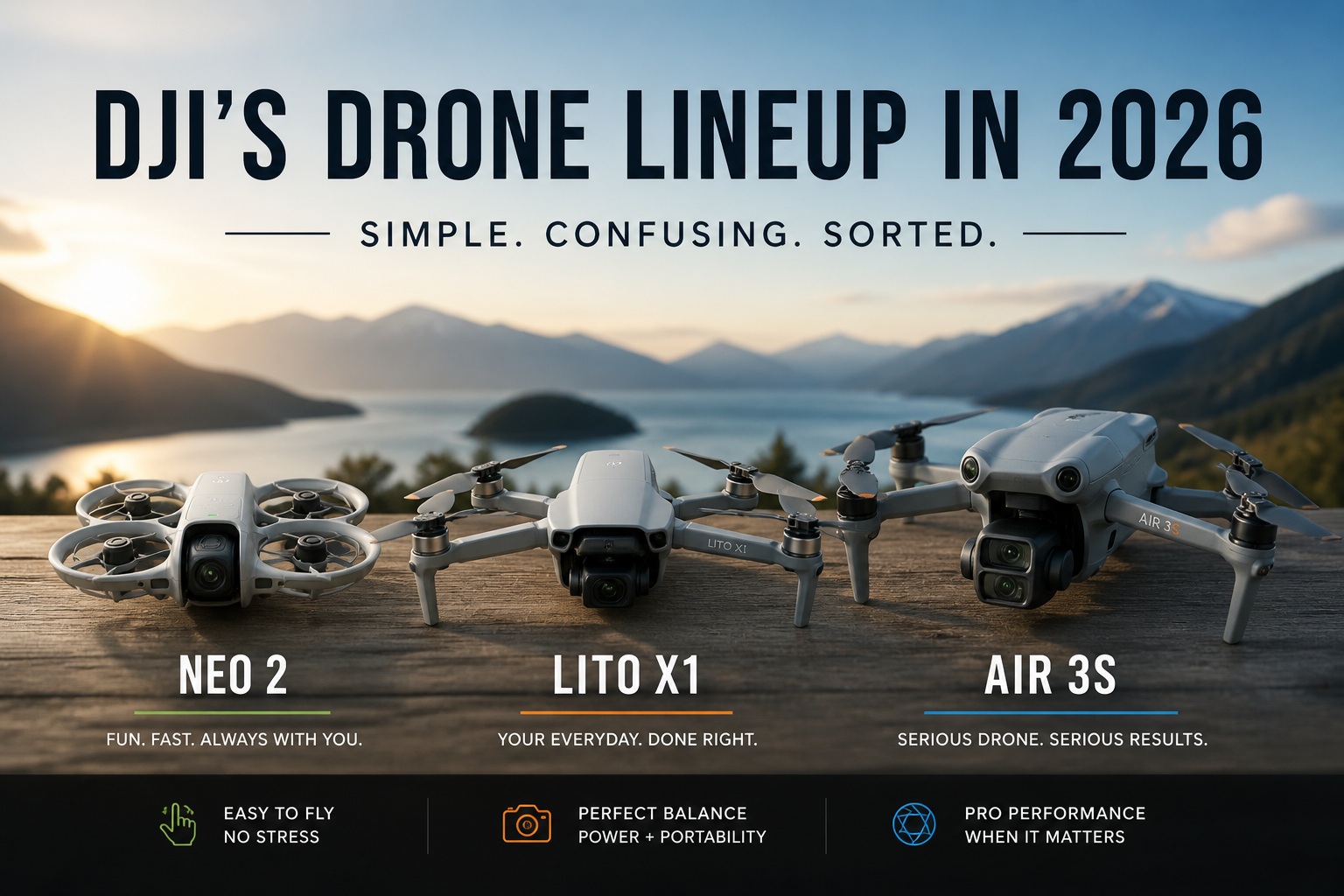
DJI’s drone lineup in 2026 is… not as straightforward as it used to be.
That’s not necessarily a bad thing. It just means you can’t look at it the way you did a couple years ago and expect it to make sense.
Because for a long time, it did.
You wanted something simple? You bought a Mini.
You wanted something better? You bought a Mini Pro.
You wanted something serious? You stepped up to the Air or Mavic line.
Done. Decision made. Go fly.
Now?
Now you’ve got the Neo 2, the Lito 1, the Lito X1, a Mini 5 Pro that may or may not still belong in the “mini” category depending on how it lands with weight, an Air 3S doing real work, and an Avata 360 off in the corner doing its own thing entirely.
So yeah… it’s a bit of a lineup shuffle.
Let’s start with the easiest one.
The Neo 2 is still the most obvious drone DJI makes. It’s not trying to be a traditional camera drone, and that’s exactly why it works. You pull it out, press a button, and it flies. No controller if you don’t want one, no waiting around, no overthinking it.
It’s the one that actually gets used.
And honestly, that matters more than specs.
Then we get into the Lito lineup, which is where things quietly changed.
Because I don’t think DJI added these drones.
I think they replaced something.
The Lito 1 feels like what the Mini 3 used to be. Entry-level “real drone,” decent camera, some smart features, and a price that doesn’t scare people off. Except now it’s got things like active tracking baked in, which wasn’t really a given at that level before.
So yeah, it’s better.
But here’s the problem — sitting right next to it is the Lito X1.
And the X1 looks like the drone most people should actually be buying. It’s under 249 grams, it’s got a proper camera, tracking, obstacle avoidance, and real flight time. It checks all the boxes most people care about, and it does it at a price that makes you stop and think.
This is the one that feels like it quietly stepped into the Mini 4 Pro’s spot.
Not perfectly. Not yet.
But close enough.
Which brings us to the Mini lineup… or what’s left of it.
The Mini 3 is basically gone, which makes sense. It had a great run, got a lot of people into drones — myself included — but it’s been replaced.
The Mini 4 Pro is still excellent. No complaints there. But if you’ve looked at DJI’s site lately, you’ll notice stock is getting thin. Fewer options, fewer bundles. That’s usually how this story ends.
It doesn’t feel like it’s being improved.
It feels like it’s being phased out.
And if the Lito X1 delivers even close to what it looks like on paper, that’s not surprising.
Then there’s the Mini 5 Pro.
And this is where things get a little… awkward.
Because if it’s not under 249 grams — especially here in Canada — then what’s the point?
The whole advantage of the Mini lineup was that it lived in that micro category. Fewer headaches, fewer restrictions, easier all around. If you lose that, you’re suddenly playing by different rules anyway.
And I’m certainly not in a position to start throwing stones about anything being overweight…
But when it comes to drones, that extra weight actually matters.
At that point, you might as well step up to something like the Air 3S and get the full capability.
Speaking of which, the Air 3S is exactly what you think it is.
This is where things get serious. Dual cameras, better image quality, more flexibility — and yes, Advanced certificate territory in Canada. This isn’t your “just in case I bring it” drone. This is the one you bring when you actually need to get something done.
And then there’s the Avata 360.
Which, to be fair, is doing something completely different.
This isn’t really competing with the Neo, the Lito, or even the Air series. It’s an FPV drone, but now it’s also pushing into that 360-style capture space. You’re not just flying a shot — you’re giving yourself more flexibility in how you use it afterward.
Looks like 360 sometimes. Definitely isn’t.
It’s cool. Probably very cool.
But it’s not what most people are looking for when they’re trying to figure out their first drone, or even their main drone. This is more of a creative tool than a “what should I buy?” answer.
So if you zoom out for a second, the lineup actually looks a lot cleaner than it first appears.
The Neo 2 is your “fun, low effort, always with you” drone.
The Lito X1 is your “this is my actual drone” drone.
The Lito 1 is there if you’re trying to hit a lower price point, but I’d personally stretch if I could.
The Mini 4 Pro is still great, but it feels like it’s on its way out.
The Mini 5 Pro sits in a weird middle ground depending on how it lands in Canada.
The Air 3S is your serious, get-it-done option.
And the Avata 360 is off doing creative FPV things for people who know they want that.
So yeah, DJI’s lineup in 2026 looks confusing at first.
But once you realize they didn’t just add more drones — they moved everything around — it starts to make a lot more sense.
They didn’t break the system.
They just reshuffled it.
Related Reads
DJI Lito X1 vs Mini 4 Pro: This Changes What Drone I Recommend in Canada
A closer look at how the Lito X1 stacks up against the Mini 4 Pro — and why it might be the better buy for most people now.
DJI Neo 2 After One Month — Insane Value, Easy to Use, and Surprisingly Tough
Real-world use, bumps included, and why the Neo 2 ends up coming everywhere with us whether we plan for it or not.
Best Drone to Buy in Canada (2026): The Honest Answer No One Gives You
Why Canadian drone rules matter more than specs — and how that actually changes what you should be buying.
