DJI Air 3S After a Year — The Drone I’d Buy Again
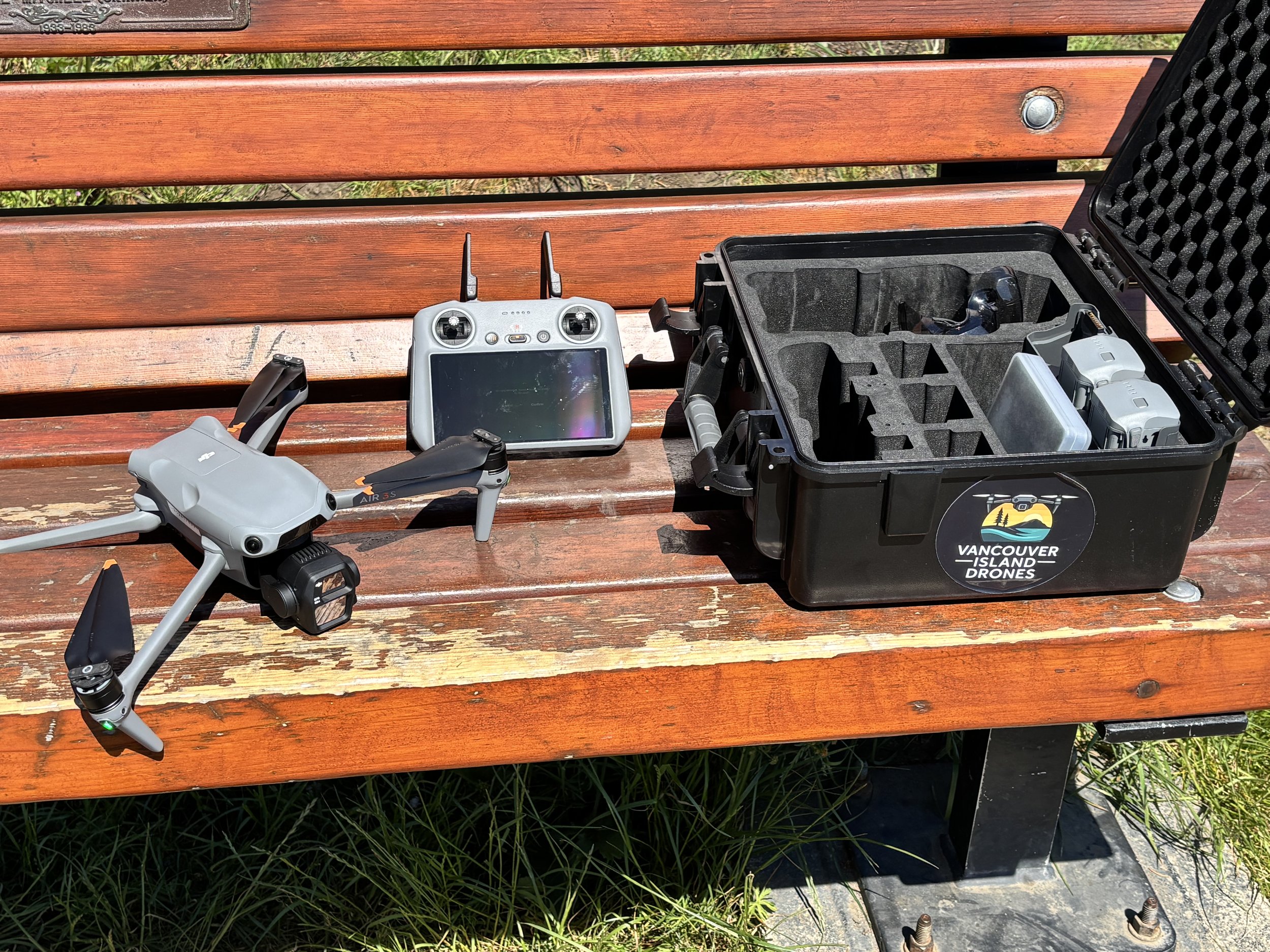
I’ve owned the DJI Air 3S for more than a year now, and I’ve used it for everything from sunrise flights around Vancouver Island to actual paid commercial work.
And after all that time, I can make this pretty simple:
I still love it.
Not “it’s pretty good for what it is.”
Not “I’d maybe consider something else now.”
I mean if mine disappeared tomorrow and I had to replace it, I’d be looking very hard at another Air 3S.
There are newer drones. Smaller drones. Cheaper drones. Drones with slightly different tricks.
But for the way I actually fly, the Air 3S has ended up sitting in a really nice sweet spot.
The Two Cameras Are Probably My Favourite Part
The Air 3S has a 24mm-equivalent wide camera with a 1-inch 50MP sensor, and a second 70mm-equivalent medium tele camera with a 48MP 1/1.3-inch sensor.
That second camera is not some gimmick I forgot about after the first week.
I use it.
A lot.
The 24mm camera is exactly what you want for big landscapes, coastlines, buildings and establishing shots. It gives you the classic wide aerial view.
Then you switch to the 70mm and suddenly everything changes.
The background compresses. Mountains look bigger. Buildings separate from their surroundings. Boats, cars and people become more interesting subjects. You can get shots that simply don’t look like the same generic wide-angle drone footage everybody has seen a thousand times.
For commercial work, that flexibility is huge.
I can show up to one location with one drone and come home with footage that looks like it came from two different camera setups.
That alone has probably ruined me for going back to a single-camera drone as my main aircraft.
It Just Feels Like a Proper Drone
This is harder to quantify on a spec sheet.
The Air 3S feels substantial without being ridiculous.
It’s still small enough that I can throw it in a case and carry it around easily, but when you unfold it and put it on the ground, it feels like a serious piece of equipment.
That matters to me.
A Mini can absolutely create professional-quality work. I’m not going to pretend otherwise.
But when somebody is paying me to show up at a construction site or photograph a commercial property, I like showing up with something that looks and feels a little more substantial.
And more importantly, it flies like it.
It feels planted. It handles wind well. It doesn’t feel like it’s getting pushed around every time Vancouver Island decides to remind you that we live beside an ocean.
The Image Quality Is Ridiculous
This is probably the least surprising part of the review.
The footage is gorgeous.
DJI gives the main camera a 1-inch sensor, up to 14 stops of claimed dynamic range in supported modes, 4K/60 HDR and 4K/120 slow motion. The 70mm camera supports the same major video formats and colour modes.
But I don’t spend much time thinking about those numbers when I’m actually flying.
What I care about is that I routinely bring the files home, put them on a computer and think:
Well, that looks fucking good.
Sunrise. Coastline. City. Construction sites. Boats. Buildings.
The Air 3S has never really left me wishing the camera were better.
And for the amount of commercial work I actually do, that matters more than chasing whatever the newest spec happens to be.
ActiveTrack Is Genuinely Cool
This is another feature I assumed I might use once or twice and then forget about.
Nope.
ActiveTrack is really useful.
It’s great for vehicles, bikes and anything where you want the drone doing some of the flying while you concentrate on the shot.
DJI has continued pushing the Air 3S pretty hard on intelligent tracking, obstacle sensing and automated flight features, and the aircraft includes omnidirectional sensing plus forward-facing LiDAR for its nightscape obstacle-avoidance system.
Which brings me to something I absolutely have not done.
I Am Not Testing the Collision Avoidance
DJI says the Air 3S can detect and avoid obstacles around the aircraft, including with its newer nightscape sensing system.
Great.
Happy for it.
I am not flying mine into a tree to see if they're telling the truth.
I clipped a branch once and crashed it.
That was enough field testing for me.
I've also watched our Neo 2 run into enough shit over the last year that my confidence in the phrase “obstacle avoidance” has some limits.
That doesn't mean the Air 3S system isn't excellent.
It probably is.
I just prefer my obstacle-avoidance strategy to involve me not flying toward obstacles in the first place.
Call me old-fashioned.
The Biggest Surprise Wasn't the Drone. It Was the Rules.
This is the one thing I wish I'd thought about more before buying it.
The Air 3S weighs 724 grams, which puts it well above Canada's under-250g micro-drone category.
And around Greater Victoria, that matters.
A lot.
For basic operations with a drone over 250g, Transport Canada requires you to remain in uncontrolled airspace and meet the other basic-operation conditions. Flying in controlled airspace requires at least an Advanced Pilot Certificate, an eligible aircraft and authorization from the air navigation service provider.
Victoria has enough controlled airspace around airports, heliports and the city that I very quickly discovered my shiny new Air 3S couldn't just go everywhere my old Mini 3 could.
That was eye-opening.
I probably should have done a little more homework before buying it.
Instead, I bought the drone first and eventually ended up getting my Advanced certificate.
In hindsight, I'm glad I did.
It opened the Air 3S up properly for the kind of flying and paid work I wanted to do anyway.
But if you're in Canada and you're moving from a Mini to an Air-series drone, look at your local airspace before you spend the money.
That's not a criticism of the Air 3S.
It's just something that can completely change the ownership experience depending on where you live.
Would I Go Back to a Mini?
As my main drone?
Probably not.
There are days when having a sub-249g drone would be convenient.
Absolutely.
And I still think something like the Mini 4 Pro is an incredible aircraft.
But I know myself.
If I bought a Mini as my main drone again, I'd immediately start missing the 70mm camera, the bigger airframe and the way the Air 3S flies.
I'd probably end up owning both.
Which is exactly the reason I skipped the Mini 4 Pro when I upgraded from my Mini 3 in the first place.
I knew I'd eventually talk myself into the Air anyway.
So I just bought the Air.
For once, apparently, I knew myself.
After a Year, What's Actually Annoyed Me?
Not much.
That's probably the most boring criticism section I've ever written.
It's bigger than a Mini.
It comes with more regulatory baggage in Canada.
You need to think more carefully about where you're flying.
And because it's a more expensive aircraft, I'm probably more protective of it than I would be with something cheap.
That's about it.
I don't have a list of horrible quirks.
I haven't spent the last year wishing DJI had fixed some glaring flaw.
I mostly just charge the batteries, take it somewhere interesting and fly it.
That's a pretty good sign.
Would I Buy the Air 3S Again?
Yes.
Easily.
After more than a year, it's still the drone I reach for when I care about the result.
It has enough camera capability that I don't feel like I've outgrown it.
It has enough size and stability that I'm comfortable using it for paid work.
The 24mm and 70mm cameras give me two genuinely different ways to shoot a scene.
ActiveTrack is useful.
The footage is beautiful.
And despite DJI apparently building enough collision-avoidance technology into it to navigate a small moon, I plan to continue keeping mine away from branches.
The only thing I'd tell a Canadian buyer before purchasing one is to understand what leaving the micro-drone category actually means where you live.
If you're somewhere with lots of controlled airspace, that can be a much bigger part of ownership than the spec sheet suggests.
But the drone itself?
I'd buy it again tomorrow.
Thinking about buying the Air 3S?
After more than a year with mine, I’d buy it again without hesitation. If you want to check out the current Air 3S lineup, bundles and accessories, you can see it directly from DJI here:
Check out the DJI Air 3S on Amazon
Related Reads
The DJI Lito X1 Is the Drone I’d Recommend Right Now
Done comparing and just want the answer? Here’s why I’d buy the Lito X1 Fly More Combo with the RC 2—and avoid immediately wishing I’d bought the better one.
DJI Mini 5 Pro: If It’s Not a Micro Drone… What’s the Point?
Why the Mini 5 Pro’s weight problem matters so much in Canada — and why losing the micro-drone advantage changes the entire buying decision.
DJI Neo 2 After 3 Months — Still Worth It?
Three months with DJI’s tiny follow-me drone, including the good, the ridiculous, and whether we were still actually using it after the novelty wore off.
