DJI Mini 5 Pro Makes Even Less Sense Now
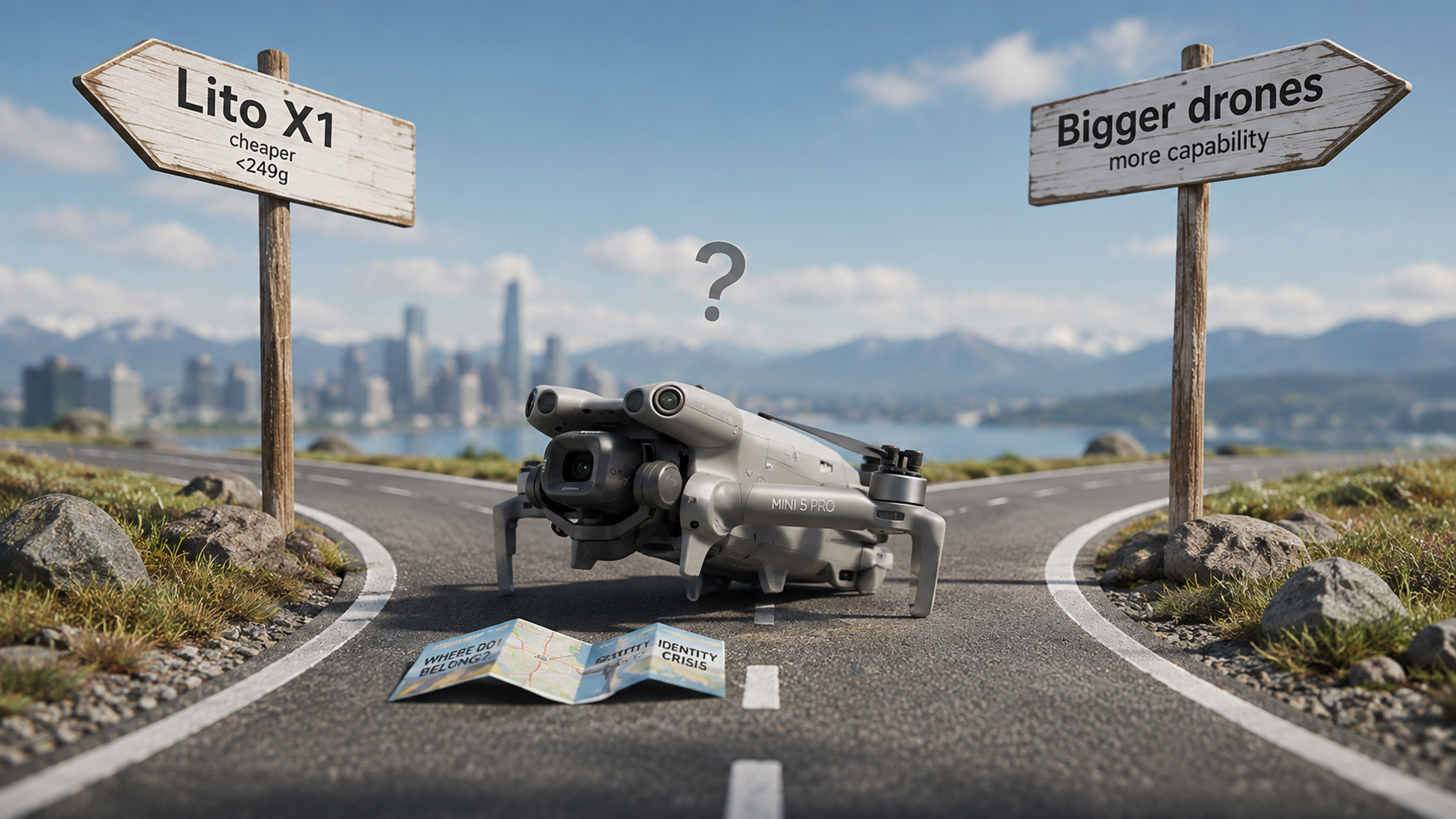
I already picked on the DJI Mini 5 Pro once.
Back in November, my problem with it was pretty straightforward: if the entire point of buying a Mini drone is staying under that magical 249-gram line, what happens when your Mini starts flirting with 250 grams?
Apparently the answer is: DJI releases another drone underneath it that makes the whole situation even more confusing.
Enter the DJI Lito X1.
And now I’m looking at the Mini 5 Pro again thinking… seriously, who exactly is this thing for?
Because let's get one thing out of the way before the angry comments arrive: the Mini 5 Pro is a very good drone.
Fantastic camera. Tons of features. Excellent obstacle avoidance. Great tracking. Small enough to throw in a bag. There is absolutely nothing wrong with the actual aircraft.
The problem is where it sits.
The Weight Problem Never Really Went Away
This was my issue with the Mini 5 Pro from day one.
The whole magic of DJI's Mini lineup has always been the weight.
Not because 249 grams somehow makes the camera better. Not because lighter drones are automatically better drones.
Because under 250 grams matters legally, particularly here in Canada.
That's the deal.
You accept the smaller aircraft, smaller battery, less wind resistance and other compromises because you get a ridiculously capable camera drone that falls into Canada's micro-drone category.
That's a pretty compelling trade.
Except the Mini 5 Pro showed up sitting basically right on the line, with the weight situation becoming an issue in multiple markets.
I went into that whole mess in my original article, DJI Mini 5 Pro: If It’s Not a Micro Drone… What’s the Point?, so I'm not going to beat the poor chubby little bastard with the same stick again.
But the important part hasn't changed:
If I'm giving up the clean sub-249g advantage, I'm immediately less interested in buying a Mini.
And now there's another problem.
The Lito X1 Exists
This is where things get awkward.
The DJI Lito X1 is considerably cheaper than the Mini 5 Pro, actually comes in under 249 grams with its standard setup, and is ridiculously well equipped for what it costs.
We're talking a 1/1.3-inch sensor, 48-megapixel stills, 4K/60 HDR video, D-Log M, tracking, omnidirectional obstacle sensing, forward-facing LiDAR and DJI's modern transmission system.
That's not a toy.
It's not as good as the Mini 5 Pro. I'm not going to pretend it is.
The Mini 5 Pro gets the larger 1-inch sensor and there are absolutely areas where it's the more capable camera drone.
But that's not really the problem.
The question is whether most people shopping for a small drone are going to care enough about those differences to justify spending substantially more.
At the time of writing, comparable Fly More packages with the screen controller at Best Buy Canada put roughly $400 CAD between the Lito X1 and Mini 5 Pro.
Four hundred bucks isn't nothing.
Especially when the cheaper drone retains the thing that made the Mini line so appealing in the first place:
It's actually a micro drone.
So What Am I Paying More For?
This is where I keep getting hung up.
If you buy the Lito X1, the argument is incredibly easy to understand.
You want a small, capable sub-249g drone without spending Mini Pro money.
Done.
If you buy something larger and more expensive, that's pretty easy to understand too.
Maybe you want a larger aircraft. Better wind performance. Multiple cameras. More photographic flexibility. Something that gives you more room to grow.
Also done.
But the Mini 5 Pro sits awkwardly between those two answers.
You're spending considerably more than Lito X1 money, you're still getting a tiny folding drone, and the weight advantage that should justify the entire Mini concept isn't nearly as clean as it should be.
That's a weird proposition.
Want to compare them yourself?
If the Lito X1 sounds like the better fit, you can check out the current lineup directly from DJI. And if you still want the more premium Mini 5 Pro, DJI has the latest bundles and specs there as well.
Check out the DJI Lito X1 on Amazon
Check out the DJI Mini 5 Pro on Amazon
I Nearly Bought a Mini 4 Pro for Exactly This Reason
Before I bought my Air 3S, I was very close to buying the Mini 4 Pro.
I was upgrading from a Mini 3 and the Mini 4 Pro seemed like the obvious move.
And to be clear, I still think the Mini 4 Pro is a fucking awesome drone.
It's small, extremely capable and — most importantly — it actually does what I expect a Mini to do.
But I also knew myself.
I wanted to start doing more paid drone work, and I knew that if I bought the Mini 4 Pro I'd probably spend the next six months looking at the Air 3S and wondering whether I should have just bought that instead.
So I skipped the stepping stone.
That doesn't mean everyone should.
A Mini drone can absolutely produce professional-quality photos and video. Plenty of people are doing excellent paid work with them.
But for me, once I was already spending serious money, I wanted the larger platform, the extra capability and especially the second camera.
I didn't want to buy one drone and immediately start obsessing over the next one.
I am perfectly capable of doing that with every other stupid thing I buy.
And That's the Mini 5 Pro's Other Problem
Once you get into Mini 5 Pro money, it's difficult not to start looking upward.
Not because everybody needs an Air-series drone.
They don't.
But if you're already spending that much and you're potentially losing the clean micro-drone advantage anyway, suddenly asking “what does a little more money get me?” becomes perfectly reasonable.
And that's where the Mini 5 Pro starts feeling squeezed from both directions.
Below it, the Lito X1 gives you an enormous amount of capability for considerably less money while staying under 249 grams.
Above it are larger drones offering things a Mini simply can't — because, at the end of the day, physics is still physics.
The Mini 5 Pro is stuck in the middle trying to justify itself.
None of This Makes the Mini 5 Pro Bad
And that's probably the weirdest thing about this whole argument.
I don't dislike the Mini 5 Pro.
If somebody handed me one tomorrow, I'd happily fly the hell out of it.
The camera is excellent. The technology packed into something that small is borderline ridiculous. For the right person, it could easily be their perfect drone.
But buying one with my own money?
That's harder.
If my priority were simplicity, portability and Canada's micro-drone advantages, I'd save the money and seriously look at the Lito X1.
If photography and commercial work were becoming the priority and I was already willing to spend Mini 5 Pro money, I'd start looking at what exists above it.
Which leaves the Mini 5 Pro sitting there in this strangely narrow middle ground.
So… What Is the Mini 5 Pro For?
That's genuinely the question.
DJI has built a technically excellent drone.
Then they put it right against one of the most important weight thresholds in the entire recreational drone market.
Then they released a much cheaper, properly sub-249g aircraft underneath it with enough features that a lot of buyers probably won't feel like they're sacrificing very much.
The Mini 5 Pro didn't become a worse drone.
Its neighbours just made its reason for existing harder to explain.
And nine months after writing that the Mini 5 Pro had an identity crisis, I somehow understand it even less.
Maybe it needs to get back on the treadmill.
Related Reads
The DJI Lito X1 Is the Drone I’d Recommend Right Now
Done comparing and just want the answer? Here’s why I’d buy the Lito X1 Fly More Combo with the RC 2—and avoid immediately wishing I’d bought the better one.
DJI Mini 5 Pro: If It’s Not a Micro Drone… What’s the Point?
The original argument: if a Mini can’t reliably stay under 249 grams, it starts losing the biggest reason to buy one in the first place.
