DJI Neo 3 Already? That Tiny Controller Could Make It a Proper Kids’ Drone
DJI, could you maybe give us a minute?
We bought the DJI Neo 2 for our son Blake last Christmas. It isn’t even a year old yet, and now apparently a DJI Neo 3 is already sitting in retail packaging somewhere, waiting for its turn to separate us from our money.
My immediate reaction was pretty simple:
Why?
The Neo 2 is awesome.
Not “awesome for a cheap drone.” Not “awesome if you’re willing to overlook a few things.” It is genuinely one of my favourite drones in the world.
It’s small, protected, ridiculously easy to launch and just smart enough to follow a five-year-old around without immediately firing itself into a tree.
Most of the time.
We take it to beaches, parks, bike rides, rugby practices and anywhere else Blake might do something worth recording. You can tuck it into a bag without dedicating half your luggage to drone crap. If your pockets are generous enough, you could probably stuff it into one of those too.
It’s the flying yellow Labrador of drones.
Happy to be included. Always ready to go. Occasionally confused, but generally delightful.
So when rumours started appearing about a DJI Neo 3, I assumed we were looking at the usual internet nonsense. A blurry photograph, twelve YouTube videos with red arrows, and somebody confidently announcing a release date they pulled out of their ass.
Then an actual retail box appeared.
And the more I read about it, the more I started thinking this might be a slightly different animal.
The Neo 2 Is Already Almost Perfect for What We Use It For
We use the Neo 2 almost entirely as a follow-me drone.
I don’t normally fly it with a controller. We palm-launch it, use gesture controls or ActiveTrack, let it follow Blake around and bring it back when we’re finished.
That is the magic of the Neo 2.
It doesn’t feel like preparing for a drone flight. There’s no elaborate setup, no scouting a launch site and no pretending I’m about to direct the next BBC nature documentary.
You turn it on and use it.
I’ve tried controlling it through my phone, and I found the experience sluggish and irritating. That may have more to do with my phone than the drone, but either way, I didn’t enjoy it enough to keep doing it.
We also have proper DJI controllers, but those are built for adult hands.
Blake is five. He can hold one, but that doesn’t mean he can comfortably operate it. Sometimes I’ll start automatic Return to Home and let him hold the controller while he watches the drone come back, but he isn’t really flying it.
His hands are too small to hold the controller properly and reach both sticks with any kind of finesse.
Until now, that hasn’t particularly bothered me because we didn’t buy the Neo 2 to teach him traditional controller flying. We bought it because it was safe, approachable and ridiculously fun.
But that brings us to the most interesting part of the alleged Neo 3.
That Tiny Controller Might Be the Whole Point
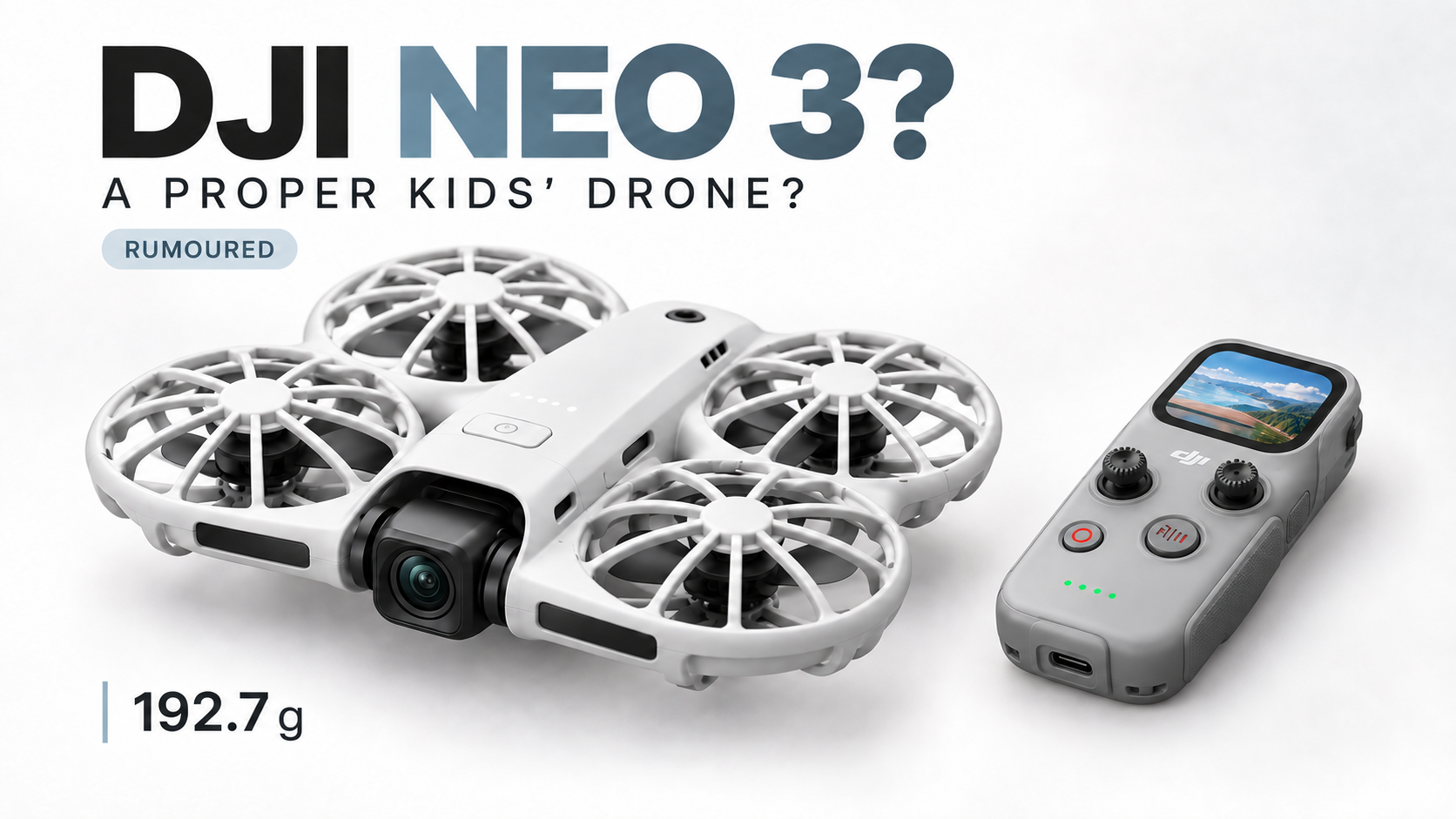
The leaked DJI Neo 3 Fly More Combo box shows a new controller called the DJI RC Mini.
It has its own built-in screen and appears considerably smaller than DJI’s existing consumer controllers.
That might sound like a downgrade if you’re an adult trying to frame cinematic footage on a tiny display. I already own the excellent DJI RC 2, and I’m certainly not campaigning for a smaller screen.
But for a five-year-old?
That could be brilliant.
If the RC Mini is genuinely small enough for Blake to hold comfortably, reach both sticks and control the drone without constantly shifting his hands around, the Neo 3 could become something the Neo 2 has never quite been for us.
An actual learn-to-fly drone.
The Neo 2 is already wonderful for kids, but in our family it’s mostly a drone that follows a kid. Blake is the subject, not really the pilot.
A Neo 3 with a controller designed for smaller hands could change that.
He could learn proper stick control instead of poking at a phone screen. He could practise gentle movements, turns, takeoffs and landings. He could begin to understand how the drone responds instead of watching it do everything automatically.
And I could keep my phone in my pocket, where it belongs.
The Neo 3 Is Apparently Heavier—and That Might Be Fine
A leaked Chinese registration listing reportedly identifies the Neo 3 as model DEN326 and lists its weight at 192.7 grams.
The Neo 2 weighs 151 grams without its Digital Transceiver and approximately 160 grams with it attached.
That makes the rumoured Neo 3 noticeably heavier on paper, but let’s maintain some perspective here.
It still weighs less than 200 grams.
It remains miles below Canada’s 250-gram microdrone threshold, and we’re talking about a difference that most people aren’t going to notice while carrying it around.
The Neo 2 is already small enough to disappear into a backpack. Unless DJI has somehow turned the Neo 3 into a flying toaster, I doubt an extra 30 or 40 grams will destroy its portability.
A little more weight may even help it feel less like an airborne leaf when the wind picks up, although that is purely speculation until somebody actually flies the thing.
We also don’t know its physical dimensions yet. Heavier doesn’t automatically mean substantially larger. DJI may have added battery capacity, reinforced the body or moved more hardware inside the aircraft.
Right now, all we really know is that it appears to have redesigned propeller protection, additional ventilation, something new sitting on top and more weight than the Neo 2.
I Don’t Particularly Care About the Missing Transmitter
One detail attracting attention is that the leaked Fly More Combo contents don’t show the removable Digital Transceiver used by the Neo 2.
That has led to speculation that DJI built the transmission hardware directly into the Neo 3.
Maybe they did.
Ours is attached to the Neo 2, and I had almost forgotten it existed until everybody started talking about it.
It weighs nine grams. Nine.
I’m not hiking Mount Everest with this thing strapped to my forehead. Removing a nine-gram attachment isn’t going to transform our lives.
Integrated transmission could make the Neo 3 cleaner and easier to set up for people using a traditional controller or goggles, but it isn’t the feature making me reconsider the drone.
The little controller is.
This Could Be More Than Another Follow-Me Drone
If DJI merely releases a slightly heavier Neo 2 with a few improved sensors and another intelligent shooting mode, I’m not interested.
Our Neo 2 already does what we bought it to do. It follows Blake, survives family life and captures footage we wouldn’t otherwise have.
I don’t need to replace it because a newer number exists.
But if the Neo 3 remains compact, includes a controller that fits smaller hands and comes in at a remotely sensible price, then DJI may have created something meaningfully different.
The Neo 2 is a brilliant follow-me camera that children love.
The Neo 3 could potentially be a proper first drone that children can learn to fly.
That distinction matters.
Protected propellers, obstacle sensing and a compact body already make the Neo platform far less intimidating than handing a kid something like my Air 3S and hoping for the best.
Add a controller they can physically operate, and suddenly the whole package starts making sense.
Price Will Decide Whether Any of This Matters
We still don’t know the Canadian price.
We don’t officially know the camera specifications, battery life, controller dimensions, release date or whether this exact bundle will even be offered here.
DJI hasn’t announced the Neo 3 at all.
So this is not a review, and I’m not recommending anybody buy a drone that technically doesn’t exist yet.
But I’m interested now.
That’s considerably more than I could say when I first heard the rumour.
If you’re buying today and don’t care about fitting a controller into a five-year-old’s hands, the Neo 2 remains incredibly easy to recommend. Get the bundle with the extra batteries and charging hub because one battery is how you turn a fun afternoon into a disappointingly short demonstration.
Check the current DJI Neo 2 Fly More Combo price on Amazon Canada.
The Neo 2 is proven, available and already bloody good.
But if the RC Mini is genuinely designed around smaller hands, the Neo 3 may finally let Blake move from being chased by his drone to properly flying one himself.
And suddenly, I understand why this thing might exist.
The Neo 3 doesn’t need to be a better follow-me drone than the Neo 2.
It just needs to be a drone Blake can actually fly.
Related Reads
DJI Neo 2 Review: The Best First Drone for Kids, Creators, and Wannabe Jedi
Our full take on the tiny flying Labrador, including palm launch, gesture control, propeller guards and enough DJI wizardry to make you feel like you’re using the Force.
Teaching Kids to Fly Drones: Fun First, Safety Always
What introducing children to drones actually looks like when the goal is to keep it fun, teach some responsibility and avoid immediately donating the aircraft to a nearby tree.
I Brought a Drone to My Five-Year-Old’s Rugby Practice—Now It’s Expected
The Neo 2 follows Blake around so well that apparently bringing a small autonomous aircraft to children’s rugby is now part of my regular parental duties.
