2026 DJI Drone Buyer’s Guide: Which One Actually Makes Sense?
Buying a DJI drone in 2026 should be simple.
It is not.
DJI now has tiny follow-me drones, beginner drones, premium beginner drones, Minis that are no longer obviously the simple choice, dual-camera Air models, flying Hasselblads and a few strange little creatures wearing permanent propeller helmets.
They are all impressive. They are not all for the same person, and you probably do not need the most expensive one.
That last sentence was mainly for me.
I own and use a DJI Air 3S, and my five-year-old son Blake owns a Neo 2 that I occasionally receive permission to touch. I have not personally flown every drone in this guide, so this is not six suspiciously convenient “reviews” from somebody who opened a specification page this morning and became an expert by lunch.
This is our quick, opinionated take on the current DJI lineup: what each drone is good at, who it makes sense for and where I think your money is best spent.
If you want the answer before the usual drone nerd rambling begins, here it is.
Buy the Neo 2 if you want a flying camera that follows you around.
Buy the Lito 1 if you want an affordable first proper camera drone.
Buy the Lito X1 if you want the best all-around sub-250g package and do not want to upgrade immediately.
Buy the Mini 5 Pro if camera quality matters more than value and its exact Canadian flying classification works for you.
Buy the Air 3S if you are serious about photography, video or paid work.
Buy the Mavic 4 Pro if you want the best and your bank account has stopped returning your calls.
There. Done.
Unfortunately, I have more thoughts.
DJI Neo 2: The Flying Yellow Lab
The DJI Neo 2 is less like a traditional camera drone and more like a flying yellow Labrador.
It is happy to see you. It follows you everywhere. It occasionally bumps into things. Children immediately love it, and once it decides you are the subject, personal space becomes more of a suggestion.
That is not criticism. It is exactly why the Neo 2 is so good.
It weighs 151 grams, has full-coverage propeller guards, launches from your palm and can follow you without dragging out a conventional controller. It shoots up to 4K/60fps, has a two-axis gimbal, obstacle sensing and 49GB of internal storage. That is an absurd amount of useful technology in something Blake can carry around like a toy.
The Neo 2 makes the most sense for biking, hiking, camping, family videos, walking shots and quick social content. It is the drone for people who care more about capturing what they are doing than learning how to fly neat, deliberate camera lines.
Blake has used ours around beaches, parks and bike rides. It gets bonked. It keeps going. More importantly, it gets used because there is almost no ceremony involved. You do not need to turn every 20-second clip into a NASA launch sequence.
Its limitations are equally obvious. The camera is useful, not magical. The 19-minute advertised flight time is short beside a proper camera drone, especially once real wind and real flying enter the conversation. It is not what I would bring when a client is paying me to come home with the shot.
But if you want your first drone to be easy, fun and slightly ridiculous, the Neo 2 is an unbelievable entry point.
I would skip the cheapest package and get the Neo 2 bundle with the extra batteries and charging hub. This is exactly the kind of drone you pull out several times during an outing, and one small battery is a wonderful way to discover that fun apparently has a time limit.
DJI Lito 1: The Sensible First Proper Drone
The DJI Lito 1 is where we move from “flying camera that follows me” to “I would actually like to learn how to fly a drone.”
It is still aimed at beginners, but it gives you the traditional experience: controller in your hands, camera framing, deliberate flight paths and the opportunity to become emotionally invested in a small grey aircraft.
The Lito 1 stays under 249 grams, uses a 1/2-inch sensor, shoots 4K video and includes ActiveTrack and omnidirectional obstacle sensing. A few years ago, that feature list would have sounded like a high-end Mini. Now DJI calls it entry-level because DJI has absolutely no respect for the money we already spent.
This is a very capable first drone. For travel, family trips, beaches, property photos, hiking and learning proper aerial photography, it does a lot without asking Air-or-Mavic money.
The reason I hesitate is not that there is anything wrong with it. The problem is sitting directly above it in the lineup.
If the Lito 1 fits your budget and the X1 does not, buy it and enjoy it. You are not buying a toy or some compromised little trainer that becomes useless after three weekends.
But if you can comfortably stretch to the X1, that is where I would go.
DJI Lito X1: The One I Would Recommend to Most People
The DJI Lito X1 Fly More Combo with the RC 2 is the drone I would recommend right now.
Not the most powerful DJI drone. Not the finest camera DJI makes. Not the drone that wins every specification-sheet sword fight.
It is simply the package that gets the balance right.
The X1 has a 1/1.3-inch 48MP sensor, 4K/60fps HDR video, ActiveTrack, omnidirectional obstacle sensing, forward-facing LiDAR and 42GB of internal storage. It remains in the sub-250g conversation with the standard battery configuration, which matters enormously in Canada.
And yes, I will keep going on about the internal storage.
Internal memory is not glamorous until you drive to the beach for sunrise, unfold your drone and discover that the SD card is still sitting in your computer. Then 42GB of built-in storage feels like divine intervention for idiots.
The X1 is what I would buy for somebody who wants a real camera drone but does not want to spend the next year staring at the model above it. It has the camera, tracking, automated shots, obstacle sensing and storage most recreational pilots are ever going to use.
Buy the Fly More Combo. Extra batteries are not an accessory you discover later; they are part of owning the drone properly. And if the budget allows it, buy the RC 2 with the built-in screen. Your phone already has enough jobs. It does not need to become a controller, accept a call at the worst possible moment and bake in the sun while you fly.
At the time we last checked, that package was around $879 CAD before tax. That is not cheap, but it is a complete setup rather than the opening deposit on a future upgrade spiral.
If you want one simple answer from this entire guide, buy the Lito X1 Fly More Combo with the RC 2.
DJI Mini 5 Pro: The Tiny Camera Monster
The DJI Mini 5 Pro is badass.
It has a 50MP one-inch sensor, 42GB of internal storage, upgraded ActiveTrack, night-capable omnidirectional obstacle sensing and a gimbal that can rotate 225 degrees for creative angles and proper vertical shooting.
On paper, it is a better drone than the Lito X1. The camera is better. The imaging flexibility is better. The whole thing is more polished and more “Pro,” in case the name did not hammer that point hard enough.
The question is whether you need any of it.
If you shoot seriously, care about low-light performance, want the one-inch sensor and need the smallest possible aircraft that still delivers high-end footage, the Mini 5 Pro makes sense. It is an astonishing amount of camera packed into something this small.
For the average person posting videos to a phone, however, the X1 already covers so much ground that the extra money becomes harder to justify.
There is also the Canadian weight question. Transport Canada defines a microdrone by its operational weight being under 250 grams. Do not assume the word “Mini” settles that for every battery, accessory and configuration. Check the exact aircraft you are buying and the way you intend to fly it.
That matters because the entire magic of the Mini line has always been simplicity. Once you lose the clean microdrone advantage, you have to ask why you are not moving up to an Air 3S instead.
The Mini 5 Pro is probably the right choice for somebody who knows exactly why they want its camera.
If you cannot explain why you need it without using the phrase “future-proofing,” save your money and buy the X1.
DJI Air 3S: The Sweet Spot for Serious Flying
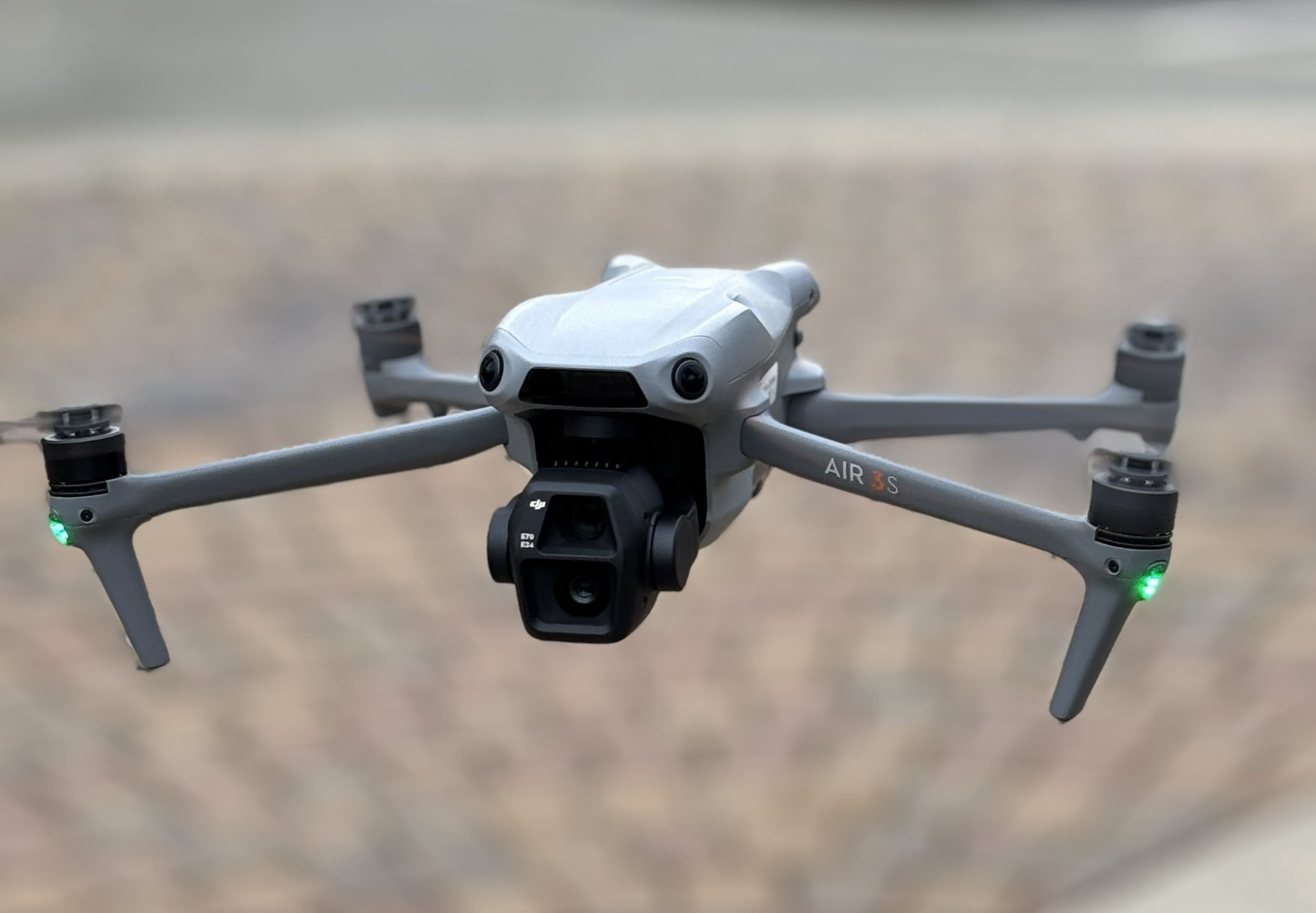
The DJI Air 3S is my main drone, and after a year of using it, I would buy it again.
That should tell you most of what you need to know.
Its one-inch main camera is excellent, but the second 1/1.3-inch medium-tele camera is what makes it special. The 3x view gives you compression, stronger subject separation and a completely different way to photograph buildings, coastlines, roads and landscapes. It does not feel like a novelty lens bolted on for the brochure. I use it.
The Air 3S also has 42GB of internal storage, forward-facing LiDAR, nightscape omnidirectional sensing and up to 45 minutes of advertised flight time. More importantly, it feels planted in coastal wind.
That matters on Vancouver Island. The beach can look perfectly peaceful from the ground while your controller politely informs you that the atmosphere has other plans. The Air 3S has handled the conditions I actually fly in—coastlines, job sites, buildings, open water and changing West Coast weather—with a level of confidence I would not trade for a slightly smaller bag.
This is the drone I bring when the image matters, the location matters or somebody is paying me to come back with useful material.
The compromise is regulation and convenience. At 724 grams, it is not a microdrone. It must be registered in Canada, the pilot needs the appropriate certificate and the places you can legally fly depend on your certificate, airspace and operation. Around Greater Victoria, where controlled airspace is part of daily life, an Advanced certificate and proper planning open far more useful doors.
It is also larger, more expensive and less likely to be casually tossed into a bag for a family walk.
But if you are serious about aerial photography or video and want the best balance of camera quality, flexibility, flight performance and price, the Air 3S is still the sweet spot.
Check current DJI Air 3S pricing on Amazon Canada.
DJI Mavic 4 Pro: Financial Responsibility Has Left the Chat
The DJI Mavic 4 Pro is the Air 3S philosophy taken to its logical conclusion: more camera, more capability, more flight time and considerably less money remaining in your bank account.
Its main camera is a 100MP 4/3 Hasselblad unit capable of 6K/60fps HDR video. It adds two telephoto cameras, a 360-degree rotating Infinity Gimbal, low-light omnidirectional obstacle sensing and up to 51 minutes of advertised flight time.
It is ridiculous.
It is also more drone than most people need.
The Mavic 4 Pro makes sense for serious commercial operators, filmmakers, high-end photographers and people who can explain precisely how its cameras will improve their work. If the better sensor, telephoto options, long flight time and gimbal freedom solve actual problems for you, it is probably spectacular.
If you mainly want beach photos, family videos and the occasional dramatic shot of your campsite, buying a Mavic 4 Pro is a little like purchasing a commercial fishing boat because you enjoy fish and chips.
Would I love one?
Absolutely.
Do I need one?
That is an unnecessarily personal question.
Like the Air 3S, it sits well above 250 grams. In Canada that means registration, certification and considerably more thought about where and how you fly—especially around Victoria.
If you have the money, the credentials and the work to justify it, this is the flagship. For everybody else, the Air 3S gets you an awful lot of the way there without requiring a family budget meeting.
DJI Mavic 4 Pro fly more combo
What About the DJI Flip?
The Flip exists.
It folds in a clever way. The built-in propeller guards are genuinely useful for beginners and close-range filming. It appears to sit somewhere between the Neo idea and a traditional camera drone.
I have not used one, and I do not have a strong enough opinion to manufacture three paragraphs of enthusiasm for Google.
It may be perfect for somebody. It just does not solve a problem I currently have.
That is all I have to say about the Flip, which may be the most honest paragraph about it on the internet.
What About the Avata and FPV Drones?
If you want goggles, speed, immersive flying and the sensation of being strapped to the front of a very angry hummingbird, DJI’s Avata and FPV products are their own category.
People love them.
I do not.
That does not make them bad. It makes me the wrong person to recommend one. I prefer camera drones, deliberate framing and seeing the world with my own eyeballs while I fly.
The newer Avata 360 idea adds even more flexibility after the flight, which is impressive if you enjoy reframing 360-degree footage. I already create enough editing work for myself without recording every possible direction at once.
If FPV is what excites you, find somebody who genuinely loves it. They will give you better advice than I will, and they may even own a pair of goggles that does not make them nauseous.
What About the Mini 4 Pro and Older DJI Drones?
Older does not mean bad.
The Mini 4 Pro remains an excellent little drone, and a properly discounted bundle can still be a great buy. The Mini 3 is the drone that started this entire addiction for me, and it is still capable of producing beautiful footage.
The problem is pricing. Once an older model gets too close to a newer Lito or X1 package, nostalgia stops being a purchasing strategy.
Compare the actual bundle, controller and battery count—not merely the number beside the drone’s name. A cheap aircraft with one battery and the phone controller may not be cheaper after you add everything you wish you had bought in the first place.
Which DJI Drone Would I Buy in 2026?
For most people, the Lito X1 Fly More Combo with the RC 2.
That is the answer.
It stays small, avoids most of the regulatory friction attached to larger drones, has the camera and intelligent features people actually want, includes internal storage and leaves fewer obvious reasons to start shopping again six months later.
For effortless follow-me videos, family adventures and something a beginner will genuinely use, buy the Neo 2.
For the lowest sensible entry into a proper camera drone, buy the Lito 1.
For a tiny aircraft with the strongest camera, buy the Mini 5 Pro—after confirming how your exact setup lands under Canadian weight rules.
For serious photography, commercial work and coastal flying, buy the Air 3S.
For the best consumer camera drone DJI currently makes, buy the Mavic 4 Pro, then delete the receipt before your spouse finds it.
Whatever you choose, buy the bundle with the extra batteries. If a screen controller is available and the budget can handle it, buy that too.
It is cheaper than buying the wrong package, regretting it and spending the next six months calling an upgrade “research.”
Ask me how I know.
As an Amazon Associate, Vancouver Island Drones may earn a commission from qualifying purchases made through links on this page. It does not change what you pay, but it may help offset our ongoing DJI addiction.
Related Reads
The DJI Lito X1 Is the Drone I’d Recommend Right Now
Done comparing and just want the answer? Here is why the Lito X1 Fly More Combo with the RC 2 is the current sweet spot.
DJI Neo 2 Review: The Best First Drone for Kids, Creators, and Wannabe Jedi
Blake’s tiny flying sidekick is easy, tough, weirdly capable and considerably more fun than its size suggests.
DJI Air 3S After a Year — The Drone I’d Buy Again
A proper long-term owner’s take on the drone I trust for coastal flying, local projects and paid work.
