Drone Accessories I Actually Use and Recommend
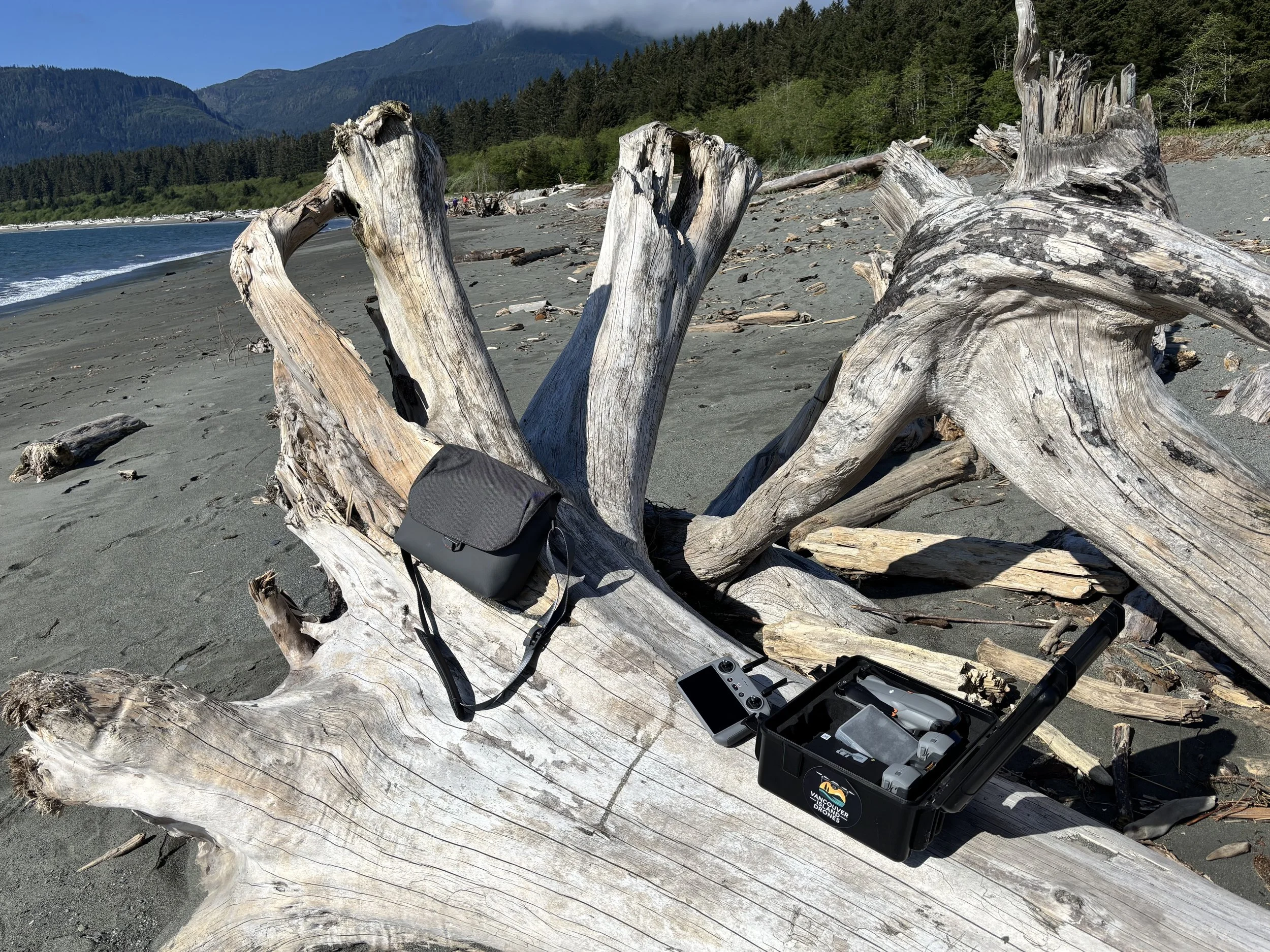
The boring drone gear that actually saves the day — hard cases, SD cards, controllers, and the stuff you only appreciate after forgetting it once. Real gear, real beach, very Vancouver Island Drones.
You do not need 47 drone accessories.
I wrote an earlier version of this article that said essentially the same thing—and then proceeded to recommend a small mountain of drone accessories.
SD cards. Card readers. Backpacks. Cleaning kits. Landing pads. Hard cases. Power stations. Probably a tactical vest if you gave me another afternoon.
It started looking less like practical advice and more like I was trying to empty an Amazon warehouse.
So, after another year of actually flying drones, here is the more honest version.
There are two drone accessories I use constantly:
My hard case
My three-foot Hoodman landing pad
That is basically the list.
I own plenty of other drone-related crap. Some of it is useful. Some of it seemed like a good idea at the time. Some of it now lives in a drawer with several microSD cards I apparently thought I was going to need forever.
Before we get into accessories, though, there is one decision you should make when buying the drone that will save you from trying to fix your setup later.
Buy the Fly More Combo
One battery is not enough.
Technically, yes, you can fly a drone with one battery. You can also go camping with one beer. Both are possible. Neither represents proper planning.
If you are buying a DJI drone, buy the Fly More Combo.
You get the extra batteries, charging hub and the setup you were probably going to end up buying separately anyway. More importantly, you can stop watching the battery percentage like it is a countdown to a small aerial funeral.
Three batteries let you settle into a shoot.
You can get the obvious shots, try a few different angles, wait for the light to change and still have enough battery left when you finally figure out what you should have been filming all along.
I would also buy the controller with the screen built in.
Yes, it costs more.
It is also much nicer than connecting your phone, dealing with cables, interrupting your flight because someone called you and discovering that your phone battery was already at 14 percent before you launched.
Buy the better controller once and be done with it.
Right now, if someone asked me which sub-249-gram drone package offers the best combination of price, camera, features and room to grow, I would point them toward the DJI Lito X1 Fly More Combo with the RC 2 controller.
I still have not flown the X1, so I am not pretending this is a hands-on review. I am looking at what you get for the money and comparing it with the rest of DJI’s lineup.
It has the camera, tracking, obstacle avoidance, internal storage and features most people will ever use—and it is good enough that you should not immediately start staring at the next drone up and wondering whether you bought the wrong one.
Check the latest DJI Lito X1 Fly More Combo pricing on Amazon
Some links in this article are affiliate links. If you buy something through one, I may earn a small commission at no extra cost to you. Think of it as helping offset a deeply unnecessary DJI addiction.
My Hard Case
Do you need a hard case?
No.
Do I love mine?
Absolutely.
My DJI Air 3S spends a lot of time in the back of my vehicle. It gets carried to beaches, construction sites, parking lots and wherever else I have convinced myself would look better from the air.
The case takes the beating so the drone does not.
That is the entire sales pitch.
I use a LEKUFEE hard case fitted specifically for the Air 3S and RC 2 controller. Everything has its place: drone, controller, batteries, charging hub, spare props and the various little cables I will probably forget the purpose of.
Nothing rattles around. Nothing gets crushed under something else in the truck. I can grab the case and know the entire drone setup is in it.
It also looks like something John Wick would carry if he got really serious about aerial photography.
Is it the best choice for hiking several kilometres into a location?
God, no.
It is a hard plastic suitcase full of electronics.
But for driving to a location, working around job sites or keeping your drone protected in the vehicle, I love it.
The only important thing is buying a case designed for your exact drone and controller. The foam layout needs to match the equipment you own.
LEKUFEE hard case for DJI Air 3S and Air 3
LEKUFEE hard case for DJI Lito and Mini series
LEKUFEE hard case for DJI Neo and Neo 2
My Hoodman Landing Pad
The other accessory I use all the time is my three-foot Hoodman drone landing pad.
This is one of those products that looks slightly ridiculous until you start flying regularly from beaches, gravel, wet grass and construction sites.
Then it makes perfect sense.
Drone propellers throw an impressive amount of crap into the air. Sand, dust, little rocks, grass clippings and whatever mystery debris is sitting around a job site all become airborne the moment you launch.
That is not stuff I want blasted into the motors, camera or gimbal of an expensive drone.
The Hoodman gives me a clean, obvious launch area. It lies properly on the ground, is large enough to be useful and does not feel like a disposable piece of fabric that will leave the beach before I do.
It is also bright orange and very easy to see when landing.
Do you need a more expensive landing pad if you only fly from clean pavement or your backyard twice a year?
Probably not.
But I fly around beaches, rough ground and commercial sites regularly. For the places I use a drone, the Hoodman earns its spot in the truck.
Check out the three-foot Hoodman drone landing pad on Amazon
A Backpack Is Probably Next
A drone backpack is the one accessory I am still genuinely tempted by.
My hard case is excellent when I am driving directly to a location. I can throw it in the truck, let it get knocked around and know the Air 3S inside will not feel any of it.
The hard case becomes considerably less brilliant when I have to carry it very far.
There are absolutely situations where I want the drone, controller, batteries, Osmo Nano, microphones, water, a jacket and the miscellaneous pile of shit that follows me everywhere. At that point, putting everything into one padded backpack makes much more sense than carrying a hard case in one hand and the rest of my life in the other.
I have not bought a dedicated drone backpack yet, so this is not a hands-on recommendation. It is simply the next accessory I can see solving an actual problem.
That is a better reason to buy something than filling a cart before you have even flown the drone.
Check out the Lowepro camera and drone backpack I’ve been considering on Amazon
All Those microSD Cards I Barely Use
When I started flying, I bought microSD cards.
Then I bought more microSD cards.
I had cards for the drones, cards for the cameras, spare cards in the cases and probably a backup card for the backup card.
After a year, I barely use any of them.
My DJI Air 3S has internal storage. Blake’s Neo 2 has internal storage. My Osmo Nano has internal storage.
I now rely almost entirely on that internal memory because it is easier.
I do not have to remember which card contains what, whether I put the card back after transferring footage or why the drone suddenly claims there is no storage available while I am standing somewhere beautiful at sunrise.
The storage is already inside the thing.
That is a deeply underrated feature.
A good microSD card still makes sense if you record a lot of video, need more capacity or own a drone without useful internal storage. Keep one in the case if it makes you feel better.
But I would not tell a new pilot to go buy a handful of cards immediately.
Fly the drone first. See how much storage you actually use. Buy a card when you have a reason.
Otherwise, you may end up with a small plastic collection sitting in a drawer like I did.
What I Would Actually Buy
If you are buying your first drone, spend the money on the right drone package before buying a pile of accessories.
Get the Fly More Combo.
Get the controller with the built-in screen.
Then fly the thing.
If you regularly launch from sand, gravel, grass or dirty job sites, buy a good landing pad.
If your drone lives in the back of a vehicle or gets knocked around between locations, buy a fitted hard case.
If you start hiking with it—or regularly need to carry your drone, cameras and other gear together—buy a backpack.
If you run out of internal storage, buy an SD card.
That is how accessories should work: a real problem appears, and you buy something that solves it.
You do not need to predict every possible inconvenience before your first flight. You definitely do not need to buy everything some drone guy on the internet links to.
Including me.
The hard case and Hoodman landing pad are the two accessories I use most. The backpack is the one I may buy next. Everything else depends on how and where you fly.
Spend less time shopping for drone gear.
Spend more time flying the drone.
Unfortunately, buying the Fly More Combo does not count as accessory shopping.
That is just making the correct decision.Related Reads
DJI Lito 1 vs Lito X1: Which One Actually Makes Sense?
A closer look at DJI’s two Lito drones, why the Lito 1 is such a strong first-drone option, and why the X1 might save you from upgrading later.
Which DJI Drone Should You Buy First: Neo 2, Lito 1, or Lito X1?
A practical and slightly biased look at the Neo 2, Lito 1, and Lito X1 — from the flying yellow Labrador to the first real drone and the one you’re least likely to outgrow.
DJI Neo 2 Review: The Best First Drone for Kids, Creators, and Wannabe Jedi
Why the Neo 2 is still one of the easiest drones to recommend for families, kids, creators, and anyone who wants a drone that actually gets used.
