Which DJI Drone Should You Buy First: Neo 2, Lito 1, or Lito X1?
Buying your first drone used to be easier.
You bought a Mini, tried not to crash it into a cedar tree, took some beach photos, and immediately started pretending you were a very normal person who definitely wasn’t about to start comparing camera sensors at midnight.
Then DJI made things weird again.
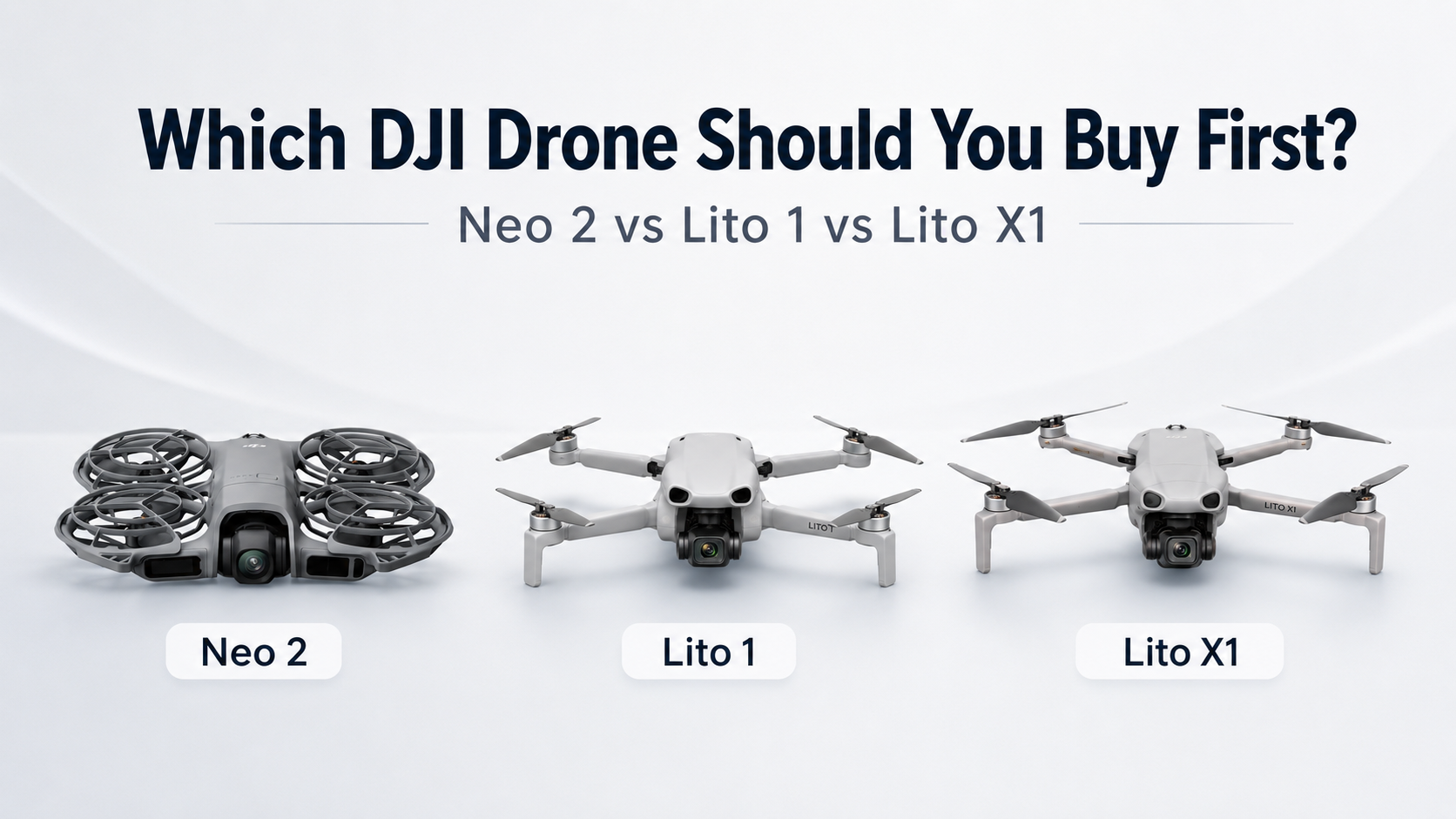
Now you’ve got the Neo 2, the Lito 1, and the Lito X1 all sitting somewhere near the “first drone” conversation.
But they are not really the same kind of thing.
The Neo 2 is its own little lunatic category.
The Lito 1 and Lito X1 are more traditional camera drones.
And before we go any further, I should admit something.
I am a card-carrying member of the Neo 2 fan club.
My son has one, which means I get to “help” with it sometimes. Very noble stuff. Pure parenting. Definitely not just dad stealing turns with a tiny flying robot.
So yes, this article might be a little biased.
But I think the Neo 2 is one of the easiest drones to recommend because it does something most drones still make too complicated.
It gets used.
DJI Neo 2: The Flying Labrador Retriever
The Neo 2 is not really a traditional drone.
It is more like an eager-to-please flying tiny Labrador retriever.
You let it out, it gets excited, follows you around, tries its best, occasionally does something dumb, and somehow you love it more because of it.
That’s the Neo 2.
It is not trying to be a serious camera drone in the same way the Lito series is. It is not asking you to pull out a controller, wait for the controller to connect, wait for satellites, think about your whole life, and turn a quick moment into a full NASA launch sequence.
You just grab it.
Press the button on the side.
Launch it from your hand.
Use gesture control to adjust where it’s filming from.
And off you go.
Ride your bike. Go for a walk. Film the truck. Chase your kid around the park until either the battery dies or the five-year-old finally runs out of energy.
The battery usually loses first.
That’s the perpetual struggle.
This is why I like the Neo 2 so much.
It removes the friction. And friction is what kills drone use.
A lot of drones are technically better, but they also require more setup. Controller. Phone. Cables. Satellites. Settings. Bag. Batteries. Propellers. Tiny little pre-flight ritual where you start feeling like you should be wearing a reflective vest and carrying a clipboard.
The Neo 2 is different.
It is pull-it-out-and-go.
And for a first drone, that matters more than people think.
The Neo 2 Is Still Way More Capable Than It Looks
The danger with the Neo 2 is that people see the size, the prop guards, the hand launch stuff, and assume it is just a toy.
It is not.
It is toy-adjacent in the best possible way, but it is not just a toy.
You still get 4K imaging, ActiveTrack, palm takeoff and landing, gesture control, full-coverage prop guards, and obstacle sensing. DJI also gives it multiple control options, so you can keep it dead simple or start adding more gear if you want to go deeper.
That is the sneaky part.
Out of the box, it can be the easiest follow-me drone ever.
No controller. No drama. Just launch it and let it track you.
But if you want to get into FPV-style flying, you can start moving that direction too. If you want to use a controller, you can. It gives you room to play without demanding that you become a drone nerd on day one.
Although, let’s be honest.
That’s probably where this is heading.
The prop guards are a big deal too, especially if you’re learning or handing it to a kid. They make the whole thing feel less terrifying. You’re still flying a drone, so don’t be an idiot, but there’s a big difference between “tiny protected follow-me camera” and “spinning sky blender with confidence issues.”
The Neo 2 is the drone I’d pick first if your goal is fun, family clips, biking, hiking, walking, social media, kid chaos, and actually using the thing all the time.
It is not the most serious drone here.
It is probably the one you will use the most.
DJI Lito 1: The First Real Drone
The Lito 1 is where this becomes a more traditional drone conversation.
This is not the flying Labrador.
This is the first real camera drone.
Controller in your hands. More stable. More intentional. More “I’m going out to fly a drone,” instead of “I released the happy robot and now it’s following me again.”
And for the price, the Lito 1 looks kind of ridiculous.
As I’m writing this, I’m seeing the Lito 1 Fly More Combo at about $615 Canadian with three batteries. That is wild compared to what my Mini 3 cost when I got started.
And the Lito 1 is not some sad little beginner drone with training wheels and a prayer.
You’re getting a proper folding DJI camera drone with 48 MP photos, 4K video, 4K/100 slow motion, ActiveTrack, omnidirectional obstacle sensing, strong transmission range, and battery life that would have made my Mini 3 feel personally attacked.
This is the one I’d look at if you want to actually learn how to fly.
Not just launch it and let it chase you.
Fly it.
Frame shots. Think about movement. Learn smooth turns. Learn height, distance, light, composition, and how not to panic every time the drone gets farther away than your driveway.
That matters.
The Neo 2 is easier.
The Lito 1 teaches you more.
And it does it without immediately making you spend “I may need to explain this purchase to my wife” money.
The New Obstacle Sensing Stuff Is Interesting
One of the coolest things with these newer DJI drones is that they seem to be moving away from the old “stick a dedicated sensor everywhere” approach.
The Lito series uses wide-angle sensing coverage — those top and bottom fisheye-style cameras — to help build awareness around the drone without needing the same obvious pile of separate sensors all over the body.
That’s part of why these things feel like a shift.
DJI is doing more with fewer pieces.
More software. Smarter processing. Wider vision coverage. Cleaner design.
The Lito 1 gets omnidirectional obstacle sensing, and the Lito X1 takes that further by adding forward-facing LiDAR.
Does that mean you should trust it with your life, your house, your truck, or your kid’s bicycle helmet?
No.
Don’t be that guy.
Obstacle sensing is help. It is not permission to turn your brain off.
But for a beginner, it is a massive confidence boost. My first drone did not have this kind of safety net. I flew that thing like a nervous squirrel.
The Lito 1 gives you more help from day one.
And that makes it a pretty compelling first “real” drone.
DJI Lito X1: The One You Are Least Likely to Outgrow
Then there’s the Lito X1.
This is the one that looks at the Lito 1 and says, “That’s cute. Now let’s make poor financial choices sound responsible.”
As far as I’m concerned, the Lito X1 is the new top of the micro-drone food chain.
It gives you the better camera system, better sensing package, forward-facing LiDAR, 4K/60 HDR, 4K/100 slow motion, 10-bit D-Log M, and 42 GB of internal storage.
And yes, I am going to talk about the internal storage again because it matters.
You will forget an SD card one day.
You will.
You’ll wake up early, grab a coffee, drive somewhere beautiful, feel like a responsible adult for once, unfold the drone, and realize the SD card is sitting at home in a reader beside your computer.
That is when internal storage goes from “boring spec” to “greatest invention in human history.”
The Lito X1 is not just better because of one feature.
It is better because it removes more excuses to upgrade later.
Better photos. Better video options. Better obstacle sensing. Built-in storage. Still small. Still portable. Still not full Air 3S money.
That’s the dangerous part.
The Lito 1 is probably enough for a lot of people.
The Lito X1 is the one you buy when you already know “enough” is a lie you tell yourself before buying another drone six months later.
So Which One Should You Buy First?
If you want the easiest, most fun drone to actually use, get the Neo 2.
It is the flying yellow lab. It follows you around, wants to be involved, makes everything more fun, and doesn’t make you go through a full launch ceremony every time you want a quick clip.
This is the one I’d pick for family, kids, biking, walking, follow-me shots, social media, quick fun, and general DJI-powered nonsense.
If you want your first proper drone, get the Lito 1.
It is the more traditional starting point. You’ll learn to fly properly, shoot cleaner footage, practice real drone movement, and still get a pile of features for the money.
If you want the one you are least likely to outgrow, get the Lito X1.
It gives you the better camera, better sensing, built-in storage, and fewer obvious reasons to upgrade immediately.
Which, in DJI terms, is about as close to financial responsibility as we get.
Check the Current DJI Pricing
This is one of those decisions where the current price matters a lot.
If you want the fun, easy follow-me drone, check the latest DJI Neo 2 pricing here.
If you want the more traditional first drone, check the latest DJI Lito 1 pricing here.
Because the best first drone is not always the most expensive one.
It is the one you’ll actually use.
For a lot of people, that is the Neo 2. It is easy, fun, quick to launch, and does not turn every little video idea into a full pre-flight ceremony.
For someone who wants to properly learn drone flying, the Lito 1 makes more sense. It gives you the controller-in-hand experience, a proper camera drone feel, strong safety features, and enough capability that it does not feel like a cheap starter drone you will immediately regret.
And if you already know how this DJI addiction works, the Lito X1 is probably the safest long-term buy. Better camera, better sensing, built-in storage, and fewer obvious reasons to upgrade six months later while pretending you are “just doing research.”
That is how DJI gets you.
First it is the fun little one.
Then it is the better one.
Then suddenly you are comparing sensors, wind resistance, controller bundles, internal storage, ND filters, and asking whether a larger drone is actually a business expense.
Welcome to DJI Addiction Anonymous.
Meetings are at sunrise.
Bring charged batteries.
Related Reads
Drone Accessories I Actually Recommend in Canada
You do not need 47 drone accessories. Just the practical stuff that keeps you flying longer, protects your gear, and saves you from ruining a flight before it even starts.
Hiring a Drone Pilot in Victoria, BC — What It Costs and What You Get
Straightforward pricing, what’s included, and what the process looks like if you need aerial photos, video, inspections, or a better look at something from above.
DJI Neo 2 Review: The Best First Drone for Kids, Creators, and Wannabe Jedi
Why the Neo 2 is still one of the easiest drones to recommend for families, kids, creators, and anyone who wants a drone that actually gets used.
