The Captain’s Log
Aerial stories, father–son adventures, and life on the edge of the Pacific.
Chasing Down a DJI Neo 2 for Christmas (And Why This Little Drone Matters More Than I Expected
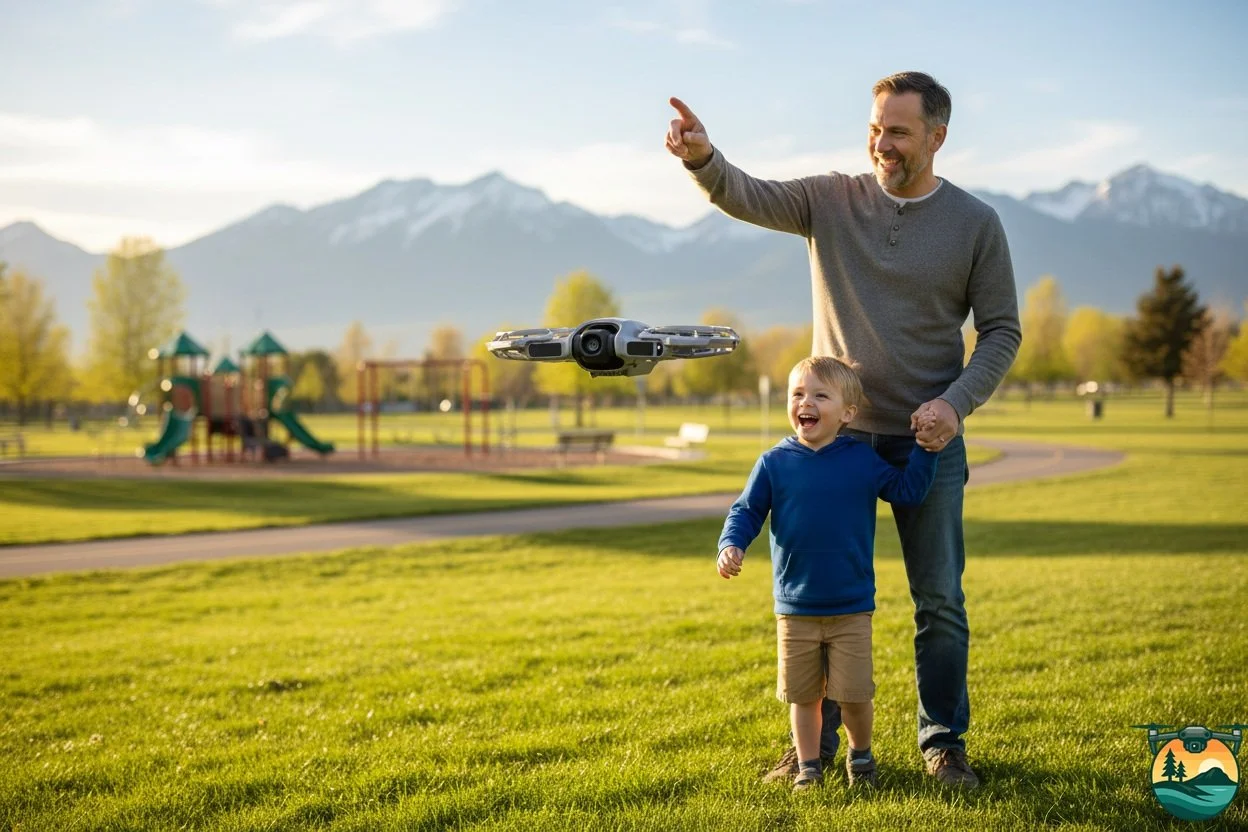
Making memories, one easy flight at a time! The DJI Neo 2 isn't just a drone; it's an invitation to spontaneous family adventures and teaching moments. So simple, even the little ones can get in on the fun!
When the first DJI Neo came out, I didn’t rush to buy it.
The camera wasn’t great, and the footage never really compared to what I get from the Air 3S. But the Neo 1 had something that did catch my attention:
they made it effortless.
No unfolding arms.
No pairing a controller.
No waiting for satellites.
No dragging out a case full of gear.
You just pulled it out of a pocket, pressed a button, and the thing followed you.
For a family that spends a lot of time outside — parks, beaches, hikes, bike trails — that kind of instant use is actually more valuable than another high-spec camera.
And when Blake started getting interested in flying, the Neo line made even more sense. Not because it was “the best drone,” but because it was simple, durable, and designed for real-world fun, not perfect cinematics.
Then the Neo 2 was announced.
Why I waited for the Neo 2 instead of grabbing the original
Everything the Neo 1 lacked, the Neo 2 seemed to fix:
better image processing
improved stability
gesture controls
voice commands
smarter tracking
stronger durability
Basically: more brains, same simplicity.
For teaching a four-year-old to fly, that combination is gold.
And for a dad who sometimes wants a drone on hand during family adventures — without opening backpacks, cases, or unfolding anything — it’s even better.
Still, actually buying one turned out to be far more complicated than expected.
The bundle circus
Once the Neo 2 arrived in Canada, it became a bundle guessing game.
I already own the DJI RC 2, which is one of DJI’s high-end screen controllers — something I use daily with the Air 3S. I had no interest in paying for the lower-end controller included in certain Neo 2 bundles. What I wanted was simple:
the drone
the extra batteries
the little transmitter
But none of the bundles offered that combination.
There was:
the bare drone
a battery bundle without the transmitter
a transmitter bundle without the batteries
and one mysterious combo that appeared briefly and vanished
Meanwhile, Christmas was getting closer, and stock kept fluctuating. The last thing I wanted was to be sitting on December 23rd refreshing product listings, hoping something magically reappeared.
So I made the practical choice:
I bought the standalone Neo 2 and will add the accessories separately.
Not elegant, but guaranteed to arrive before Christmas.
The moment that convinced me this was the right call
A coworker sent me a video of his five-year-old flying the Neo 2 indoors using nothing but gesture controls — holding out a hand, lifting a palm, catching the drone as it landed.
That clip sold me more than any spec sheet.
It wasn’t about the camera or the tracking.
It was about seeing a kid Blake’s age genuinely controlling a drone without fear.
That’s exactly the tool I want to teach him with.
This drone isn’t just for Blake — it’s for our family adventures
Yes, the Neo 2 is technically Blake’s first drone.
But realistically, it’s also something I’m going to grab on family outings where:
we didn’t plan to fly
we didn’t bring the Air 3S
we’re just outside enjoying the day
something cool happens and we want to capture it
or Blake wants to show me something he learned
The beauty of this drone is that it doesn’t require a “drone day.”
It fits into the pocket of normal life.
It’s the opposite of the Air 3S — not in quality, but in intent.
The Air 3S is for planned flights, sunrise missions, storytelling, and real cinematic work.
The Neo 2 is for:
chasing Blake at the bike park
quick follow-me shots on a hike
catching a moment without unpacking a bag
letting him fly without stress
little spontaneous adventures
Two different tools for two different kinds of days.
Final thoughts
Buying the Neo 2 took more effort than expected, but the goal never changed:
give Blake a drone he can learn on — one that’s safe, durable, and fun, and one that makes it easy for us to fly together.
And honestly, the more I’ve thought about it, the more I’ve realized:
This little drone isn’t just for him.
It’s for us.
For the spur-of-the-moment memories.
For the unplanned flights.
For the days when the Air 3S can stay at home and we just explore, with a pocket-sized drone that can keep up.
Once the weather improves, we’ll see what it can do — and I have a feeling it’ll show up in more than a few future videos, especially once Blake starts chasing me instead of the other way around.
Related Stories
Chasing Down a DJI Neo 2 for Christmas — Why This Drone Matters More Than I Expected
A father–son story about finding the right beginner drone and why the Neo 2 was the perfect fit.
DJI Neo 2: Why This Little Drone Is About to Become My Four-Year-Old’s First Co-Pilot
A closer look at how this tiny drone became the cornerstone of our safe flying lessons.
Why I Fly at Sunrise — A West Coast Morning Ritual
The calm, patient flying philosophy that shapes how I teach my son to fly.
Why Aerial Photos Get Attention: Our My-Chosen Café Shots Reach 8,000 Views
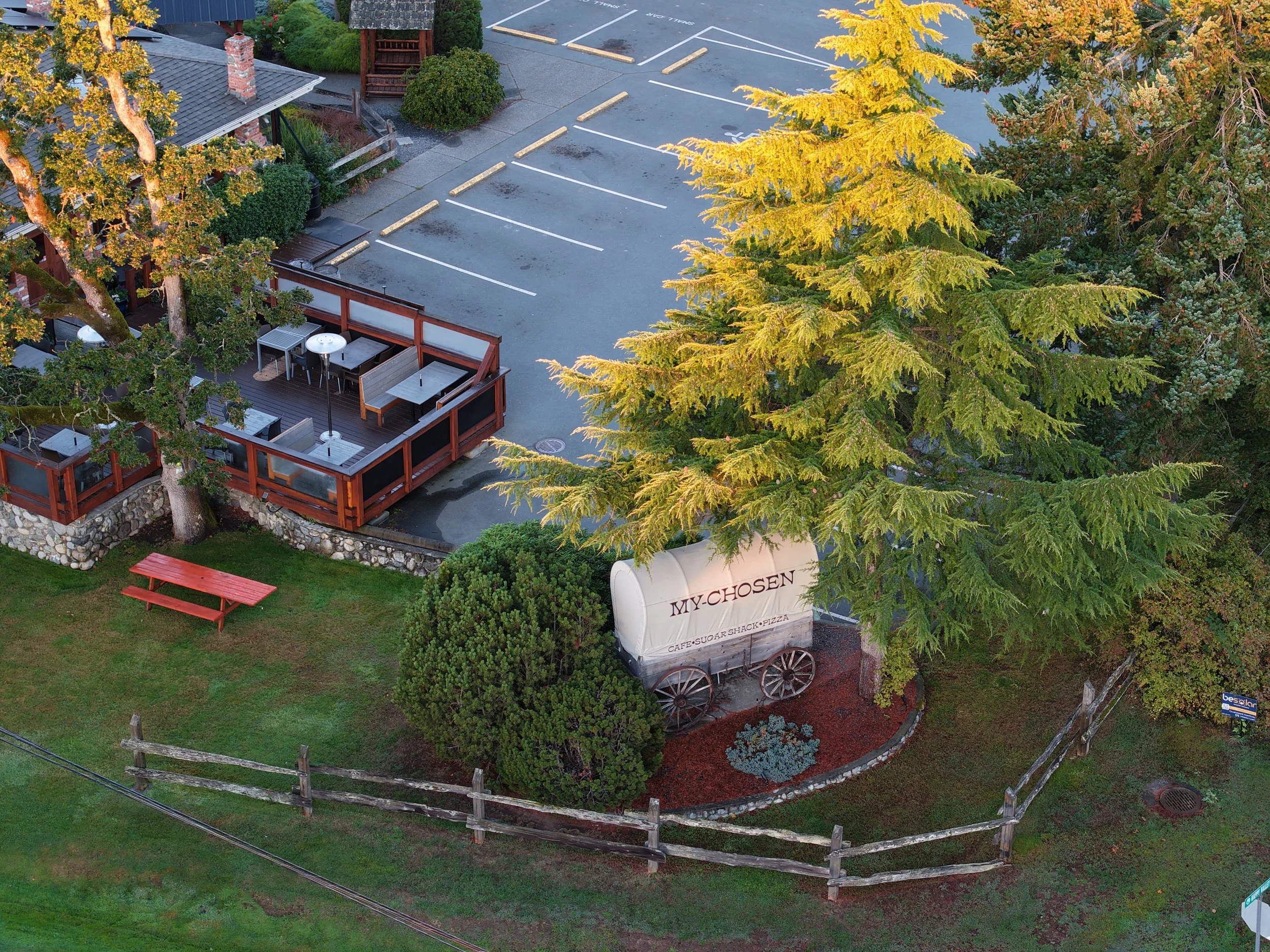
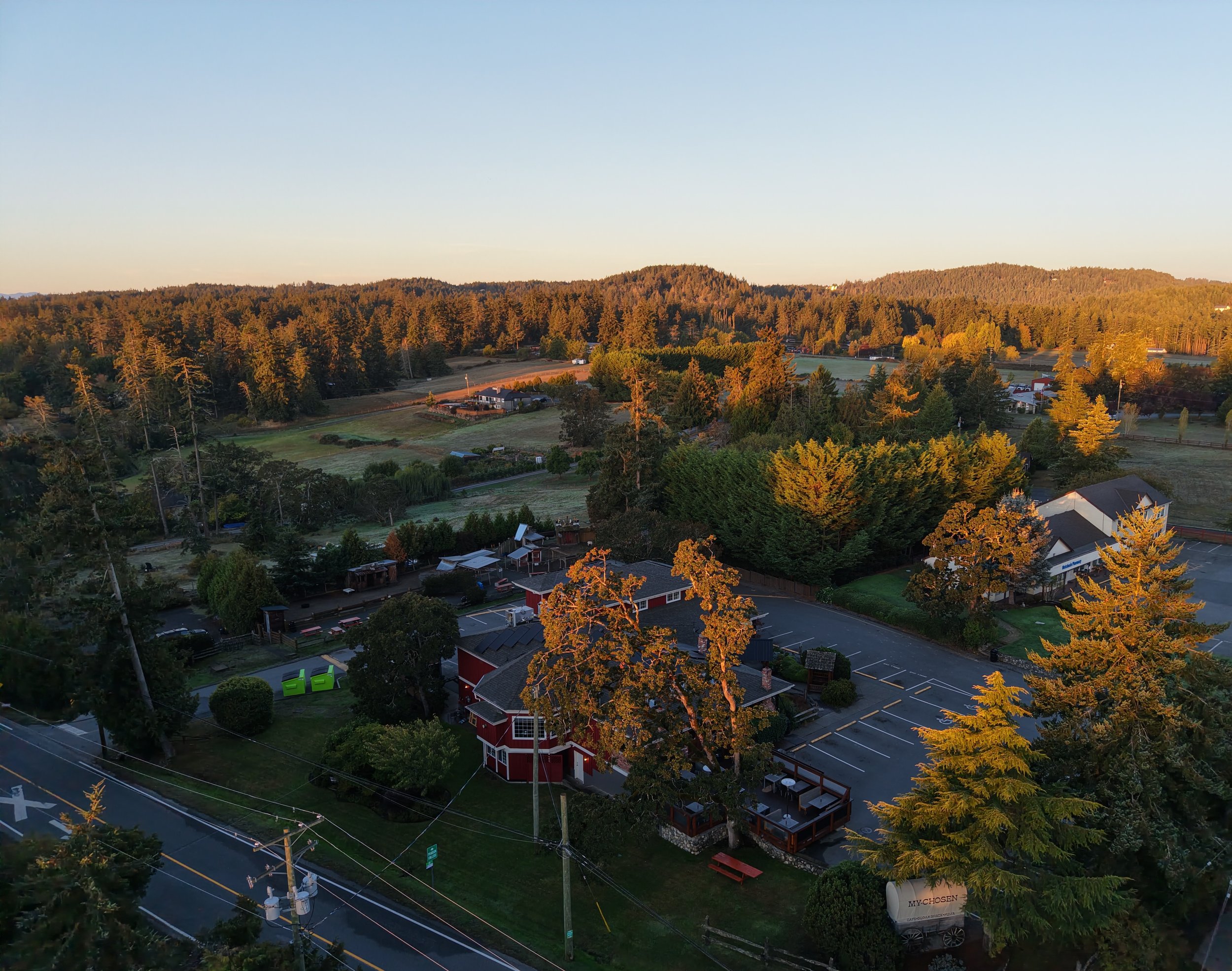
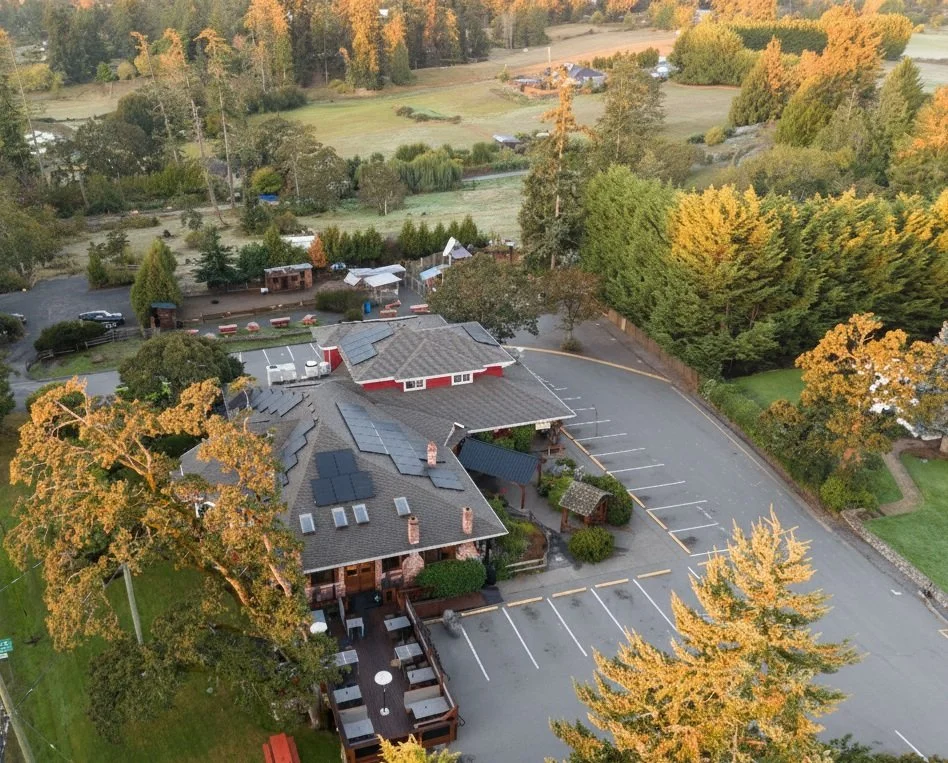
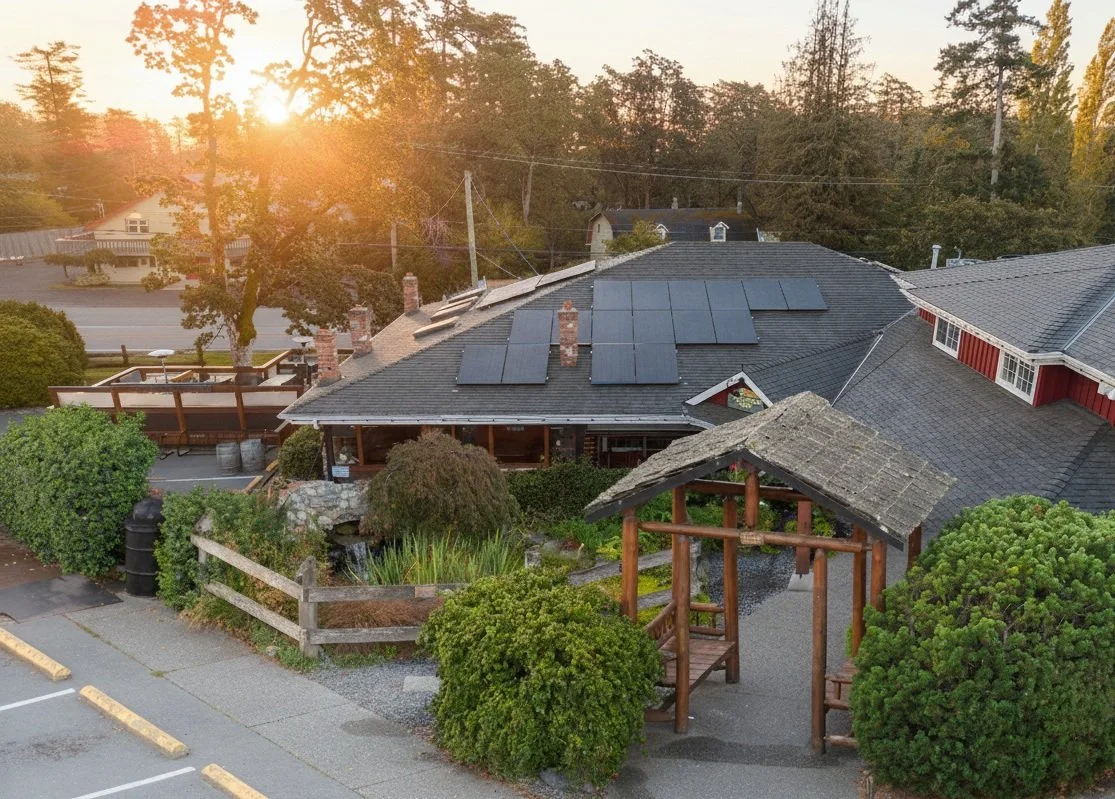
Earlier this fall, we spent a morning at My-Chosen Café, capturing a set of aerial stills of the restaurant and the surrounding countryside. I’ve been visiting My-Chosen for more than twenty years now, and it’s one of those places where the location is part of the experience. Even though I don’t live in Metchosin, the drive out — winding rural roads, open fields, coastal pockets — has always felt like a small escape.
That’s exactly why the property is such a strong fit for aerial photography. The setting already tells a story. The drone doesn’t create anything new; it simply reveals what’s already there.
Once the photos were added to My-Chosen’s Google listing, the response was clear:
several of the images quickly passed 8,000 views each.
For a local restaurant, that kind of steady engagement stands out. And it highlights something we see over and over again:
Most businesses already have hundreds of customer photos taken at eye level — selfies, snapshots, phone pictures at the table.
What they don’t have is a view from above.
Aerial photos offer a perspective no one ever sees in real life, and that alone makes people stop and look. The numbers back it up.
That’s one of the real strengths of aerial media. For a relatively small amount of work, you end up with evergreen content that keeps showing up where customers are already looking. A single strong image can quietly accumulate thousands of impressions on Google Maps without anyone boosting it or promoting it.
The team at My-Chosen was incredibly receptive and enthusiastic throughout the process, which made the shoot easy and genuinely enjoyable. When a place already has character, history, and a setting like theirs, the visuals almost build themselves.
If you're a local business owner in the Westshore or Greater Victoria area and you're curious what a new perspective might do for your visibility online, we’re always open to a conversation. Sometimes all it takes is showing your location from a different angle.
Related Stories
Why I Fly at Sunrise — A West Coast Morning Ritual
How early light, calm air, and quiet spaces shape safer, more intentional flights.
Teaching Kids to Fly Drones — Fun First, Safety Always
A simple, practical look at introducing young pilots to safe micro-drone flying.
Victoria — Why Everything Starts With a Conversation
How clear expectations and honest communication make local flying smoother for everyone.
Vancouver Island Drones vs. The Pacific Ocean Falling From the Sky
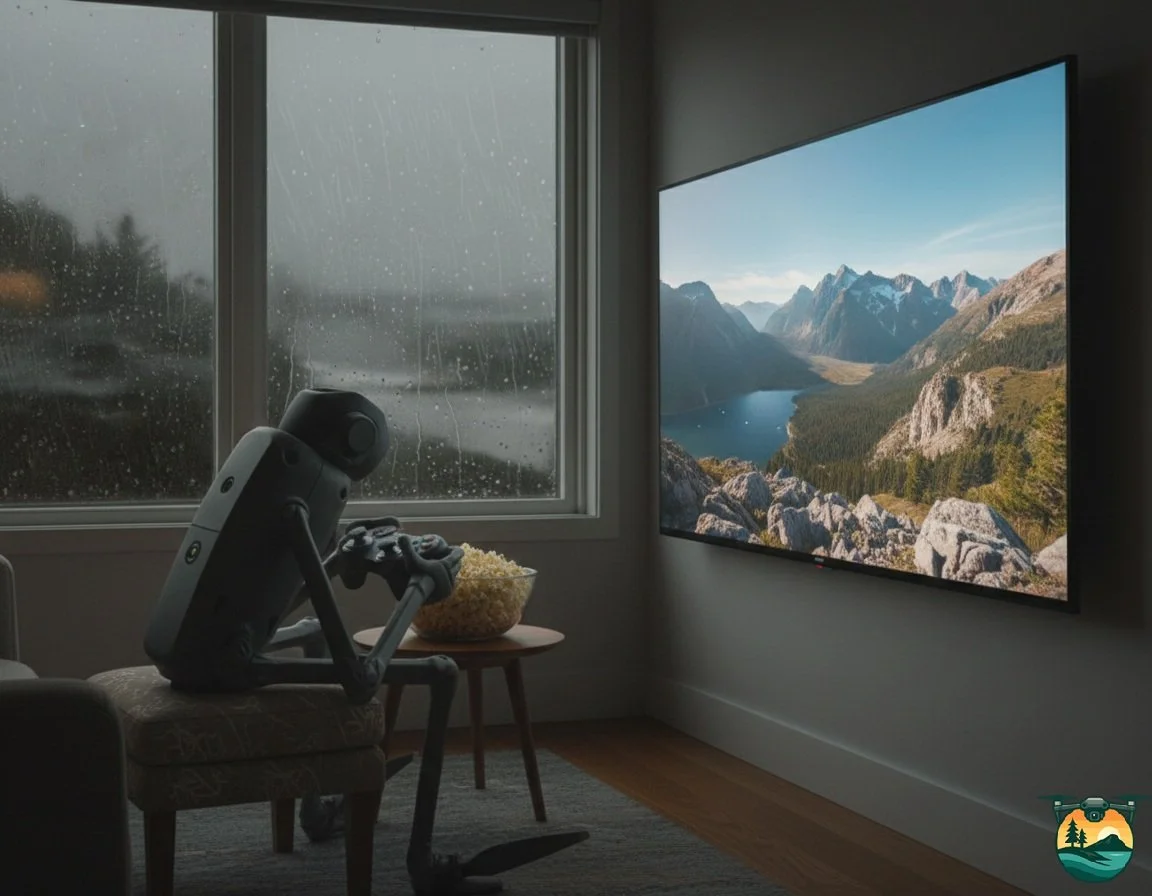
When the rain’s coming down sideways for the third week straight, even Gizmo gives up on flying and settles in for a bit of wish-fulfillment. Nothing like watching other people enjoy blue skies while the Island tries to merge with the Pacific.
I don’t know if we’re in an atmospheric river, an atmospheric waterfall, or whatever new name they’ve invented this year, but it has been biblically pouring rain on Vancouver Island since the end of summer. It hasn’t let up. It hasn’t even taken a lunch break. The sky has basically been dumping a full season’s worth of water on us every single day, and my DJI Air 3S has now entered its window-watching era.
That’s what it looked like this morning—Gizmo (yes, the drone finally has a name) standing on the ledge, legs out, props up, staring through the raindrops like a dog that desperately wants to go outside but knows it’ll be miserable the second it does. If drones had facial expressions, Gizmo would have been giving me the same look Blake gives me when I tell him we can’t go to the playground because everything’s soaked.
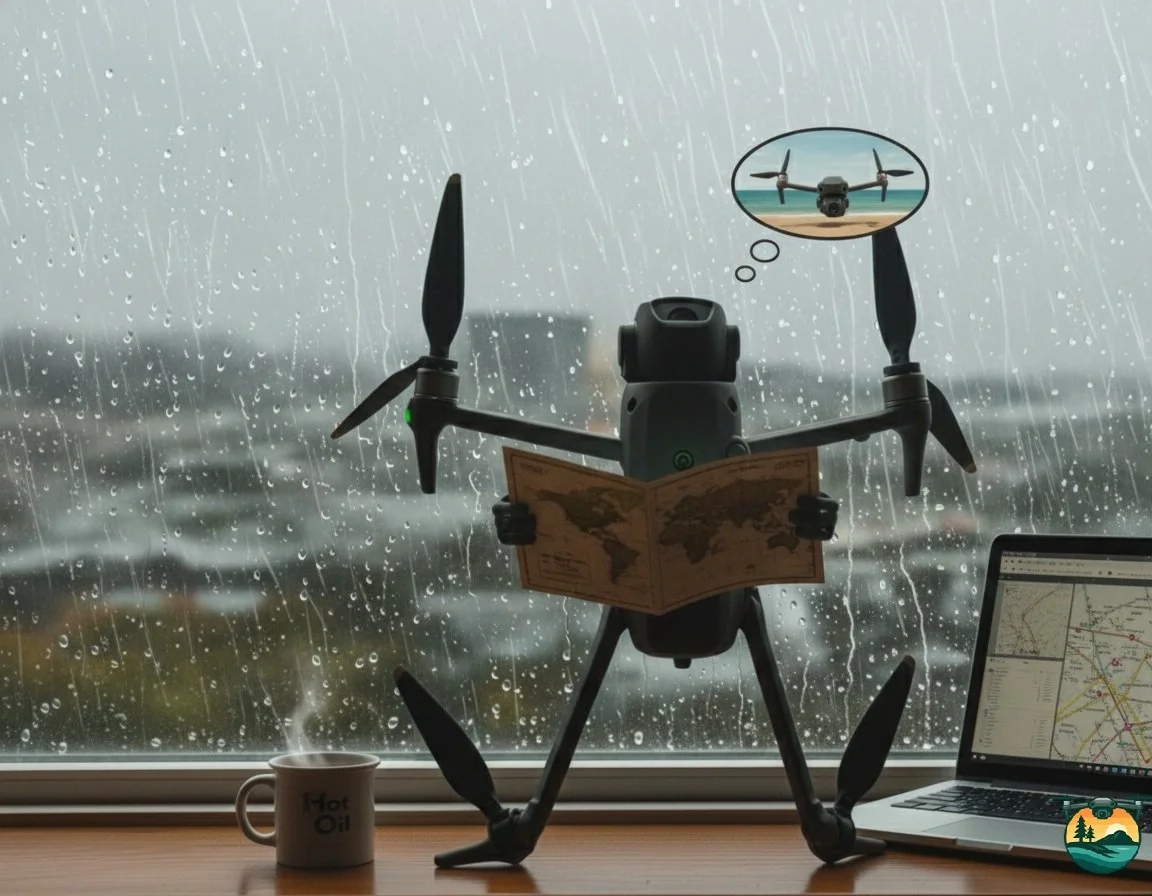
When the rain hasn’t stopped since August, even Gizmo starts daydreaming about warm beaches and dry skies. Stuck inside with a map, a mug of “Hot Oil,” and nothing but atmospheric rivers outside the window, it’s officially vacation-fantasy season on Vancouver Island.
And that’s the thing about flying here. We always pretend we can just wait out the weather, but waiting out Vancouver Island rain is like waiting for a toddler to “calm down on their own.” You’re going to be there a while. Every time the rain slows down, the wind picks up. Every time the wind relaxes, the fog rolls in. You start questioning whether the idea of “flying conditions” is even real or just something people in Alberta made up.
Honestly, you get used to it. You tune your batteries, make another coffee, glance out the window every fifteen minutes, and hope for a six-minute break in the sky where you can squeeze a flight in before the next wave hits. This time of year, that’s all you get—a few stolen minutes, and then the Pacific comes crashing down again.
The good news is the payoff is coming. January and February here are some of the clearest, crispest flying months you get all year. Perfect light, perfect air, gorgeous visibility. When that hits, the Air 3S is getting launched out the door so fast it won’t even remember its rainy little existential crisis by the window.
Until then, we’re just trying to stay dry like the rest of the Island.
Related Stories
Chasing Down a DJI Neo 2 for Christmas — Why This Drone Matters More Than I Expected
A father–son story about finding the right beginner drone and why the Neo 2 was the perfect fit.
DJI Neo 2: Why This Little Drone Is About to Become My Four-Year-Old’s First Co-Pilot
A closer look at how this tiny drone became the cornerstone of our safe flying lessons.
Why I Fly at Sunrise — A West Coast Morning Ritual
The calm, patient flying philosophy that shapes how I teach my son to fly.
DJI Mini 5 Pro: If It’s Not a Micro Drone… What’s the Point?

Even drones have cheat days. The Mini 5 Pro stepping on the scale is basically me after Thanksgiving — trying to convince everyone it’s “just the batteries.”
Let’s talk about the DJI Mini 5 Pro, because depending on who you ask, it’s either the perfect evolution of the Mini line… or a confused little chonker that wandered into the wrong weight class. And honestly, for a drone that’s supposed to be “lightweight,” it sure has sparked a lot of conversations about the one thing it absolutely shouldn’t be flirting with: breaking the sub-250g barrier.
The entire reason the Mini series exists — the whole identity of the line — is that glorious micro-drone freedom. Sub-250g means fewer rules, fewer restrictions, less paperwork, and more places you can legally fly without Transport Canada tapping you on the shoulder. That’s the magic. That’s the appeal. That’s why people buy these things.
But here’s the part that DJI hopes slips under the radar: the Mini 5 Pro is coming in overweight in multiple countries. Not “my scale’s off” overweight — I mean regulators outright refusing to classify it as a micro drone. The UK didn’t classify it as micro. Parts of the EU didn’t. Australia didn’t. New Zealand didn’t. And DJI has already quietly tweaked their own packaging and marketing language, which is never a great sign.
And look — trust me when I say I’m in absolutely no position to judge anything for being a little overweight. I’m walking around with a full-time dad bod myself. But even I know when something is carrying too much for its weight class.
So now we’ve got a drone still being marketed like a Mini, but being treated more like a “tiny adult drone” in several countries. And that’s a problem. Because if you lose the micro-drone advantage, you lose the whole reason to even consider a Mini in the first place. If I’m going to deal with more restrictions anyway, I’d rather fly something with bigger sensors, better stability, longer flight times, better low-light performance — you know, something with real muscle behind it.
And that leads to the obvious question: if the Mini 5 Pro isn’t reliably a micro drone, then… what’s the point? Why would you buy it? It’s priced high enough that it’s not “cheap and cheerful,” and without micro classification it suddenly sits in the same regulatory neighborhood as drones that absolutely outperform it.

Which brings me to my actual opinion: if I were buying a Mini right now, I wouldn’t buy the Mini 5 Pro. Not a chance. I’d buy the DJI Mini 4 Pro without even thinking twice about it.
The Mini 4 Pro is still everything a Mini is supposed to be. It’s a proper micro drone. It has excellent collision avoidance, a very capable camera, a mature and stable platform, and as of now it’s a fantastic deal. Most importantly, it still gives you the legal freedom that Micro drones are meant to deliver — and for a lot of recreational and travel flyers, that freedom is the whole game.
The Mini 5 Pro, on the other hand, feels like it’s having an identity crisis. It’s feature-packed and extremely capable, but if it’s not actually giving you the micro-drone benefits, then you’re paying a premium for something that doesn’t deliver the one thing the Mini line is famous for.
Is the Mini 5 Pro a good drone? Absolutely. But is it the smarter buy for most people in Canada right now? Not in my books. Not when the Mini 4 Pro exists, and not when the Mini 5 Pro’s entire legal advantage is up in the air — literally and figuratively.
So here’s where I land: if you want performance, skip the Mini 5 Pro and get something beefier. If you want the freedom that Mini drones are supposed to give you, get the Mini 4 Pro. And if you want something fun, tiny, and perfect for a four-year-old to boss around with voice commands, we’ve got the NEO 2 coming for exactly that purpose.
But the Mini 5 Pro? Until DJI sorts out this whole weight-class rollercoaster, it’s stuck in a weird middle zone that doesn’t make a lot of sense — especially if you’re flying in Canada and want simplicity.
Vancouver Island Drones — independent, local, and not affiliated with DJI or anybody else. Just calling it like it is, dad bod and all.
Related Stories
Chasing Down a DJI Neo 2 for Christmas — Why This Drone Matters More Than I Expected
A father–son story about finding the right beginner drone and why the Neo 2 was the perfect fit.
DJI Neo 2: Why This Little Drone Is About to Become My Four-Year-Old’s First Co-Pilot
A closer look at how this tiny drone became the cornerstone of our safe flying lessons.
DJI Drones & Accessories
Straightforward reviews and recommendations for DJI drones and accessories, based on practical experience and long-term use.
DJI NEO 2: Why This Little Drone Is About to Become My Four-Year-Old’s First Co-Pilot
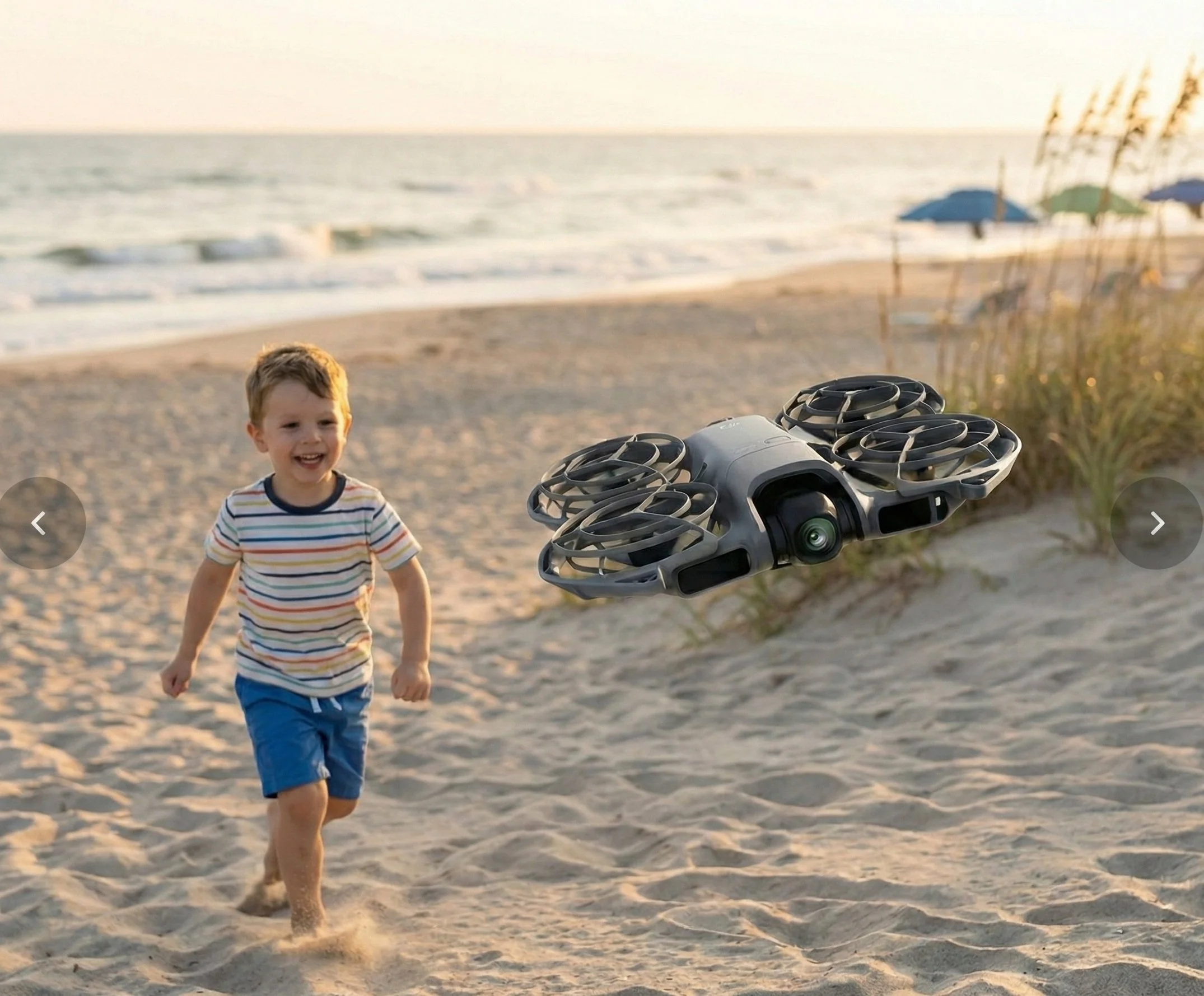
Pocket-sized drone, big memories. This is why we wanted the NEO 2
The DJI NEO 2 has a ridiculous amount of capability for its size and price, and that’s exactly why I’m picking one up. I’m not buying it to replace anything in my current setup or to compete with the prosumer drones I fly for work. I’m buying it because it’s the perfect first drone for my four-year-old son, and because the NEO 2 brings a mix of features that make it fun, safe, and actually worth using on our family adventures.
For starters, the voice and gesture controls are perfect for a kid. Blake can literally talk to the drone. He can wave at it. He can tell it to go up or come back, and the drone actually listens. That’s a pretty incredible way to teach a young kid how flight works without throwing them into full manual controls right away. It removes all the friction and makes learning feel natural. The follow-me tracking is another big deal for us. Blake is four and full throttle all the time, whether he’s running around the playground, riding his bike, tearing down a trail, or just being a maniac in the backyard. Being able to pull a drone out of my pocket, speak a command, and have it track him while he zooms around is unbelievably convenient, and it gives us shots we could never get otherwise without firing up bigger gear.
The NEO 2 also brings real safety features, which matter when you’re teaching a kid. You get full obstacle sensing, palm takeoff and landing, and the kind of durability that means a bump or two isn’t the end of the world. The original NEO already had a reputation for surviving “oops” moments, and everything about the NEO 2 suggests they’ve improved that even further. I want Blake to learn without worrying that every mistake is going to cost me a fortune, and this drone makes that possible.
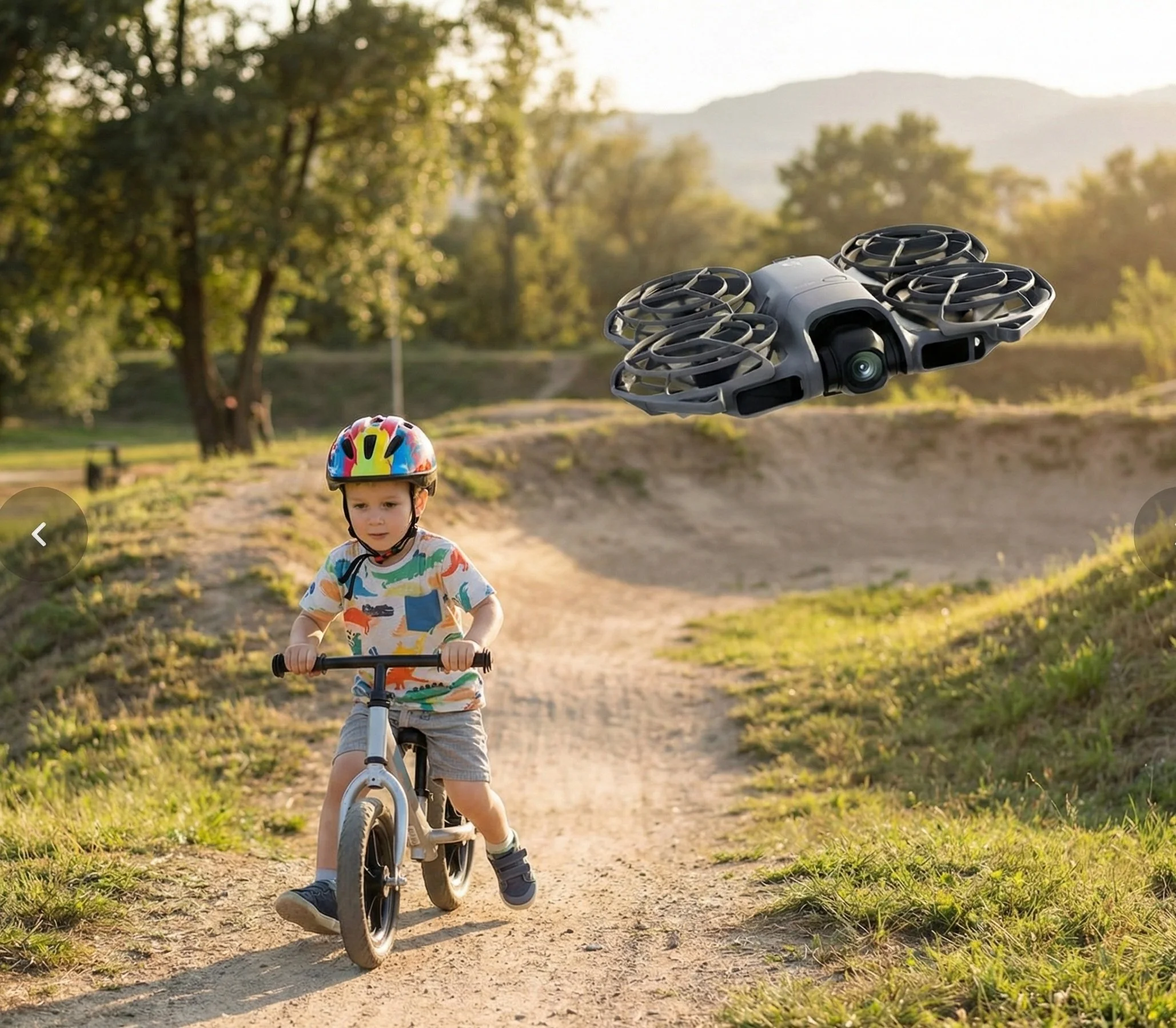
Teaching the next generation of pilot — one ride at a time.
Then there’s the camera. For the size and price, 4K video up to 60fps (and even 100fps in certain modes) is honestly wild. No, this isn’t meant to replace a prosumer drone for paid aerial work, but that’s not what we’re using it for. This is for family clips, quick moments on a trail, spontaneous shots on a beach, and, most importantly, documenting Blake learning to fly. It’s more than good enough for YouTube, social media, and the kind of personal content we create together.
This little drone is going to be a huge part of our upcoming long-format YouTube series where I teach Blake to fly. That’s something we’ve talked about for a long time, and the NEO 2 is the perfect tool for it. It’s simple enough for a kid, smart enough to avoid disasters, and capable enough to capture footage that still looks great. We’re going to get plenty of behind-the-scenes moments, lots of teaching clips, and a ton of genuine father-son content out of it. It fits our workflow and our brand perfectly.
The bottom line is that for the price, the DJI NEO 2 is an absolute no-brainer if you’re a parent who flies drones and wants to bring your kid along for the ride. It’s fun, it’s safe, it’s capable, and it opens the door for kids to learn in a way that feels exciting instead of intimidating. For us, it’s going to be a great teaching tool, a great storytelling tool, and a great little drone to have in our pocket when Blake and I head out on our next adventure.
Related Stories
Chasing Down a DJI Neo 2 for Christmas — Why This Drone Matters More Than I Expected
A father–son story about finding the right beginner drone and why the Neo 2 was the perfect fit.
DJI Neo 2: Why This Little Drone Is About to Become My Four-Year-Old’s First Co-Pilot
A closer look at how this tiny drone became the cornerstone of our safe flying lessons.
Why I Fly at Sunrise — A West Coast Morning Ritual
The calm, patient flying philosophy that shapes how I teach my son to fly.
What Canada’s 2025 Drone Regulations Mean for Everyday Flyers
Transport Canada has now rolled out its full wave of drone regulation changes for 2025, with the April updates long behind us and the November rules newly in effect. There’s been a lot of noise online about what all this means, and most of it either oversells the changes or completely misses the point. So here’s the simple version, from someone who actually flies on Vancouver Island constantly, in real weather, real airspace, around real people, at real hours of the morning when most of the Island is still asleep and the only witnesses are gulls and the occasional deer.
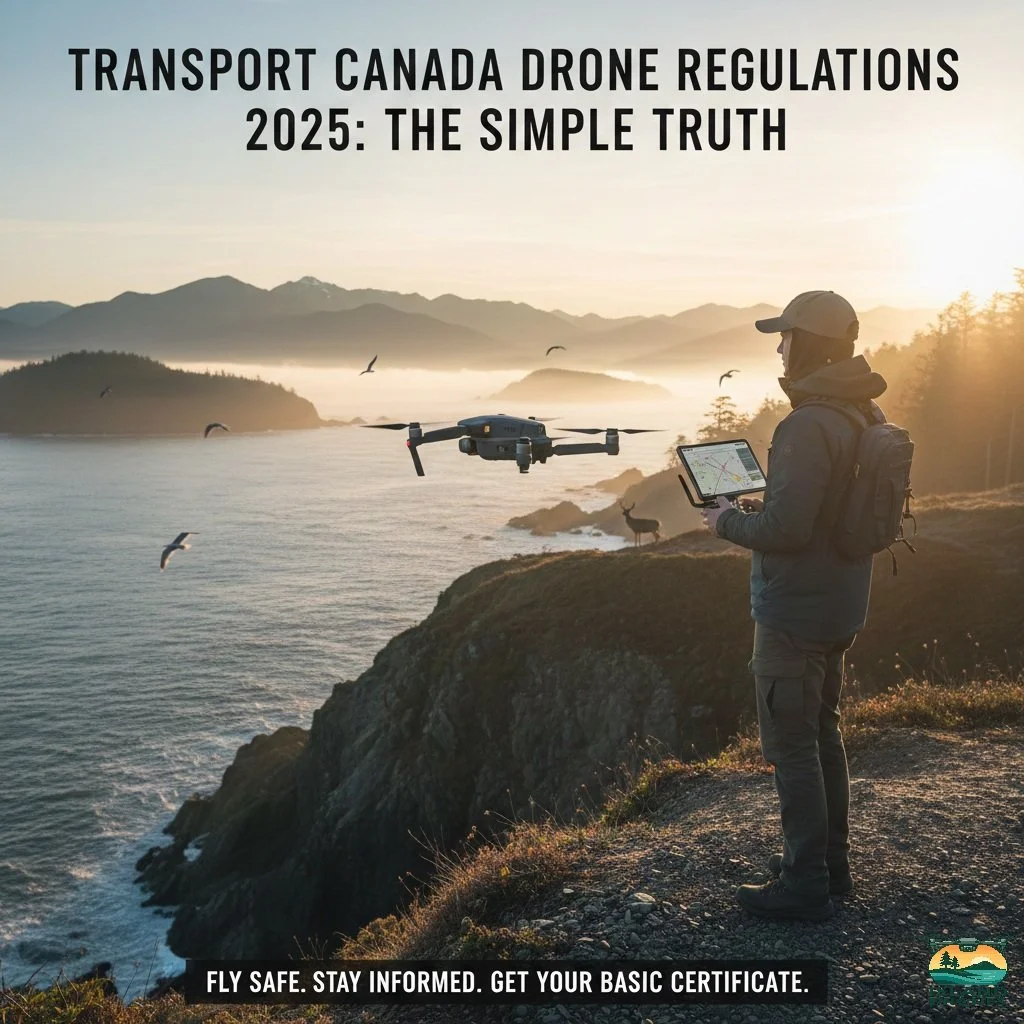
The new rules essentially break down into two categories: administrative changes that happened back in April, and more meaningful operational changes that arrived in early November. The April side of things handled restructures like new exam tracks and the operator certificate (RPOC) framework. The November update was the one that actually affected flying — adding defined categories for extended visual line of sight (EVLOS), low-risk beyond line of sight allowances, sheltered operations, and some clearer boundaries for medium-sized drones. NAV Drone updated to match, with new flight type options and more precise authorization pathways. If you’re an advanced pilot, none of this is scary or confusing. If you’ve been treating drone rules like an optional suggestion, it probably feels overwhelming.
And that brings me to my one opinion that hasn’t changed in years: every single person who flies a drone in Canada should get the Basic Certificate. I don’t care if you’re flying a $200 toy or a $5,000 rig — the Basic exam teaches you things you absolutely need to know. The rules in Canada are not intuitive. You cannot tell by looking whether you’re in controlled airspace. You cannot “just guess” whether your location is safe, or whether you’re accidentally over bystanders, or what altitude restrictions actually apply to the terrain you’re on. You won’t magically know that migratory bird sanctuaries are off-limits. You won’t instinctively understand NOTAMs or heliport radiuses or how weather interacts with your drone’s sensors. These things must be learned, and the Basic Certificate is designed to teach exactly that.
It costs ten bucks. That’s literally it. Ten dollars and an hour or two of studying using completely free resources. It’s the easiest, cheapest way to prevent yourself from being the pilot who ruins it for everyone else. Almost every time someone confronts me while I’m flying — even when I’m following every rule — it’s because they had a previous bad experience with someone who didn’t know what they were doing. Those pilots are the reason regular fliers like me get questioned, yelled at, or lectured about rules we’re already following. If more new pilots took the Basic exam, there’d be fewer incidents, fewer complaints, and a lot less drama on beaches and boardwalks.
As for advanced pilots, the 2025 changes don’t rewrite your world, but they do matter. If you’re flying commercially, the new categories make your planning more structured whether you’re staying within VLOS, using EVLOS with a spotter, or exploring any of the newly defined operation types. It’s still the same job, but with clearer paperwork and expectations. What hasn’t changed is that you’re expected to be competent, current, and aware of the rules — something that honestly should’ve always been the baseline.
And just to clear up one last thing I see confusing people online: not every new drone is an “upgrade.” The Air 3S is still my primary tool. It’s my cinematic camera, the one I trust for commercial flights and the drone that handles Vancouver Island wind and light properly. The new Neo 2 is fun, impressive for the price, and fantastic for kids — especially for follow-me shots and early training — but it’s not a replacement for a real cinematic aircraft. It lives in a totally different category, and that’s how it should be.
So here’s the bottom line. Canada tightened the rules this year, not to make life harder for pilots, but to make the sky safer and more predictable as drones become more common. If you fly, you owe it to yourself and everyone around you to understand the basics. Get the Basic Certificate. Or at the very least, study the exact material for it so you know what’s legal, what isn’t, and how not to accidentally end up being “that pilot” who becomes the reason someone tries to ban drones from another park.
If you treat the airspace with respect, it treats you well back — and you get to keep enjoying the freedom of flying on this island without unnecessary headaches. And honestly, that’s worth a lot more than ten bucks.
Related Stories
Why I Fly at Sunrise — A West Coast Morning Ritual
How early light, calm air, and quiet spaces shape safer, more intentional flights.
Teaching Kids to Fly Drones — Fun First, Safety Always
A simple, practical look at introducing young pilots to safe micro-drone flying.
Victoria — Why Everything Starts With a Conversation
How clear expectations and honest communication make local flying smoother for everyone.
Our Favorite Camping Spot in Parksville


We snuck away to Parksville for the long weekend — a little family adventure on the stat. Technically, I got “called into the office,” but when your office has ocean views, warm light, and soft sand under your shoes, you don’t argue.
This was our fourth stay at The Beach Club Resort, which we now proudly call our favourite “camping spot” on Vancouver Island. The joke started last summer when we abandoned an actual campsite and ended up here instead. We’ve refined our camping setup so well now that we can camp comfortably any time of year… mostly because our gear includes a beachfront suite, comfy beds, and an in-suite laundry. Roughing it, Westshore edition.
The beach was quiet that morning — low tide stretching forever, soft light coming over the ocean, the kind of peaceful moment that hits a little differently on a holiday where most people take time to reflect. We weren’t there for Remembrance Day specifically, but it’s why we were wearing poppies on a beach instead of rushing anywhere else. A calm moment, a beautiful place, and a reminder of how lucky we are to live where we do.
Blake, of course, made a beeline for the giant playground next door (the best on the Island if you ask him), and we spent the rest of the morning doing what we always do here — walking the boardwalk, taking it slow, appreciating this little stretch of Vancouver Island that somehow feels different every time we visit.
I flew a little, as I always do. Parksville never disappoints. Even on a quiet November morning, the place shows off like it’s peak summer.
We’ll be back in December for Christmas — same favourite “campsite,” same routine, same view we never get tired of.
Vancouver Island Drones — independent, family-run, and always grateful to explore places like this.
Related Stories
Why I Fly at Sunrise — A West Coast Morning Ritual
How early light, calm air, and quiet spaces shape safer, more intentional flights.
Teaching Kids to Fly Drones — Fun First, Safety Always
A simple, practical look at introducing young pilots to safe micro-drone flying.
Victoria — Why Everything Starts With a Conversation
How clear expectations and honest communication make local flying smoother for everyone.
Between Atmospheric Rivers: View Royal to Victoria in Six Minutes of Sunshine
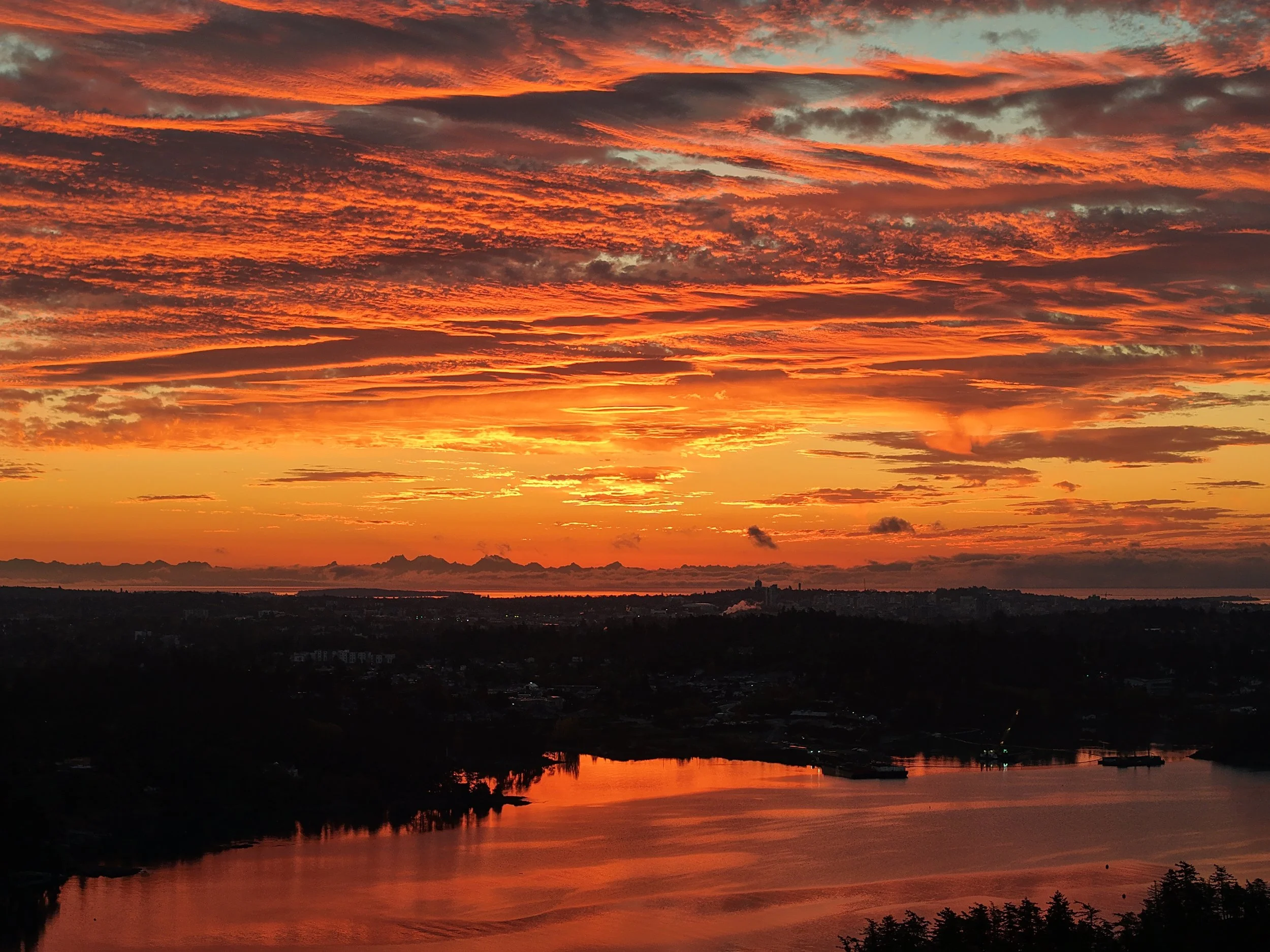


You know those breaks in the weather that make you question whether you imagined the last two weeks of rain? That was last week.
One moment it’s dumping sideways, the next — blue sky. And not just blue sky, but that golden glow that makes the entire West Coast look like it’s auditioning for a travel ad. I had about six minutes before the next atmospheric river came barreling through, so I did what any rational adult would do: ran to the parking lot with the drone like it was a fire drill.
From up there, View Royal looked unreal. The clouds were splitting open, light spilling through onto Esquimalt and downtown Victoria, the ocean catching every bit of orange reflection. It’s one of those rare moments where you’re not just filming — you’re kind of standing there, half-laughing, half-freezing, trying to believe you live somewhere this moody and beautiful.
And yes — before anyone asks — no filters, no ND, no presets. We were raw-dogging it. Straight sensor to sky, baby. Sometimes you just have to let the glass and the light do the talking.
I didn’t plan this flight, didn’t prep anything, didn’t even bring gloves. It was supposed to be another “meh” weather day. But that’s the West Coast — it’ll drown you for a week, then give you five minutes that remind you exactly why you stay.
The Air 3S did its thing, the light did the rest, and by the time I landed, the next wave of rain was already moving in from the Strait. Timing: 10/10. Fingers: frozen. Battery: worth it.
Sometimes the best flights don’t come from road trips or fancy locations — they happen in the parking lot outside your own front door, between storms, when you decide to ignore common sense and fly anyway.
(Captured from View Royal, looking toward Esquimalt and downtown Victoria. West Coast skies — unpredictable, dramatic, and occasionally polite enough to pose for six minutes.)
Vancouver Island Drones – still grounded, but not for long.
Related Stories
Why I Fly at Sunrise — A West Coast Morning Ritual
How early light, calm air, and quiet spaces shape safer, more intentional flights.
Teaching Kids to Fly Drones — Fun First, Safety Always
A simple, practical look at introducing young pilots to safe micro-drone flying.
Victoria — Why Everything Starts With a Conversation
How clear expectations and honest communication make local flying smoother for everyone.
Chilly Sunday Sunrise at Royal Bay Beach
Another chilly West Coast Sunday morning, another reason to pull over at Royal Bay Beach.
You know that kind of sunrise that makes you forget you’re holding a coffee, because your fingers are too busy freezing off while you fumble for the drone controller? Yeah — one of those mornings.
The sky was glowing bright orange, the tankers were parked offshore like they’d reserved front-row seats, and Victoria was just starting to wake up. Couldn’t resist taking the Air 3S out for a few shots — mostly just to justify why I was up this early on a Sunday.
And sure enough, the universe has a sense of humor — same guy, same truck, same parking spot as the last time I came down here. At this point, we might as well start a Royal Bay Beach sunrise club. Great guy, knows all the local history, and somehow always beats me to the beach.
It’s always nice running into locals like that — just two people watching the light hit the water, pretending it’s not freezing, and pretending this isn’t slowly becoming a habit.
Beautiful morning, beautiful shots, great conversation. If every early-morning flight turned out like this, I’d stop pretending I hate getting up early.
Vancouver Island Drones — still grounded (but never for long).
Related Stories
Why I Fly at Sunrise — A West Coast Morning Ritual
How early light, calm air, and quiet spaces shape safer, more intentional flights.
Teaching Kids to Fly Drones — Fun First, Safety Always
A simple, practical look at introducing young pilots to safe micro-drone flying.
Victoria — Why Everything Starts With a Conversation
How clear expectations and honest communication make local flying smoother for everyone.
Good Morning, My-Chosen Café — A Sunrise Worth Waking Up For


There’s something timeless about My-Chosen Café.
It’s the kind of place that hasn’t needed to reinvent itself in twenty years — because it never had to. Horses in the fields, coffee on the porch, and that classic Metchosin quiet that somehow feels like home even if you’re just passing through.
For me, it’s more than a local landmark. I’ve been coming here for over two decades — long before drones, cameras, or aerial photography ever became part of my life. So when the chance came to finally capture this spot from above, I knew it wasn’t just another shoot. It was personal.
The Flight
We lifted off just before sunrise, when the first light was brushing the tops of the trees but the sun hadn’t yet crested the hills. The café sat calm and still, lights warm against the morning blue.
As the drone rose above the treeline, the entire landscape opened up — the fields, the winding Metchosin roads, and the distant ocean beginning to catch the reflection of the rising sun. From that height, you can see why My-Chosen Café feels like the heart of this little pocket of Vancouver Island.
The video sequence starts at the front of the restaurant and slowly climbs through the trees — and then, like nature’s cue, the horizon ignites. The sky goes from deep blue to gold in seconds, the kind of light you can’t fake or predict.
Why We Fly
This shoot was a reminder of why we do what we do at Vancouver Island Drones. It’s not just about capturing pretty pictures — it’s about documenting the stories, the businesses, and the moments that make the Island feel alive.
Every café, every job site, every sunrise — they all tell part of the bigger story of this community. And sometimes, all it takes is a few minutes in the air to see it differently.
Want to Show Off Your Location?
If you run a restaurant, resort, or local business with a setting worth sharing, we’d love to help you showcase it from above. Whether it’s the early-morning calm or the full buzz of your busy hours, aerial footage can tell your story in a way that connects instantly.
Related Stories
Why I Fly at Sunrise — A West Coast Morning Ritual
How early light, calm air, and quiet spaces shape safer, more intentional flights.
Teaching Kids to Fly Drones — Fun First, Safety Always
A simple, practical look at introducing young pilots to safe micro-drone flying.
Victoria — Why Everything Starts With a Conversation
How clear expectations and honest communication make local flying smoother for everyone.
I Passed My Advanced Flight Review
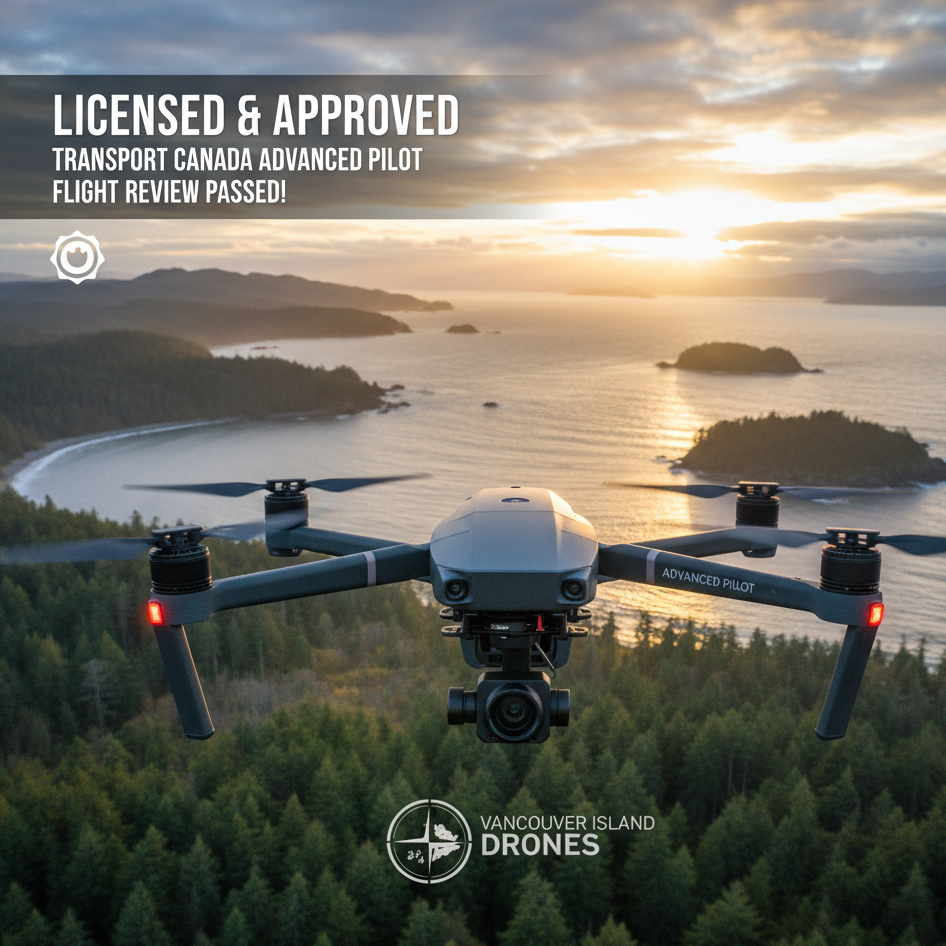
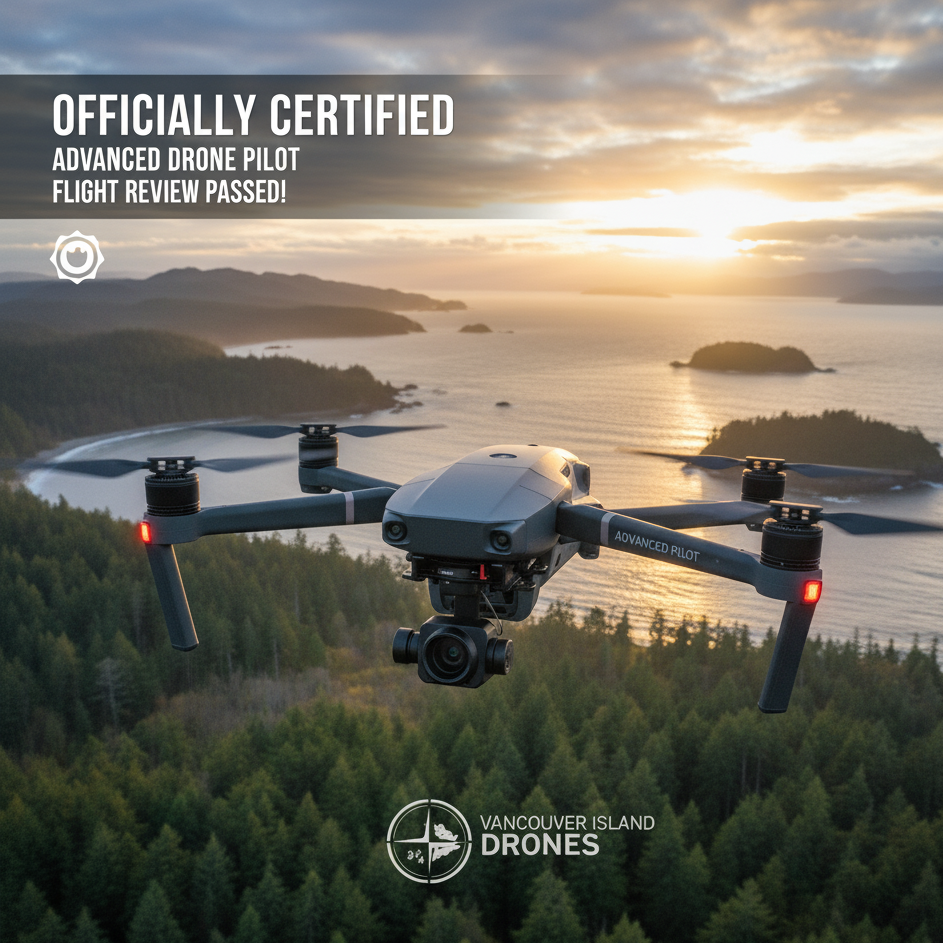
Well, that’s it. The box is ticked, the paperwork is filed, and the hi-viz vest has sweat stains to prove it: I officially passed my Transport Canada Advanced Flight Review.
For anyone who hasn’t been down this rabbit hole, the Advanced is what separates the “flying a toy in the park” crew from the people who can actually work in controlled airspace without Transport Canada knocking on the door. It’s the big kid license.
What did it take? A pile of prep. Site survey scripts memorized like bad karaoke lyrics (CARs 901.27, anyone?). Emergency procedures on loop in my head — lost link, fly-away, the whole “call Nav Canada before your heart rate hits 200” routine. And yes, cones, launch pad, fire extinguisher, first aid kit — the whole portable circus stuffed in the back of the car.
Then there’s the actual review: fifteen minutes of proving you can keep your drone in sight, call your own takeoff/landing like you’re hosting a morning radio show, and convince a flight reviewer you’re not about to fly into a 737 on final. Sounds simple. It isn’t.
But here’s the thing: I passed. Which means Vancouver Island Drones can now operate at the level I’ve been aiming for — advanced airspace, higher-stakes projects, and the kind of credibility you can’t fake.
Am I suddenly Captain Professional? No. I’m still the same Westshore dad with a drone addiction, only now I’ve got Transport Canada saying, “Alright, you know your stuff, go play in the big leagues.”
What’s next? Logging some serious airtime on the DJI Air 3S — getting hours, honing skills, and putting that new license to work on construction, hospitality, and conservation flights right here on the Island.
For today though? I’m just celebrating. Advanced in the bag. Lord of the Wings (the Air 3S) still humming. Vancouver Island Drones moving up a rung.
We get up early in the Westshore… so you don’t have to.
— Ryan, Vancouver Island Drones
Related Stories
Why I Fly at Sunrise — A West Coast Morning Ritual
How early light, calm air, and quiet spaces shape safer, more intentional flights.
Teaching Kids to Fly Drones — Fun First, Safety Always
A simple, practical look at introducing young pilots to safe micro-drone flying.
Victoria — Why Everything Starts With a Conversation
How clear expectations and honest communication make local flying smoother for everyone.
Westshore From Above: Lakes, Lagoons, and a Little Bit of Langford Pride
The Westshore has a reputation. Ask anyone from Victoria and they’ll say it’s all strip malls and traffic jams. They’re wrong. From the air, it’s one of the most beautiful corners of Vancouver Island. And yes, I’m biased — but that’s why I keep getting up at stupid o’clock with my drone batteries charged.
I’ve been flying over our lakes, stadiums, and even the famous Goldstream sign downtown Langford, because this is home. And if Vancouver Island Drones is going to be known for anything, it’s showing people the Westshore they drive past every day but don’t really see.

Thetis Lake
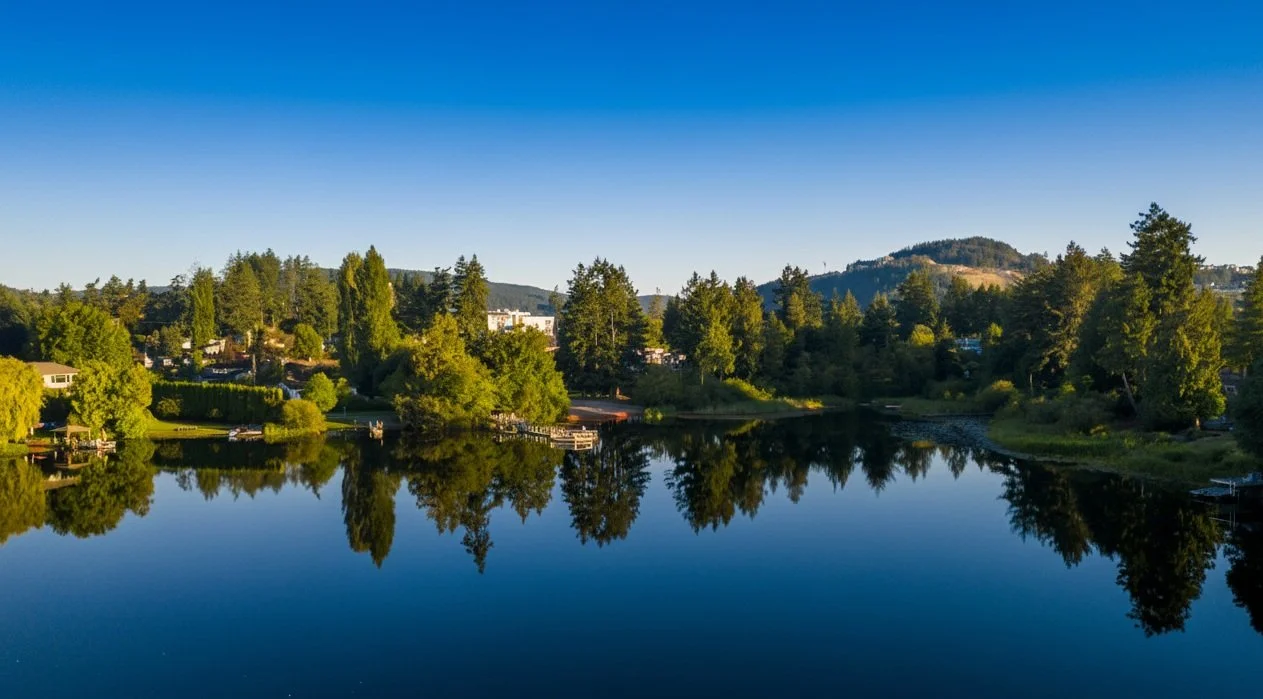
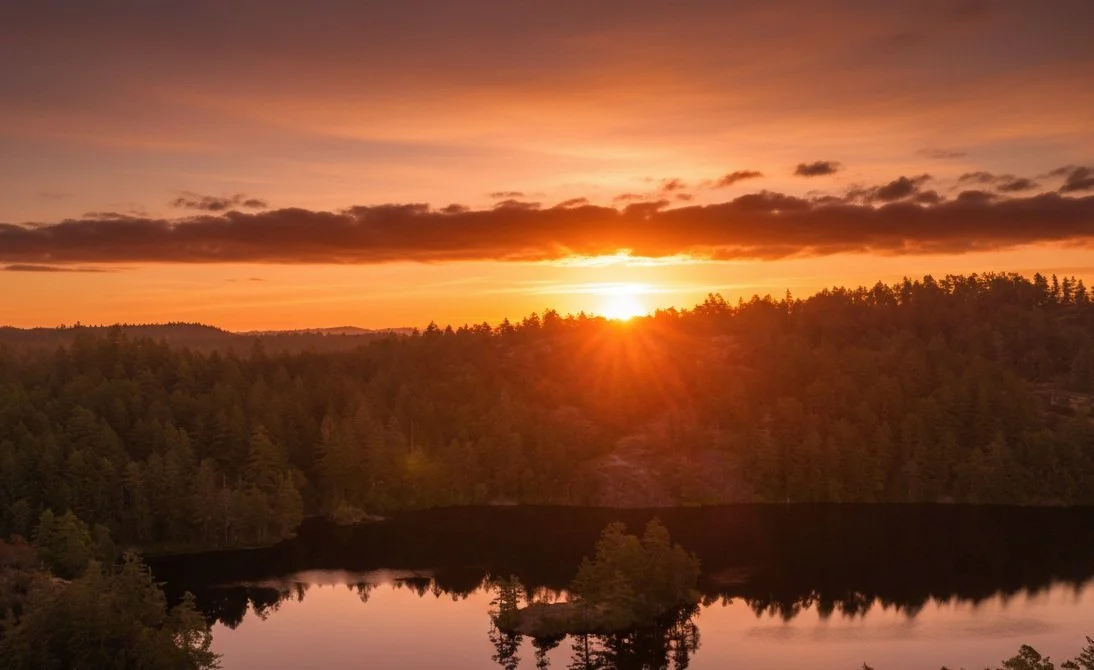
From ground level, Thetis is all about paddleboards and sunburns. From the sky, it’s a mosaic of emerald water wrapped in forest. The drone pulls back and suddenly you realize just how tucked away and perfect this place is.
Glen Lake
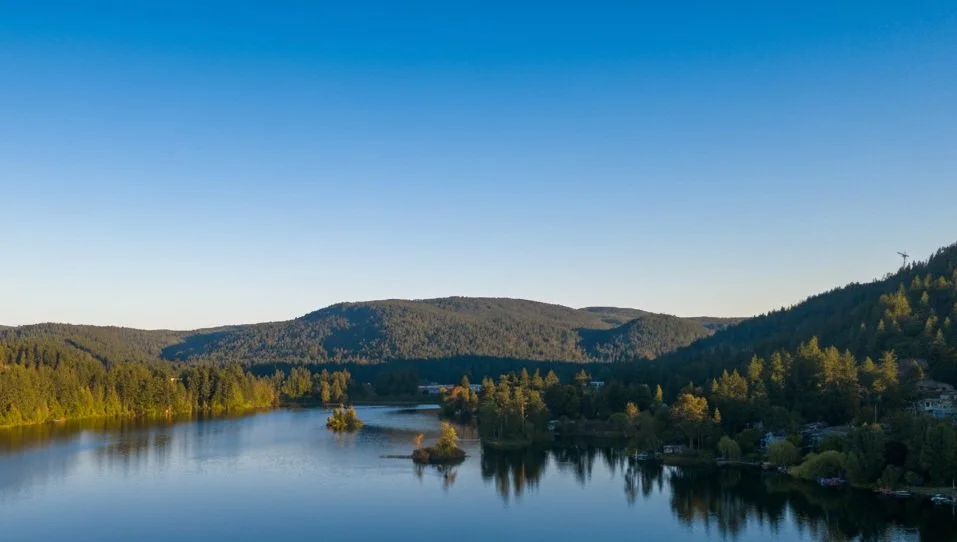
Smaller, but no less Westshore. You can see the docks, the houses that crowd the shoreline, and the kind of reflections you only get when the wind takes a coffee break.
Langford Lake
This one feels endless when you’re circling it from above. Families fishing, rowers carving paths across the surface, and the city building up around it. Langford Lake is the heartbeat in the middle of all this growth.
Esquimalt Lagoon
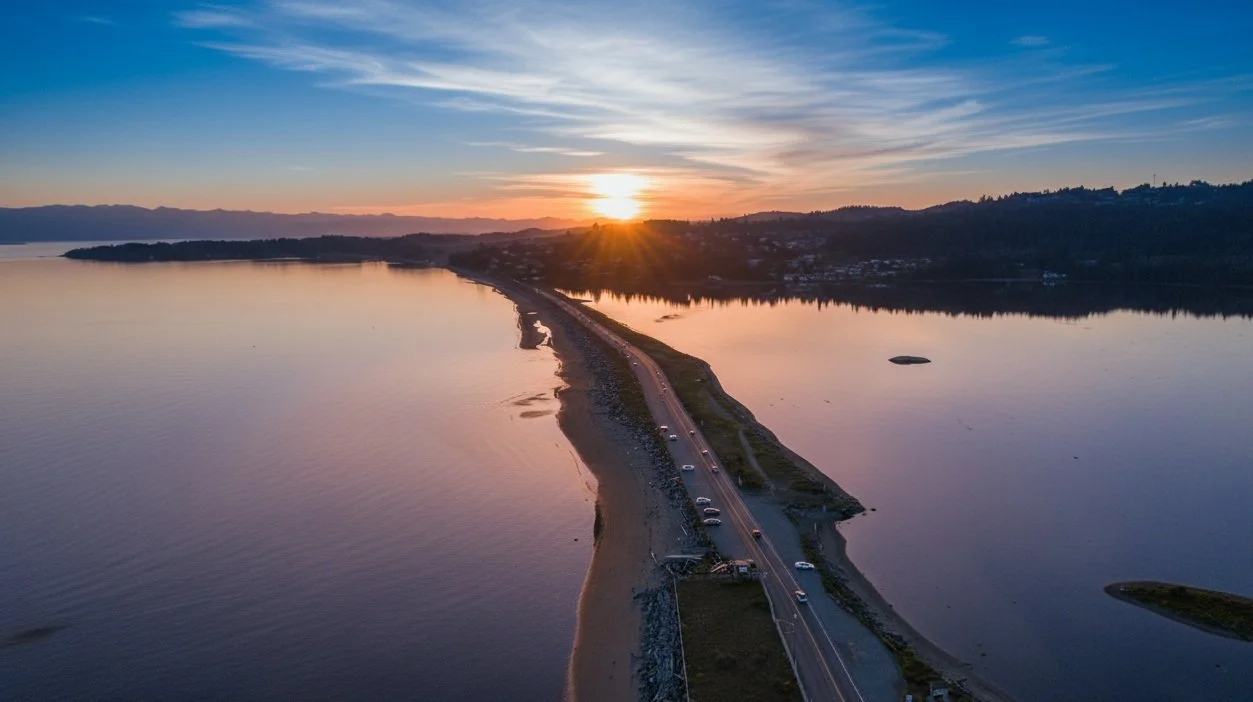
Let’s be honest — the Lagoon is our crown jewel. Sunrise here is like someone cranked the saturation dial in Photoshop, except it’s real. The driftwood, the spit, the ocean horizon… it’s why I call myself addicted. Every time I swear I’ll sleep in, the Lagoon calls me back.
Starlight Stadium
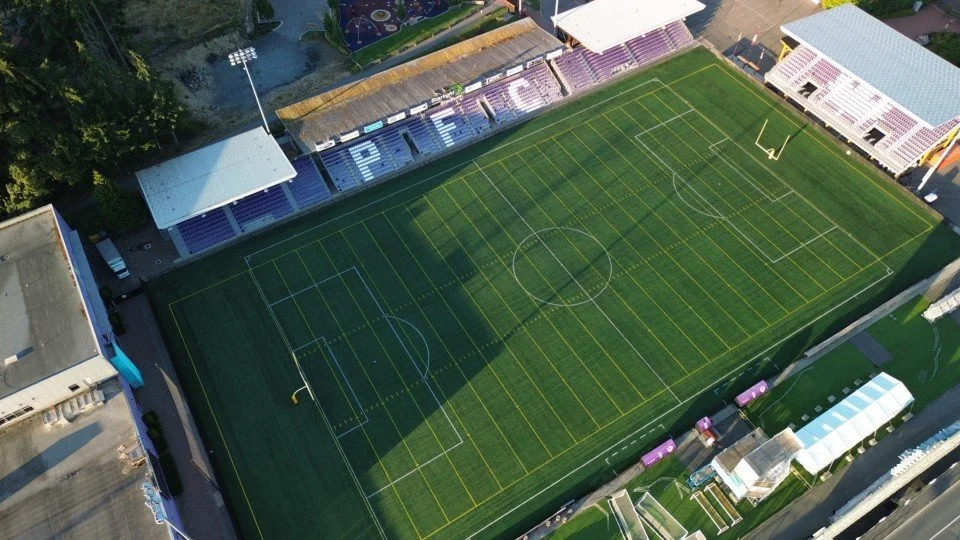
Sure, from the bleachers you see rugby scrums and soccer goals. From the air? It looks like a jewel box under the lights, dropped in the middle of Langford. Proof that even concrete and turf can be beautiful if you climb high enough.
The Goldstream Sign
It’s kitschy. It’s iconic. It’s ours. Flying over downtown Langford, that glowing sign is a reminder that the Westshore has an identity — and I’m leaning all the way into it.
This is the long game. Vancouver Island Drones isn’t about one-off gigs or quick shots. It’s about being the drone guy for the Westshore — the one who makes people stop scrolling, recognize their own backyard, and see it from a perspective they didn’t know they needed.
So yeah, I’ll keep chasing sunrises, flying over lakes, and dropping footage of landmarks that matter to the people who live here. Because this is home, and someone’s got to show it off properly.
Related Stories
Why I Fly at Sunrise — A West Coast Morning Ritual
How early light, calm air, and quiet spaces shape safer, more intentional flights.
Teaching Kids to Fly Drones — Fun First, Safety Always
A simple, practical look at introducing young pilots to safe micro-drone flying.
Victoria — Why Everything Starts With a Conversation
How clear expectations and honest communication make local flying smoother for everyone.
Sunrise Confessions from the Lagoon
There’s a point in life where you stop being able to sleep in. You can blame kids, stress, or just getting old, but one way or another you find yourself wide awake at 5:00 a.m. staring at the ceiling, wondering if you should make coffee or just admit defeat.


For me, defeat looks like tossing the drone in the bag and heading for the Esquimalt Lagoon. Call it therapy, call it obsession — either way, when most people are fumbling for the snooze button, I’m chasing light and fighting driftwood for tripod space.
And here’s the thing: it’s worth it. Every single time.
The View Most People Sleep Through
Sunrise at the Lagoon isn’t subtle. Some mornings it’s pure fire — the whole sky bleeding orange and red over calm water, the kind of light that makes you forget your hands are freezing. Other mornings, it’s soft pastels and clouds painted like brushstrokes. Either way, it’s a reminder that the best show in town doesn’t come with a ticket price.
The drone doesn’t complain either. It just hums up into the sky, catching angles no human could manage unless they had a ladder the height of a condo tower. That’s the beauty of it: a fresh perspective on a scene that’s been there forever.
Why We Get Up Early
We joke that “We get up early in the Westshore… so you don’t have to.” But it’s true. Most people aren’t dragging themselves out of bed for this view. That’s fine — I’ll be the one running on caffeine, collecting the shots, and letting you enjoy them later at a civilized hour.
This is why Vancouver Island Drones exists. Not just to fly for the sake of flying, but to capture the places we love in ways that make people stop scrolling for a second and think, damn, I live here.
Sunrise, Old Man Style
So yeah — old man can’t sleep, dad mode engaged, drone in the air before most alarms have gone off. I’ll take it. Beats lying awake pretending I’ll fall back asleep.
Next time you see a Lagoon sunrise photo, know it’s powered by equal parts caffeine, insomnia, and stubborn love for the Westshore. And honestly? I wouldn’t have it any other way.
Related Stories
Why I Fly at Sunrise — A West Coast Morning Ritual
How early light, calm air, and quiet spaces shape safer, more intentional flights.
Teaching Kids to Fly Drones — Fun First, Safety Always
A simple, practical look at introducing young pilots to safe micro-drone flying.
Victoria — Why Everything Starts With a Conversation
How clear expectations and honest communication make local flying smoother for everyone.
Victoria BC from Above — 4 Minutes of Vancouver Island Coast & Lakes
Victoria’s not just a city you visit — it’s a view you chase. And sometimes, the only way to really see it is from the air.
We took the DJI Air 3S (with the Mini 3 as backup) out for a spin and stitched together four minutes of pure Vancouver Island: coastlines, lakes, sunsets, and skies that look like they were painted by a pyromaniac.
The Spots We Hit
This isn’t real estate fluff. It’s the places that make people pack up and move here (or never leave in the first place):
Cordova Bay — when the sky catches fire at sunset, the ocean turns into molten glass.
Esquimalt Lagoon — sand, driftwood, and coastal wildlife right on the edge of Colwood.
Thetis Lake & Glen Lake — calm, mirror-like mornings that scream “Westshore life.”
Muir Creek — rugged, untamed shoreline west of Sooke.
Telegraph Cove — a tucked-away West Coast gem.
Why We Fly
This is still a passion project — a hobby that’s trying its best to become a business. But the beauty of Vancouver Island makes it hard not to keep flying. Whether it’s construction updates, hospitality promos, or content for local businesses, drones give you a perspective you just can’t get any other way.
Watch the Film
The full 4-minute cut is up on YouTube:
👉 Victoria BC Drone Tour | Vancouver Island Coast & Lakes in 4K

Pour a coffee, hit play, and let Vancouver Island remind you why the West Coast is the best coast.
Related Stories
Why I Fly at Sunrise — A West Coast Morning Ritual
How early light, calm air, and quiet spaces shape safer, more intentional flights.
Teaching Kids to Fly Drones — Fun First, Safety Always
A simple, practical look at introducing young pilots to safe micro-drone flying.
Victoria — Why Everything Starts With a Conversation
How clear expectations and honest communication make local flying smoother for everyone.
Cordova Bay on Fire — Maiden Flight with the DJI Air 3S
The maiden voyage of our new DJI Air 3S didn’t disappoint. Cordova Bay lit up like someone spilled gasoline across the horizon and struck a match — the sky and ocean both glowing orange in one of those rare “drop everything and fly” moments.
This is exactly why I drag drones out of their cases at stupid o’clock in the morning. Half the time you end up with grey skies and gulls bombing the beach. But once in a while, you get 30 seconds of pure Vancouver Island flex — and suddenly the addiction feels justified.
The Drone Addiction Confessional
Let’s be honest: I didn’t need another drone. But the Air 3S is different. Dual cameras, longer flight times, better stability in wind — it’s built to actually deliver for the kind of stuff we’re chasing. Whether it’s construction progress, social media promos for local businesses, or just capturing the Island showing off, this drone earns its keep.
Do I have a problem? Absolutely. Is it paying for itself yet? Not even close. But that’s the whole point of Vancouver Island Drones — turning an expensive hobby into something that at least subsidizes the habit.
What’s Possible vs. What’s Worth It
Sure, we can do construction updates, hospitality reels, and coastal highlight pieces — and we’re already building the system to make that happen. But sometimes, it’s not about deliverables or KPIs. Sometimes it’s about strapping in, sending it, and remembering why we do this in the first place.
Cordova Bay gave us that on day one with the Air 3S. A reminder that no matter how many spreadsheets and permits and SEO tweaks pile up, at the end of the day it’s about perspective.
And from 120 metres above the shoreline, this perspective was on fire.
Related Stories
Vancouver Island From Above — James Bay Athletic Association
A personal story about history, community, and the places that stay with you.
Willows Beach — A Quiet Morning on the Edge of Victoria
A calm, reflective look at one of the Island’s most peaceful shoreline spots.
Why Vancouver Island Is Perfect for Quiet Cinematic Aerial Stories
How light, texture, and solitude shape the Island’s unique visual identity.
Transport Canada’s Drone Exam Portal is Down — and I’m Losing My Mind
It’s been over a week. I’ve called Transport Canada. They admitted it. The drone exam portal is down and nobody knows when it’s coming back.
Meanwhile, I’ve got a brand new DJI Air 3S — shiny, hungry, sitting on my desk like a dog that wants out. Registered, insured, begging to stretch its wings. And me? I can only legally fly it in a handful of spots because I can’t write the damn Advanced exam.
This is the definition of cruel and unusual punishment for a drone addict.
I’m up early, coffee in hand, sun coming up over the Westshore, and instead of flying my Air 3S I’m staring at a Transport Canada login page that might as well say: “Sorry bud, not today.”
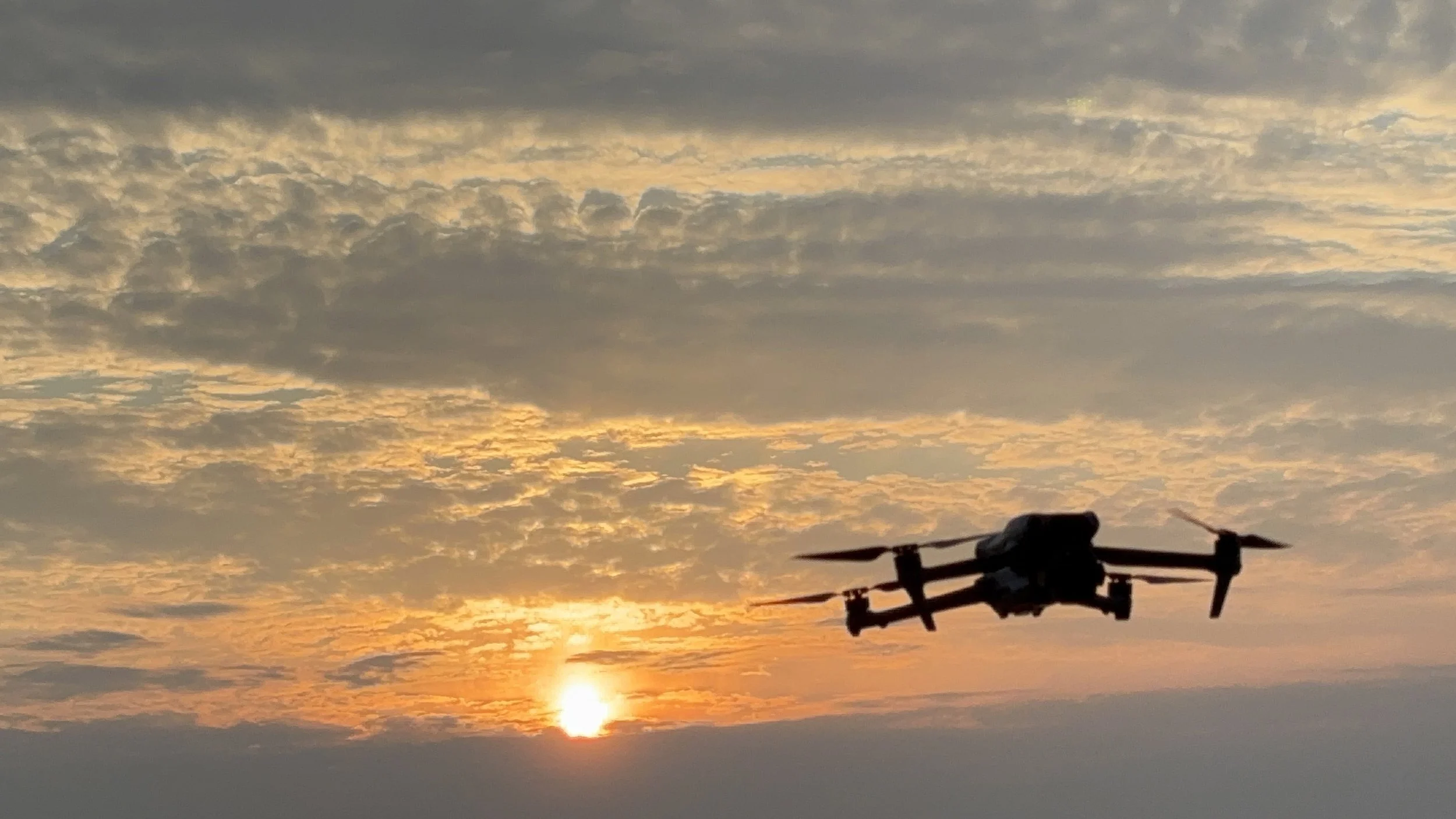
New DJI Air 3S
How long does it take to reboot a website? We’re not talking about a Mars mission here — it’s a multiple-choice test with a credit card checkout. And yet here we are, grounded, because the one portal that actually lets Canadians level up is taking a nap.
So if you see me out flying the Mini 3 again, don’t judge. It’s not because I don’t want to take the next step. It’s because Ottawa has me on drone probation until further notice.
Some people get their morning fix with coffee. Me? I just need my Air 3S in the sky. And right now, Transport Canada is holding the stash.
Related Stories
Vancouver Island From Above — James Bay Athletic Association
A personal story about history, community, and the places that stay with you.
Willows Beach — A Quiet Morning on the Edge of Victoria
A calm, reflective look at one of the Island’s most peaceful shoreline spots.
Why Vancouver Island Is Perfect for Quiet Cinematic Aerial Stories
How light, texture, and solitude shape the Island’s unique visual identity.
VicPD Joins the Drone Age in Victoria
Victoria just got a little more futuristic. The Victoria Police Department (VicPD) has officially launched its own Remotely Piloted Aircraft System (RPAS) program — in plain English, they’ve got a drone.
And honestly? We’re here for it.
Why a Police Drone?
Drones aren’t just for YouTubers chasing sunset shots or real estate agents showing off the latest listing. They’re a serious tool for:
Event safety — large crowds, parades, festivals.
Emergency response — fires, crashes, missing persons.
Situational awareness — a bird’s-eye view officers can’t always get from the street.
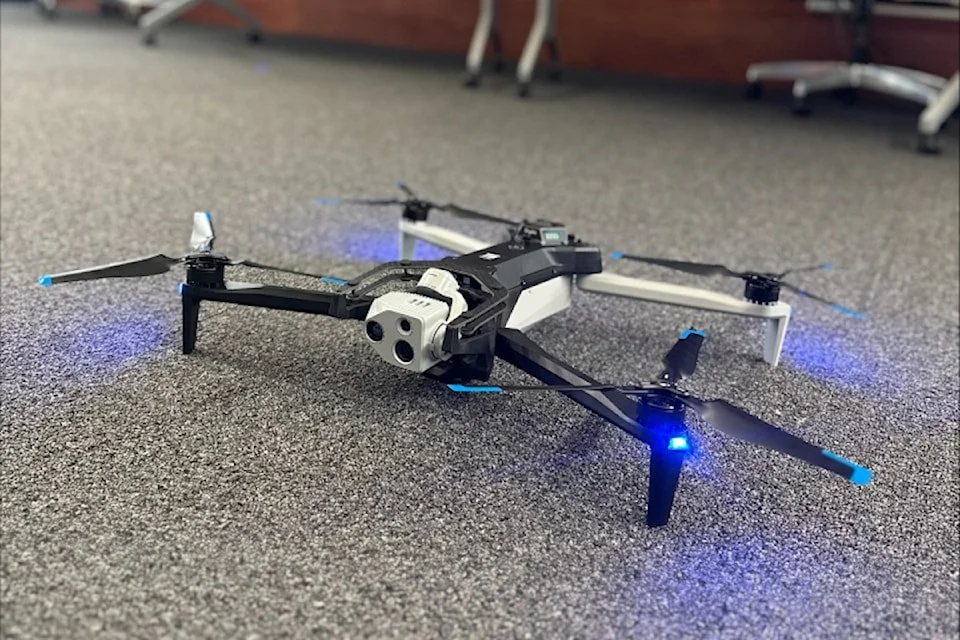
New VicPD Drone
It’s fast, flexible, and a whole lot cheaper than running a helicopter over downtown.
The Local Angle
What makes this interesting for Victoria is scale. We’re not Toronto, Vancouver, or New York — we’re a compact city with busy summer events, a vibrant downtown, and a unique geography (Inner Harbour, narrow streets, nearby hills). A drone is actually a perfect fit here.
Picture VicPD flying their RPAS over:
A packed Canada Day crowd on Belleville.
A missing hiker search near Thetis or Mt. Doug.
A traffic snarl on Douglas Street.
That’s not Big Brother — that’s a smarter, safer way to keep people moving and keep resources where they’re needed.
A Sign of the Times
The bigger story? Drones are going mainstream.
Police services across Canada are adding them.
Fire departments use them for hotspots.
Conservation officers use them for wildlife monitoring.
And now VicPD has joined the list. If you still think drones are toys, you’re officially behind the times.
Our Take
At Vancouver Island Drones, we obviously believe in the power of a good aerial view. Whether it’s a construction progress shoot, a coastal sunrise, or yes — even a VicPD safety patrol — drones give perspective you can’t get anywhere else.
VicPD’s drone is proof that this technology isn’t niche anymore. It’s here, it’s practical, and it’s becoming part of how Victoria runs day-to-day.
Not quite Robocop, but definitely a step toward a safer, smarter city.
Related Stories
Vancouver Island From Above — James Bay Athletic Association
A personal story about history, community, and the places that stay with you.
Willows Beach — A Quiet Morning on the Edge of Victoria
A calm, reflective look at one of the Island’s most peaceful shoreline spots.
Why Vancouver Island Is Perfect for Quiet Cinematic Aerial Stories
How light, texture, and solitude shape the Island’s unique visual identity.
First Light Run: Coffee, a Brand-New DJI Air 3S, and a Sunrise That Paid Off
I dragged my butt out of the house before dawn, grabbed a coffee that was hotter than I am awake at that hour, tossed the DJI Air 3S in the car, and drove across town. The plan was simple: beat the wind, beat the crowds, and see what first light would hand us. It handed us glass water and clean color.
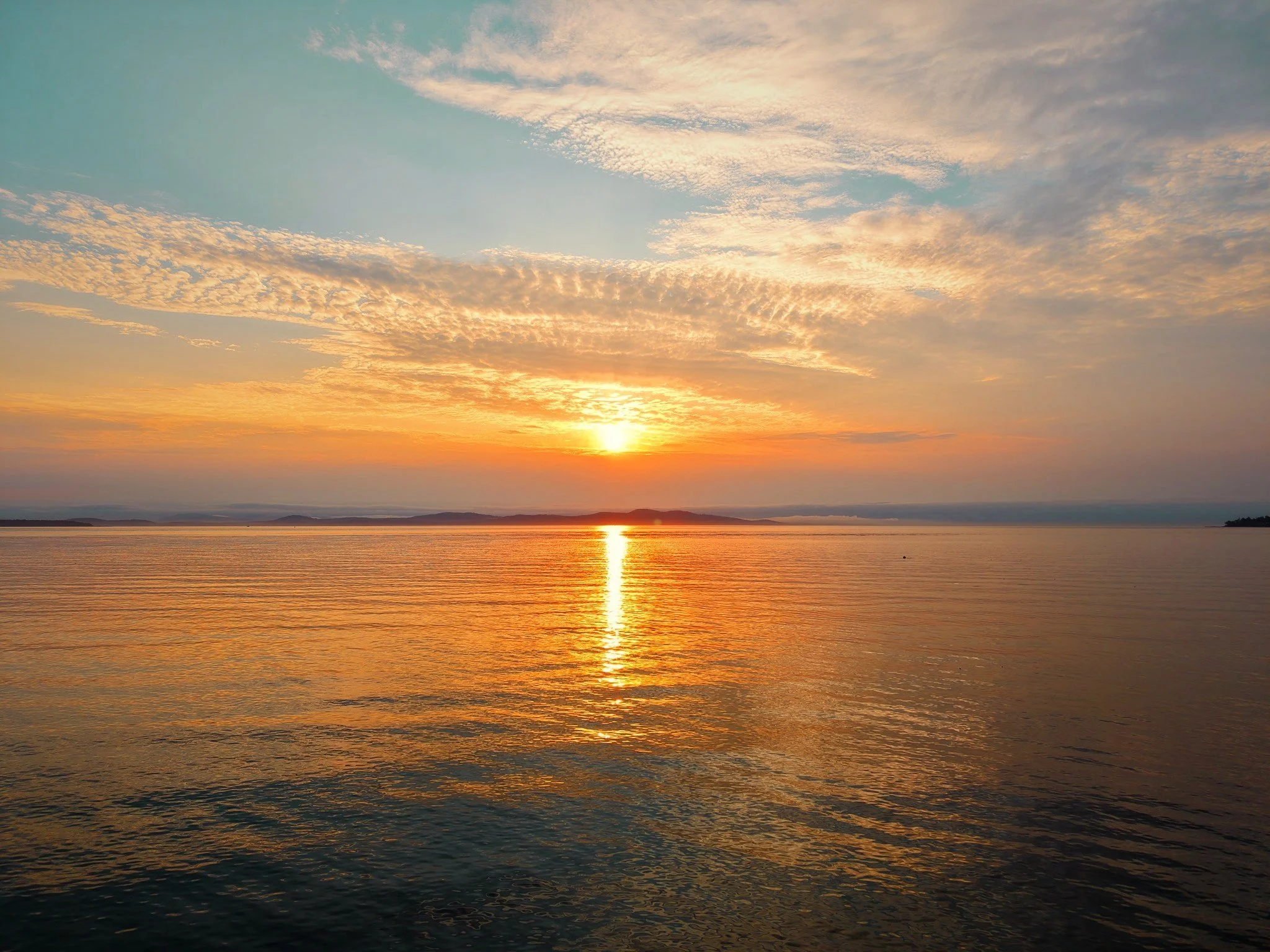

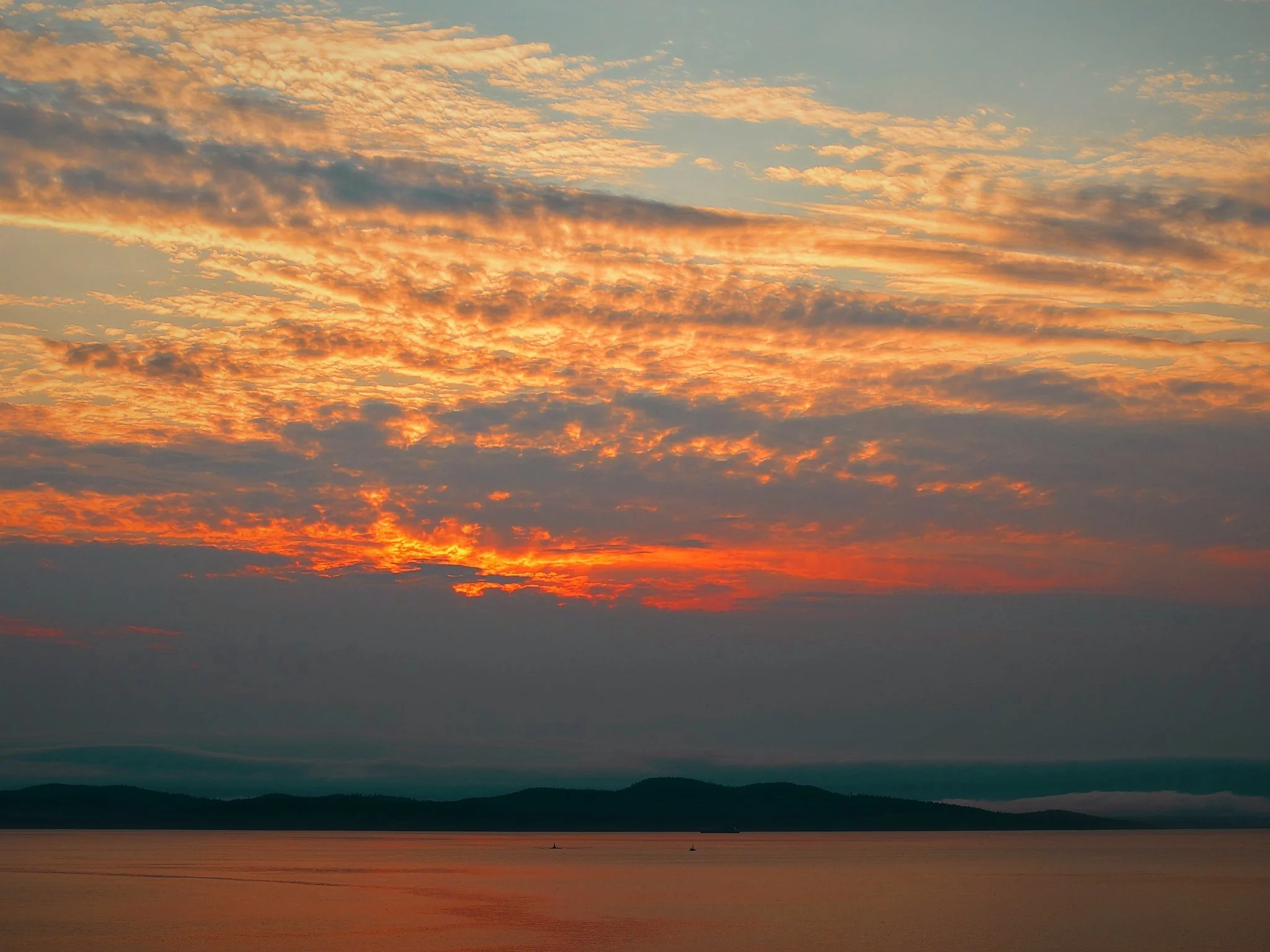
Why this spot, why this time
Cordova Bay, Saanich faces east across Haro Strait toward Washington, which means sunrise actually does something here. If the breeze hasn’t woken up yet, you get reflections and that natural teal/orange separation everyone tries to fake at noon. Fewer people, fewer boats, more keepers. That’s the whole play.
The kit (and the settings that mattered)
Drone: DJI Air 3S (brand-new, first real outing).
Reason it’s perfect for this: solid low-light, medium tele for stacking islands/cloud bands, rock-steady in coastal air.
Settings (plain English):
Exposure: protect the sky first, lift shadows later.
Shutter fast enough to tame ripples; ISO kept low; white balance fixed (no auto sneaks).
ND on if the sky ramps up; off if the light is still soft.
Nothing exotic. The trick is timing, not wizardry.
What we shot (three frames, three reasons)
Wide opener — horizon slightly off-center, long reflection path on flat water, shoreline doing the leading-line thing.
Medium stack — island silhouettes and banded cloud toward the San Juans; compressed, a little cinematic without getting silly.
After-glow — the color that hangs for a few minutes once the sun clears the low band and the beach is still quiet.
They live well as a three-image carousel or a single hero with two support frames. No gimmicks; just that 20–30 minute window when the coast cooperates.
Why we keep doing this
Sunrise shoots aren’t about suffering for art. They’re about cleaner frames with less work.
Lower wind → steadier aircraft, sharper edges.
Less human noise → no dodging dogs, joggers, or paddleboards.
Real color → less grading, more trust.
If you’re a builder, this reads as professional progress, not chaos. If you’re hospitality, this sells the place instead of shouting about it.
A quick word on how we fly
We stay within Transport Canada rules, launch away from people, and keep distance from wildlife. Cordova Bay is gorgeous at first light—no reason to annoy anyone to prove it.
The punchline
The coffee did its job, the Air 3S did its job, and sunrise did the rest. Three frames, in and out, and no wrestling with harsh midday shadows later. That’s the whole point.
Request availability: vancouverislanddrones.ca
Related Stories
Vancouver Island From Above — James Bay Athletic Association
A personal story about history, community, and the places that stay with you.
Willows Beach — A Quiet Morning on the Edge of Victoria
A calm, reflective look at one of the Island’s most peaceful shoreline spots.
Why Vancouver Island Is Perfect for Quiet Cinematic Aerial Stories
How light, texture, and solitude shape the Island’s unique visual identity.
The Gateway Drone: How the Mini 3 Hooked Me (and Will Probably Hook You Too)
Hi, my name is Ryan, and I have a problem.
Zero days since my last relapse.
It all started with one little piece of plastic — the DJI Mini 3. The gateway drone. The first beer. The slippery slope into a garage full of cases, ND filters, and a growing collection of awkward conversations with my wife.
If you’re reading this because you’re thinking, “Maybe I’ll just get a cheap little drone to try it out” — stop. Save yourself. This is your intervention. Nobody stops at one.
The First Beer: My Mini 3 Origin Story
The Mini 3 is under 250 grams, which means in Canada it slides under the licensing radar. No tests, no advanced certificate, no bureaucracy. Just charge the batteries, toss it in the air, and boom — you’re suddenly a “drone pilot.”
That’s what got me. It looked harmless. Cute, even. A little flying GoPro that fits in a jacket pocket. DJI markets it like it’s the gateway to fun family memories: beaches, road trips, backyard BBQs. And yeah, it can do all that.
But here’s the thing: once you’ve had a taste of that perspective, the hook is set.
At first I told myself, “I’ll just film a couple sunsets, maybe grab a few overhead shots of the Westshore for fun.” Then suddenly I’m waking up at stupid o’clock to film Esquimalt Lagoon at sunrise, telling myself it’s “for practice.” That’s like saying you’re just “researching” bourbon by drinking half the bottle.

Note: This post was written early in my drone journey back when the Mini 3 was my gateway into drone flying. I’ve kept it here because it’s part of the story of how Vancouver Island Drones began.
The Slippery Slope
The Mini 3 is good — but it’s also just good enough to make you crave more.
Wind picks up? Suddenly you’re watching it wobble like a drunk flamingo.
Low light? Grainy footage that screams “amateur.”
Clients? Forget it — nobody’s impressed when you pull out the “starter drone” for a paid shoot.
And that’s when you start scrolling forums, lurking on DJI rumor accounts, bingeing YouTube reviews at 2 a.m. The cycle is the same: “I don’t really need the upgrade… but man, that Air 3S dual camera setup looks sharp.”
This is how it happens. This is how you end up with a drone nickname spreadsheet and a budget spreadsheet that don’t line up.
DJI: The Friendly Neighborhood Dealer
I swear DJI has studied addiction psychology.
First, they give you the Mini series. No license required. Easy. Cheap.
Then they dangle the Air line in front of you: bigger sensors, longer flights, sexy omnidirectional obstacle sensing.
And once you’re hooked? They casually drop the Mavic 4 Pro with a Hasselblad that makes your Mini footage look like it was shot on a potato.
The Mini 3 was my first taste. The Air 3S — my latest relapse. I even gave it a nickname: Lord of the Wings. It’s sitting on my desk right now, smelling like a big credit card bill.
Do I regret it? Absolutely not. Am I in too deep? Definitely.
The Mini 3’s Place in the Story
To be clear — the Mini 3 still has a role. It’s my “backup goalie.” When the Air 3S is on the ice, the Mini 3 is riding the pine, waiting for its moment.
And honestly, it’s still a killer choice for new pilots. Portable. Legal everywhere. Great for casual shots and tight spaces. It’s the gateway drone for a reason.
But like the first beer, it’s rarely the last one.
So You’re Thinking of Buying a Drone…
Here’s my honest, unapologetic take:
If you just want to dabble: Sure, grab a Mini 3 or Mini 4 Pro. You’ll love it. Just don’t kid yourself — it won’t stop there.
If you’re eyeing bigger gigs (construction, hospitality, conservation): Skip the gateway. Go Air 3S or higher. You’ll thank yourself later when your footage actually looks pro.
If you’re telling yourself you’ll be “disciplined”: Good luck. I said the same thing. Now I run a business called Vancouver Island Drones and my YouTube channel is half therapy session, half relapse confessional.
Closing Confession
So yeah, the Mini 3 isn’t the best drone. But it’s the gateway. The first beer. And nobody stops at one.
If you’re reading this because you “just want to get into drones casually,” I’ll save you the suspense: see you in a year with a heavier backpack and a lighter wallet.
Related Stories
Vancouver Island From Above — James Bay Athletic Association
A personal story about history, community, and the places that stay with you.
Willows Beach — A Quiet Morning on the Edge of Victoria
A calm, reflective look at one of the Island’s most peaceful shoreline spots.
Why Vancouver Island Is Perfect for Quiet Cinematic Aerial Stories
How light, texture, and solitude shape the Island’s unique visual identity.
Why We Became Vancouver Island Drones
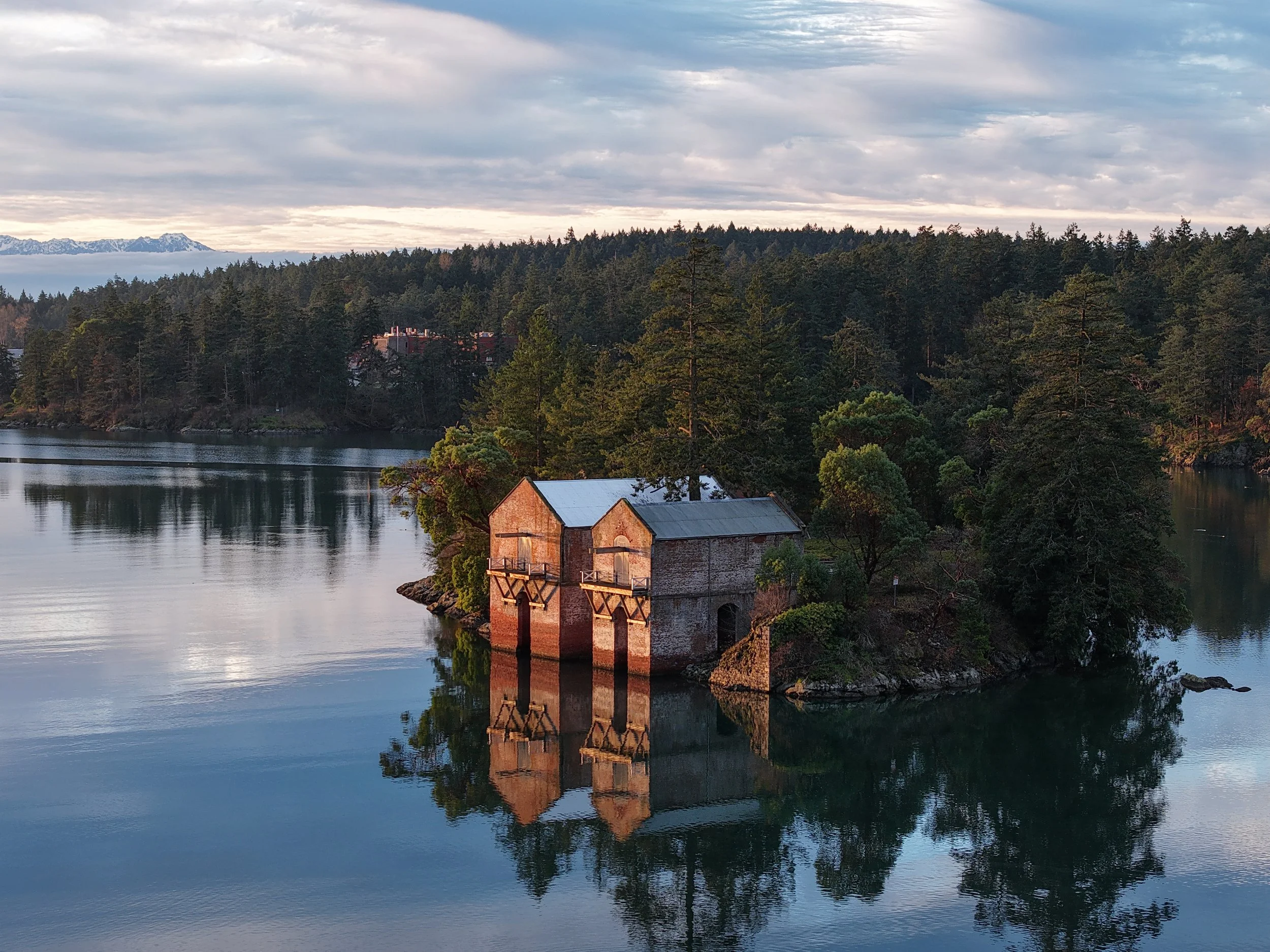
We started this whole thing as Island Drones—an impulsive domain purchase, a borrowed Saturday morning, and the idea that maybe, just maybe, we could carve out a space filming the coastlines we love.
But as we kept flying, something became obvious:
Every frame we captured—sunrise over the Lagoon, mist at Thetis, tide-out mornings in Parksville, cliffside shoots in Shirley—was unmistakably Vancouver Island. Not generic. Not exportable. Not shot in some interchangeable coastal town somewhere else.
This is home.
And the name needed to reflect that.
So now you’ll see us as Vancouver Island Drones.
Same pilot. Same early mornings. Same fingers going numb on cold flights.
Just a name that finally matches what we’ve been showing the whole time.
**What Actually Changes?
Not much—and everything.**
A clearer identity.
People seeing our work should instantly know it comes from here—these beaches, these forests, this coastline.
A stronger local focus.
Westshore and Greater Victoria remain our home base. Sunrise flights, coastal cinematics, local businesses, builders, hospitality—this is our lane.
Better alignment for the business side.
If a café, resort, builder, or contractor in Victoria is looking for aerial photos or video, they shouldn’t have to guess where we’re based.
A grounded philosophy.
No upsells. No rigid packages. No agency buzzwords.
It starts with a conversation and ends with you getting the footage that actually matters.
What We Do (and Keep Doing)
Capture the Island honestly.
Warm light, wide coastlines, quiet mornings—this is the foundation of everything we shoot.
Create aerial photos and videos that feel like the Island.
Real places. Real conditions. No plastic stock footage energy.
Help local businesses look their best.
Sunrise shots for hospitality. Clean aerials for contractors. Cinematic reels that sell the lifestyle, not the drywall.
Document the progress that matters.
Builders, renovators, trades—your work deserves more than a shaky phone pic.
Same mission. Better name.
We’re still the small Westshore-based crew getting up early, checking airspace, watching the weather roll in off the Strait, and chasing that perfect window of light.
We just finally put the right name on the footage.
Vancouver Island Drones — the Island, from above.
If you ever want to capture your space, your project, or your favourite spot in the best light we can find, you know where to find us.
Related Stories
Vancouver Island From Above — James Bay Athletic Association
A personal story about history, community, and the places that stay with you.
Willows Beach — A Quiet Morning on the Edge of Victoria
A calm, reflective look at one of the Island’s most peaceful shoreline spots.
Why Vancouver Island Is Perfect for Quiet Cinematic Aerial Stories
How light, texture, and solitude shape the Island’s unique visual identity.