The Captain’s Log
Aerial stories, father–son adventures, and life on the edge of the Pacific.
DJI’s Drone Lineup in 2026 (And Why It Feels So Weird Right Now)
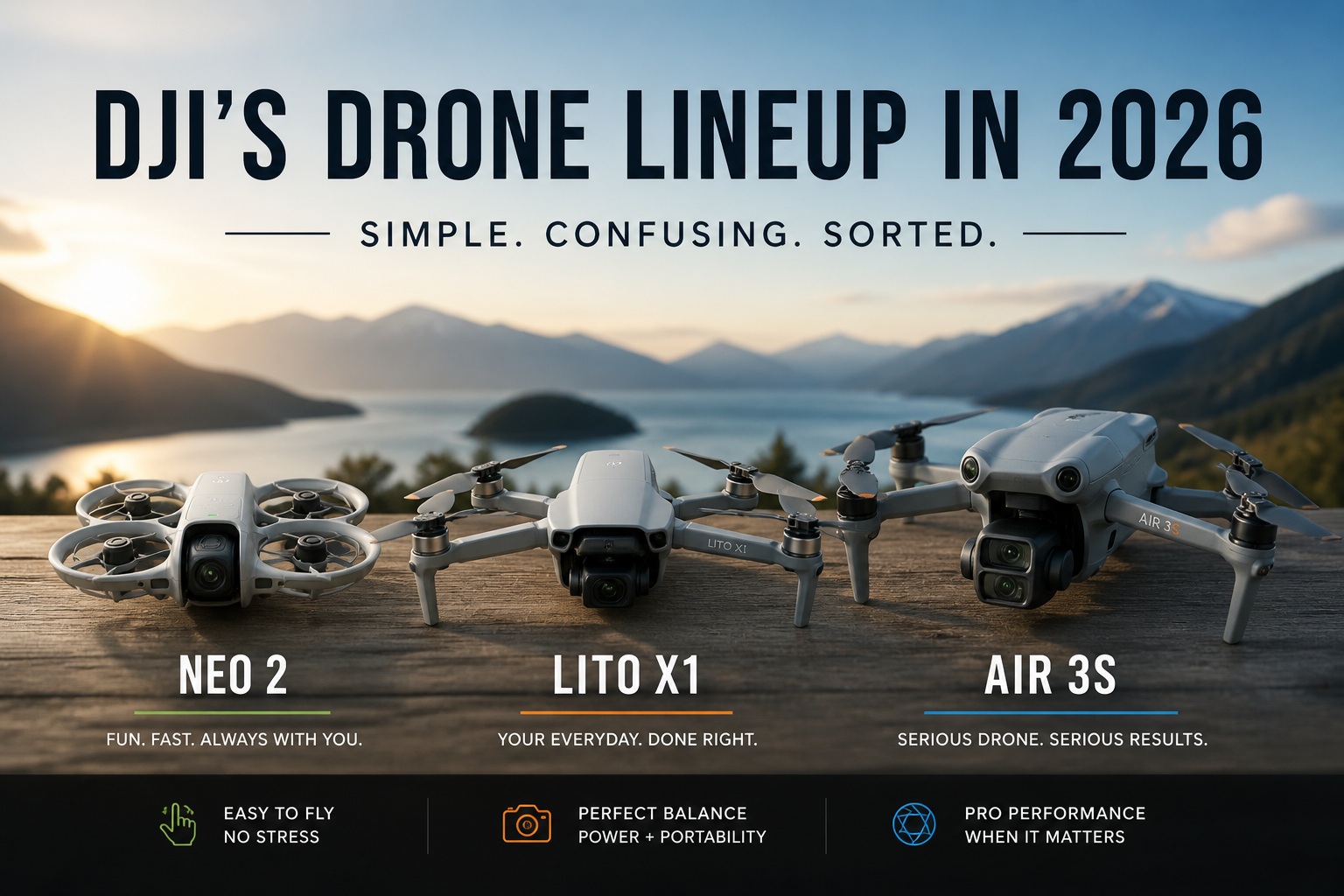
DJI’s drone lineup in 2026 is… not as straightforward as it used to be.
That’s not necessarily a bad thing. It just means you can’t look at it the way you did a couple years ago and expect it to make sense.
Because for a long time, it did.
You wanted something simple? You bought a Mini.
You wanted something better? You bought a Mini Pro.
You wanted something serious? You stepped up to the Air or Mavic line.
Done. Decision made. Go fly.
Now?
Now you’ve got the Neo 2, the Lito 1, the Lito X1, a Mini 5 Pro that may or may not still belong in the “mini” category depending on how it lands with weight, an Air 3S doing real work, and an Avata 360 off in the corner doing its own thing entirely.
So yeah… it’s a bit of a lineup shuffle.
Let’s start with the easiest one.
The Neo 2 is still the most obvious drone DJI makes. It’s not trying to be a traditional camera drone, and that’s exactly why it works. You pull it out, press a button, and it flies. No controller if you don’t want one, no waiting around, no overthinking it.
It’s the one that actually gets used.
And honestly, that matters more than specs.
Then we get into the Lito lineup, which is where things quietly changed.
Because I don’t think DJI added these drones.
I think they replaced something.
The Lito 1 feels like what the Mini 3 used to be. Entry-level “real drone,” decent camera, some smart features, and a price that doesn’t scare people off. Except now it’s got things like active tracking baked in, which wasn’t really a given at that level before.
So yeah, it’s better.
But here’s the problem — sitting right next to it is the Lito X1.
And the X1 looks like the drone most people should actually be buying. It’s under 249 grams, it’s got a proper camera, tracking, obstacle avoidance, and real flight time. It checks all the boxes most people care about, and it does it at a price that makes you stop and think.
This is the one that feels like it quietly stepped into the Mini 4 Pro’s spot.
Not perfectly. Not yet.
But close enough.
Which brings us to the Mini lineup… or what’s left of it.
The Mini 3 is basically gone, which makes sense. It had a great run, got a lot of people into drones — myself included — but it’s been replaced.
The Mini 4 Pro is still excellent. No complaints there. But if you’ve looked at DJI’s site lately, you’ll notice stock is getting thin. Fewer options, fewer bundles. That’s usually how this story ends.
It doesn’t feel like it’s being improved.
It feels like it’s being phased out.
And if the Lito X1 delivers even close to what it looks like on paper, that’s not surprising.
Then there’s the Mini 5 Pro.
And this is where things get a little… awkward.
Because if it’s not under 249 grams — especially here in Canada — then what’s the point?
The whole advantage of the Mini lineup was that it lived in that micro category. Fewer headaches, fewer restrictions, easier all around. If you lose that, you’re suddenly playing by different rules anyway.
And I’m certainly not in a position to start throwing stones about anything being overweight…
But when it comes to drones, that extra weight actually matters.
At that point, you might as well step up to something like the Air 3S and get the full capability.
Speaking of which, the Air 3S is exactly what you think it is.
This is where things get serious. Dual cameras, better image quality, more flexibility — and yes, Advanced certificate territory in Canada. This isn’t your “just in case I bring it” drone. This is the one you bring when you actually need to get something done.
And then there’s the Avata 360.
Which, to be fair, is doing something completely different.
This isn’t really competing with the Neo, the Lito, or even the Air series. It’s an FPV drone, but now it’s also pushing into that 360-style capture space. You’re not just flying a shot — you’re giving yourself more flexibility in how you use it afterward.
Looks like 360 sometimes. Definitely isn’t.
It’s cool. Probably very cool.
But it’s not what most people are looking for when they’re trying to figure out their first drone, or even their main drone. This is more of a creative tool than a “what should I buy?” answer.
So if you zoom out for a second, the lineup actually looks a lot cleaner than it first appears.
The Neo 2 is your “fun, low effort, always with you” drone.
The Lito X1 is your “this is my actual drone” drone.
The Lito 1 is there if you’re trying to hit a lower price point, but I’d personally stretch if I could.
The Mini 4 Pro is still great, but it feels like it’s on its way out.
The Mini 5 Pro sits in a weird middle ground depending on how it lands in Canada.
The Air 3S is your serious, get-it-done option.
And the Avata 360 is off doing creative FPV things for people who know they want that.
So yeah, DJI’s lineup in 2026 looks confusing at first.
But once you realize they didn’t just add more drones — they moved everything around — it starts to make a lot more sense.
They didn’t break the system.
They just reshuffled it.
Related Reads
DJI Lito X1 vs Mini 4 Pro: This Changes What Drone I Recommend in Canada
A closer look at how the Lito X1 stacks up against the Mini 4 Pro — and why it might be the better buy for most people now.
DJI Neo 2 After One Month — Insane Value, Easy to Use, and Surprisingly Tough
Real-world use, bumps included, and why the Neo 2 ends up coming everywhere with us whether we plan for it or not.
Best Drone to Buy in Canada (2026): The Honest Answer No One Gives You
Why Canadian drone rules matter more than specs — and how that actually changes what you should be buying.
DJI Lito X1 vs Mini 4 Pro: This Changes What Drone I Recommend in Canada
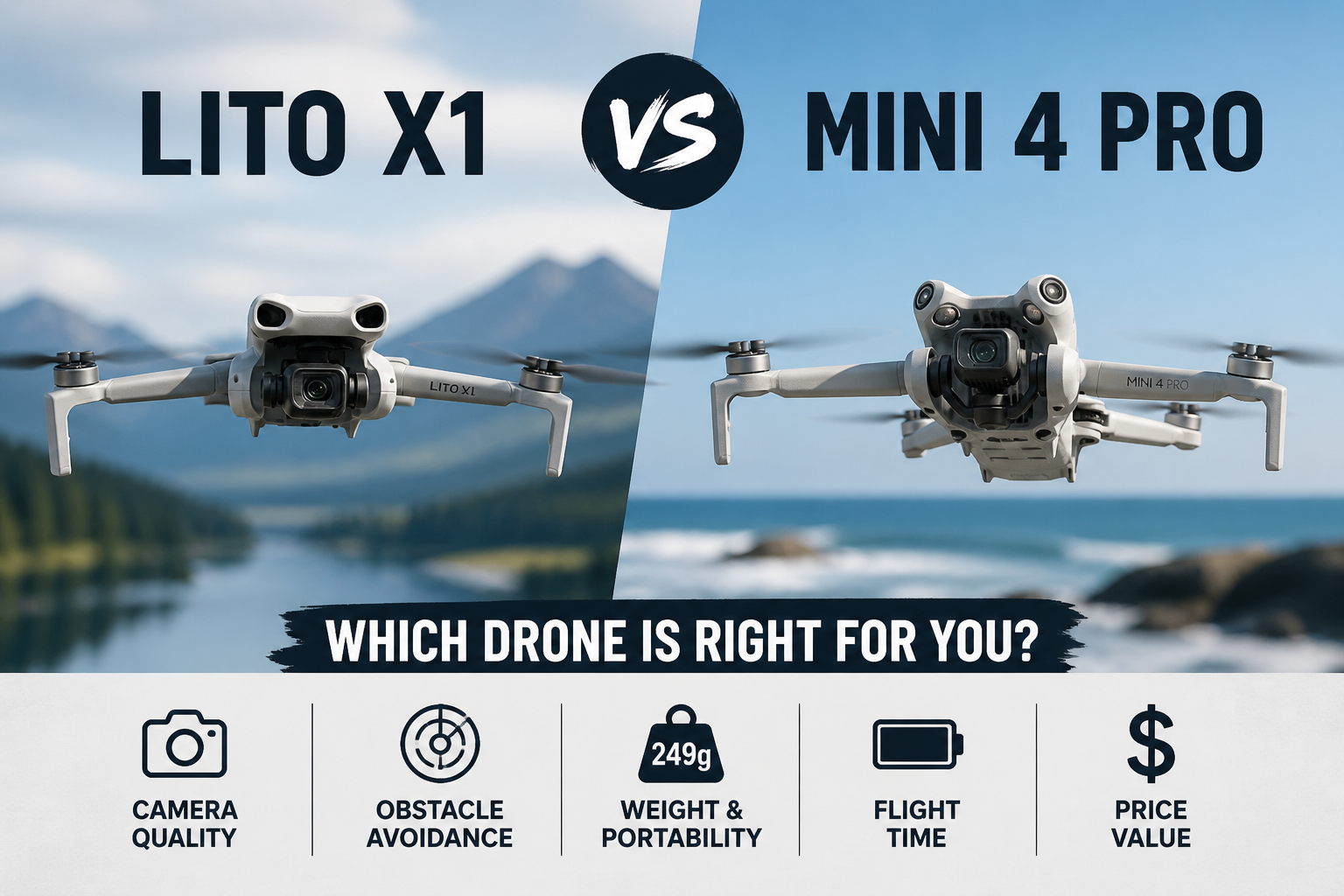
DJI’s lineup is getting… confusing.
And honestly, I think they did it to themselves.
For a while, it was simple. If you wanted something fun, you grabbed a Neo 2. If you wanted something serious but still under that 249g limit, you went Mini 4 Pro. And if you needed something that could actually do real work, you stepped up into the Air series.
That made sense.
Now we’ve got the Lito 1, the Lito X1, a Mini 5 Pro that doesn’t really behave like a micro drone anymore, and a bunch of overlap that didn’t used to exist. So instead of trying to decode DJI’s naming strategy, here’s what I’d actually tell someone if they asked me what to buy right now.
The Neo 2 is still the easiest recommendation on the board. It’s fun, it’s cheap, it’s tough, and more importantly, it actually gets used. There’s no setup, no waiting around — you pull it out, press a button, and you’re flying. If you’ve got kids, or you just want something you’ll actually bring with you instead of leaving it at home, this is still the move.
Then there’s the Lito X1, and this is where things get interesting.
Because on paper, it looks a lot like what the Mini 4 Pro was supposed to be. It’s under 249 grams, it’s got a solid camera, active tracking, obstacle avoidance, and real flight time. And it comes in cheaper. So unless I’m missing something — and I’ll leave that door open because this thing is new — it feels like the Lito X1 just stepped directly into the Mini 4 Pro’s spot.
Not perfectly. Not yet.
But close enough that for most people, it’s going to be hard to justify spending more.
And then there’s the Air 3S, which doesn’t really change anything. This is still where you go when you actually need to get something done. Dual cameras, better image quality, more flexibility, and yeah — the Advanced license requirement here in Canada. Different category entirely.
Where it gets messy is everything in between.
The Lito 1… I don’t really get it. Maybe it exists to hit a lower price point, maybe it’s there as a stepping stone, but if you’re already looking at this level of drone, I’d seriously consider scraping together the extra money for the X1. That’s the one that actually competes.
The Mini 3 will always have a bit of a soft spot for me. It was my first drone — or as I like to call it, my gateway drug… or my first beer. And like both of those things, it led to more. But at this point, it’s been replaced. There are just better options now.
The Mini 4 Pro is the interesting one. I don’t think it’s bad — far from it. It’s just in a weird spot now. If the Lito X1 delivers even 90% of what it does for less money, it stops being the obvious choice. It’s still the safer bet. Still the proven one. But not the no-brainer it used to be.
And then there’s the Mini 5 Pro, which still doesn’t make a lot of sense to me. If it’s not under 249 grams — especially in Canada — then what’s the point? You’re dealing with more restrictions anyway. And I’m certainly not in a position to start pointing fingers about anything being overweight… but when it comes to drones, that extra weight actually matters. At that point, you might as well step up to something like the Air 3S and get the full capability.
So if you don’t feel like overthinking it, here’s the simple version.
If you want something fun, get the Neo 2. If you want a capable all-around drone, the Lito X1 is probably the new move. And if you want something professional, you’re still looking at the Air 3S.
DJI didn’t just release a new drone here. They blurred their own lineup.
And honestly?
That’s probably good for buyers.
Because if the Lito X1 delivers the way it looks like it might, it forces everything else to justify itself again.
And honestly, that’s probably good for buyers.
This is also one of those articles where the current pricing matters more than the spec sheet. DJI’s lineup only really makes sense once you see the price gaps between these drones.
If you want the fun, easy, no-fuss option, check the latest DJI Neo 2 pricing on DJI’s website.
If you want the drone that probably makes the most sense for most people right now, check the latest DJI Lito X1 pricing on DJI’s website.
And if you’re stepping up into something more serious for better cameras, wind confidence, and real paid work, check the latest DJI Air 3S pricing on DJI’s website.
Because the best drone here isn’t necessarily the most expensive one.
It’s the one you’ll actually use.
Related Reads
Hiring a Drone Pilot in Victoria, BC — What It Costs and What You Get
Straightforward pricing, what’s included, and what the process looks like if you need aerial photos, video, inspections, or a better look at something from above.
DJI Air 3S vs Mini 5 Pro in Canada: When Bigger Still Makes Sense
The Mini 5 Pro is seriously capable, but if it’s not comfortably a micro drone in Canada, the Air 3S starts looking a lot more interesting — especially with dual cameras, bigger battery life, and real confidence in coastal wind.
DJI Neo 2 Review: The Best First Drone for Kids, Creators, and Wannabe Jedi
A tiny follow-me drone with palm launch, gesture control, prop guards, and just enough weird DJI wizardry to make you feel like you’re using the Force. Great for kids, creators, hikers, bikers, and anyone who wants a drone they’ll actually use.
Brought a Drone to My 5-Year-Old’s Rugby Practice — Now It’s Expected
There are a few things you expect to see at kids’ rugby practice.
Cleats, water bottles, a bunch of kids half-listening while the coach is trying to get them organized.
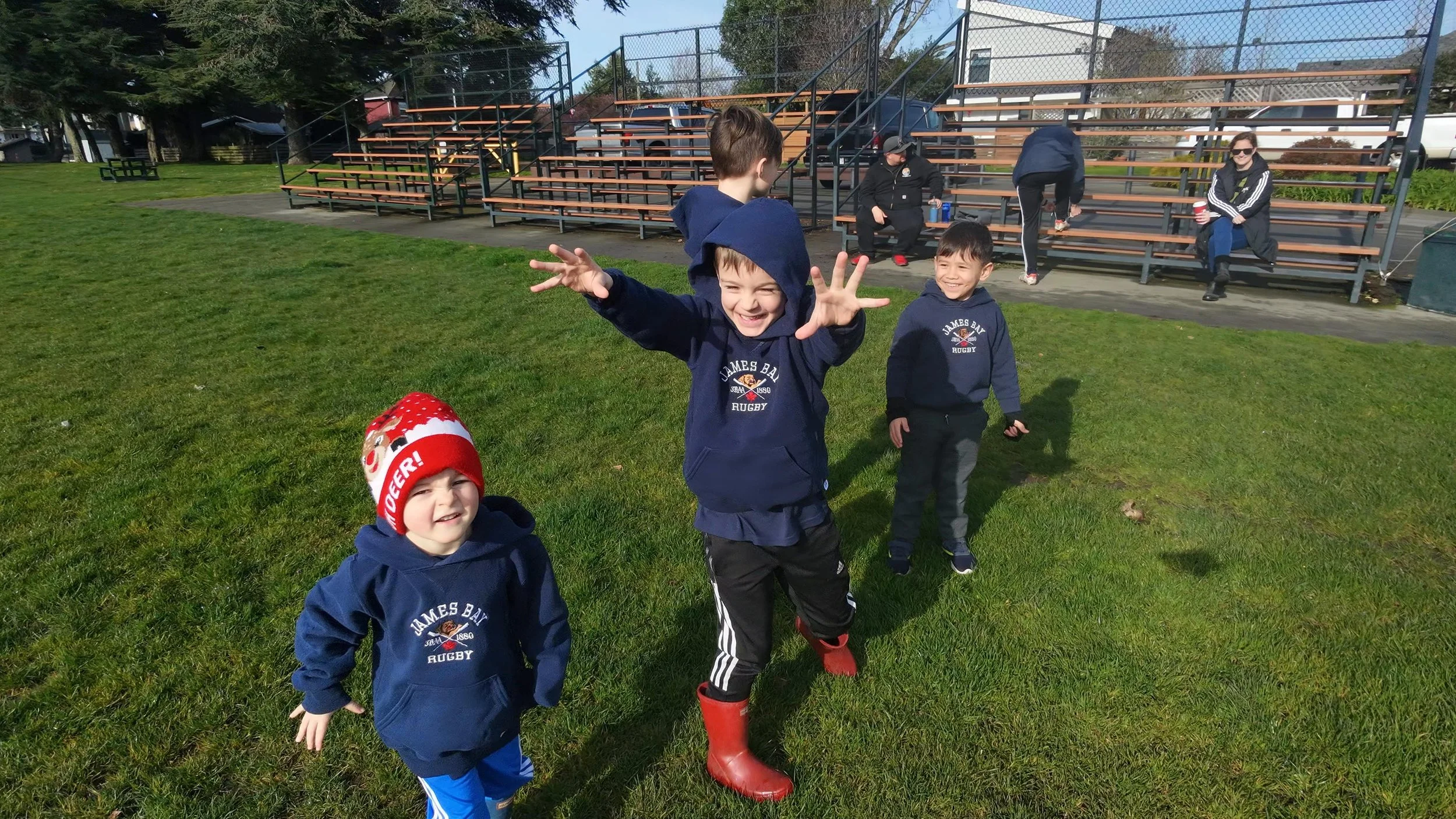
What I didn’t expect the first time I brought the drone was a full-on pack of kids chasing it like it was the last ice cream truck on earth.
That part caught me off guard.
It started pretty simply. Blake brought the Neo 2 out and showed a couple of the kids how it works. Gesture controls, taking off from your hand, the basics.
That lasted maybe five minutes.
Then the coach’s kids got involved, then a couple more wandered over, then suddenly I’ve got a lineup of kids asking if they can try it, and I’m standing there thinking, “Alright… this escalated quickly.”
Now it’s just part of the routine.
We show up and I’ll get asked almost immediately:
“Did you bring the drone?”
And once it’s out, that’s it. Practice is still happening, technically, but there’s also a group of kids sprinting around trying to outrun it, wave at it, or convince it to follow them instead.
It turns into this weird mix of rugby practice and… I don’t even know… drone-based cardio.
The funny part is the drone is doing exactly what it’s supposed to do — tracking, following, keeping someone in frame — but I’m in the background messing with it on my phone.
Switching it from follow-behind to follow-in-front, changing the distance, adjusting the angle.
So from their perspective, it kind of looks like the drone has a mind of its own.
In reality, I’m just quietly stirring the pot.
Every kid wants to land it.
Every single one.
And honestly, that’s one of the best parts of the whole thing. Normally you’d be a bit hesitant handing a drone to a bunch of kids, but the Neo 2 is small, it’s got prop guards, and it can take a bump without turning into an expensive mistake.
So instead of constantly saying “don’t touch that,” it turns into “alright, let’s see what you’ve got.”
Some of those landings are… not textbook.
But they figure it out.
At one point I looked over at a couple of parents and said, “Is this a weird way to wear out my kid?”
Because I’ve got a couple spare batteries, and if I run through all of them, these kids will just keep going. Running, chasing, laughing the whole time.
And honestly, the best way I can describe it is this:
It’s basically the modern-day version of throwing a stick for a dog at the park.
Except instead of one dog, it’s a full pack of kids, all convinced the drone is following them specifically.
No one’s bored. No one’s asking for a screen. They’re just running around chasing a flying camera like it owes them money.
The reason it works is because there’s almost no friction to using it.
You don’t need to pull out a controller, wait for satellites, deal with menus, or kill the moment trying to get everything set up.
You pull it out, press a button, and it’s flying.
That’s the difference.
That’s why it actually gets used.
Now, it’s not perfect.
If there’s a bit of wind, you’ll see it working to compensate. And the collision avoidance is… let’s call it optimistic. You still need to pay attention.
This is not a “set it and forget it” situation.
It’s more like controlled chaos.
The unexpected bonus is the footage.
It’s not cinematic, it’s not perfect, but it’s real. Kids laughing, running, trying to outrun something that is very clearly faster than they are.
It’s the kind of stuff you actually want to keep.
At the end of the day, this thing has turned into something I didn’t plan on at all.
It’s part of rugby practice now. Kids are learning how it works, parents are asking questions, and everyone ends up a little more tired than they expected.
For something that costs what it does, and takes zero effort to get in the air, it’s kind of ridiculous how good it is at what it does.
There are better drones. Bigger drones. More capable drones.
But none of them come out this easily, get used this often, or turn into this much fun this quickly.
And none of them turn a rugby practice into a pack of kids chasing a flying camera across a field.
Related Reads
DJI Neo 2 After One Month — Insane Value, Easy to Use, and Surprisingly Tough
A real-world look at how the Neo 2 actually holds up after a month of constant use — bumps, bike rides, and all.
Can the DJI Neo 2 Keep Up With a Four-Year-Old?
What happens when you let a kid set the pace — and whether the Neo 2 can actually keep up with the chaos.
Teaching Kids to Fly a Drone (Safe, Simple, and Actually Fun)
A practical, no-BS approach to getting kids started with drones without turning it into a stressful experience.
Best Drone to Buy in Canada (2026): The Honest Answer No One Gives You
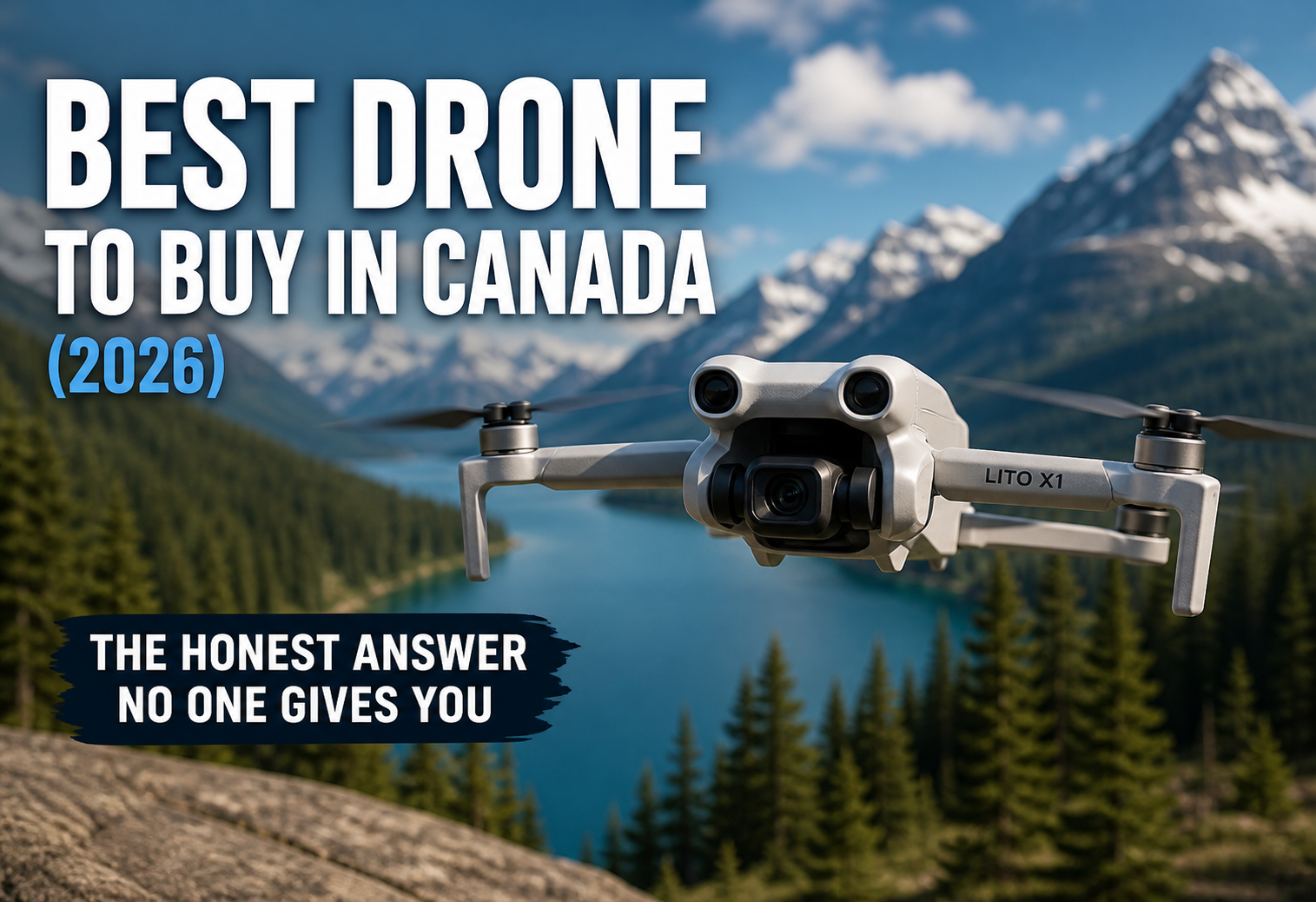
Everyone asks the same question:
What’s the best drone to buy in Canada right now?
And honestly, most of the answers out there aren’t that helpful.
Because they all focus on specs.
Camera this. Sensors that. Flight time. Range.
But in Canada, that’s not actually the decision that matters.
The real question is:
Do you want to deal with drone regulations, or not?
Because that one choice completely changes what the “best” drone actually is.
The Only Decision That Actually Matters in Canada
You can break this down really simply:
Micro drones (under 250g) mean way less hassle.
Everything else means more capability, but more rules.
That’s it.
That’s the fork in the road nobody explains properly.
If you want to keep things simple — early morning flights, staying low-key, not overthinking every takeoff — micro drones exist for a reason.
But here’s where things just changed.
The New Micro Drone Reality
For a long time, this was easy.
Buy a Mini.
Done.
Now?
DJI’s quietly reshuffled everything.
And the answer isn’t as obvious as it used to be.
Best Micro Drone (Keep It Simple)
DJI Lito X1 (The New Default)
This is the one that makes the most sense right now.
It’s under 249g, it’s got the features people actually want, and it’s priced in a way that makes you stop and think.
You’re getting:
a proper camera
active tracking
obstacle avoidance
real flight time
And you’re still staying in that low-hassle category.
If you’re buying your first “real” drone in 2026, this is probably where you land.
DJI Neo 2 (The One Nobody Talks About Enough)
This one is a bit of a wildcard.
But honestly, for a lot of people, this makes more sense than anything else.
Especially if you’ve got kids, or you just want something fun and easy.
It’s:
super easy to use
durable and forgiving
quick to get in the air
actually fun
This is the kind of drone you actually use, not just baby.
And that matters more than people think.
DJI Mini 4 Pro (If You Can Still Find One)
Still a great drone.
Still one of the best all-around micro drones ever made.
But it’s getting harder to find, and it doesn’t feel like DJI’s focus anymore.
If you can find one at a good price, it’s still a safe bet.
It’s just not the obvious choice anymore.
The Mini 5 Pro Problem
On paper, the Mini 5 Pro is awesome.
Better camera. Better sensors. More features.
But if it’s not firmly in that micro drone category…
what’s the point?
The whole appeal of the Mini lineup was:
simple ownership
fewer restrictions
just get out and fly
If you lose that, you end up in a weird middle ground where:
you’re dealing with more rules
but not getting the full benefit of stepping up
And at that point, the question becomes:
Why not just go bigger?
If You’re Willing to Get Licensed, Do It Properly
If you’re already thinking:
“I don’t mind getting my Advanced license”
Then don’t mess around in the middle.
Go straight to something that makes it worth it.
DJI Air 3S
This is where things start to make sense again.
dual lenses
better image quality
more stable in real conditions
feels like a real tool
If you’re playing by the rules anyway, you might as well get something that delivers.
DJI Mini 3
This is your first beer.
You’re not stopping at one.
It’s:
affordable
easy to fly
gets you hooked
And once you start using it regularly, you’ll probably upgrade.
That’s just how it goes.
So What Would I Actually Buy?
Simple.
Want zero hassle → Lito X1
Want fun and easy flying → Neo 2
Want a serious camera drone → Air 3S
Just getting started (budget) → Mini 3
Mini 4 Pro → still great if you find one
Mini 5 Pro → still a bit of a weird fit in Canada
Final Thought
The best drone isn’t about specs.
It’s about:
how often you’ll actually use it
how much friction is involved
whether it fits your life
Because the best drone is the one you actually take out of the bag.
Not the one that looks best on paper.
Related Blog Posts
DJI’s Drone Lineup in 2026 (And Why It Feels So Weird Right Now)
A breakdown of how DJI reshuffled everything — and why the Lito lineup changes the way you should think about buying a drone.
DJI Neo 2 After One Month — Insane Value, Easy to Use, and Surprisingly Tough
Real-world use, bumps included, and why the Neo 2 ends up coming everywhere with us whether we plan for it or not.
DJI Lito X1 vs Mini 4 Pro: This Changes What Drone I Recommend in Canada
A closer look at how the Lito X1 stacks up against the Mini 4 Pro — and why it might be the better buy for most people now.
Why I’ll Never Get Tired of Sunrise at Esquimalt Lagoon
It had been a while since I’d done one of my favourite Vancouver Island morning rituals.
Life’s been busy, work’s been busy, and if I’m being honest, I’d been spending a little too much time doing responsible adult things and not nearly enough time doing grab a coffee and drive to the ocean before sunrise things.
So last weekend, I fixed that.
Coffee in hand, still half asleep, I pointed the truck toward Esquimalt Lagoon while most sane people were still warm in bed making good life choices.
I, on the other hand, was chasing sunrise with a drone in the back seat like the sleep-deprived coastal goblin I apparently am.
And wow… what a payoff.
The kind of payoff that makes you laugh a little because it almost feels rude how beautiful this place can be.
The water was glassy, the sky started flexing before the sun even cleared the horizon, and Fisgard Lighthouse was sitting there in the middle of it all looking like it knew exactly how photogenic it was.
Some places just have that effect.
Esquimalt Lagoon is one of them.
Every time I go out there, it gives me something different. Some mornings it’s moody and dramatic, some mornings it’s all soft pastel calm, and sometimes it just decides to absolutely show off like it did last weekend.
This was one of those “okay fine, I guess I live in one of the most beautiful places on earth” mornings.
And honestly, I needed that reminder.
No rushing.
No forcing content.
No “I should probably be editing something.”
Just coffee, calm water, ridiculous skies, and a peaceful sunrise that made all the responsible-adult excuses from the last few weeks feel pretty silly.
The stills turned out beautifully, and I’ve got some really nice video from the morning still to come, which I’m pretty excited about.
But even beyond the footage, it was just good for the soul.
That’s the part I think gets lost sometimes when we turn hobbies into businesses or “content.”
Sometimes the whole point is just:
get out there
breathe the salt air
watch the Island wake up
remind yourself how lucky we are to call this place home
And if you happen to come back with gorgeous aerials, well, that’s a pretty nice bonus.
This is exactly why I still love doing this.
Not because every sunrise needs to become a Reel or a YouTube video.
But because every once in a while, Vancouver Island gives you one of those mornings that makes you stop, laugh, and think:
yeah… this place is ridiculous.
And thankfully, we get to live here.
Related Articles
DJI Neo 2 Real-World Use with Kids | Hands-Free Drone Filming in Everyday Settings
A parent’s real-world look at using the Neo 2 with a four-year-old — gesture control, ActiveTrack, and everyday family moments without the hype.
Flying a Drone in Victoria, BC | Local Rules, Airspace, and Practical Tips
A practical guide to navigating Victoria’s complex airspace, timing your flights, and flying respectfully in Greater Victoria.
Why Victoria Construction Companies Use Drone Photography
How local construction teams use aerial imagery for safer site visibility, progress tracking, and clearer documentation across active projects.
Why Parksville Beach Never Gets Old From the Air
Parksville is one of those places on Vancouver Island that somehow looks unreal no matter how many times you go back.
We head up there a few times a year as a family, and every single trip I end up doing the exact same thing: wake up stupid early, grab a coffee, sneak down to the beach, and send the drone up while most sane people are still in bed.
Honestly, it’s one of my favourite ways to start a day.
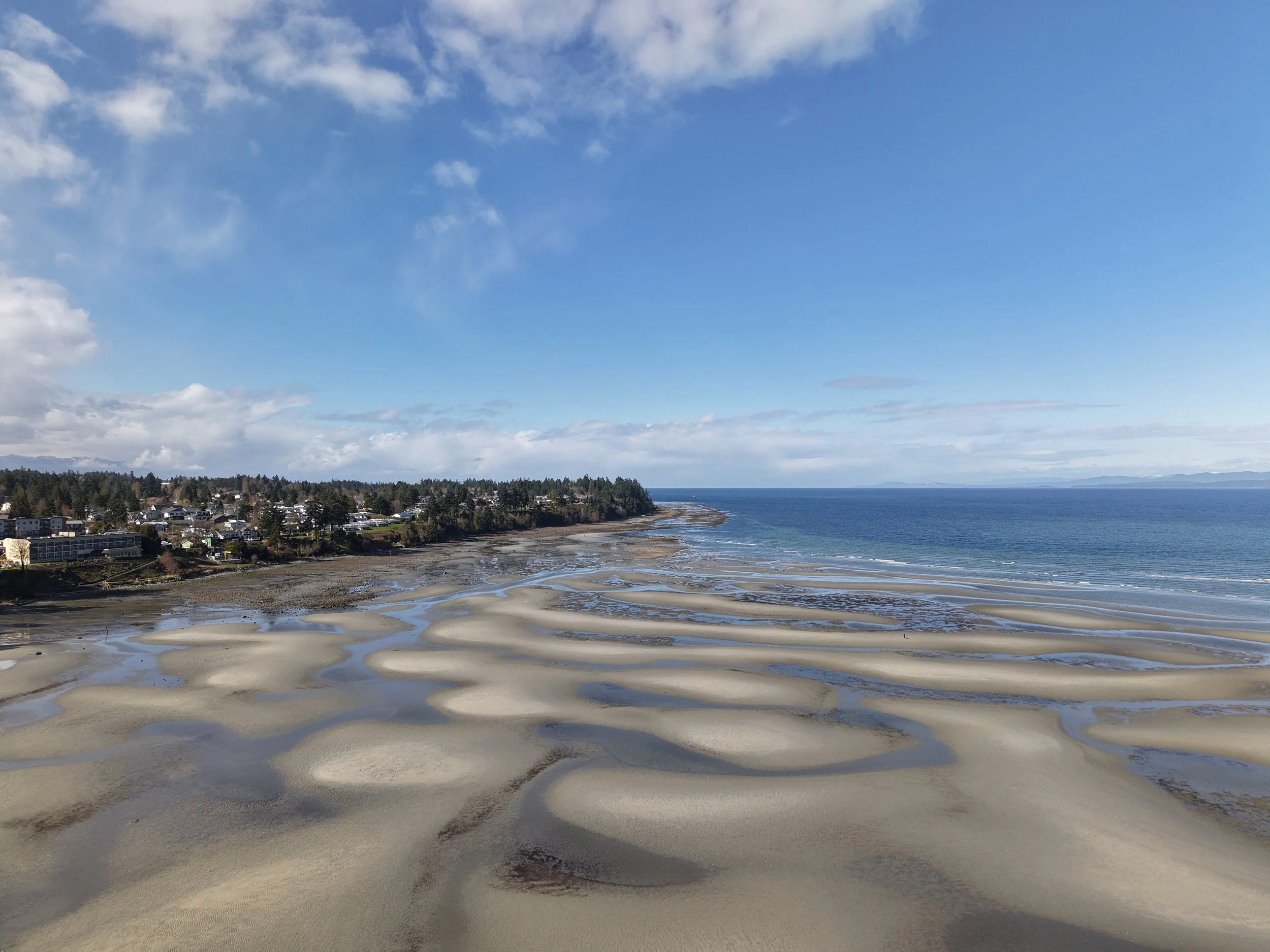
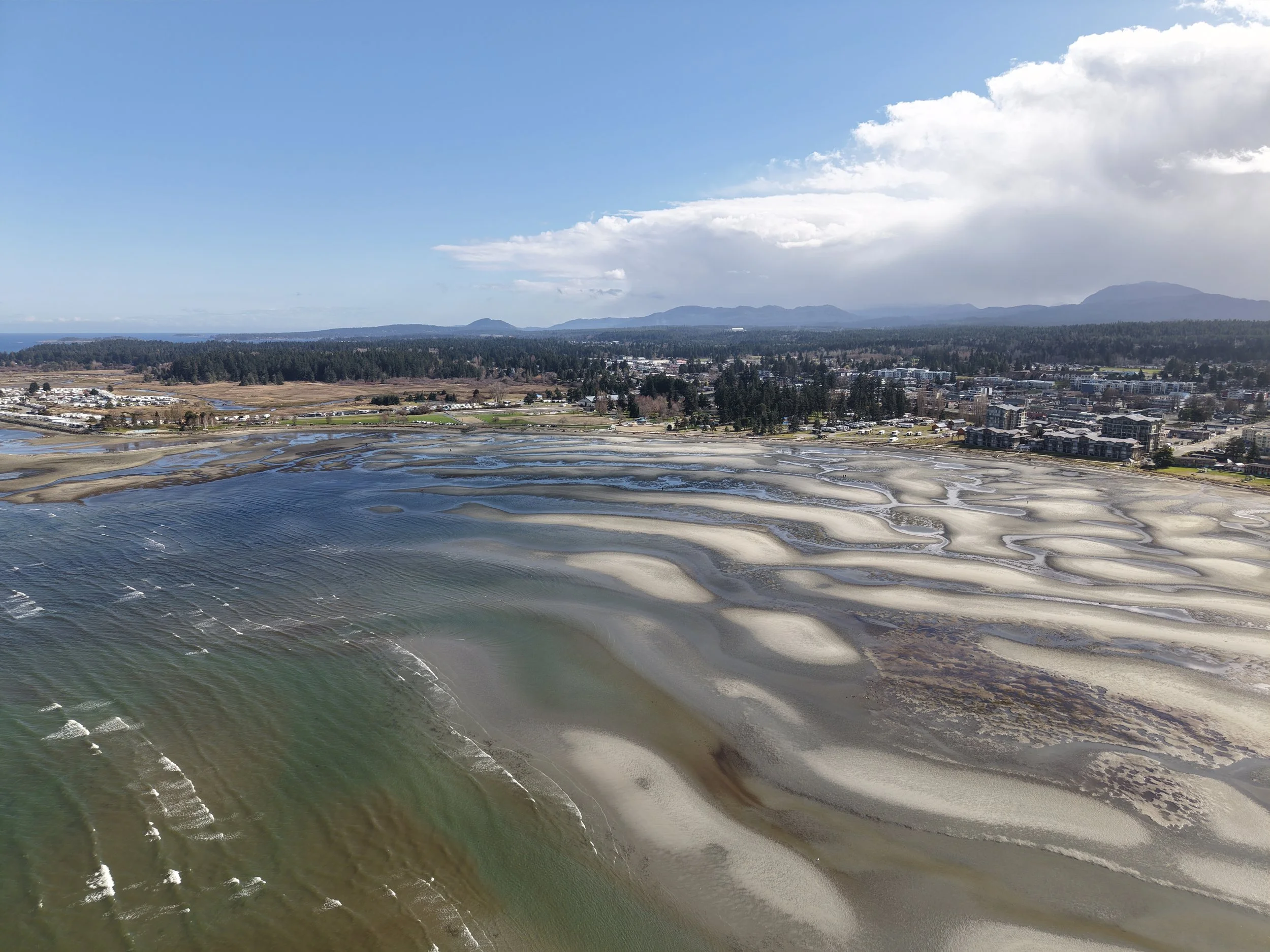
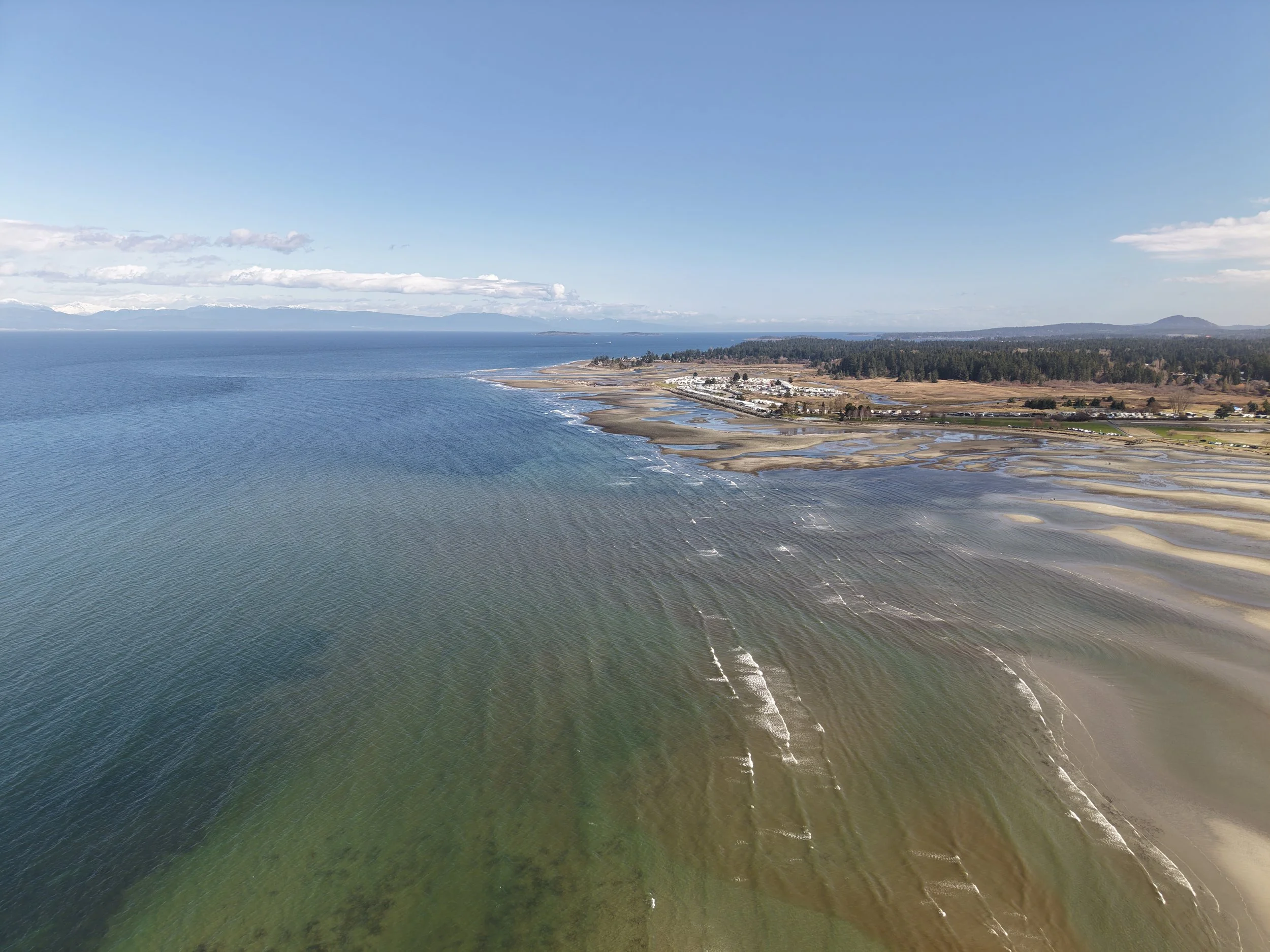
From the air, Parksville at low tide is just ridiculous. The beach turns into this giant maze of winding channels, smooth sandbars, and patterns that look like nature got bored and decided to show off a little.
It’s one of those places where the footage almost feels unfair because the location is doing half the work for you.
That said, Parksville isn’t one of those spots where you just roll up and go full send without thinking.
The airspace around there can be a little spicy thanks to Qualicum Beach Airport, so this is always a check NAV CANADA / NAV Drone first kind of flight for me.
Even if you’re flying a micro drone, I’ve never really subscribed to the idea that micro drone means micro responsibility.
No need to be the hall monitor of drone regulations, but at least know where you are, what’s nearby, and whether you’re about to accidentally become the main character in an airport incident.
The other part of it for me is just common courtesy.
I like to fly when the beach is quiet, mostly because it’s easier to get clean shots, but also because I genuinely don’t want to be that guy.
Nobody drove to Parksville for a peaceful beach morning just to listen to some dude’s drone buzzing overhead while they’re trying to enjoy their coffee and tide pools.
So I go with what I’d describe as a ninja assassin approach:
get in, get the shots, get out.
Although if we’re being honest, in my case it’s less ninja assassin and more Kung Fu Panda with a drone controller and a large coffee.
The nice thing about the DJI Air 3S is once it’s up a little ways, it’s quiet enough that it more or less disappears into the background. And even though I’ve usually got three batteries with me, I almost never burn through one full pack.
A few good passes over the sandbars, a nice coastal reveal, maybe a couple stills that make the place look as magical as it actually is, and that’s usually enough.
That’s kind of the beauty of Parksville.
You don’t need to force it. You don’t need a complicated shot list. The place is already spectacular.
For me, it’s less about “creating content” and more about documenting another beautiful Vancouver Island morning in a place my family keeps coming back to.
Coffee.
Quiet beach.
Low tide patterns.
A quick ninja mission.
Hard to beat that.
Related Reads
DJI Lito X1 vs Mini 4 Pro: This Changes What Drone I Recommend in Canada
A real-world look at how close the Lito X1 gets to the Mini 4 Pro — and why price and practicality might make it the easier recommendation for most people right now.
DJI Neo 2 After 3 Months — Still Worth It?
What happens after the novelty wears off. Real use, real bumps, and why this thing still comes everywhere with us without even thinking about it.
Teaching Kids to Fly a Drone (What Actually Works)
The basics that matter — where to start, what to avoid, and how to keep it fun without doing anything stupid, especially here in Canada.
Teaching Kids to Fly Drones: Fun First, Safety Always
There’s no shortage of drone tutorials online.
Advanced certifications. Flight breakdowns. Endless gear reviews.
But teaching a four-year-old to fly?
That’s a completely different conversation.
When I take Blake out with a drone — whether it’s the Air 3S for a quiet sunrise shoot or the DJI Neo 2 tucked into my jacket pocket — the goal isn’t to turn him into a pilot.
Not yet.
The goal is simple.
Have fun.
Be safe.
Build good habits early.
That balance is everything.
Even a micro drone deserves respect. And if we want this hobby to stay welcome and respected in Canada, that foundation starts early.
Here’s how I approach teaching my four-year-old — in a way that keeps the joy alive while quietly building responsibility underneath it.
The Air 3S Is Dad’s Drone. The Neo 2 Is His.
Let’s be clear about something.
Blake does not fly the Air 3S.
The controller is still too big for his hands. When he’s “landed” it, I’ve already initiated Return to Home. He holds the controller while it descends, and he watches it touch down.
It makes him feel involved.
But the real flying?
That happens on the Neo 2.
And that’s intentional.
The Neo 2 fits his stage. No bulky controller. No satellite waiting. No complex menus. We can pull it out of a pocket, power it up, and be airborne in seconds.
Palm takeoff.
Gesture control.
ActiveTrack.
It feels like magic to a kid.
And because it’s small, protected, and tough, when it bumps something or tips over, it’s not a crisis. We reset and try again.
That completely changes the tone of learning.
1. Make It Exciting First
Kids don’t learn from lectures.
They learn from curiosity.
If the first experience feels complicated or stressful, you lose them.
The Neo 2 gives Blake immediate feedback. He sees it lift off. He sees it follow him. He sees himself on camera.
That spark matters.
Once he’s excited, I can layer in the important lessons naturally.
2. “Fun” Opens the Door. “Responsibility” Lives Behind It.
Every time we fly, we repeat two truths:
Drones are fun.
Drones can hurt people if you’re careless.
I don’t dramatize it. I don’t scare him.
But I don’t pretend it’s a toy either.
We keep space around people.
We don’t fly toward strangers.
We don’t chase dogs or birds.
We don’t buzz our friends.
We land immediately when asked.
To him, these aren’t aviation rules.
They’re just being respectful.
That framing works.
3. Keep the First Lessons Simple
We don’t try to do everything at once.
Lesson 1: Take off and land on your palm.
Lesson 2: Hover in one spot.
Lesson 3: Move toward you, then away.
Lesson 4: Stop when Dad says stop.
That last one might be the most important skill he learns for years.
It’s not about precision.
It’s about awareness.
4. Micro Drone Does Not Mean Micro Responsibility
In Canada, sub-250g drones come with fewer regulatory requirements.
That does not mean they’re toys.
Blake watches me choose quiet spaces.
He sees me check the environment.
He hears me talk about wind and airspace.
He doesn’t understand Transport Canada regulations yet.
But he absorbs the behaviour.
Kids mirror what they see.
If you treat drones seriously, they will too.
5. Sunrise Is the Best Classroom
Most of our flights happen early.
Sunrise is quiet.
There’s space.
Fewer distractions.
Less risk of irritating anyone.
That calm environment makes learning easier.
No chaos.
No crowd energy.
No dogs running under the drone.
Just space to practice and talk.
6. Managing Excitement Is the Real Challenge
The hardest part of teaching kids to fly isn’t the drone.
It’s the energy.
Especially when friends are around.
Excitement goes up.
Impulse control goes down.
That’s when we pause.
We reset.
We remind ourselves why we’re flying.
Safe.
Respectful.
Fun.
Not chaotic. Not annoying. Not disruptive.
If we can’t keep that balance, we pack it up.
That lesson matters more than any maneuver.
7. This Is How the Hobby Survives
Drones are getting smarter every year.
But technology doesn’t replace responsibility.
If kids grow up understanding that drones are creative tools — not toys to show off with — that’s how you protect the future of the hobby.
For us, it’s not about creating a four-year-old pilot.
It’s about sharing something cool together and building habits that will stick when he’s older.
The Neo 2 makes the entry point easy.
The values around it are what actually matter.
And honestly?
These quiet West Coast sunrise flights together will matter more than whatever footage we bring home.
Related Articles
DJI Neo 2 Real-World Use with Kids | Hands-Free Drone Filming in Everyday Settings
A parent’s real-world look at using the Neo 2 with a four-year-old — gesture control, ActiveTrack, and everyday family moments without the hype.
Flying a Drone in Victoria, BC | Local Rules, Airspace, and Practical Tips
A practical guide to navigating Victoria’s complex airspace, timing your flights, and flying respectfully in Greater Victoria.
Why Victoria Construction Companies Use Drone Photography
How local construction teams use aerial imagery for safer site visibility, progress tracking, and clearer documentation across active projects.
A “Freezing” February Sunrise — Mount Tolmie to Cadboro Bay
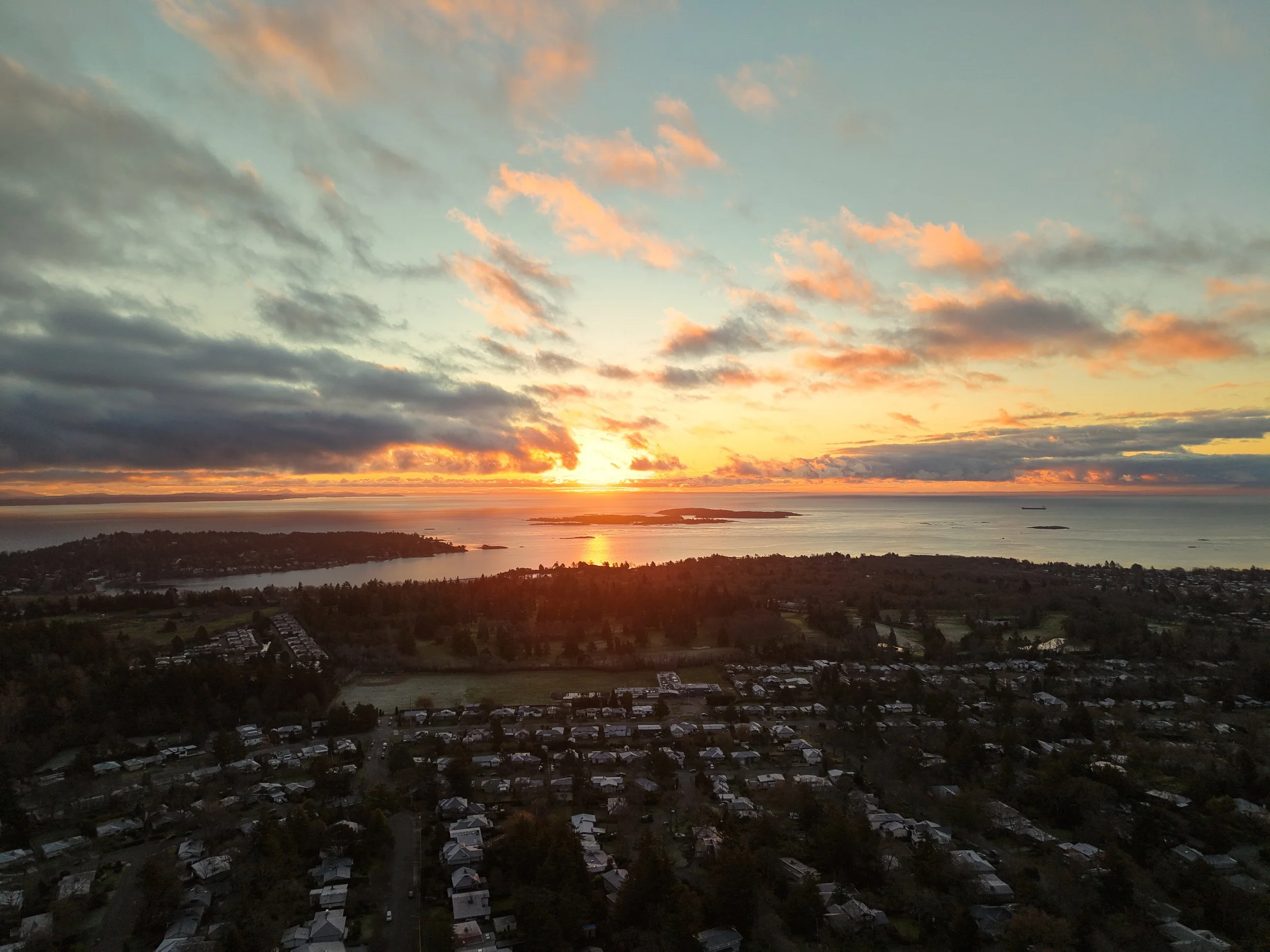
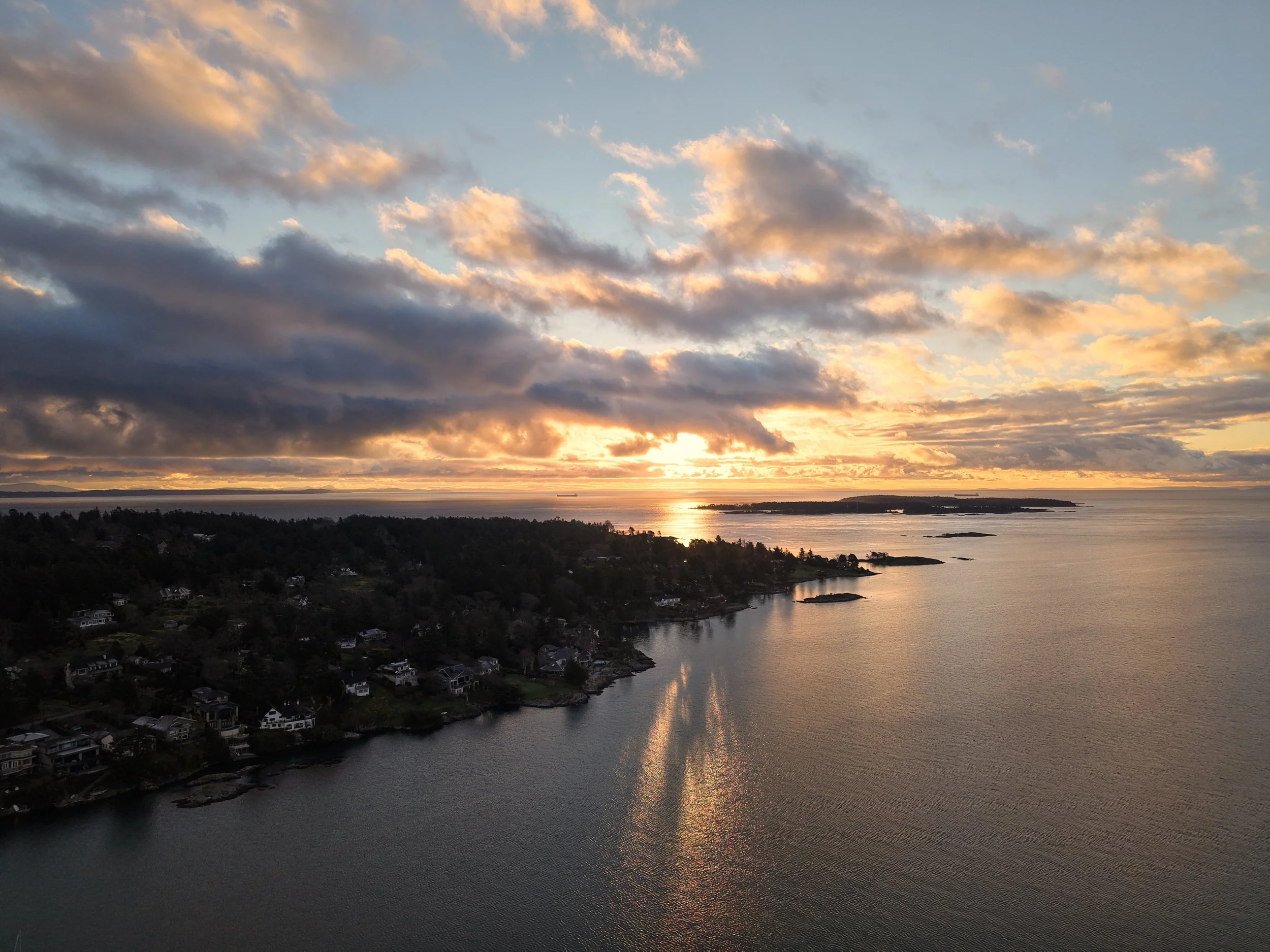
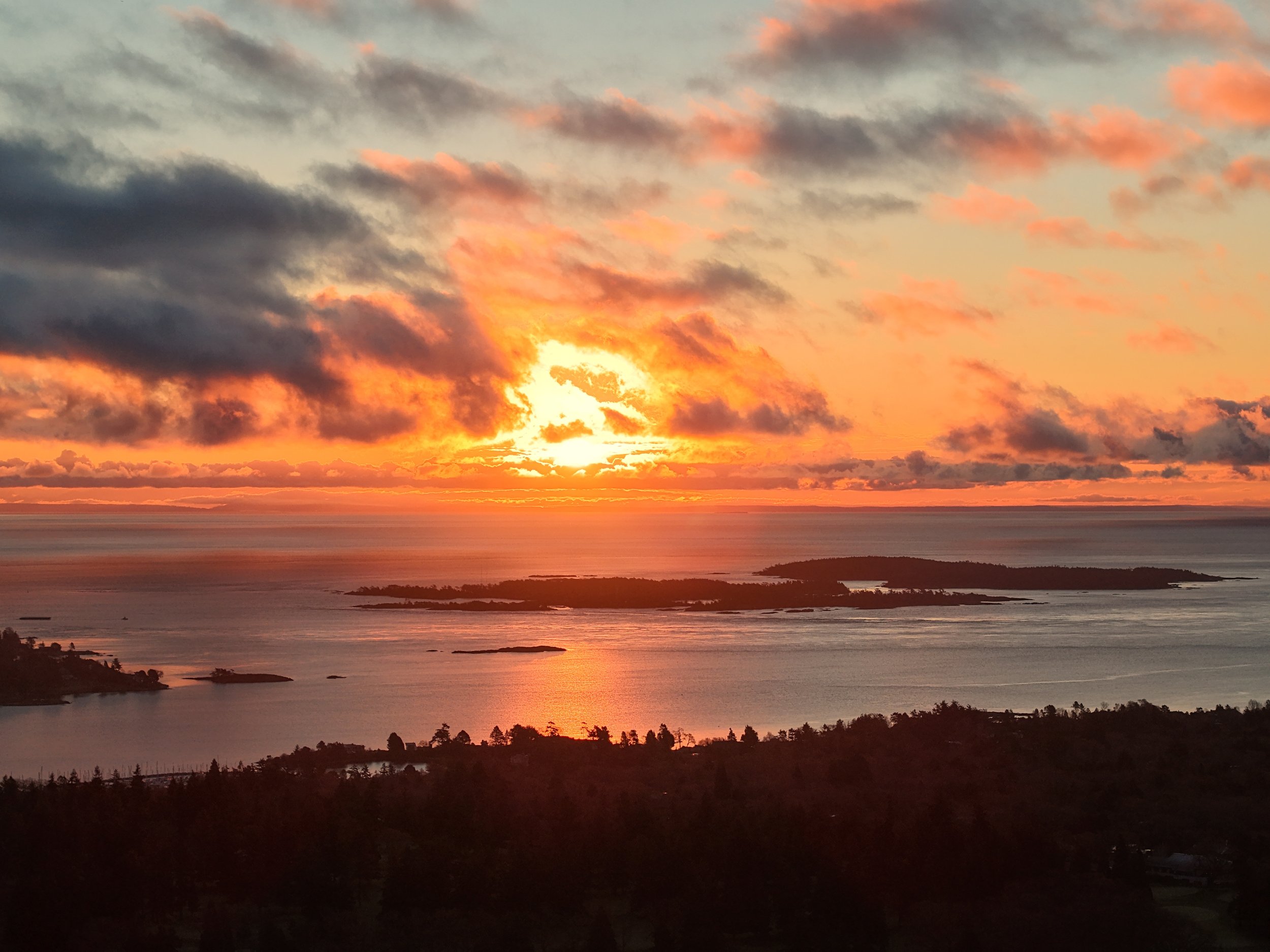
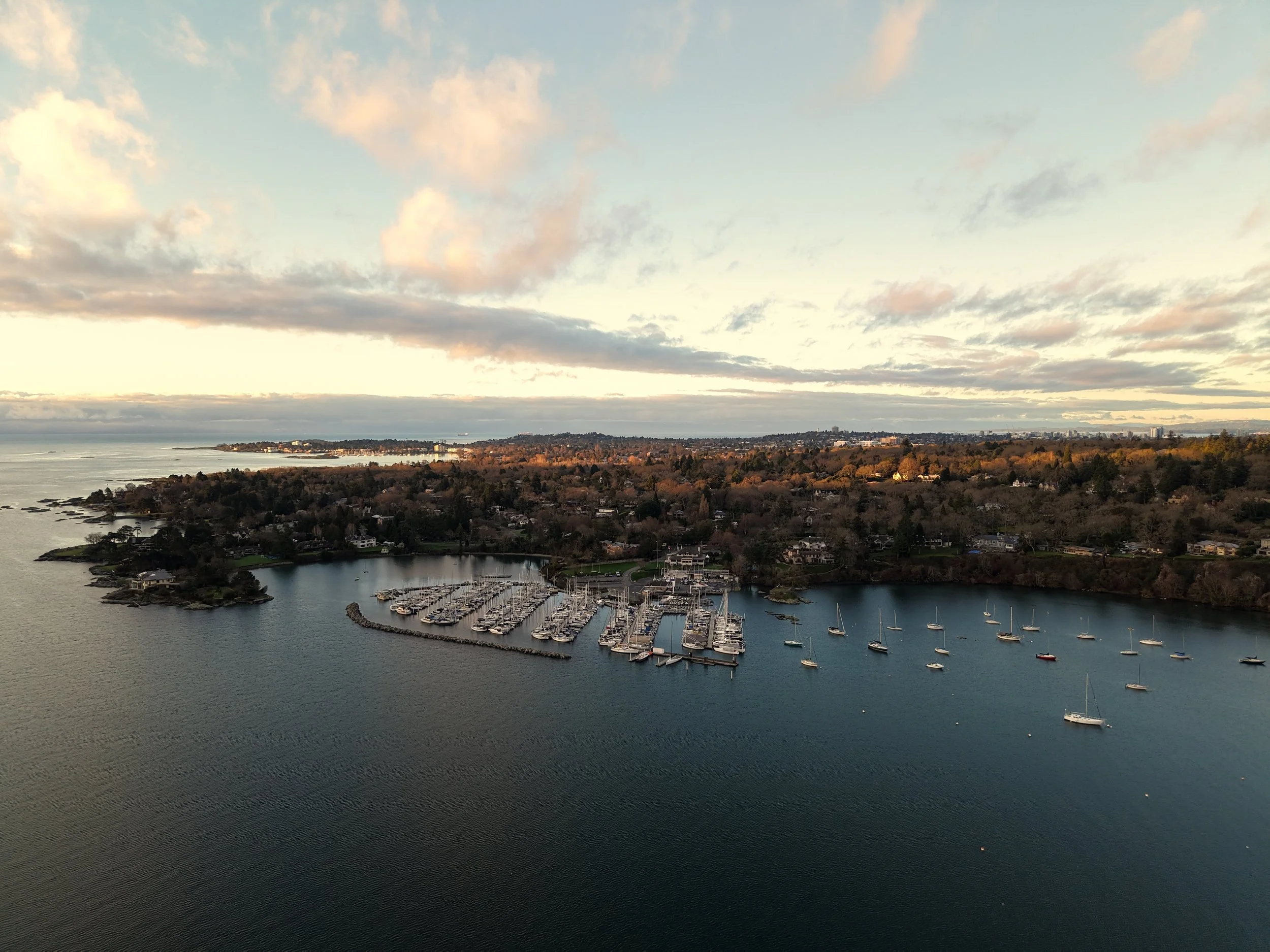
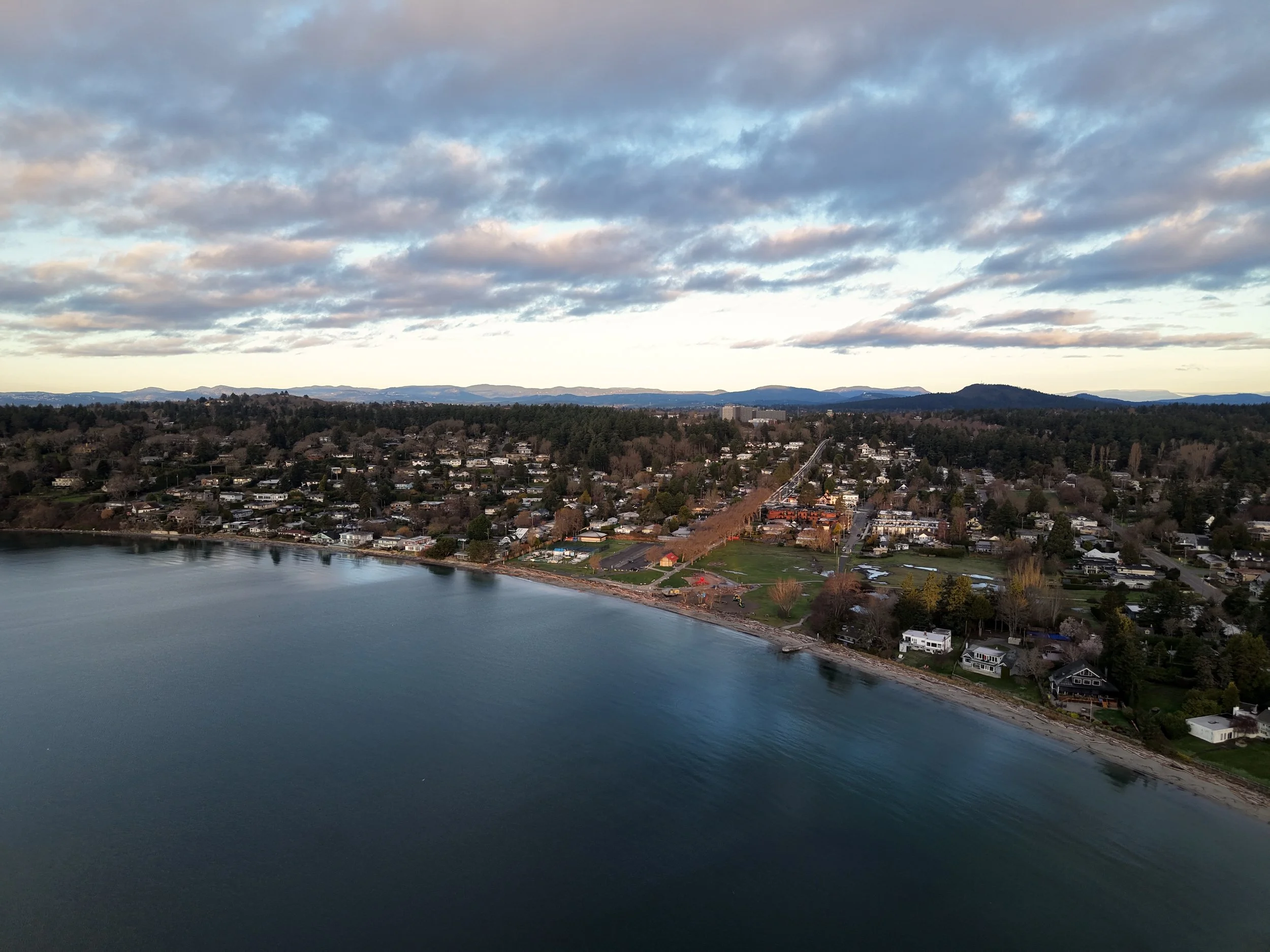
Let me be clear before the rest of Canada revokes my citizenship.
It was not actually cold.
It was Victoria cold.
Which means the temperature technically required a jacket and I dramatically considered gloves while the Prairies were probably measuring snowfall in metres and laughing at us.
But standing on Mount Tolmie at sunrise with a drone controller in your hands? That little coastal breeze suddenly feels personal.
I drove up early with a coffee, telling myself I grew up on the Prairies and therefore “know cold.”
Turns out, coastal living has softened me. Completely.
There’s a special kind of humility that comes from realizing teenage-you used to scrape frost off a windshield at -30, and present-day-you is grumbling at +4 because your fingers are chilly while flying a flying robot for fun.
That said — the sky showed up.
Mount Tolmie lit up in deep oranges over the Strait, light stretching toward the Gulf Islands, the city still half asleep below. That moment where you forget about your frozen fingers because the horizon is doing something ridiculous.
I’ve been coming up here since I was a teenager. Back then it was just a place to hang out, talk nonsense, and look at the lights. Now I come back with better coffee and more expensive hobbies.
Same view. Slightly more responsible human.
After grabbing a few shots up top (and regaining partial feeling in my hands), I drove down to Cadboro Bay — another place that’s been part of my orbit since my teens.
From the air, Cadboro in winter is calm and honest. Long reflections. Soft light over the water. Quiet neighbourhoods tucked along the shoreline. No drama. Just West Coast doing what it does.
There’s something about revisiting places you’ve known for decades and seeing them from a new angle. Same coast. Same memories. Different perspective.
Also — I need to learn to fly with gloves. That’s the takeaway here.
The Prairies version of me would be embarrassed by this entire paragraph. But February sunrises on Vancouver Island? Still worth “suffering” for.
And yes — before anyone asks — I survived.
Barely.
Related Blog Posts
A Drone, a Four-Year-Old, and a Lot of Curiosity
A real-world look at the DJI Neo 2 through the eyes of a four-year-old. No specs, no hype — just hand gestures, active tracking, bike rides, boardwalk runs, and a little drone that’s become part of everyday family life.
Flying a Drone in Victoria, BC: What You Should Know Before You Go
A practical, local-first guide to flying in Greater Victoria — from floatplanes and military traffic to early-morning timing and common-sense etiquette. Whether you’re flying a micro-drone or something larger, here’s what actually matters.
The DJI Drones & Accessories We Actually Recommend (and Why)
A curated list of the drones and gear we genuinely use — from the DJI Air 3S workhorse to the surprisingly capable Neo 2. No “top 10” nonsense, just tools that earn their place in real-world flying.
A Drone, a Four-Year-Old, and a Lot of Curiosity
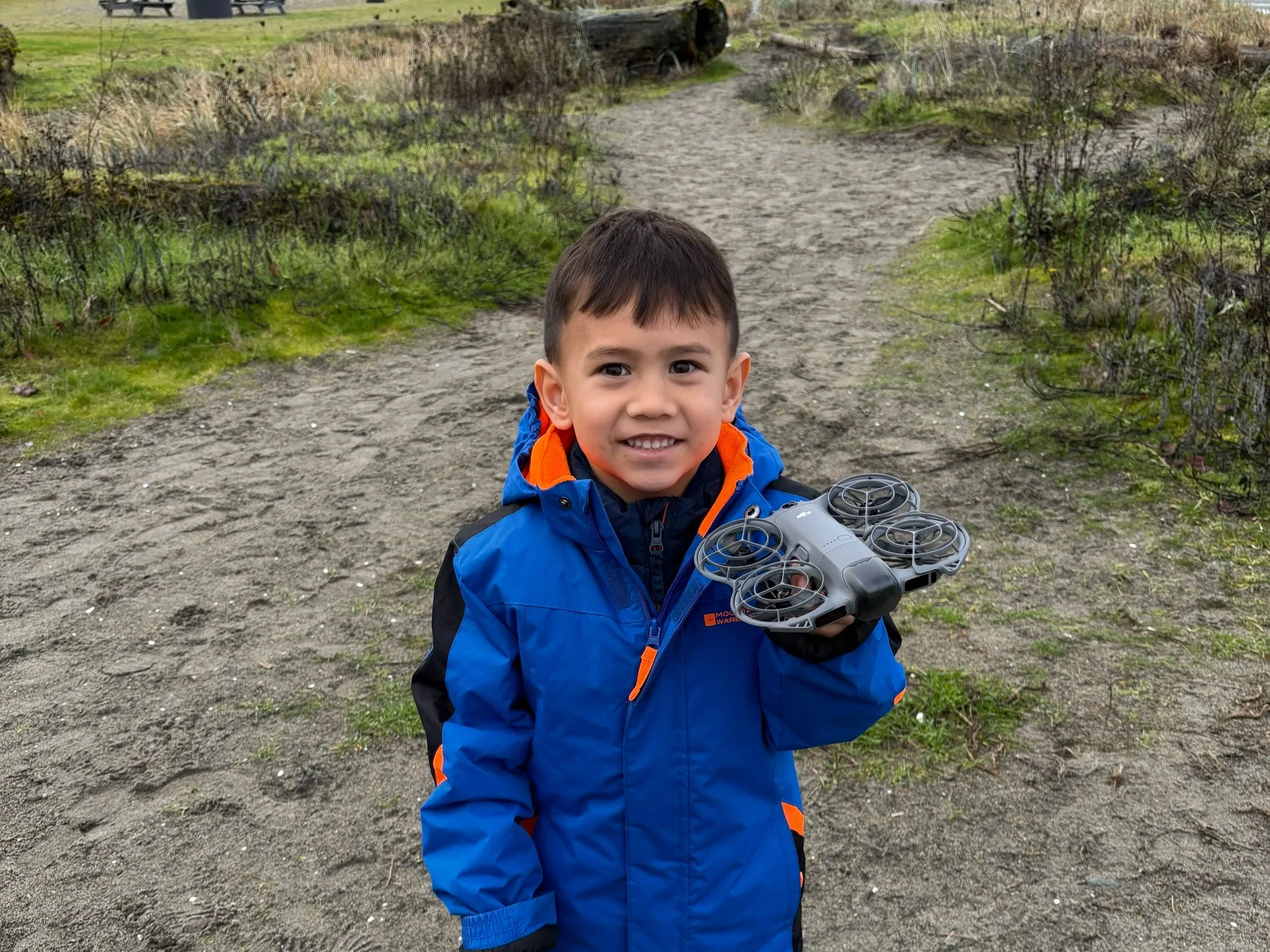
Blake got a DJI Neo 2 for Christmas. He’s four. No controller, no screens — just hand gestures, active tracking, and a drone that’s happy to follow him around like a very patient flying cameraman.
Over the last couple of months, we’ve been messing around with it in low-key ways. Blake riding his bike, running along boardwalks, showing off his dance moves, and generally treating the Neo 2 like it exists purely to document his daily adventures. And honestly, that’s where this little drone shines.
This video is a collection of those moments. No spec breakdowns, no dramatic claims — just real-world use, in real places, by a kid who’s more interested in seeing himself on screen than worrying about flight modes.
From a parent’s perspective, what stood out most is how approachable it is. The Neo 2 isn’t intimidating. It doesn’t feel like “dad’s expensive drone.” It feels like a toy — but one that quietly does some impressive things in the background.
We’re not affiliated with DJI in any way, and this isn’t a review in the traditional sense. It’s just an honest look at how this little drone has fit into our lives since Christmas, and how tech like this can be fun, creative, and a bit magical when you strip away the hype.
Video below 👇
Royal Bay at Sunrise
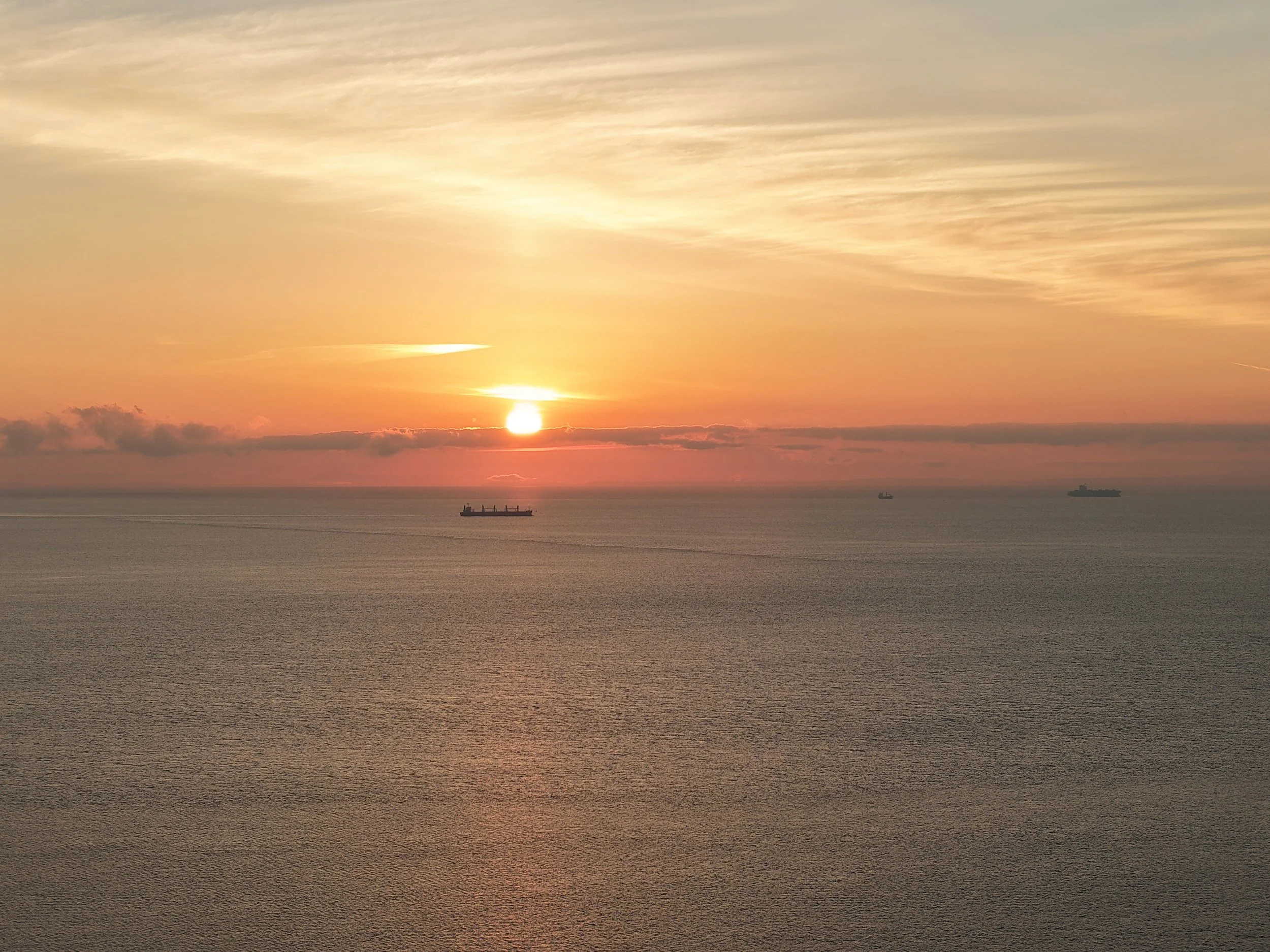
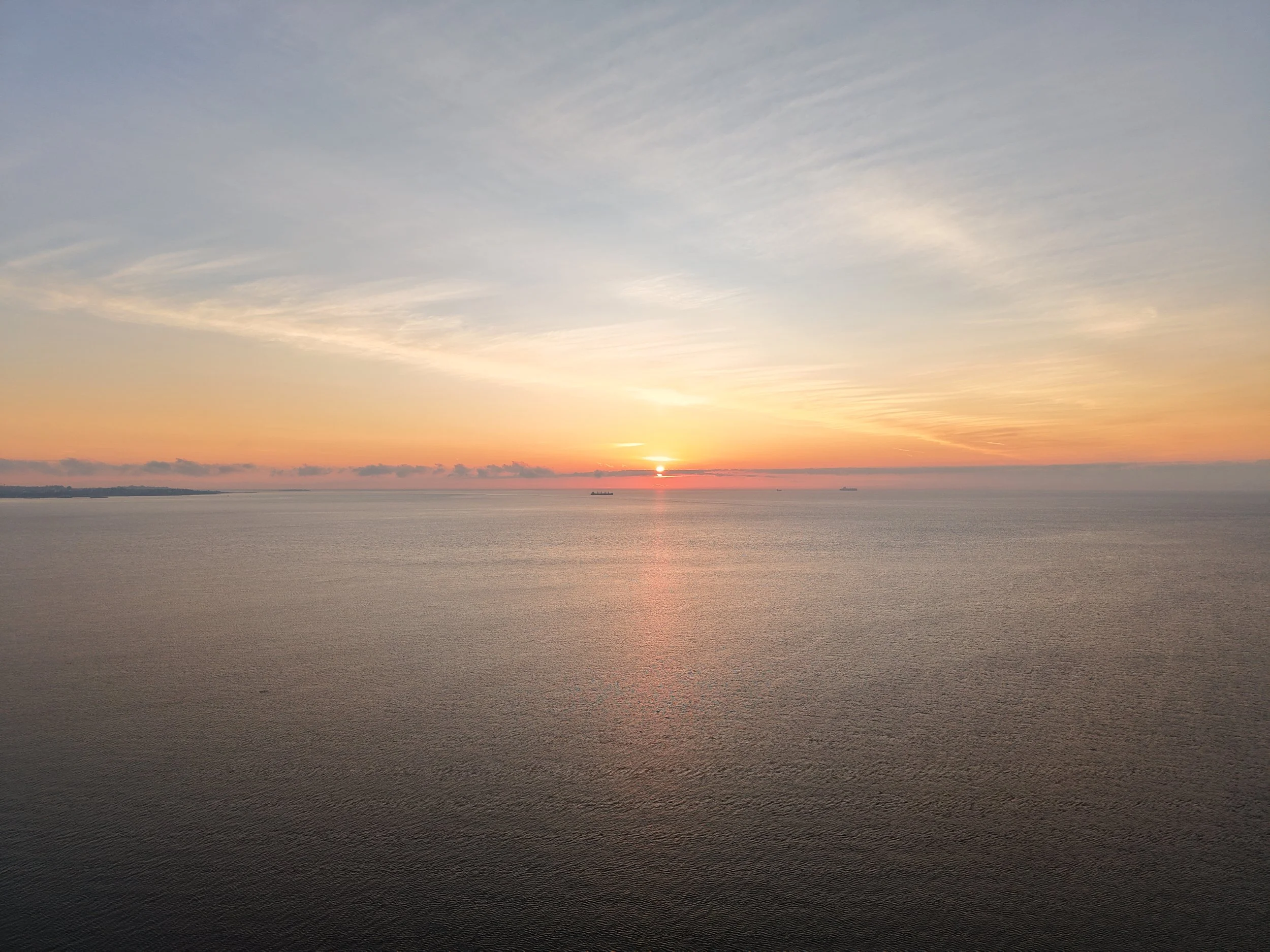
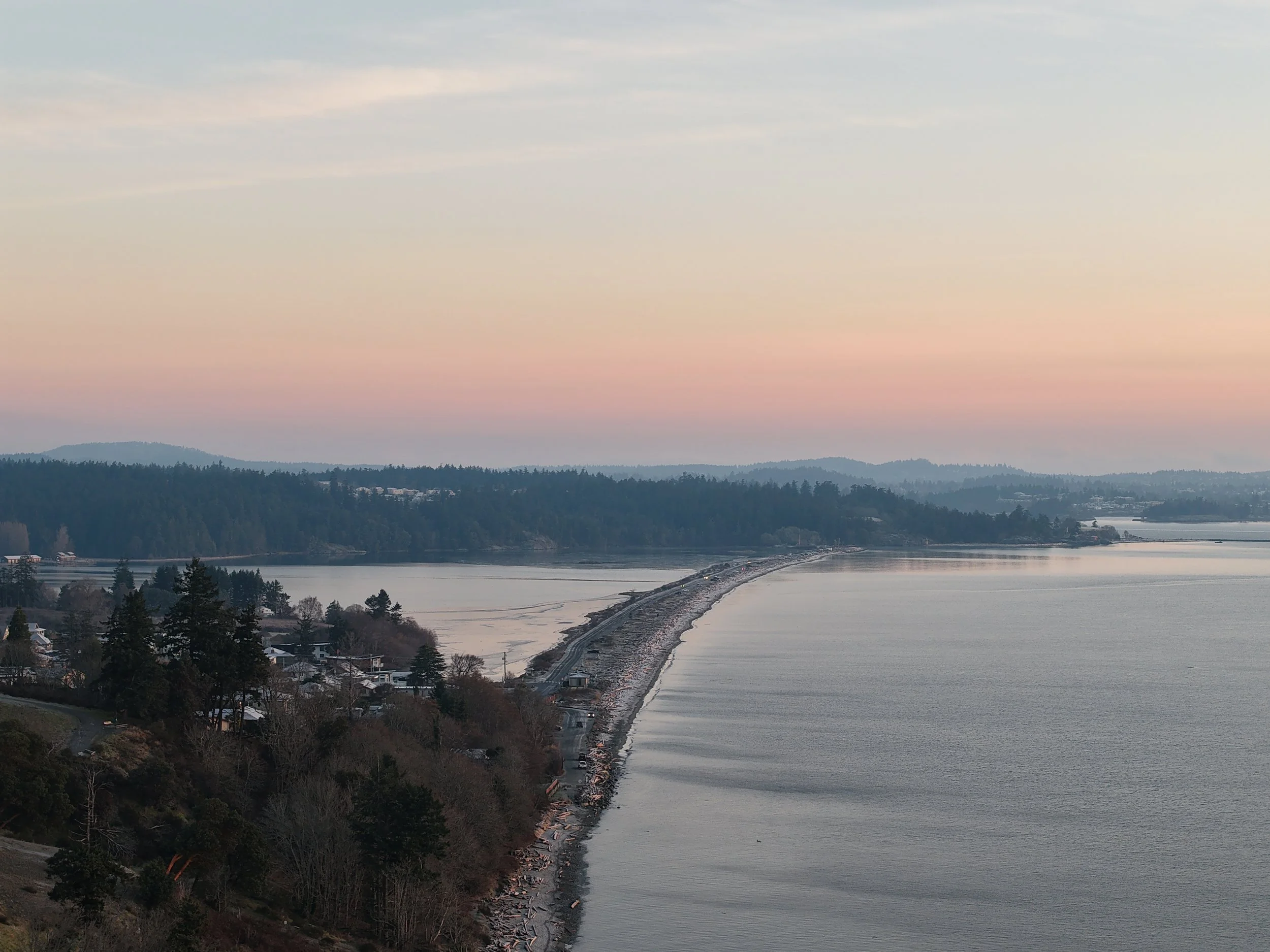
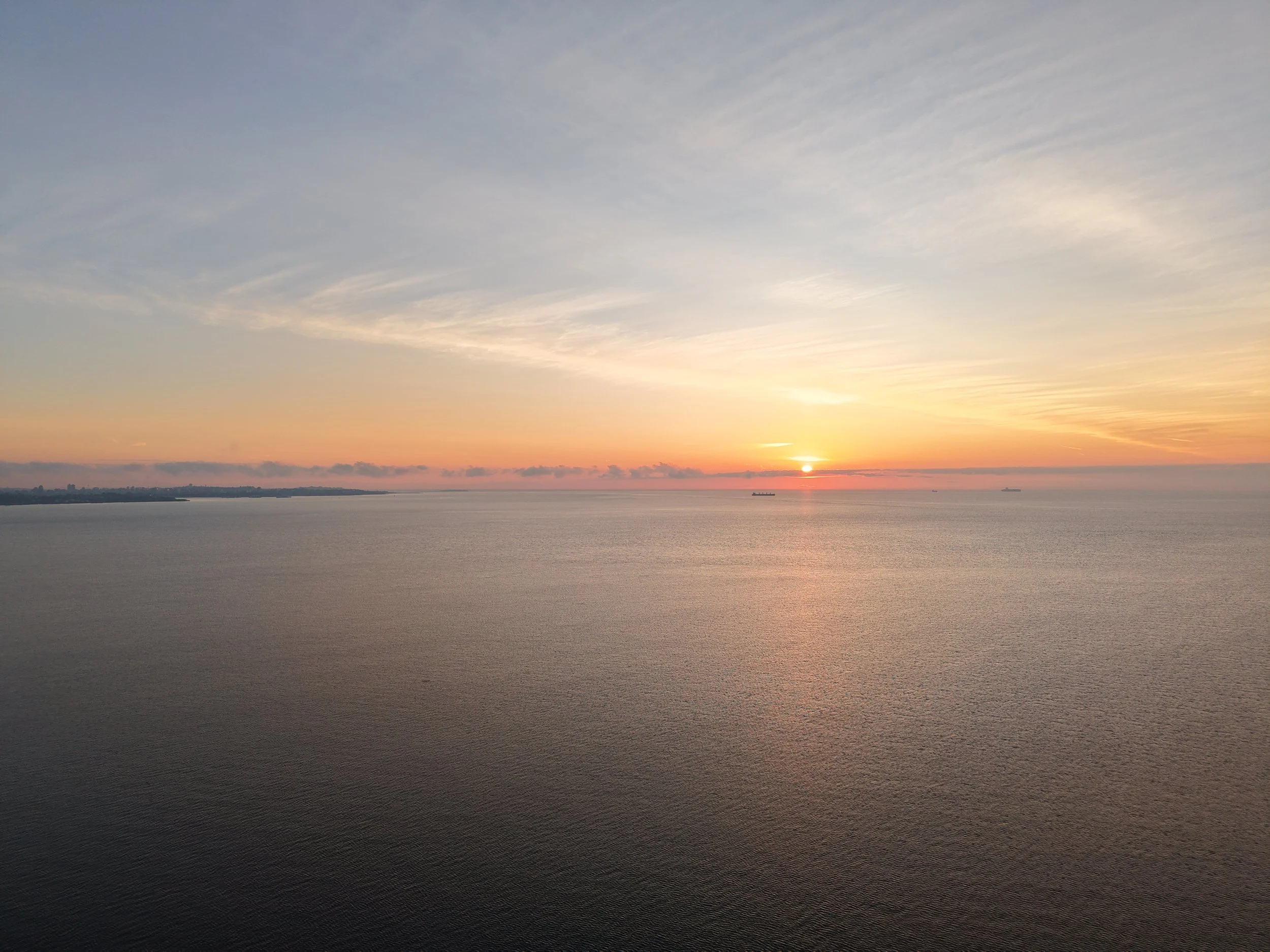
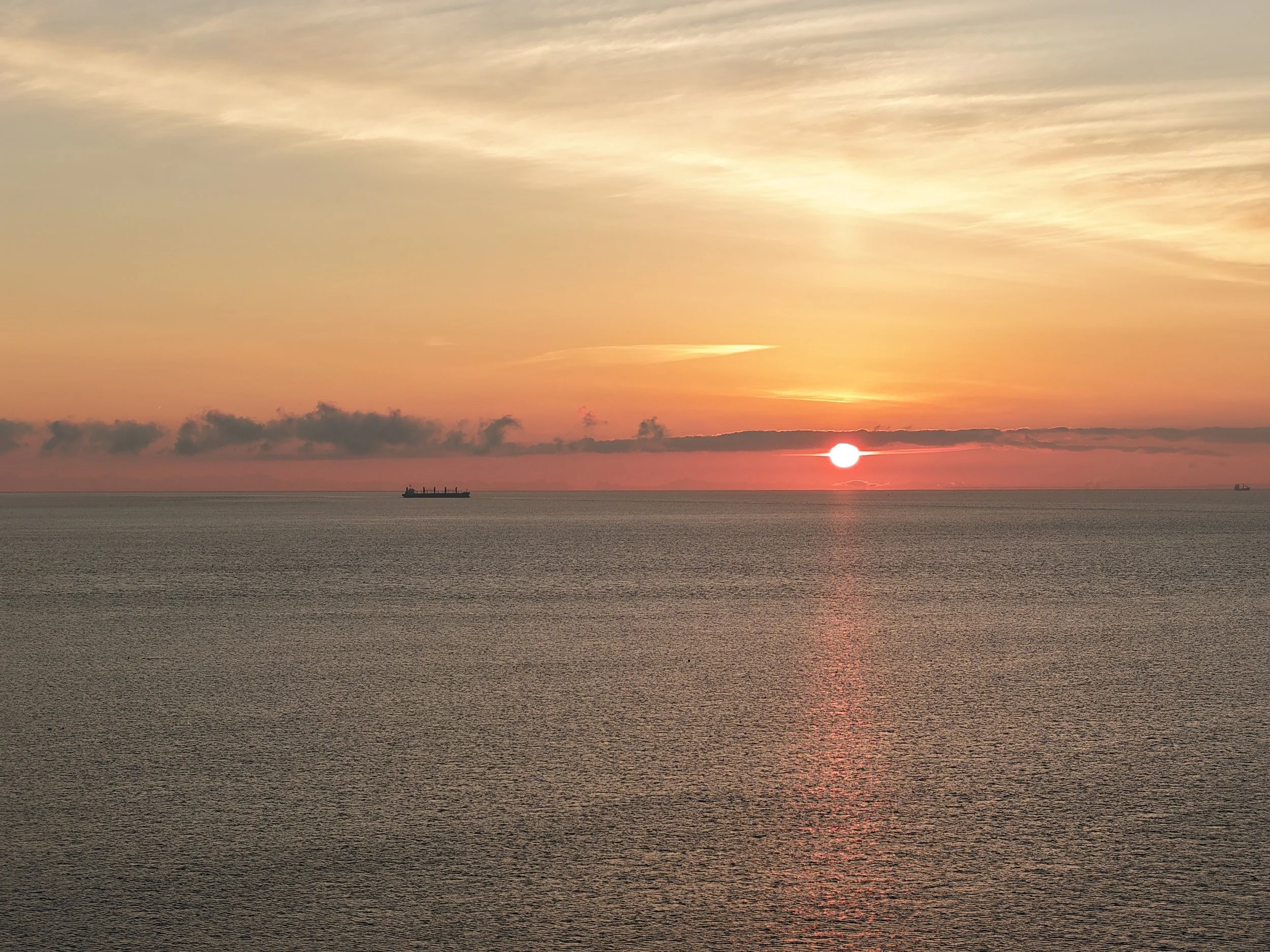
Royal Bay is one of those spots I keep coming back to, mostly because it just works. It’s close, it’s easy to get to early in the morning, and at sunrise you’re not bothering anyone. No neighbours, no dog walkers wondering what the buzzing sound is, no awkward “should I even be here right now?” moments. Just open space, cold air, and a clear view east.
From this angle, you get a fantastic look back toward Victoria. The lagoon sits off to the side, the coastline stretches out, and the sun usually comes up right where you want it to. On a good morning, you’ll also catch ships sitting out on the water, barely moving, which always adds a bit of scale and calm to the scene. It’s quiet in that way that only really happens early in the day, before the rest of the city wakes up.
It’s also funny how often I run into the same people down there. There’s a guy named Greg I seem to cross paths with almost every time. I think he’s ex-military, drives a similar vehicle to mine, and we usually end up having a quick chat while watching the light change. Nothing deep, nothing dramatic — just two guys standing in the cold, talking cars, weather, and whatever else comes up. It’s become part of the routine, honestly.
Royal Bay always feels colder than everywhere else. I don’t know why, but it does. Even when it’s calm, that air coming off the water cuts a bit sharper. Still, that’s kind of the trade-off. You put up with cold hands for a few minutes, and you get views like this. No crowds, no rush, just a clean look at Victoria starting its day.
These images were taken on one of those crisp January mornings where everything lines up just right. Not dramatic, not overcooked — just a simple reminder of why I keep the drone charged and the alarm set early. Sometimes the best places aren’t far away or complicated. They’re just familiar, reliable, and quietly beautiful if you catch them at the right time.
DJI Osmo Nano: A Tiny Camera We Take Everywhere (and Abuse Daily)
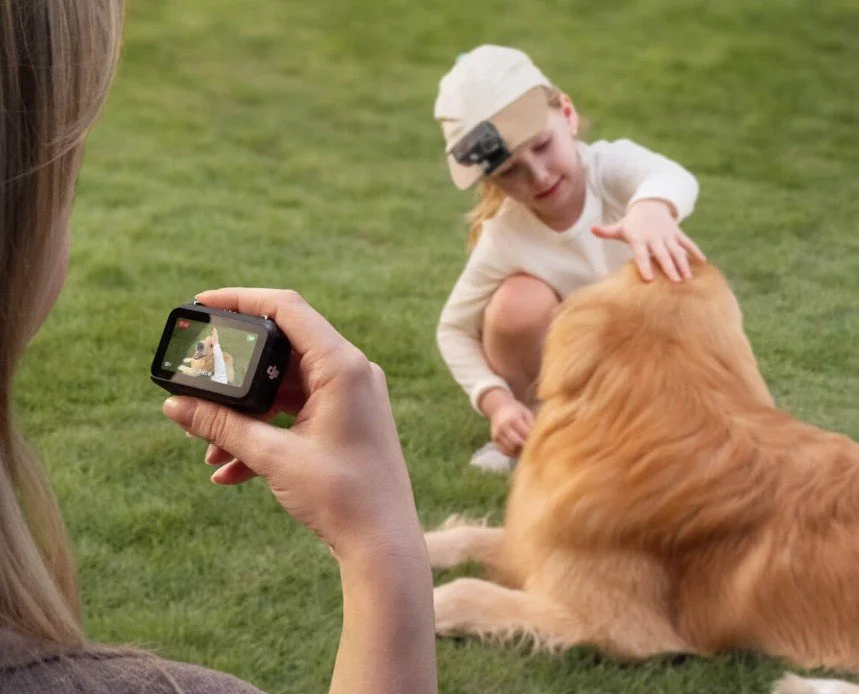
Some gear earns its place in the bag.
Some gear earns its place attached to a four-year-old.
The DJI Osmo Nano falls into the second category.
This thing is tiny, lightweight, and unintentionally hilarious when you hand it to a kid or strap it to one. It’s also surprisingly capable for something that looks like it could get lost in a jacket pocket.
We didn’t buy it to be cinematic. We bought it because it’s always ready — and that’s exactly where it shines.
Why the Osmo Nano Is So Handy
The biggest strength of the Osmo Nano is simple: it’s there when other cameras aren’t.
Because it’s:
ultra-lightweight
genuinely pocketable
fast to mount and remove
not precious
It comes with us everywhere. Walks, errands, family outings, random adventures that were never supposed to be content. And because it’s so small, it doesn’t change behaviour the way a bigger camera does.
That’s when you get the good stuff.
The Magnetic Design Is Half the Fun
The dual-sided magnetic mounting sounds like marketing fluff until you actually use it.
In practice, it means:
quick chest mounts
easy kid-POV angles
fast switches between selfie and forward-facing shots
hands-free filming without fiddling
Strapping it to a four-year-old results in footage that is chaotic, fast, slightly unhinged, and genuinely entertaining. It feels like seeing the world at knee height, at full speed, with commentary you didn’t ask for.
Highly recommended.
Image Quality That Punches Way Above Its Size
For something this small, the image quality is kind of ridiculous.
Key highlights that actually matter in real use:
1/1.3″ sensor with strong dynamic range
4K up to 60fps, plus higher-frame-rate slow motion
143° wide field of view that captures more than you expect
10-bit & D-Log M if you want grading flexibility
It handles bright days, shade, and mixed lighting better than most tiny cameras. Low light is also surprisingly usable thanks to DJI’s processing and SuperNight mode, especially considering the size.
You stop thinking about specs pretty quickly and just trust it.
Stabilization That Makes Chaos Watchable
When the camera is attached to someone who does not walk, only sprints, stabilization matters.
Osmo Nano’s stabilization modes do a lot of heavy lifting:
RockSteady smooths out frantic movement
HorizonBalancing keeps things from tilting into pure madness
The result is footage that’s energetic without being nauseating. It still feels real, just… watchable.
Battery Life That Refuses to Be a Problem
For a camera this small, battery anxiety is almost non-existent.
With the Vision Dock:
fast charging gets you back up quickly
extended runtime means you don’t think about it much
you’re far more likely to run out of patience than battery
That alone makes it easy to toss into a bag and forget about until it’s needed.
Audio: Better Than Expected, More Flexible Than It Looks
The built-in microphones are fine for casual use, but the real standout is OsmoAudio direct microphone support.
Being able to connect microphones directly (without extra receivers) opens up:
cleaner dialogue
two-person audio capture
better run-and-gun setups
For something this small, that’s impressive.
Waterproof, Kid-Proof, Life-Proof (Mostly)
The Osmo Nano being waterproof to 10 metres without a housing is one of those features you don’t think you’ll need — until you do.
Add splash resistance with the dock, and suddenly:
rain isn’t a concern
puddles become tempting
water shots feel low-stress
It’s a camera you don’t baby, which is exactly why it gets used.
The Real Value: Always With You
The Osmo Nano doesn’t replace a drone, a mirrorless camera, or even a phone.
What it replaces is the excuse of “I didn’t bring a camera.”
Because it’s so small and fast to deploy, it captures moments that would otherwise disappear. Family chaos, quick adventures, weird perspectives, and honest, unplanned footage.
That’s its superpower.
Final Thought
The DJI Osmo Nano isn’t about perfection. It’s about presence.
It’s the camera you grab when you don’t want to think, don’t want to set up, and don’t want to miss the moment. For us, it’s become one of those tools that quietly earns its keep by being used constantly.
If you’re curious about the full specs, accessories, and DJI’s official breakdown of the Osmo Nano, you can find it here:
Learn more about the DJI Osmo Nano on DJI’s website
Disclosure: This article reflects personal experience and general information only. We are not affiliated with DJI and do not sell DJI products. DJI Osmo Nano is referenced as a consumer camera we enjoy using.
Related Articles
Chasing Down a DJI Neo 2 for Christmas — And Why This Drone Matters More Than I Expected
A story about hunting down the perfect starter drone for my son, and how a simple piece of tech turned into real father–son time.
DJI Neo 2 — Why This Little Drone Is About to Become My Four-Year-Old’s First Co-Pilot
A closer look at the Neo 2 and why its size, safety profile, and simplicity make it the ideal micro-drone for teaching kids to fly responsibly.
DJI Mini 5 Pro — If It’s Not a Micro-Drone… That’s the Point
A practical breakdown of why the Mini 5 Pro steps out of the micro-drone category — and why that matters for new pilots, kids learning the basics, and safe flying in Victoria.
Enterprise Drones in Public Safety: Why Agencies Use Them
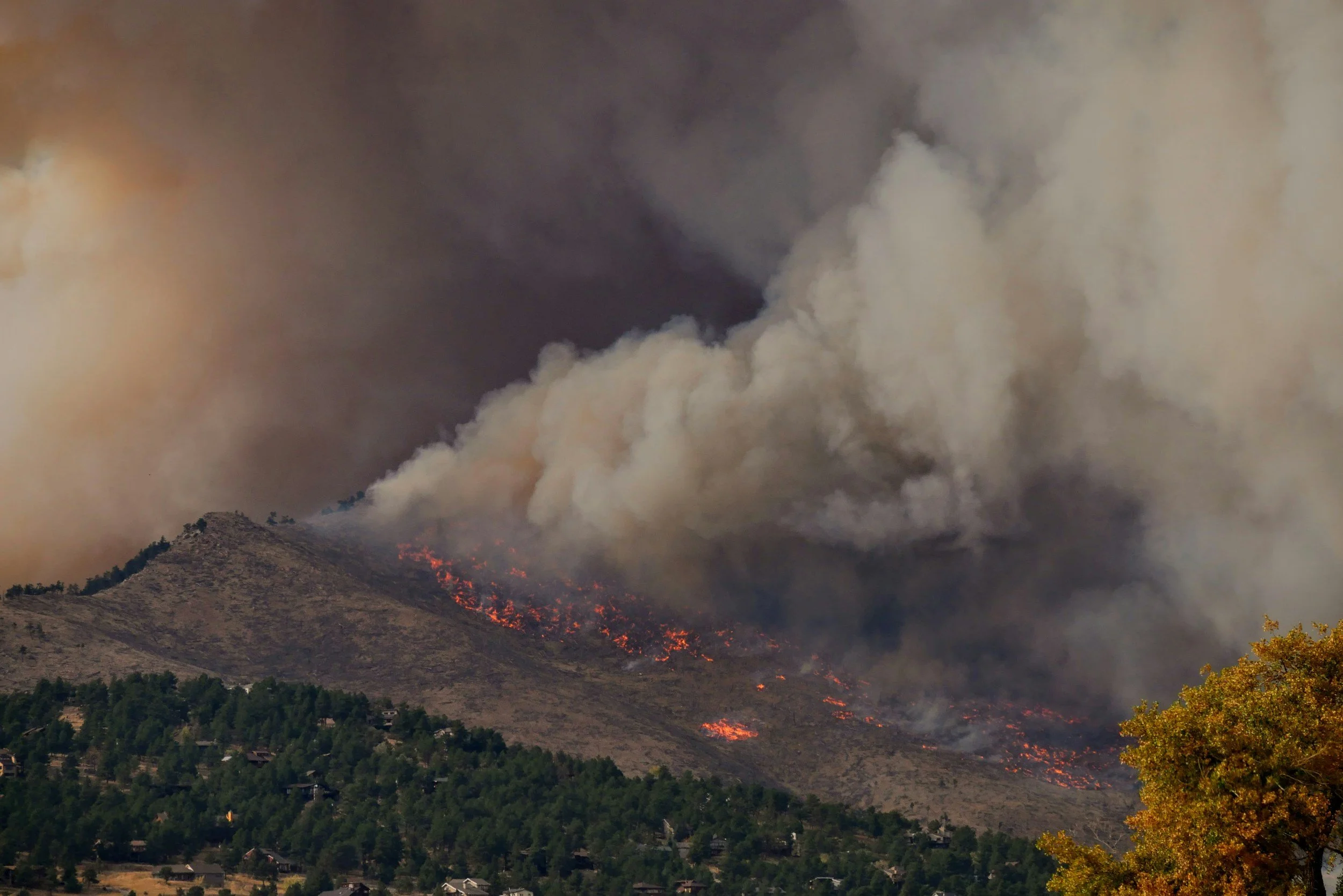
When people think of drones, they usually picture photography or construction sites.
Public safety agencies were thinking about them much earlier.
Police, fire, search and rescue, and emergency response teams don’t use drones because they’re interesting technology. They use them because drones can get eyes on a situation faster, safer, and cheaper than many traditional tools.
That’s where enterprise drones fit in.
Why Public Safety Was an Early Drone Adopter
Public safety work has a few constant challenges:
Situations evolve quickly
Information is incomplete at the start
Scenes can be dangerous or unstable
Decisions need to be made fast
Sending people into unknown conditions is risky. Sending a drone first is often not.
Enterprise drones exist because public safety work demands reliable, repeatable aerial intelligence, not experimental gadgets.
Law Enforcement Applications
Police departments use drones primarily for situational awareness, not enforcement.
Common uses include:
Mission situational awareness
Real-time aerial views of developing situations
Better coordination between ground teams
Improved decision-making without escalating risk
First response and DFR (Drone as First Responder)
Faster scene assessment before officers arrive
More efficient resource allocation
Collision reconstruction and forensics
Rapid aerial documentation of crash scenes
Faster road reopening
Digitized records for later analysis
In many cases, drones reduce the need for officers to stand in traffic or hazardous environments longer than necessary.
Firefighting and Emergency Response
Fire departments were quick to recognize the value of drones, especially when thermal imaging became practical.
Typical firefighting applications include:
Urban fires
Identifying hotspots through smoke and darkness
Supporting safer interior and exterior operations
Wildfires
Mapping fire spread
Locating hotspots
Improving responder safety in low-visibility conditions
Drones don’t replace firefighters. They help firefighters make better-informed decisions before committing people to dangerous areas.
Disaster Response and Natural Events
During floods, landslides, earthquakes, and severe weather events, access is often limited when information is needed most.
Enterprise drones are used to:
Capture visual and thermal data over large areas
Assess damage quickly
Support planning and coordination
Improve responder safety
Being able to see the situation from above often changes how resources are deployed on the ground.
Search and Rescue
Search and rescue is one of the most intuitive drone use cases.
Drones allow teams to:
Scan large or difficult terrain quickly
Use thermal imaging to locate individuals
Reduce time spent searching blindly
Improve outcomes when time is critical
In remote or rugged areas, a drone can cover ground that would take hours on foot.
Private Security and Wildlife Protection
Beyond government agencies, drones are also used in:
Private security
Rapid patrol of large properties
Early detection of potential issues
Improved situational awareness for ground teams
Wildlife protection
Monitoring large habitats
Detecting activity with zoom and thermal sensors
Supporting conservation and anti-poaching efforts
In both cases, drones provide visibility without disturbing the environment or placing people at risk.
Why Enterprise Platforms Are Used
Public safety work benefits from drones that are:
Reliable in demanding conditions
Capable of carrying visual and thermal sensors
Stable during close or precise operations
Designed for repeatable, documented workflows
That’s why enterprise platforms like the DJI Matrice are often referenced in public safety applications.
For readers who want to explore DJI’s own breakdown of enterprise drones used in public safety, law enforcement, firefighting, and emergency response, their enterprise site goes into much deeper technical detail:
Learn more about DJI Enterprise drones for public safety here
Final Thought
Public safety drones aren’t about replacing people. They’re about giving people better information before they step into danger.
From policing and firefighting to disaster response and search and rescue, enterprise drones exist because some decisions are safer and smarter when made with an aerial view.
Disclosure: This article is for informational purposes only. The author is not affiliated with DJI and does not sell DJI products or enterprise services. DJI platforms are referenced as examples of enterprise public safety drone technology.
Related Reads
Business & Property Drone Services
Professional aerial photos and video for businesses, restaurants, hotels, and properties across Greater Victoria — handled safely, legally, and without guesswork.
Construction Drone Services
Progress tracking, site documentation, and inspections for construction projects in the Westshore and Greater Victoria, with compliant and insured operations.
DJI Drones & Accessories
Straightforward reviews and recommendations for DJI drones and accessories, based on practical experience and long-term use.
Enterprise Drones for Inspection: Why They’re Used (and Where They Actually Help)
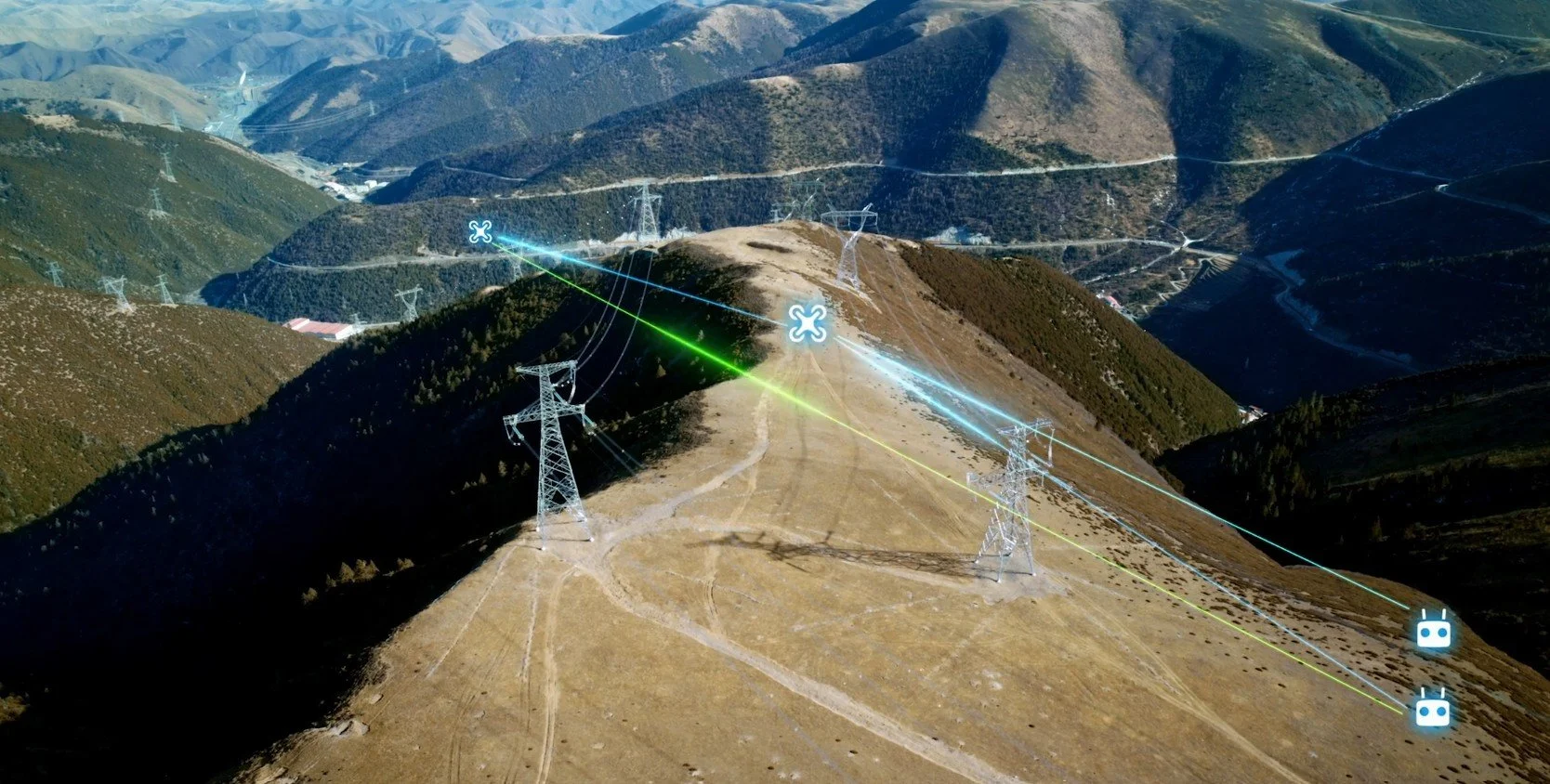
Inspections are one of those jobs where drones didn’t just make things easier — they made them safer.
Long before drones were common on construction sites or in marketing, they were being used to inspect things people didn’t really want to climb, hang from, or shut down just to take a closer look.
That’s where enterprise drones come in.
Why Inspections Were an Early Fit for Drones
Traditional inspections often involve:
Working at height
Shutting down equipment or access
Limited viewing angles
Time-consuming manual checks
Increased risk to personnel
Drones changed that equation by allowing inspectors to collect detailed visual and thermal data without putting people in dangerous positions or interrupting operations more than necessary.
Enterprise drones exist because inspections need precision, repeatability, and reliability, not just photos.
What Makes Inspection Drones “Enterprise”
Inspection-focused enterprise drones are built around data capture, not convenience.
Compared to consumer drones, enterprise platforms are designed to support:
Close-range, multi-angle inspections
High-resolution visual imagery for fine detail
Thermal imaging to detect heat anomalies and defects
Repeatable flight paths for consistent inspections over time
Stable flight in complex environments
This makes them suitable for inspections where missing a small detail can turn into a big problem later.
Electricity and Power Infrastructure Inspections
Electrical infrastructure was one of the earliest adopters of drone inspections.
Common use cases include:
Powerline inspections
Close-range, multi-angle views
Reduced need for climbing or lift equipment
Improved safety and inspection efficiency
Substation inspections
Visual and infrared inspections
Detecting overheating components
Supporting safe, stable power operations
Drones allow inspectors to gather detailed data while maintaining safe distances from live equipment.
Oil, Gas, and Industrial Facilities
In oil and gas environments, inspections are often complex, repetitive, and expensive to perform manually.
Enterprise drones are commonly used for:
Facility inspections
Visual and thermal checks
Early detection of defects or irregularities
Pipeline inspections
Monitoring pumping units and stations
Identifying leaks, loose components, or damage
Reducing inspection time across large areas
Here, drones help reduce downtime and improve inspection coverage without increasing risk.
Renewable Energy Inspections
Renewable energy sites benefit from inspections that are both frequent and consistent.
Typical applications include:
Photovoltaic power plants
Autonomous or repeatable flight paths
Thermal imaging to identify faulty panels
Faster detection of performance issues
Wind turbine inspections
Close inspection of blades and components
Early detection of cracks or surface damage
Reduced need for rope access or shutdowns
In these cases, drones help protect both personnel and long-term infrastructure investment.
Infrastructure and Building Inspections
Drones are also widely used to inspect large or hard-to-access structures.
Common examples include:
Bridge inspections
High-resolution imagery
Digital models and inspection records
Reduced need for lane closures or scaffolding
Roof inspections
Identifying cracks, leaks, and damage
Keeping people off hazardous rooftops
Faster assessments after storms or events
For infrastructure, drones provide a safer way to document condition while creating a visual record that can be reviewed and shared.
Why Enterprise Platforms Are Used for Inspections
Inspection work benefits from drones that are:
Reliable in varied environments
Capable of carrying visual and thermal sensors
Stable at close range
Designed for repeatable, documented workflows
That’s why enterprise platforms like the DJI Matrice are commonly referenced in inspection use cases across energy, infrastructure, and industrial sectors.
For readers who want a deeper technical look at DJI’s enterprise inspection workflows and platforms, DJI outlines these use cases in detail on their enterprise site:
Learn more about DJI Enterprise inspection applications here
Final Thought
Inspections are about reducing uncertainty.
Enterprise drones exist because some inspections demand accuracy, consistency, and safety that manual methods struggle to deliver efficiently. Whether inspecting power infrastructure, industrial facilities, renewable energy assets, or large structures, drones allow teams to collect better information while keeping people out of harm’s way.
Disclosure: This article is for informational purposes only. The author is not affiliated with DJI and does not sell DJI products or enterprise services. DJI platforms are referenced as examples of enterprise inspection technology.
Related Reads
Business & Property Drone Services
Professional aerial photos and video for businesses, restaurants, hotels, and properties across Greater Victoria — handled safely, legally, and without guesswork.
Construction Drone Services
Progress tracking, site documentation, and inspections for construction projects in the Westshore and Greater Victoria, with compliant and insured operations.
DJI Drones & Accessories
Straightforward reviews and recommendations for DJI drones and accessories, based on practical experience and long-term use.
Enterprise Drones in Construction: Why the DJI Matrice Exists
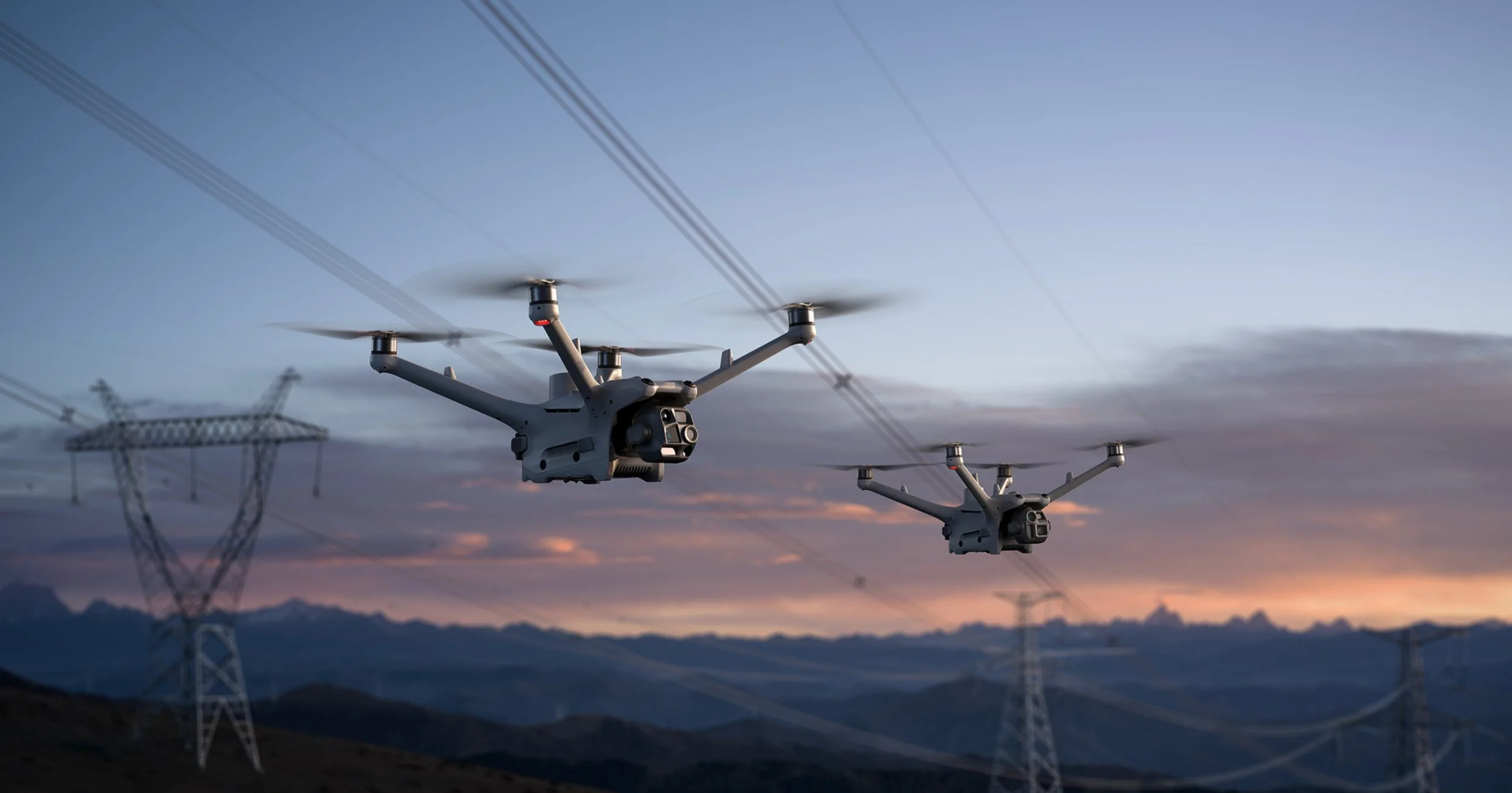
Most construction projects don’t need a drone that looks like it belongs on a sci-fi movie set.
But some do.
And that’s exactly why the DJI Matrice exists.
Enterprise drones weren’t built for cinematic shots or marketing videos. They were built for job sites where accuracy, repeatability, and documentation matter more than aesthetics. Construction was one of the first industries to really take advantage of that.
Construction Has a Visibility Problem
Construction sites change constantly. What was accurate last week may already be outdated, and relying on walk-throughs, ground photos, or memory introduces gaps quickly.
Common challenges include:
Lack of up-to-date visual progress information
Inefficient collaboration between teams and stakeholders
Rework caused by missed or outdated data
Time and cost lost to manual measurements
This is where enterprise drones started to make sense.
What Enterprise Drones Are Used for in Construction
Enterprise platforms like the DJI Matrice are designed for repeatable data collection, not one-off flights.
Typical construction use cases include:
Progress tracking over time using consistent flight paths
2D and 3D site models for comparison against historical data
Earthwork and stockpile measurements using point clouds
Pre-build and post-build documentation
Inspections that would otherwise require lifts, scaffolding, or working at height
Instead of relying on estimates, teams can work with visual records that can be reviewed, shared, and compared.
Why the DJI Matrice Is an “Enterprise” Drone
From the outside, the DJI Matrice just looks like a larger drone. The difference is what it’s built to do reliably, over and over, in real job-site conditions.
Enterprise drones are designed around:
Mechanical shutters and RTK for centimetre-level accuracy
Repeatable missions that collect data the same way every time
Multiple data outputs such as orthomosaics, point clouds, and 3D models
Workflow integration with enterprise mapping and management software
Longer flight times and better environmental tolerance than consumer drones
They’re tools built for measurement and documentation, not convenience flying.
Automation and Routine Site Monitoring
On larger or long-term projects, enterprise drone systems can be paired with docked or scheduled workflows that allow routine site monitoring without a pilot being physically present every time.
This makes it easier to:
Capture consistent progress data
Compare changes over weeks or months
Share information across teams
Reduce manual site visits for visual checks
At scale, drones become part of the project workflow rather than a novelty.
Earthwork and Stockpile Measurement
Enterprise drones are also commonly used for earthwork tracking.
By generating dense point clouds and 3D models, teams can:
Measure stockpile volumes more frequently
Reduce labour time and exposure on active sites
Improve accuracy by repeating the same flight plans
Compare cut and fill over time
This is one of the clearest examples of drones replacing slow, manual processes with faster, safer data collection.
Not Every Project Needs an Enterprise Drone
It’s worth saying plainly: most construction projects don’t need enterprise drones.
Enterprise platforms make sense when:
Accuracy is critical
Flights are frequent and repeatable
Data is compared over time
Outputs are used for measurement, planning, or reporting
For many projects, simpler aerial documentation is still perfectly adequate.
Final Thought
The DJI Matrice wasn’t designed to be impressive. It was designed to be useful.
Construction sites were an early fit because they benefit from consistent, accurate, repeatable visual data. Enterprise drones exist for the situations where precision and workflow integration justify the complexity.
For readers who want a deeper technical breakdown of DJI’s enterprise platforms and construction workflows, DJI’s own documentation is the best place to explore further:
Learn more about DJI Enterprise drones here:
Disclosure: This article is for informational purposes only. The author is not affiliated with DJI and is not selling DJI products or services. The DJI Matrice is referenced here as an example of an enterprise-class construction drone platform.
Related Articles
Business & Property Drone Services
Professional aerial photos and video for businesses, restaurants, hotels, and properties across Greater Victoria — handled safely, legally, and without guesswork.
Construction Drone Services
Progress tracking, site documentation, and inspections for construction projects in the Westshore and Greater Victoria, with compliant and insured operations.
DJI Drones & Accessories
Straightforward reviews and recommendations for DJI drones and accessories, based on practical experience and long-term use.
When Professional Drone Services Make Sense on Vancouver Island
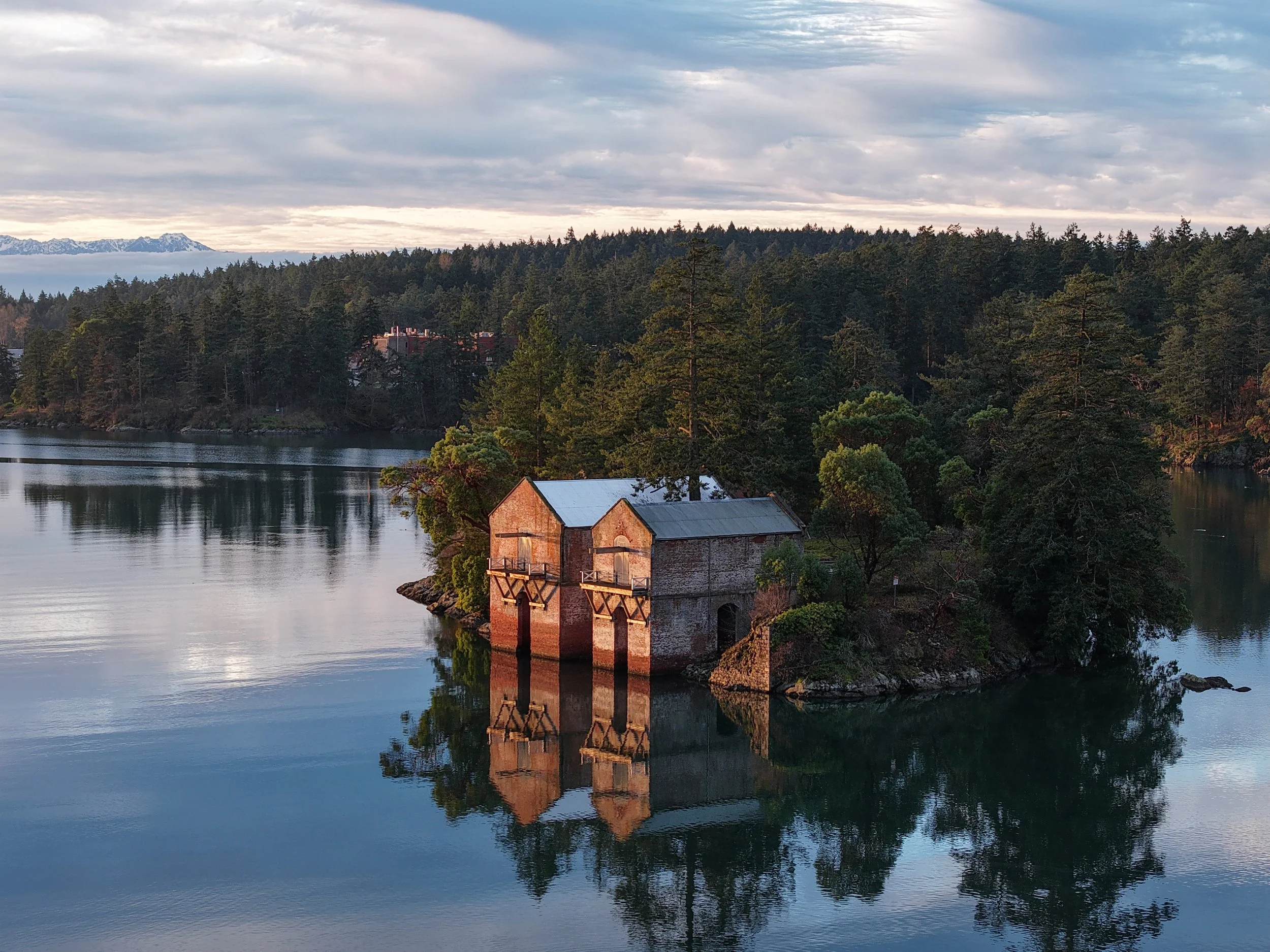
Cole Island
Not every drone project fits neatly into a category.
Some jobs aren’t marketing.
They’re not construction progress.
They’re not real estate listings or social media clips.
They’re simply situations where getting eyes in the air is the safest, fastest, or most practical way to understand what’s going on.
That’s where professional drone services come in.
Across Vancouver Island, drones are increasingly used for one-off tasks, documentation, inspections, and short-notice projects where ground access is limited or impractical. Sometimes it’s about replacing a ladder. Sometimes it’s about avoiding scaffolding. Sometimes it’s just about seeing something clearly without guesswork.
These projects tend to be less flashy — but no less important.
Common examples include aerial documentation for records or planning, visual checks in hard-to-reach areas, site overviews, context shots, or unique situations where a drone provides information you simply can’t get from the ground.
What these jobs all have in common is that they require more than just flying a drone.
Professional drone work starts well before the aircraft leaves the ground. Airspace, location constraints, access, and timing all matter — especially on Vancouver Island, where air traffic, terrain, and land use don’t always line up neatly. Knowing when a location is flyable, when it isn’t, and when conditions aren’t appropriate is part of doing the job properly.
That planning is just as important as the footage itself.
Most professional drone projects are straightforward once expectations are clear. Others need flexibility. Some take minutes in the air. Others require careful positioning, multiple angles, or repeat visits. The goal isn’t to overcomplicate things — it’s to get accurate, usable visuals without unnecessary risk or disruption.
If a drone can safely replace manual access, reduce uncertainty, or provide a clearer picture than the ground allows, it’s usually worth having a conversation.
For projects that don’t fall cleanly under construction tracking or business marketing, our Professional Drone Services page outlines how we handle general and custom aerial work across Vancouver Island, including typical pricing and what to expect.
Sometimes the right tool is obvious.
Sometimes it just helps to talk it through.
Related Articles
Business & Property Drone Services
Professional aerial photos and video for businesses, restaurants, hotels, and properties across Greater Victoria — handled safely, legally, and without guesswork.
Construction Drone Services
Progress tracking, site documentation, and inspections for construction projects in the Westshore and Greater Victoria, with compliant and insured operations.
DJI Drones & Accessories
Straightforward reviews and recommendations for DJI drones and accessories, based on practical experience and long-term use.
Flying a Drone in Victoria, BC: What You Should Know Before You Go
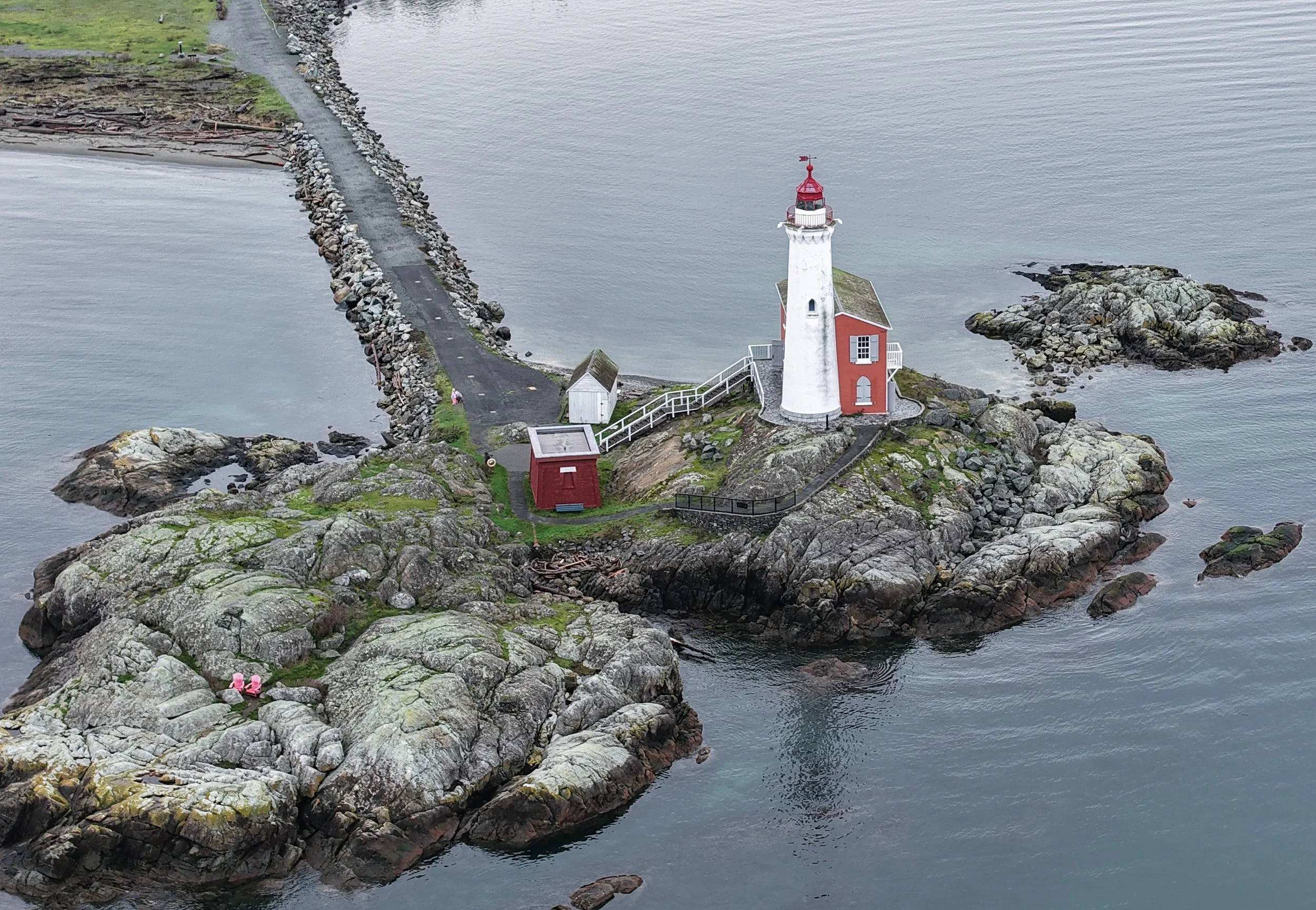
Fisgard Lighthouse
Flying a drone in Victoria feels like it should be straightforward. Beaches, ocean, skylines, mountains, and some of the best morning light you’ll find anywhere. And honestly — most of the time, it is straightforward.
You just need a bit of local awareness before you head out.
Greater Victoria has a lot going on in the air. Floatplanes are part of daily life. Helicopters come and go. There’s Coast Guard activity, military traffic nearby, and the YYJ control zone covers more ground than people expect. None of that means you can’t fly — it just means this isn’t empty sky.
That applies whether you’re flying a big drone or a tiny one.
A micro drone gives you flexibility, but it doesn’t give you a free pass to ignore what’s around you. The good news is that most common-sense flying already lines up with the rules: stay away from people, don’t hover over crowds, and don’t do anything that makes others uncomfortable. If someone didn’t agree to be part of your flight, they shouldn’t be under it.
One thing that helps a lot around here is timing. Early mornings are hard to beat. The light is better, the air is calmer, and there are usually far fewer people around. It’s simply a nicer way to fly — less pressure, fewer distractions, and nobody wondering what the buzzing noise is over their head.
That’s mostly how we fly now. Sometimes it’s professional work with a larger drone, planned properly and done by the book. Other times it’s much simpler — flying a small DJI Neo 2 alongside my four-year-old son, taking turns, laughing at less-than-perfect landings, and packing it up once we’ve had our fun. Same place, same rules, very different pace.
One thing that surprises people is that airspace isn’t always the only thing to think about. Even if the sky itself is fine, there can be separate rules tied to land use or specific locations. They’re not always obvious, and they don’t always line up neatly with what the airspace map shows. It’s just part of flying in a place as layered as Victoria.
And this is the part most people don’t realize until they’re already into it — if you just need photos, video, or a clear look at something, dealing with all of this can be more hassle than it’s worth.
If that’s where you’re at, that’s literally what I do.
I handle the planning, airspace checks, and flying properly so you don’t have to figure it out. Most jobs are quick — a short visit, get the shots, and send everything over. Construction, inspections, properties, or just getting a better look at something from the air. A lot of aerial photo or video work realistically lands somewhere in the $200–$300 range depending on the location and what’s needed.
If you’ve got something in mind, send me what you need and where it is. I’ll tell you straight up if it makes sense and what it’ll cost.
The easiest rule to follow is also the simplest: if a spot feels busy, awkward, or like it might irritate people, come back another time. Vancouver Island isn’t short on beautiful places to fly, and there’s always another quiet morning waiting.
Despite the quirks, this is an incredible place to fly a drone. Long coastlines, dramatic weather, calm stretches of water, and endless views make it worth taking the time to do it right — and to enjoy it.
Go fly.
Be aware of what’s around you.
Be respectful of other people.
And enjoy seeing Vancouver Island from above.
Related Articles
Hiring a Drone Pilot in Victoria, BC — What It Costs and What You Get
Straightforward pricing, what’s included, and what the process looks like if you need aerial photos, video, inspections, or a better look at something from above.
Teaching Kids to Fly a Drone for the First Time
A simple, real-world look at getting kids started with drones safely — what to watch for, what to avoid, and why the Neo 2 makes it easier than people expect.
Best Drone for Kids (2026): What I’d Actually Buy (and Why)
A practical buying guide for parents who want something fun, tough, and easy enough for kids to actually use without turning it into a stressful mess.
DJI Mini 5 Pro Review: A Compact Drone That Brings the Big Guns
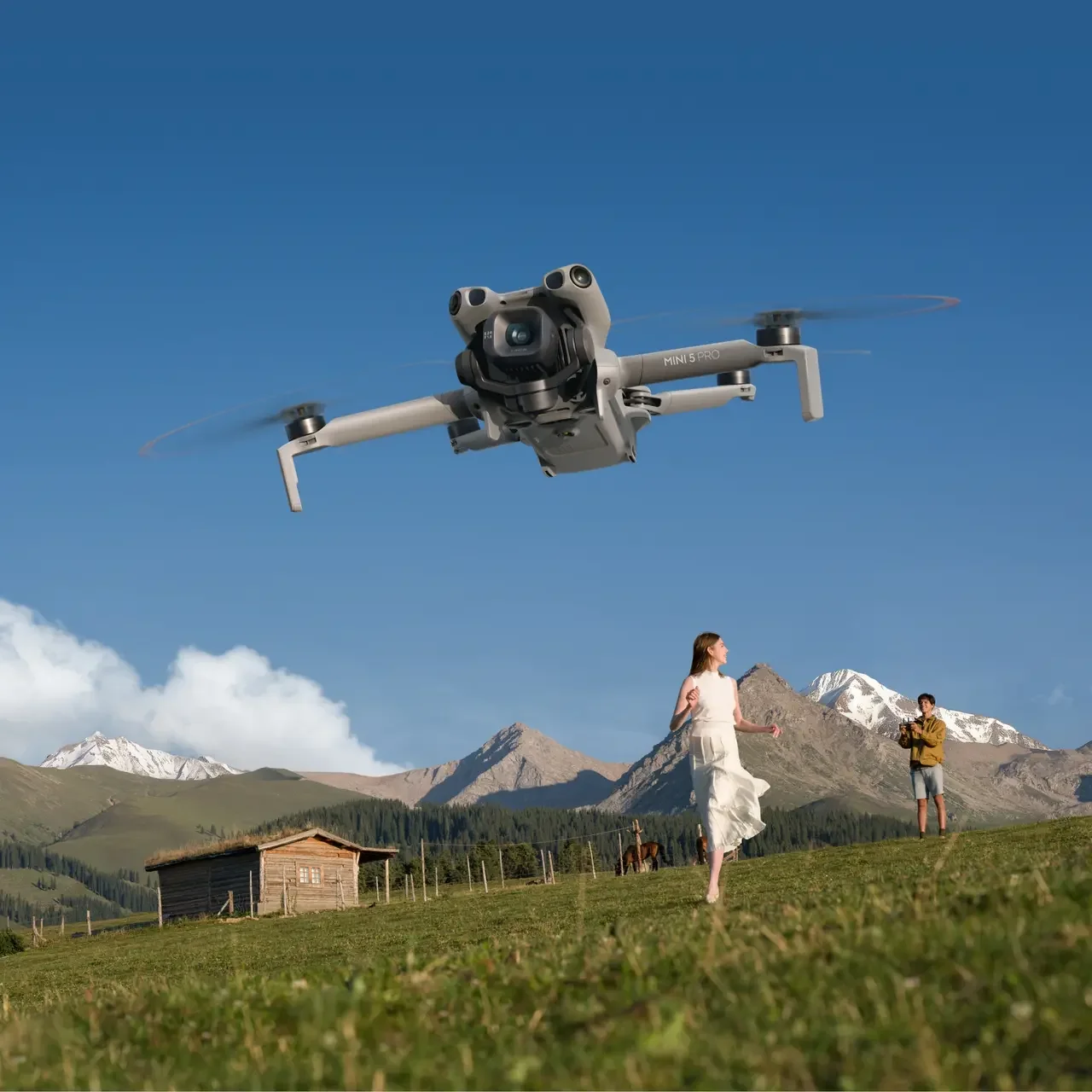
The DJI Mini 5 Pro is one of those drones that makes you pause, reread the specs, and then say, “Wait… seriously?”
Because on paper, this thing looks less like an incremental update and more like DJI asking, “How much flagship tech can we cram into a compact body before people start checking for hidden asterisks?”
Spoiler: there aren’t many.
This isn’t a debate piece or a hot take. It’s a straight gear review. And from a pure features-for-the-money standpoint, the Mini 5 Pro is a very impressive piece of kit.
A Proper 1-Inch Sensor Changes the Game
The headline feature is the 1-inch CMOS camera, and yes, it matters as much as people think it does.
You get noticeably better dynamic range, cleaner shadows, and much stronger low-light performance compared to earlier Mini models. Sunrise, sunset, overcast coastal days, and mixed lighting scenes all benefit here. This is the kind of sensor you’d normally expect to see on much larger drones, not something you casually toss into a backpack.
If image quality is your priority, this alone puts the Mini 5 Pro in a different league.
Nightscape Obstacle Avoidance Is a Big Deal
DJI’s nightscape omnidirectional obstacle sensing isn’t just marketing fluff. This is real, confidence-boosting tech.
Flying near trees, buildings, docks, or uneven terrain is less stressful when the drone actually understands what’s around it, even in lower light. It doesn’t replace good judgment, but it absolutely raises the safety floor — especially for creators who fly in real environments instead of empty demo fields.
That Gimbal Is Way More Interesting Than It Sounds
The 225° flexible gimbal rotation combined with true vertical shooting is quietly one of the coolest parts of the Mini 5 Pro.
This isn’t just about social media verticals. It’s about creative freedom. You can frame shots in ways that previously required awkward maneuvers or compromises. Being able to rotate, tilt, and reframe without fighting the aircraft opens up genuinely useful creative options.
It’s one of those features you don’t fully appreciate until you start using it.
ActiveTrack 360° Keeps Getting Smarter
DJI’s ActiveTrack 360° continues to be one of the best subject-tracking systems in the drone world.
It’s smoother, more reliable, and better at maintaining framing while navigating around obstacles. Whether you’re tracking a person, a vehicle, or movement along a shoreline or trail, it feels more intentional and less “hope this works.”
For solo creators, this kind of tech is invaluable.
Battery Life That Actually Helps You Relax
The extended battery life isn’t just about flying longer — it’s about flying calmer.
More time in the air means fewer rushed decisions, fewer “one more quick shot” moments, and better overall results. You can wait for light to shift, try alternate angles, or simply slow down and fly with intention.
That matters more than raw flight time numbers.
So Who Is the Mini 5 Pro For?
The Mini 5 Pro makes a lot of sense for creators who want high-end imaging, strong safety features, and serious creative flexibility in a compact, portable package.
It’s especially appealing if you:
travel frequently
value image quality above all else
shoot in mixed or low-light conditions
want advanced tracking and obstacle avoidance
prefer one drone that does a lot very well
At its price point, there really isn’t much else that offers this combination of camera, sensing, tracking, and gimbal flexibility in such a compact form.
Where It Fits in the Bigger Picture
The reason the Mini 5 Pro is getting so much attention isn’t controversy or hype — it’s capability.
DJI packed a feature set normally reserved for larger, more expensive drones into something that’s easy to carry, quick to deploy, and genuinely fun to fly. Whether you’re shooting landscapes, travel footage, social content, or creative projects, the Mini 5 Pro delivers an impressive amount of performance for its size.
Want More Details?
We keep links to official specs, features, and DJI’s own product information on our DJI Drones & Accessories page. We’re not affiliated with DJI and don’t earn anything from those links — they’re simply there as a reference if you want to dig deeper.
Bottom line: the DJI Mini 5 Pro is a seriously capable drone that punches well above what most people expect from something this compact. If you’re shopping in this category and want maximum features without stepping into a much larger platform, it’s easy to see why this drone is getting so much attention.
And yeah — it’s pretty fun to fly, too.
Related Articles
Business & Property Drone Services
Professional aerial photos and video for businesses, restaurants, hotels, and properties across Greater Victoria — handled safely, legally, and without guesswork.
Construction Drone Services
Progress tracking, site documentation, and inspections for construction projects in the Westshore and Greater Victoria, with compliant and insured operations.
DJI Drones & Accessories
Straightforward reviews and recommendations for DJI drones and accessories, based on practical experience and long-term use.
The DJI Drones & Accessories We Actually Recommend (and Why)
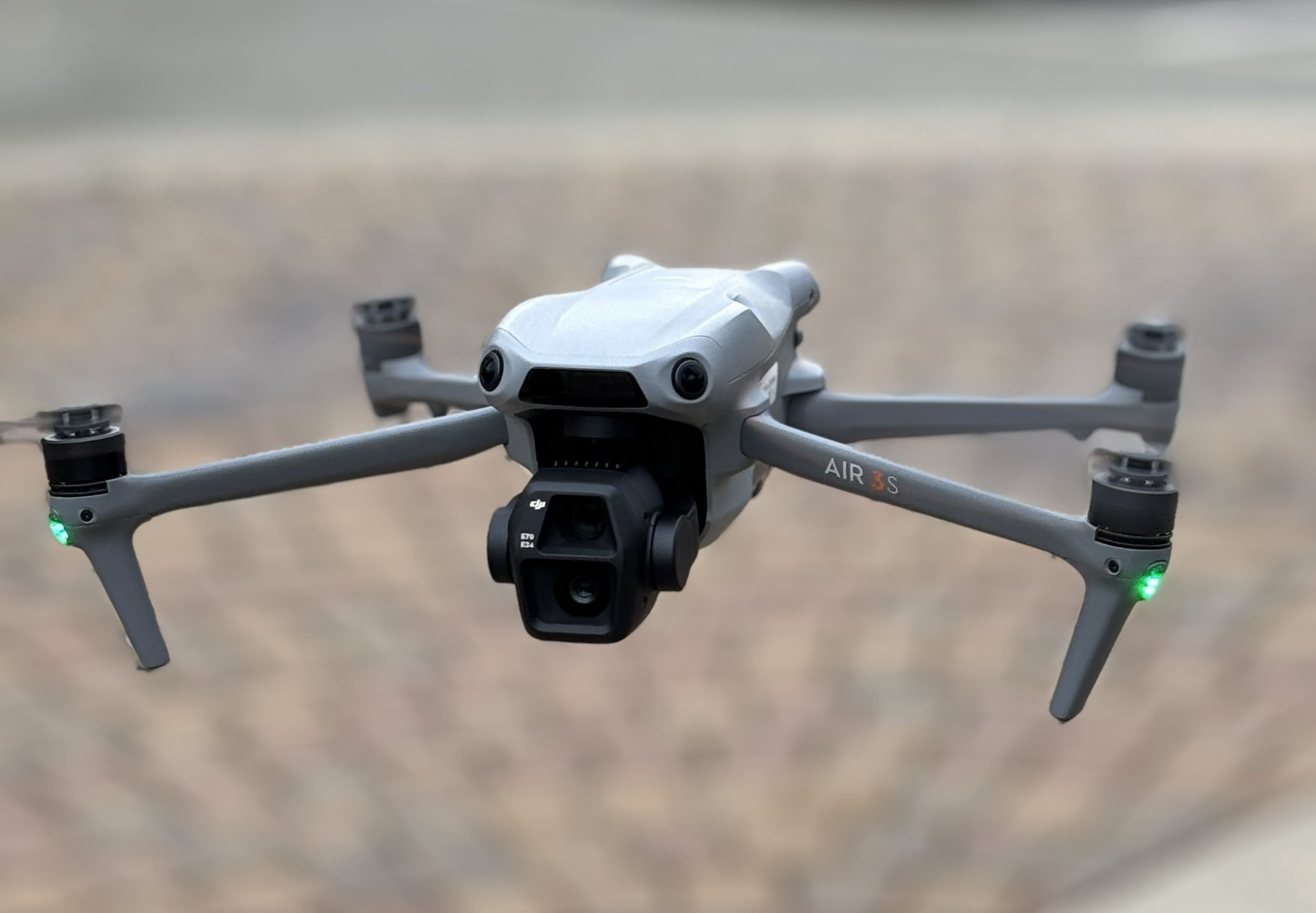
Our DJI Air 3S
This page exists because we get asked this question a lot.
What drone should I buy?
What accessories actually matter?
What do you fly when it’s not a YouTube thumbnail or a spec sheet?
So instead of answering that one conversation at a time, we finally put it all in one place.
Not a store.
Not a “top 10” list.
Just the drones and tools we either fly ourselves, or recommend because they’re well-built, well-priced, and genuinely useful.
What we fly
Our main workhorse is the DJI Air 3S.
It’s the drone that actually goes up when something matters. Dual cameras, reliable low-light performance, long flight times, and the kind of consistency you want when you’re flying early mornings, coastal conditions, or controlled airspace. It’s not flashy. It just works. That’s why it gets used.
At the other end of the spectrum is the DJI Neo 2, which has become Blake’s drone.
And honestly, it’s one of the most impressive things DJI has built in years.
It’s tough, simple, and unintimidating. Palm takeoffs, gesture control, solid tracking, and full prop guards mean a four-year-old can fly it confidently without turning it into a stress event. We use it for family stuff, quick clips, and just having fun. The fact that it shoots stabilized 4K at that price still feels a little ridiculous.
Different drones. Same philosophy. If it earns its place, it stays.
About the gear page
The new Gear page is a rotating list.
Some of the items on it are things we fly every week. Some are accessories we own and use regularly. Others are tools we recommend because they solve real problems without overcomplicating things.
Batteries that don’t quit early.
Bags that actually fit your kit.
Cards that don’t fail mid-flight.
Small upgrades that make flying easier, not fussier.
It’s intentionally curated. We don’t want everything. We want the right things.
You can see the full list here:
DJI Drones & Accessories Worth Buying
Why we’re doing it this way
This isn’t about pretending we’re a retailer.
It’s about being useful.
If you’re new to drones, this saves you from buying the wrong thing.
If you already fly, it might confirm what you’re looking at next.
If you’re just curious, it gives you a realistic snapshot of what actually gets used in the real world.
The list will change over time as gear changes and prices shift. The standard stays the same.
If it flies well, holds up, and makes the experience better, it belongs.
Related Articles
Business & Property Drone Services
Professional aerial photos and video for businesses, restaurants, hotels, and properties across Greater Victoria — handled safely, legally, and without guesswork.
Construction Drone Services
Progress tracking, site documentation, and inspections for construction projects in the Westshore and Greater Victoria, with compliant and insured operations.
DJI Drones & Accessories
Straightforward reviews and recommendations for DJI drones and accessories, based on practical experience and long-term use.
Why Businesses on Vancouver Island Benefit From Drone Photography

Most businesses already have plenty of photos.
Menus, interiors, people smiling at tables, drinks on patios. Those images matter, but they also tend to look like everyone else’s. What’s often missing is context. Where the business actually is, what surrounds it, and why the location itself is part of the experience.
That’s where aerial imagery makes sense.
Vancouver Island Drones provides professional drone services for businesses and properties across Vancouver Island, with a focus on restaurants, cafés, hotels, resorts, and unique commercial spaces where setting and surroundings add real value.
Showing the Part People Don’t See From the Ground
On Vancouver Island, location is often the selling point.
A waterfront patio, a tucked-away café, a resort surrounded by trees, or a building with views people don’t fully appreciate from the parking lot. Aerial photos and video help tell that story in a single glance.
Instead of just showing what’s on the table or inside the building, aerials show:
Where the business sits
How close it is to the ocean, forest, or town
The scale and layout of the property
The overall atmosphere before someone ever arrives
It’s not about hype. It’s about giving people a clear sense of place.
Where Aerials Make the Most Sense
Aerial imagery works especially well for businesses and properties where surroundings matter as much as the service itself.
Common examples include:
Restaurants, cafés, and pubs with patios, views, or outdoor spaces
Hotels and resorts highlighting buildings, grounds, and location
Lodges and destination-style properties
Unique or commercial properties where context adds appeal
Website updates, social media, and seasonal marketing
Used alongside ground-level photography, aerials add a layer most businesses don’t have. And that difference tends to stand out.
Planned, Legal, and Low-Impact Flying
Drone work around businesses isn’t something you just show up and wing.
All flights are planned in advance and conducted in accordance with Transport Canada regulations. That includes airspace checks, authorization when required, and careful planning around guests, staff, and day-to-day operations.
Flights are done discreetly and at appropriate times. If a location isn’t suitable to fly, or conditions aren’t right, that’s communicated upfront.
The goal is simple: capture strong visuals without disrupting the business or the guest experience.
What You Receive
Depending on the project, deliverables typically include:
High-resolution aerial photos
Stabilized 4K video footage
Edited visuals ready for websites, social media, or marketing use
Digital delivery in practical formats
If there’s a specific goal in mind, it’s best discussed early so the flight and deliverables are planned around it.
Flexible, Project-Based Work
There are no rigid packages or one-size-fits-all pricing.
Some businesses need a one-time shoot. Others want occasional updates or visuals for a new website or campaign. Everything starts with a short conversation to understand the property, the goal, and whether aerial imagery is actually the right fit.
If it makes sense, we move forward. If it doesn’t, you’ll know that too.
Other Aerial Projects
While business and property work is a major focus, other project-based aerial requests are considered depending on location, airspace, and overall fit.
If you’re unsure whether your project applies, it’s always worth asking.
Let’s Talk
If you own or manage a business or property on Vancouver Island and think aerial imagery could help, I’m happy to talk it through.
No pressure. Just a straightforward conversation to see if it makes sense.
You may also be interested in:
Construction Drone Services
Professional Drone Services on Vancouver Island
Related Stories
DJI Lito X1 vs Mini 4 Pro: This Changes What Drone I Recommend in Canada
A closer look at how the Lito X1 stacks up against the Mini 4 Pro — and why it might be the better buy for most people now.
DJI Neo 2 After 3 Months — Still Worth It?What happens after the novelty wears off. Real use, real bumps, and why this thing still comes everywhere with us without even thinking about it.
Hiring a Drone Pilot in Victoria, BC — What It Costs and What You Get
Straightforward pricing, what’s included, and what the process looks like if you need aerial photos, video, inspections, or a better look at something from above.
Why Construction Companies in Victoria Use Drone Photography

Construction sites move quickly, and getting accurate eyes on a site shouldn’t slow work down or create extra risk. In many cases, all that’s needed is a clear visual record, not a ladder, scaffolding, or someone climbing into an awkward position.
Construction drone services provide a safer, faster way to see what’s happening on site using high-resolution aerial photography and 4K video, captured from the ground.
Vancouver Island Drones offers compliant, professional construction drone services across the Westshore and Greater Victoria, focused on documentation, visibility, and practical decision-making.
A Safer Alternative to Ladders, Scaffolding, and Risky Access
One of the biggest advantages of using a drone on a construction site is safety.
Instead of putting someone on a ladder, up on scaffolding, or in a position that exists solely to “get a look,” a drone can be flown from the ground and capture the same information in minutes.
High-resolution photos and 4K video allow teams to:
View roofs, elevations, and structures without climbing
Check hard-to-reach areas without exposing workers to unnecessary risk
Review footage later instead of making repeat site access trips
Share clear visuals with off-site stakeholders without additional walkthroughs
In many cases, a drone flight replaces what would otherwise require temporary access equipment, safety gear, extra setup time, or additional insurance considerations.
The goal isn’t to replace trades, inspectors, or proper safety procedures. It’s to reduce avoidable exposure when visual information is all that’s required.
Practical Uses on Active Job Sites
Construction drone services are typically used for:
Progress tracking and visual records over time
Site overviews for owners, developers, and project managers
Visual checks of roofs, structures, and elevations
Documentation before, during, and after key project phases
Context imagery for planning, reporting, or issue resolution
The deliverables are straightforward and usable. Clear images and video that help people make decisions, not cinematic fluff.
Why Professional and Certified Operations Matter
Active construction sites are not simple flying environments. Workers, equipment, structures, and nearby airspace all introduce risk if flights are not planned properly.
Vancouver Island Drones operates with:
Transport Canada Advanced RPAS certification
Insured operations
Airspace checks and site surveys
Planned flights appropriate for active worksites
This ensures flights are legal, controlled, and suitable for use in professional documentation and reporting.
Local Experience in Victoria and the Westshore
Many construction projects in Greater Victoria fall within controlled or complex airspace. Being Westshore-based means understanding the local realities before a drone ever leaves the ground.
Local familiarity helps with:
Identifying airspace constraints early
Planning flights that won’t cause delays
Operating within real Island conditions, not ideal scenarios
The focus is always on practical results, not forcing a flight where it doesn’t make sense.
How Construction Clients Use the Deliverables
Most clients use construction drone imagery for:
Internal coordination and updates
Sharing progress with remote stakeholders
Visual records alongside reports or schedules
Documentation at key milestones
High-resolution photos and 4K video provide a clear, defensible record without additional site disruption.
Getting Started
Every site is different. Vancouver Island Drones works on a conversation-first basis to understand:
Location and airspace
Scope and timing
What the imagery will actually be used for
From there, a simple, compliant plan is put in place.
Related Stories
Business & Property Drone Services
Professional aerial photos and video for businesses, restaurants, hotels, and properties across Greater Victoria — handled safely, legally, and without guesswork.
Construction Drone Services
Progress tracking, site documentation, and inspections for construction projects in the Westshore and Greater Victoria, with compliant and insured operations.
DJI Drones & Accessories
Straightforward reviews and recommendations for DJI drones and accessories, based on practical experience and long-term use.