The Captain’s Log
Aerial stories, father–son adventures, and life on the edge of the Pacific.
The DJI Mini 4 Pro Is Insane Value Right Now
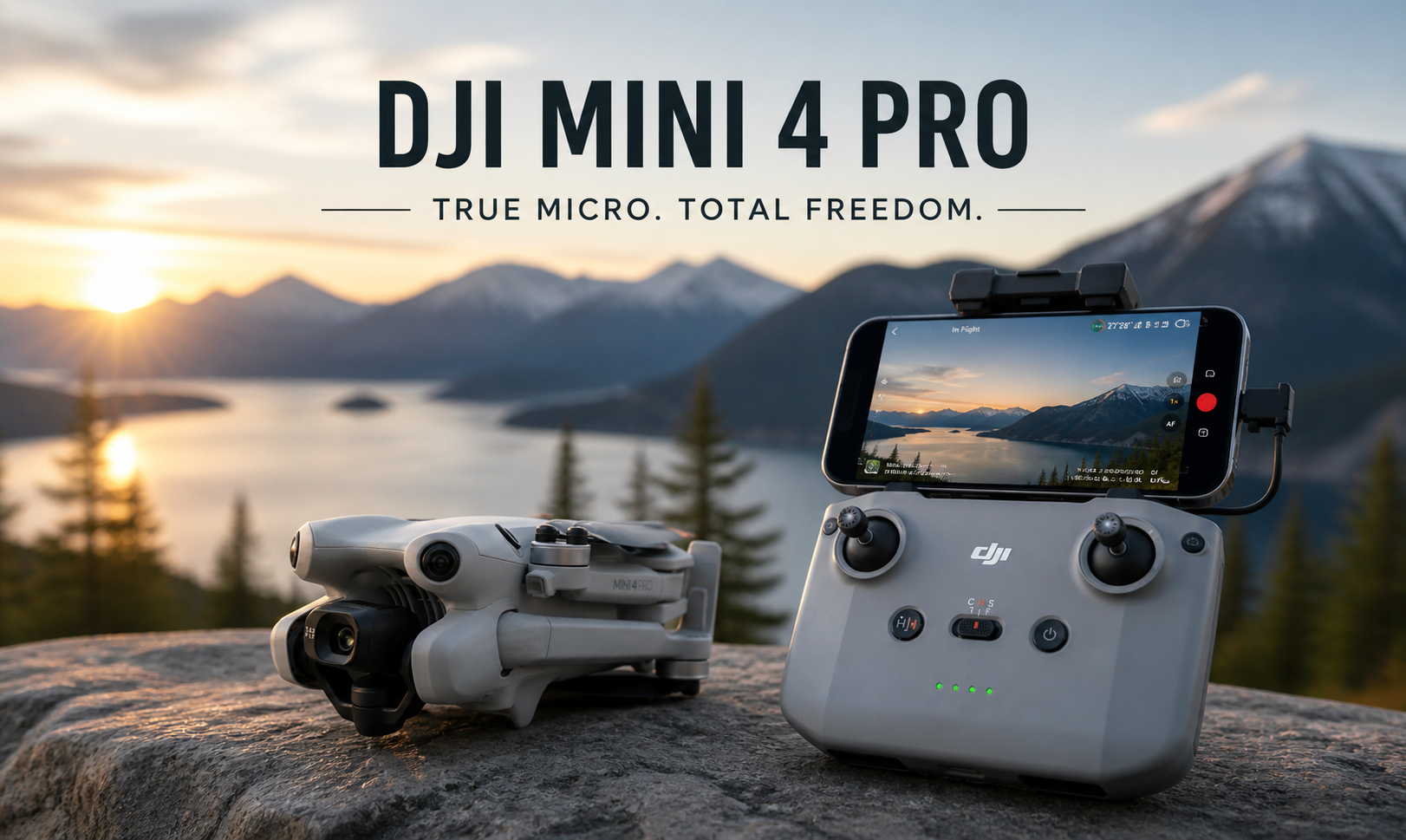
DJI Mini 4 Pro
If you’re shopping in DJI’s Mini lineup, there’s usually one very specific reason:
You want a micro drone.
Sub-250 grams.
Fewer rules.
Less paperwork.
Less “am I even allowed to fly here?”
That’s the whole deal.
And that’s exactly why the DJI Mini 4 Pro is such a strong buy right now.
A quick reality check on the Mini 5 Pro (for context)
When the Mini 5 Pro launched, it was intended to be a micro drone.
In practice, once people actually put them on scales, the story changed. In many countries — including here — the Mini 5 Pro is not classified as a micro drone. That immediately puts it into a different regulatory category, with more restrictions.
Now, to be clear: this isn’t a Mini 5 Pro hate post. It’s a great drone.
We’re not judging it for being a little bit chubby.
We’re rocking dad bods too. No shame here.
But just like with jeans, once you’re not fitting into the “skinny” category anymore, you don’t get the benefits of pretending you do. You buy the bigger shirt, you accept reality, and you move on.
And in drone terms, once you’re not a micro drone, you’re playing a different game.
Why that makes the Mini 4 Pro such a smart buy
The Mini 4 Pro doesn’t live in that gray zone.
It is classified as a micro drone.
Cleanly.
Consistently.
Without scale anxiety.
That means:
fewer restrictions
less second-guessing
less regulatory mental load
You fly responsibly and enjoy the drone for what it’s meant to be.
That simplicity is the entire point of the Mini category.
And you’re not giving up much to get it
This is where the value argument really lands.
The Mini 4 Pro isn’t some stripped-down compromise. It’s packed with genuinely useful features, strong image quality for its size, and smart flight modes that actually work in the real world.
It feels finished. Mature. Proven.
If you want DJI’s official breakdown of features and specs, you can see it all on DJI’s Mini 4 Pro product page — this post is more about whether it makes sense to buy, not reading marketing slides.
Timing matters (and this is excellent timing)
Here’s the quiet bonus.
Because the Mini 5 exists, the Mini 4 Pro price has come down.
That’s how this always works:
new model launches
attention shifts
the previous one becomes the value play
Right now, you’re getting:
a true micro drone
with strong, modern features
at a reduced price
without regulatory gymnastics
That’s a rare combo.
If it’s not a micro, it needs to earn it
Once a drone isn’t classified as a micro, it needs to justify the extra rules by being meaningfully better.
That’s why the Air 3S makes sense. It costs more, but it earns that cost with real advantages: stability, confidence in wind, dual lenses, and flexibility. It justifies the rules it comes with.
The Mini 4 Pro does the opposite.
It justifies staying small.
And that’s why it works.
Who the Mini 4 Pro is actually for
This drone makes the most sense if you:
want true sub-250 simplicity
don’t want to think about regulations every time you fly
want something capable but low-friction
don’t feel the need to own the newest thing just because it’s new
If you’re buying a Mini because it’s a Mini, this is the one that still delivers on that promise.
Bottom line
No judgment toward the Mini 5 Pro. We’re all carrying a little extra these days.
But if you’re shopping specifically for a micro drone, the DJI Mini 4 Pro is still doing exactly what it was designed to do — and now it costs less than it used to.
That’s why it’s insane value right now.
Sometimes the smartest buy isn’t the newest drone.
It’s the one that fits the rules, the reality, and your actual life.
DJI Mini 3: The Gateway Drug (or My First Beer)
How a harmless-looking micro drone started a much deeper journey.
Why the DJI Mini 5 Pro Doesn’t Make Sense (If It’s Not a Micro Drone)
If it’s over 249 grams, what’s the point?
Flying With Blake: Learning on the DJI Neo 2
Why micro drones still matter — especially when you’re teaching someone new.
DJI Neo 2 After One Month — Insane Value, Easy to Use, and Surprisingly Tough
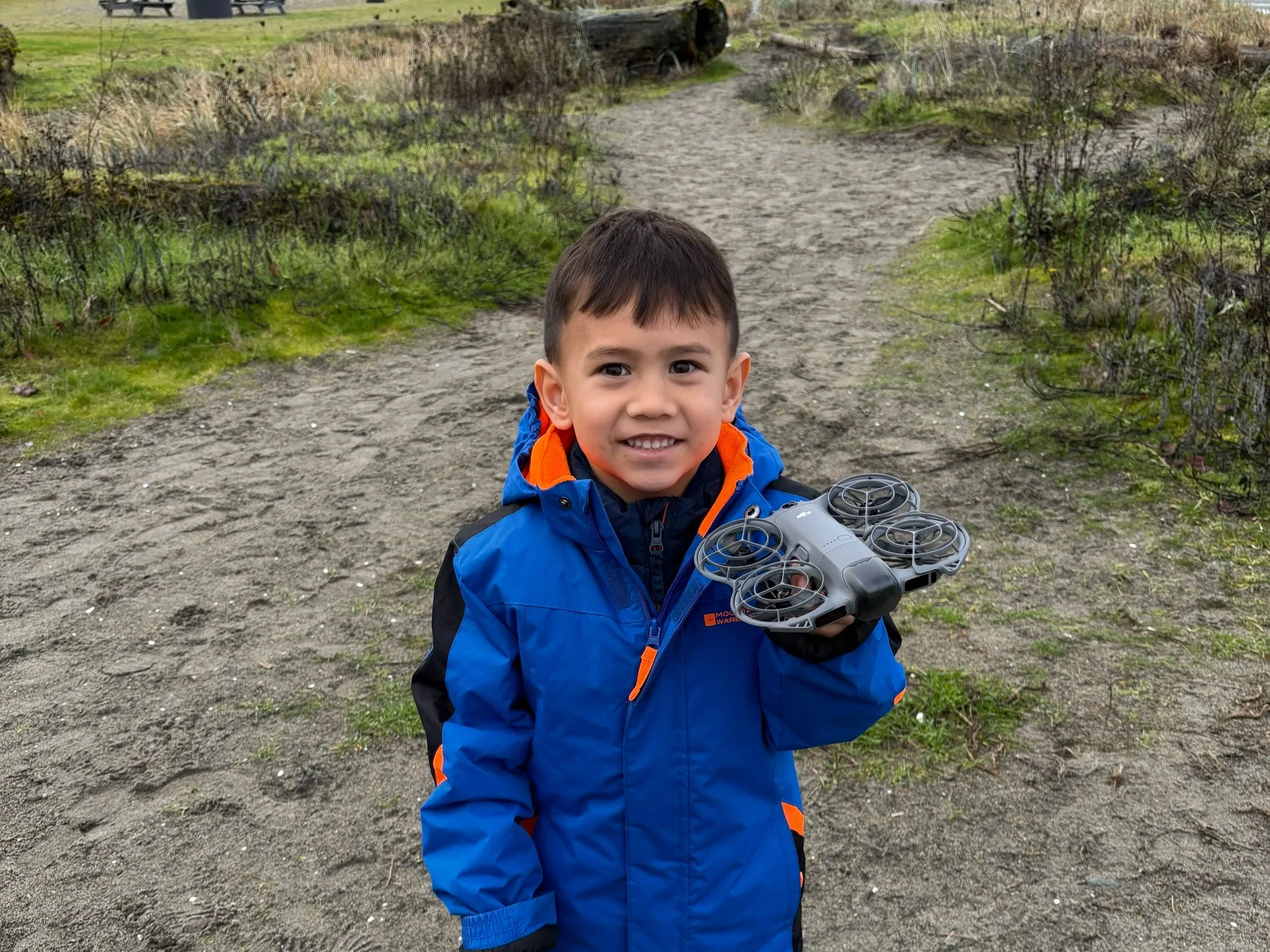
Christmas week on the beach with Blake and his first drone.
The DJI Neo 2 was Blake’s Christmas present, which comes with some very specific rules.
I’m allowed to:
Charge it
Download the footage
Untangle it from backpacks, jackets, and occasionally bushes
I am not usually allowed to fly it.
That hasn’t stopped this thing from getting used constantly over the last month.
First Impressions: No Manual, No Stress
The first day out, we didn’t read a manual.
We turned it on, held it in our hand, waved at it like idiots, and waited to see what would happen.
It worked.
Gesture controls clicked immediately. Takeoff, follow, basic framing — Blake figured it out faster than most adults figure out a new phone. That’s a big deal. If something’s confusing, a four-year-old abandons it instantly. If it makes sense, they stick with it.
The Neo 2 passed that test on day one.
Active Tracking: Genuinely Good (Collision Avoidance… Let’s Talk)
Active tracking has been surprisingly solid for a drone this small.
Walking, biking, running around the neighborhood, showing off new dance moves — it keeps up, stays framed, and does what it’s supposed to do most of the time.
Collision avoidance, however, is more of a friendly suggestion.
We’ve had bonks. A few of them. One particularly memorable one involved the drone tracking Blake directly into his helmet at the bike park. Helmet did its job. Drone survived. Blake laughed. The footage was excellent.
This is not a “set it and forget it” drone. You still need to supervise. Micro drone does not mean micro consequences.
Why This Thing Comes Everywhere With Us
Here’s the real magic.
There’s almost no startup tax.
No controller to power up.
No satellites to wait for.
No app updates killing the moment.
You pull it out of your pocket, press a couple buttons, and you’re flying.
Blake wants to bring it everywhere. Walks, bike rides, trips to the park. Because it’s small and light, it actually goes with us instead of staying at home “for next time.”
That’s why it gets used.
$300 Goes a Long Way Here
For roughly 300 bucks, the amount of technology packed into this thing is honestly kind of wild.
Gesture controls.
Active tracking.
Stabilized footage.
And the ability to survive a surprising number of minor impacts.
It’s not cinematic. It’s not replacing a proper drone. But the value is undeniable, especially if you care about actually capturing moments instead of planning to capture them someday.
You can get into a Neo 2 pretty cheaply, but if I were buying it again, I’d personally spend the extra money on the kit with the additional batteries and charging hub.
For a drone this easy to carry around, the extra batteries are actually useful. You’re much more likely to burn through a battery at the park, on a bike ride, or while travelling than you are to carefully plan one perfect flight and call it a day.
→ Check DJI Neo 2 bundle pricing on Amazon
If you want the official breakdown of features and specs, DJI’s Neo 2 product page covers it — this post is more about how it actually behaves in the real world.
What I’ve Played With (And What I Haven’t)
Most of our use so far has been gesture control and active tracking. That’s where the Neo 2 shines, and that’s what Blake keeps going back to.
I briefly tried flying it with my phone, and honestly, I don’t think that’s the way to go for most people. It works, but it kind of defeats the whole point of how easy this drone is supposed to be.
That said, using the phone to quickly change settings — follow in front, follow behind, height, distance — while it was chasing my kid around the bike park was actually pretty cool. Being able to change angles on the fly without landing adds a lot of flexibility.
We haven’t even scratched the surface on all the automated shots yet. That’s coming.
The Stuff I’m Looking Forward To (If I Ever Get Flight Privileges)
At some point, I’m hoping to connect this thing to my RC2 controller from the Air 3S and see how it feels with proper sticks.
I think it’ll be fun.
Whether that happens anytime soon is… unclear.
For now, I’m mostly on charging and download duty.
One Month In: The Honest Take
After a month of real use:
The DJI Neo 2 is ridiculously easy to use.
It offers insane value for the money.
It’s tougher than it looks.
And it gets used because it’s not a hassle.
Between the bonks, the bike rides, and the ever-evolving dance routines, this little drone has already earned its keep.
If you’re thinking about buying one, I’d personally skip the absolute cheapest package and get the kit with the extra batteries and charger. That’s the version that makes the most sense to me for how this drone actually gets used.
→ Check current DJI Neo 2 bundle pricing on Amazon
When I eventually get to fly it properly, we’ll see how far it can be pushed. Until then, it’s doing exactly what it’s supposed to do.
As an Amazon Associate, Vancouver Island Drones may earn from qualifying purchases made through links on this page.
Watch It in Action
Below is a video showing what the Neo 2 actually gets used for — tracking, gestures, bike rides, dance moves, and yes, a few bonks along the way.
Related reads
DJI Mini 3: The Gateway Drug (or My First Beer)
How a harmless-looking micro drone started a much deeper journey.
Why the DJI Mini 5 Pro Doesn’t Make Sense (If It’s Not a Micro Drone)
If it’s over 249 grams, what’s the point?
Flying With Blake: Learning on the DJI Neo 2
Why micro drones still matter — especially when you’re teaching someone new.
Why Does Everyone Have a Tent on Their Roof?
Rooftop tents, unused recovery boards, airport-grade lighting and the strange urge to outfit every vehicle for an expedition to Costco.
Living With the DJI Air 3S on Vancouver Island
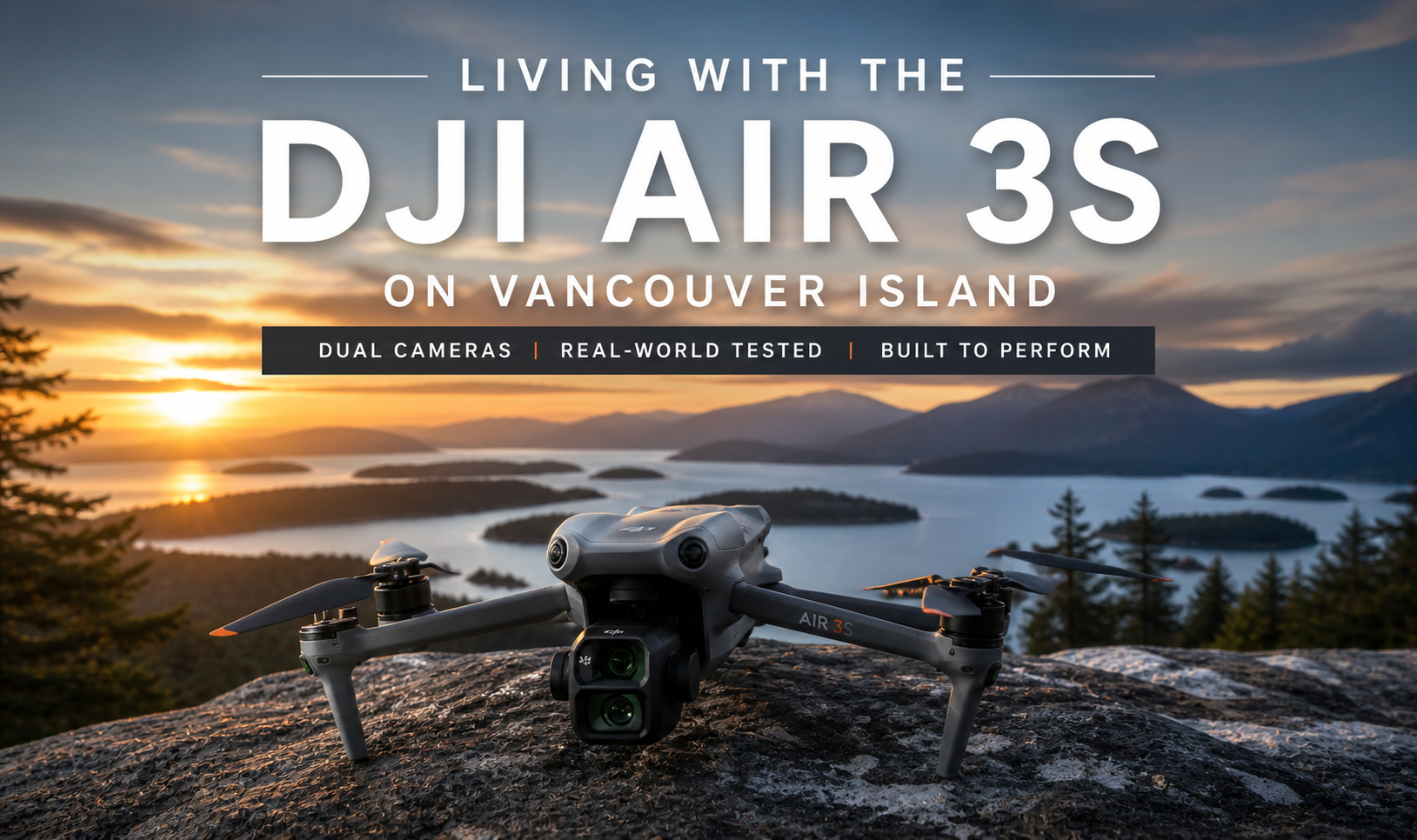
Shot with DJI Air3S
I’ve been flying the DJI Air 3S for a while now across Vancouver Island, mostly in real-world conditions—coastal wind, changing light, early mornings, and familiar locations shot repeatedly over time. After living with it, I’m comfortable saying this: for the money, it’s one of the best drones available in Canada if you’re willing to get an Advanced RPAS license.
That license requirement alone will steer some people toward smaller drones, but if you’re already considering something beyond a micro, the Air 3S deserves serious attention.
For reference, DJI’s official Air 3S product page lays out the full specs and feature set if you want the manufacturer’s overview.
→DJI’s official Air 3S product page
Dual lenses change how you shoot
The dual-camera setup is one of the biggest reasons I enjoy flying the Air 3S. Being able to switch focal lengths mid-flight makes a huge difference when revisiting the same locations.
From similar takeoff points and angles, I can get:
wider contextual shots
tighter, more compressed compositions
different storytelling options without repositioning the aircraft
It keeps familiar places feeling fresh and gives you flexibility that’s hard to go back from once you’ve used it.
Wind resistance matters more than specs
On paper, smaller drones can look appealing. In practice—especially on the Island—weight matters.
Compared to a Mini, the Air 3S:
handles wind far better
feels more planted and predictable
inspires confidence in marginal conditions
That stability translates directly into better photos and video, and less second-guessing when conditions aren’t perfect.
Image quality and collision avoidance
The image quality has been consistently solid for what I shoot: coastal landscapes, sunrises, and elevated context shots. Combined with robust collision avoidance, the Air 3S feels like a tool you can trust rather than babysit.
It’s also rugged. At one point, we unexpectedly clipped a branch. The drone went down, but it was my ego that took the bigger hit—the Air 3S came out of it without issue. That kind of durability matters when you’re flying regularly, not just on perfect days.
ND filters and real-world usability
DJI’s ND filters for the Air 3S are easy to use and integrate well into a normal workflow. They’re not something you fight with or overthink—you put them on and get back to flying.
The drone itself isn’t particularly loud for its size, which helps when flying early or in quiet environments. It’s not silent, but it’s well-balanced and unobtrusive for a drone in this class.
Why I’d choose this over a Mini in Canada
This is where things get interesting for Canadian pilots.
With recent changes, drones like the DJI Mini 5 Pro are no longer classified as micro drones in Canada. Once you’re no longer operating under micro-drone rules, the advantage of going “Mini” starts to disappear.
If you’re already committing to:
registration
compliance
additional rules
Then it’s worth asking whether stepping up to the Air 3S makes more sense.
Yes, it costs more.
But in return, you get:
better wind handling
better cameras
collision avoidance
dual lenses
a more capable, longer-term platform
For many pilots, that step up is worth it.
From Mini 3 to Air 3S
We started with a Mini 3, and it was absolutely a gateway drone. It taught us the basics and confirmed that this was something we wanted to take seriously.
Rather than upgrading incrementally again, moving straight to the Air 3S made sense. It’s a drone you can grow into instead of outgrowing quickly.
Final thoughts
After months of use, I’m genuinely happy with the Air 3S. No regrets, no disappointments, and no feeling that I settled.
If you’re flying in Canada, willing to pursue an Advanced licence, and want a drone that balances capability, durability, and flexibility, the DJI Air 3S remains a very strong choice.
Related Reads
Hiring a Drone Pilot in Victoria, BC — What It Costs and What You Get
Straightforward pricing, what’s included, and what the process looks like if you need aerial photos, video, inspections, or a better look at something from above.
DJI Lito X1 vs Mini 4 Pro: This Changes What Drone I Recommend in Canada
A closer look at how the Lito X1 stacks up against the Mini 4 Pro—and why it might be the better buy for most people right now.
DJI Neo 2 After 3 Months — Still Worth It?
What happens after the novelty wears off. Real use, real bumps, and why this thing still comes everywhere with us without even thinking about it.
To the Keyboard Warriors and Confident Strangers: A Friendly(ish) Drone Rant
This is a rant.
It’s not aimed at the general public.
It’s not aimed at curious people asking honest questions.
It’s aimed squarely at two groups:
Armchair keyboard warriors on social media
People who walk up to a drone pilot in real life and confidently announce, “That’s illegal.”
You know who you are.
Confidence Is Not the Same as Knowing the Rules
I fly drones legally. I follow the rules. I fly safely. I understand Canadian drone regulations, airspace, and operational requirements.
I do not:
• fly over people
• buzz crowds
• hover over picnic tables
• chase attention
And yet, without fail, there will always be someone who appears — either online or in person — armed with absolute confidence and absolutely no understanding of how drone law actually works.
That confidence is impressive.
Misplaced, but impressive.
You Can’t Declare a Drone Flight “Illegal” Without Knowing a Few Things
Here’s the part that really gets me.
You cannot walk up to a drone pilot and say, “That’s illegal,” unless you know at least three things:
How much the drone weighs
What license or certification the pilot holds
What the airspace restrictions are in that exact location
If you haven’t asked those questions — or don’t even know they matter — then you don’t actually know whether the flight is legal.
Full stop.
Drone legality in Canada is not determined by:
• how annoyed someone feels
• whether drones make them uncomfortable
• something they once read in a Facebook comment
It’s determined by weight class, certification, airspace, and how the flight is conducted.
I know those things.
Do you?
The Keyboard Warriors vs. The In-Person Experts
Online comments are annoying, but at least they’re predictable.
You post a calm sunrise shot and someone inevitably comments:
“Illegal.”
“Enjoy your $25,000 fine.”
“Drones aren’t allowed there.”
None of these people know:
• the drone’s weight
• the pilot’s certification
• whether the airspace is controlled
• whether NAV CANADA authorization was required or obtained
They’re just guessing, loudly.
But the real mood-killers are the people who come up to you in person and do the same thing.
They approach with confidence, start explaining the law, and within the first sentence or two it becomes painfully obvious they have no idea what they’re talking about.
And yes — this has happened while I was wearing a shirt that literally says Vancouver Island Drones.
At that point, it’s not concern.
It’s theatre.
No, the City Is Not Going to Fine Me (Especially for Using My Own Footage)
One of my favourite myths is this idea that municipalities are handing out massive drone fines based on photos they saw online.
I’ve had people tell me — with a straight face — that a city is going to fine me for flying in certain locations.
Here’s the funny part:
That same municipality has used my aerial footage. Multiple times. Officially. In community publications and materials.
So the idea that a city is quietly building a case against me, while simultaneously choosing my footage to represent the area, is… impressive logic.
Municipalities do not enforce aviation law.
They are not reviewing Instagram posts.
They are not issuing secret drone tickets.
Drone regulations in Canada are federally governed, and enforcement is incident- and safety-based — not vibe-based.
NAV CANADA is not scrolling social media looking for sunsets to prosecute.
I Fly Early, Quietly, and Away From People — On Purpose
Here’s the part that makes the accusations especially irritating.
I deliberately fly early in the morning.
Partly because I’m awake anyway.
Mostly because it’s quiet, peaceful, and safe.
I choose times when:
• nobody’s around
• there are no crowds
• foot traffic is minimal
I do this:
• to be safe
• to avoid irritating people
• to respect the space
• and, frankly, to avoid unnecessary confrontations
And for the record: once a modern drone is more than 20–30 feet up, you can barely hear it — if at all. Almost all of my shots are taken well above that.
I’m not buzzing people.
I’m not ruining anyone’s morning.
I’m trying very hard not to be the problem.
And yet, someone still feels the need to show up and announce that what I’m doing is illegal.
Nothing kills a beautiful sunrise faster than a stranger confidently explaining rules they don’t understand.
Questions Are Fine. Accusations Are Not.
If someone comes up and says:
“Hey, are drones allowed here?”
or
“Do you need special permission for that?”
That’s totally fine. Curiosity is fair.
What’s not fine is accusing someone of illegal activity without understanding the system at all.
If you don’t know:
• drone weight classes
• pilot certification
• airspace authorization
then maybe — just maybe — don’t lecture strangers about aviation law.
Just to be clear — none of this is an argument for doing dumb shit with drones.
I believe people should know the rules before they fly. If you’re operating anything beyond a toy, you should at least have the knowledge required to pass the Basic exam, even if you’re not legally required to hold a certificate. Fly safely. Fly away from people. Use common sense. Don’t irritate everyone around you. And don’t make things worse for the rest of us who are trying to do this responsibly.
Most pilots I know already operate this way. That’s the point.
Final Thought
This isn’t about hating people.
It’s not about ignoring concerns.
It’s not about doing whatever I want.
It’s about this:
If you don’t understand how drone regulations work in Canada, stop pretending that you do — especially with confidence.
Because the pilots who actually follow the rules are tired of having calm, beautiful moments interrupted by people who don’t know the basics but feel very sure anyway.
And if you’re another drone pilot reading this and nodding along:
Yeah. You’re not alone.
Related reads
DJI Mini 3: The Gateway Drug (or My First Beer)
How a harmless-looking micro drone started a much deeper journey.
Why the DJI Mini 5 Pro Doesn’t Make Sense (If It’s Not a Micro Drone)
If it’s over 249 grams, what’s the point?
Flying With Blake: Learning on the DJI Neo 2
Why micro drones still matter — especially when you’re teaching someone new.
Albert Head Lagoon — A Break in the December Rain
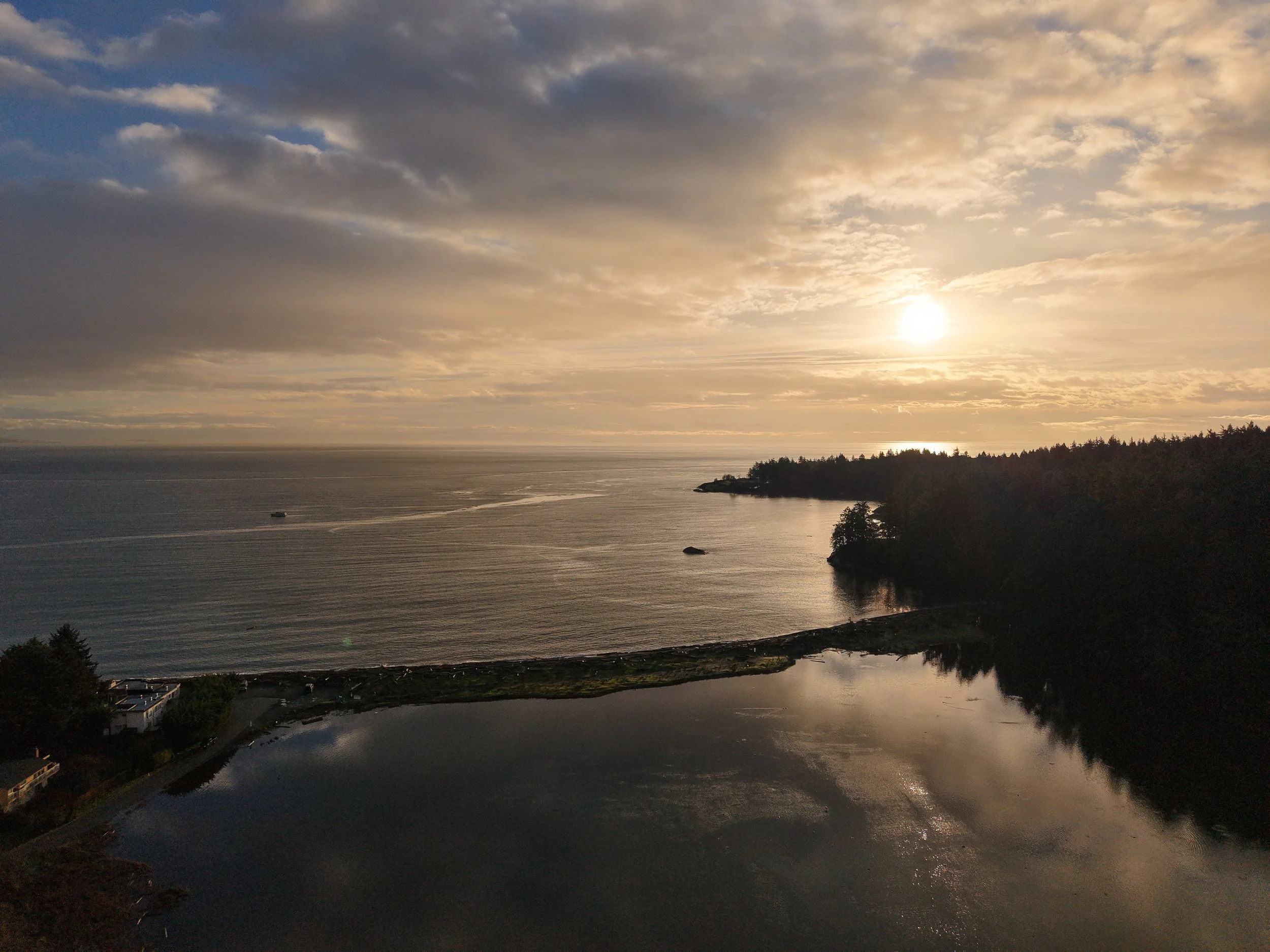
There are days on Vancouver Island where it feels like the rain isn’t just falling — it’s committed. Sideways, horizontal, relentless rain. The kind where you stop checking the forecast and just accept that everything is damp now, including your motivation.
This was one of those weeks.
I had the drone in the truck anyway. Not because I expected to fly, but because if you don’t bring it, that’s usually when the weather decides to behave out of spite.
Sure enough, while driving around on the west side of Victoria, the rain eased up just enough to suggest a brief ceasefire. Not a full clearing. Not blue skies. Just a quiet pause. And I happened to be a few minutes from Albert Head Lagoon.
So I made a quick beeline.
A quiet little surprise just outside Victoria
Albert Head Lagoon is one of those places that doesn’t announce itself. Tucked between the ocean and the forest, it’s easy to drive past without realizing how calm and sheltered it feels once you’re actually there — especially in winter.
In December, the lagoon takes on a different personality. Fewer people. Muted colours. Low clouds drifting just high enough to let the light sneak through when you least expect it. It’s quiet in a way that feels earned.
I got the drone up while the conditions allowed, keeping things simple and unhurried. No chasing shots. No dramatic moves. Just letting the place do its thing.
And for a few moments, the sun actually showed up.
Not long. Just enough.
Winter flying, Vancouver Island style
This wasn’t one of those cinematic, postcard-perfect mornings. It was very much a December flight. Grey skies, soft contrast, and that familiar West Coast palette where everything leans a little cooler and a little calmer.
But that’s exactly what made it work.
The lagoon reflected what little light there was. The shoreline wrapped around quietly. The ocean beyond stayed calm. It’s the kind of place that doesn’t need drama — it just needs a bit of patience.
I grabbed a handful of stills and a short video while the weather cooperated, then packed it up before the rain remembered what it was supposed to be doing.
A short film from a brief window
The result is a short December film from Albert Head Lagoon, captured during one of those fleeting breaks in the weather that make winter flying on Vancouver Island feel a bit like a game of chance.
Sometimes you win. Sometimes you don’t.
This time, the timing worked.
The video is embedded below if you’d like to watch it. It’s part of an ongoing series documenting some of my favourite quiet places around southern Vancouver Island — focusing on calm moments rather than fast edits or commentary.
More quiet West Coast locations to come — whenever the rain allows it.
More From Vancouver Island Drones
Aerial Photography & Video in Victoria — Why Everything Starts With a Conversation
A look at how we approach real, human, conversation-first aerial work in Greater Victoria.
Aerial Photographer in Victoria — What to Know Before Hiring One
Key things locals should look for when choosing a drone photographer who’s compliant, safe, and storytelling-minded.
Aerial Videographer in Victoria — What Makes Footage Stand Out
A breakdown of what separates cinematic, meaningful aerial video from basic flyovers.
How I Got My Transport Canada Advanced Drone License for Under $300
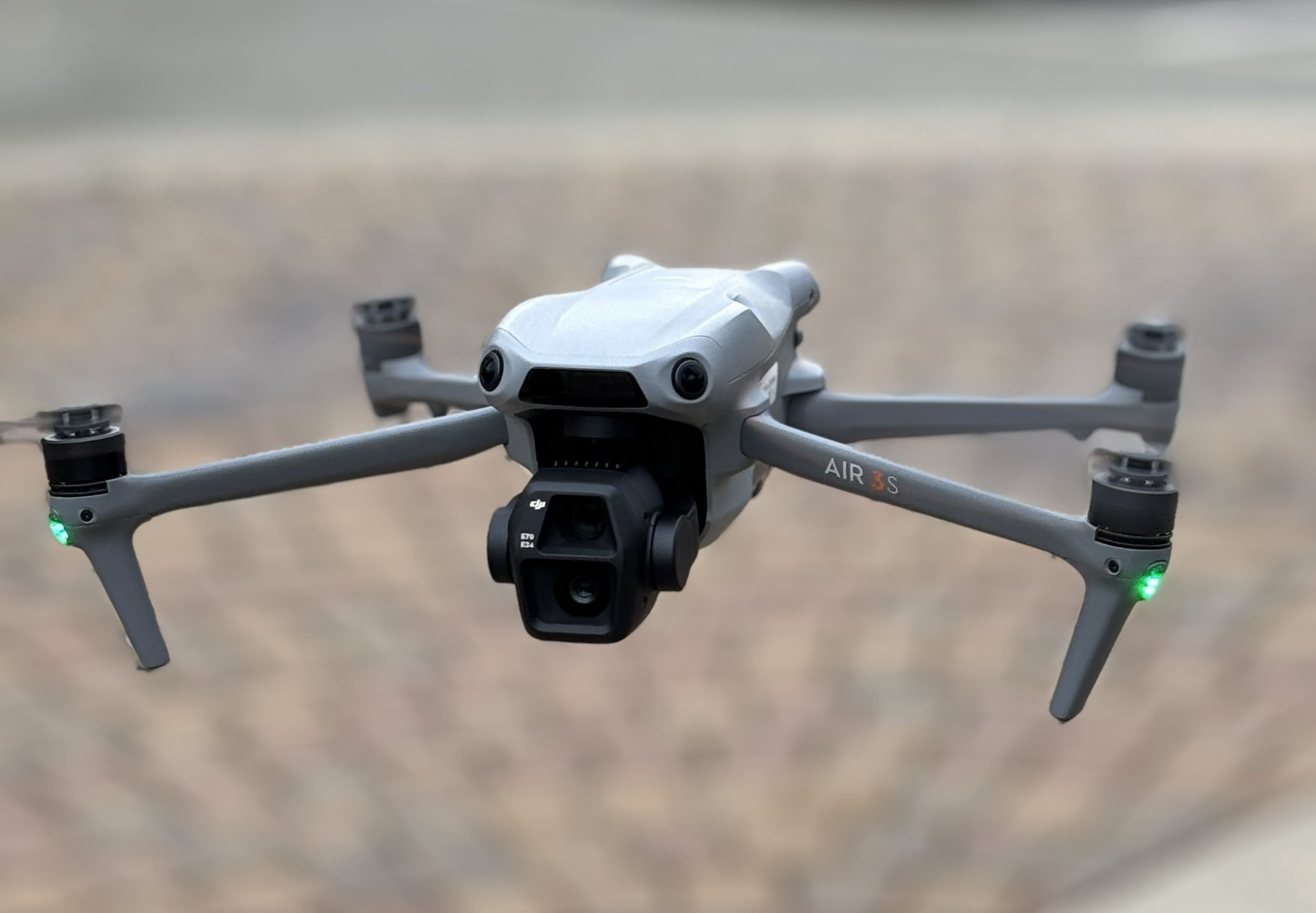
DJI Air3S
This whole thing started with a DJI Mini 3.
If you’ve read any of my other posts, you already know I’ve referred to it as a gateway drug — or my first beer. It was small, approachable, and just harmless enough to convince me I had everything under control. Much like your first beer, there was obviously more to follow.
At the time, the Mini 3 felt like one of the best entry points into drones if you wanted decent image quality without spending a fortune. Looking back, it still holds up as a solid starting place — but it didn’t take long before curiosity turned into ambition.
And ambition, in the drone world, gets expensive quickly.
Micro Drone ≠ Micro Responsibility
One thing I decided early on was that just because Transport Canada doesn’t require a license to fly a micro drone doesn’t mean you shouldn’t understand the rules.
Micro drone does not mean micro responsibility.
So even though I technically didn’t need to, I studied for the Basic RPAS license anyway. Not because I wanted another card in my wallet, but because I wanted to actually know what I was doing. Airspace rules, weather considerations, emergency procedures — all the unglamorous stuff that suddenly feels very important when you realize your “toy” is still an aircraft.
The Basic exam cost $10. I used free online resources, watched videos, did some practice questions, and passed it without much drama. Do you need to take the test if you only ever fly a micro drone? No. But should you at least know that material? I genuinely think yes.
The Upgrade Trap (and the Dent That Did It)
Like most people, I told myself I wasn’t going to upgrade.
Then I started looking at features.
ActiveTrack would be nice. Collision avoidance would be nice. A bit more range would be nice. And suddenly I was deep into the familiar mental gymnastics of “for a few hundred dollars more…”
Around this time, I also crashed the Mini 3. Twice. One of those crashes left a small dent that stared back at me every time I powered it on — a constant reminder that collision avoidance would, in fact, be pretty cool.
I briefly considered the Mini 4 Pro. Then rumours about the Mini 5 started floating around. Don’t get me started on that whole situation — I’ve already written a separate article on why a non-micro “Mini” doesn’t make much sense to me.
In the end, I landed on the DJI Air 3S.
Honestly, it’s the sweet spot. Prosumer, capable, respectable. Anything more starts to feel like overkill unless you’re doing serious commercial work. The Mavic line is impressive, but for what I do, the Air 3S made far more sense.
The Victoria Airspace Reality Check
I opened the airspace map around Victoria and it had more red dots than a teenager’s face the morning after discovering pizza and poor life choices.
This is the moment a lot of people hit the wall. Once you’re flying something bigger than a micro drone, the rules matter — especially here. Controlled airspace, authorization requirements, and restrictions that make it very clear: if you want to fly legally and with any flexibility around southern Vancouver Island, Basic isn’t going to cut it.
That’s when I realized Advanced wasn’t optional. It was inevitable.
Studying for Advanced (Without Paying for a Course)
I’m not anti-course.
I’m just pro-not-spending-money-I-don’t-have-after-buying-a-drone.
So I did what I’d done before: I found free resources. They’re everywhere if you’re willing to look — videos, study guides, practice exams, forums. I studied properly, took my time, and wrote the Advanced exam.
It cost another $10.
I passed.
No shortcuts. No paid program. Just time and effort.
The Flight Review (Not Nearly as Scary as You Think)
The part that intimidates most people is the flight review.
It shouldn’t.
I found a local flight reviewer who was excellent — calm, professional, and genuinely invested in making sure I was flying safely and legally. It felt less like an interrogation and more like someone confirming I wasn’t about to do something stupid with an aircraft.
We talked through scenarios, flew practical exercises, and focused on decision-making rather than perfection. I passed without any drama.
The Real Cost Breakdown
Here’s the part everyone actually wants to know.
From no license at all to Advanced RPAS certification, my costs looked roughly like this:
Basic exam: $10
Advanced exam: $10
Flight review: about $200
Safety gear (fire extinguisher, cones, a few odds and ends): roughly $50
All in, I came in under $300.
Could you spend more? Absolutely.
Should you, if a course fits your learning style? Maybe.
Do you have to? No.
A Quick Reflection on Entry-Level Drones (Now vs Then)
At the time I started, the Mini 3 was the obvious choice if you wanted a capable camera in a micro drone.
If I were starting today, I’d probably point people toward something like the Neo 2 as a true entry-level option — especially for learning. And if budget allowed, the Mini 4 Pro would be very high on my list.
The key thing is this: your first drone doesn’t need to be perfect. It just needs to get you flying, learning, and thinking responsibly.
Final Thoughts
This isn’t about chasing licences or justifying upgrades. It’s about understanding the airspace you’re flying in — especially in Canada, where the rules are clear, even if they’re sometimes frustrating.
You don’t need to rush. You don’t need to buy the most expensive drone. And you don’t need to spend thousands to become compliant.
Learn the rules. Fly legally. And maybe don’t ignore the dent in your drone the way I did.
Related reads
Business & Property Drone Services
Professional aerial photos and video for businesses, restaurants, hotels, and properties across Greater Victoria — handled safely, legally, and without guesswork.
Construction Drone Services
Progress tracking, site documentation, and inspections for construction projects in the Westshore and Greater Victoria, with compliant and insured operations.
DJI Drones & Accessories
Straightforward reviews and recommendations for DJI drones and accessories, based on practical experience and long-term use.
Can the DJI Neo 2 Keep Up With a Four-Year-Old?
Blake and his Christmas present
I’ll be honest: I was skeptical.
Not skeptical of my kid — skeptical of the drone.
If you’ve ever met a four-year-old with a full battery and zero sense of pacing, you’ll understand the concern. The real question going into this wasn’t “Will the DJI Neo 2 work?” It was “Which one of these is going to run out of batteries first?”
First Flight, Boxing Day, Beach Test
We were down in Parksville over Christmas, staying near the beach, and Boxing Day felt like the right moment to see what this little drone could actually do in the real world. No backyard hovering. No careful demo. Just open space, sand, and a kid who absolutely does not slow down for technology.
The Neo 2 came out of a pocket. Not a case. Not a backpack. A pocket.
Press a button. It’s on. Another button. It’s in the air.
From there, it was off chasing Blake up and down the boardwalk while I stood back, half amused and half waiting for something to go wrong.
It didn’t.
“Wait… It Just Does That?”
We watched a short video beforehand, and that was about it. I helped him turn it on and launch it, but the gesture controls clicked almost immediately. Start following. Stop. Land back in his hand. Repeat.
No controller. No panic. No drama.
That part surprised me more than anything. Not just that he could do it — but how quickly it made sense to him. Five minutes might actually be generous.
And here’s the thing: watching the drone chase him around in person feels a little chaotic, but when you look at the footage afterward, it’s impressively stable. The framing holds. The motion is smooth. You’re clearly watching a kid running full tilt, but the video itself doesn’t feel frantic.
That’s not nothing.
This Is Not an Air 3S (And That’s the Point)
I fly an Air 3S regularly. That’s a very different tool, for very different work. It lives in a case, gets set up deliberately, checks satellites, checks airspace, and goes up with intention.
The Neo 2 is the opposite of that.
This thing is basically a pocket-sized, mildly obedient videographer. You pull it out, press a button, and it starts capturing whatever’s happening — kids running, family walks, quick moments you normally wouldn’t bother setting a drone up for.
That’s the real difference.
This isn’t about cinematic shots or production value. It’s about use. It’s about actually using a drone instead of talking yourself out of it because setup feels like work.
Price, Practicality, and Reality
For the money — especially if you’re realistic about accessories — it’s hard not to be impressed. You don’t need the whole kit. A spare battery (maybe two if you’re feeling ambitious) and you’re in good shape.
For families, that matters.
This is the kind of drone you can teach a kid to use responsibly. Gesture control first. Controller later. Safety always. It goes back in the pocket when you’re done. It gets looked after when you bring it home.
And yes, responsibility is part of the fun. Learning when not to fly is just as important as learning how.
Final Thoughts
I went into this curious. Mildly skeptical. Fully prepared for the drone to lose a race with a four-year-old.
Instead, I walked away impressed — not just with the tech, but with how naturally it fits into real family life. It’s fast, approachable, surprisingly capable, and doesn’t demand a whole production just to capture a moment.
If nothing else, it answered the original question.
The drone didn’t run out of batteries first.
The kid didn’t either.
Related Articles
DJI Lito X1 vs Mini 4 Pro: This Changes What Drone I Recommend in Canada
A closer look at how the Lito X1 stacks up against the Mini 4 Pro — and why it might be the better buy for most people now.
DJI Neo 2 After 3 Months — Still Worth It?What happens after the novelty wears off. Real use, real bumps, and why this thing still comes everywhere with us without even thinking about it.
Hiring a Drone Pilot in Victoria, BC — What It Costs and What You Get
Straightforward pricing, what’s included, and what the process looks like if you need aerial photos, video, inspections, or a better look at something from above.
From the Beach to the Mountain: A Winter Day at Mount Washington
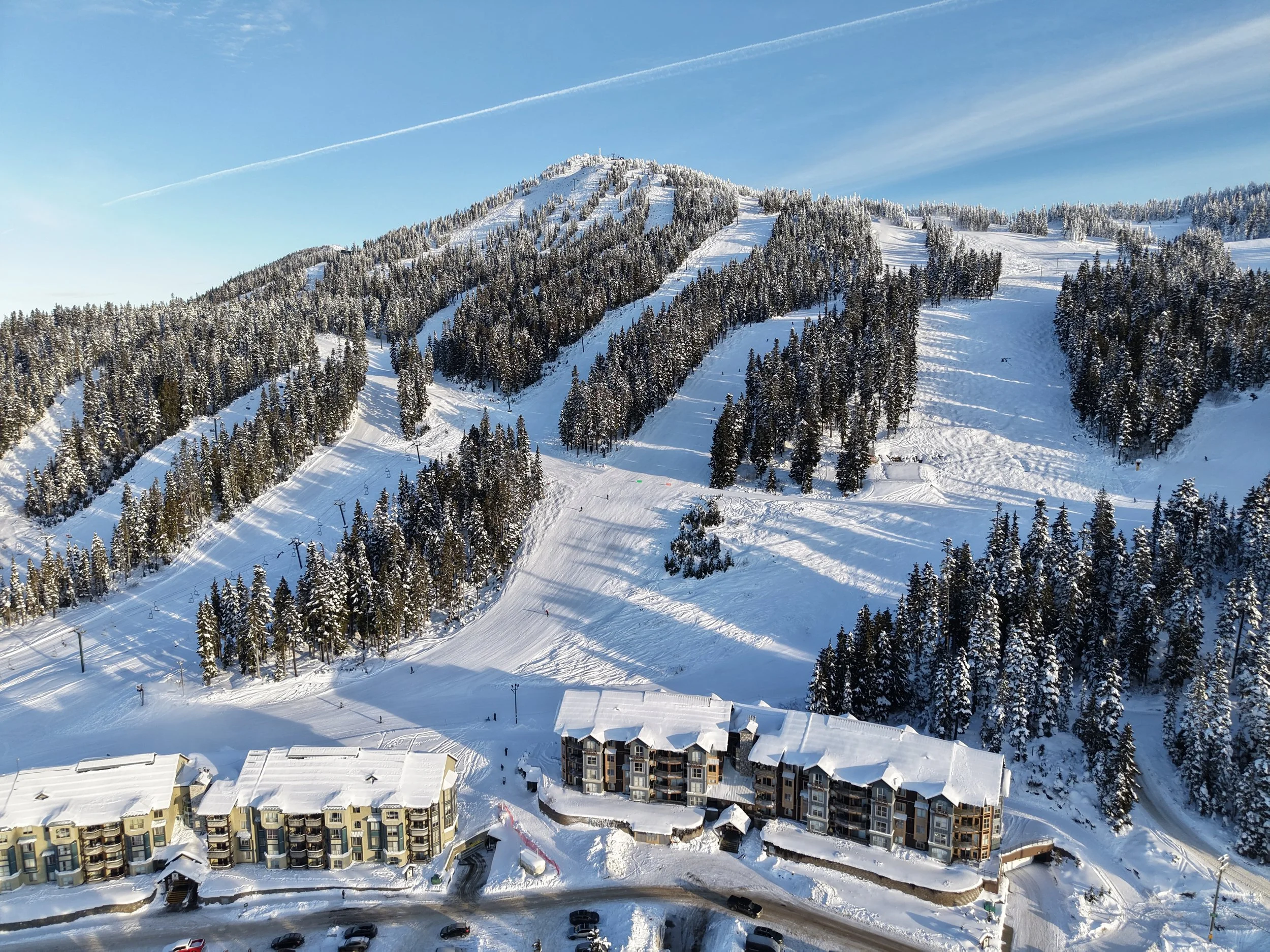
We were staying down on the beach in Parksville over the holidays, one of those rare winter stretches where the air is clear and the Island feels quiet. Looking east, it was hard not to notice how close Mount Washington really is. Ocean in front of you, snow-covered peaks not that far away. The proximity alone made the decision for us.
It also happened to be my four-year-old son’s first real trip to the mountain, and only the second time he’d ever seen snow. Living in Victoria, winter usually means rain, grey skies, and damp trails. Snow still feels like a novelty.
The drive up was part of the experience. You leave the coastline behind and climb steadily into a completely different landscape. Forests get thicker, the air sharpens, and then suddenly everything is white. Snow-covered trees, open alpine terrain, and long views stretching back toward the Island and the ocean beyond.
We didn’t plan perfectly. For anyone heading up for the first time, learn from my mistake: buy tickets in advance. Showing up without a plan during the holidays is a rookie move, and Dad definitely felt that one. Thankfully, we managed to get him into the tube park for a bit, which turned out to be exactly what he needed.
That first run down the hill was all it took. The kind of laughter that only comes from something completely new. Snow flying everywhere, boots soaked, cheeks red from the cold, and zero interest in leaving. He got a taste of winter up there and immediately wanted more.
The day itself couldn’t have been better. Clear skies, crisp light, and that quiet brightness you only get in winter. Between tubing runs and wandering around, I took the opportunity to put the drone up for a few quick flights. Nothing complicated. Just letting it rise above the base area and take in the scale of the place.
From the air, Mount Washington really shows itself. Snow-covered forests wrapping around open runs, buildings tucked neatly into the landscape, and the Island stretching away in every direction. It’s one of those spots where the sea-to-alpine contrast becomes very real, very fast.
Those aerial moments were calm and unhurried, the kind that fit naturally into the day rather than interrupting it. Just enough time to capture the setting as it was: winter light, clean lines, and a mountain that feels surprisingly close to home.
By the time we headed back down toward Parksville, the decision had already been made. This wouldn’t be a one-off trip. A beach stay paired with a mountain day felt like the perfect Vancouver Island combination, especially with a kid who’s just discovering snow for the first time.
So that was it. A Christmas trip that quietly turned into a tradition. Parksville below, Mount Washington above, and a reminder of how much variety you can pack into a single winter day on the Island.
We’ll be back next year. And the year after that.
Related Articles
Chasing Down a DJI Neo 2 for Christmas — And Why This Drone Matters More Than I Expected
A story about hunting down the perfect starter drone for my son, and how a simple piece of tech turned into real father–son time.
DJI Neo 2 — Why This Little Drone Is About to Become My Four-Year-Old’s First Co-Pilot
A closer look at the Neo 2 and why its size, safety profile, and simplicity make it the ideal micro-drone for teaching kids to fly responsibly.
DJI Mini 5 Pro — If It’s Not a Micro-Drone… That’s the Point
A practical breakdown of why the Mini 5 Pro steps out of the micro-drone category — and why that matters for new pilots, kids learning the basics, and safe flying in Victoria.
Inner Harbor at Night — A First Downtown Night Flight
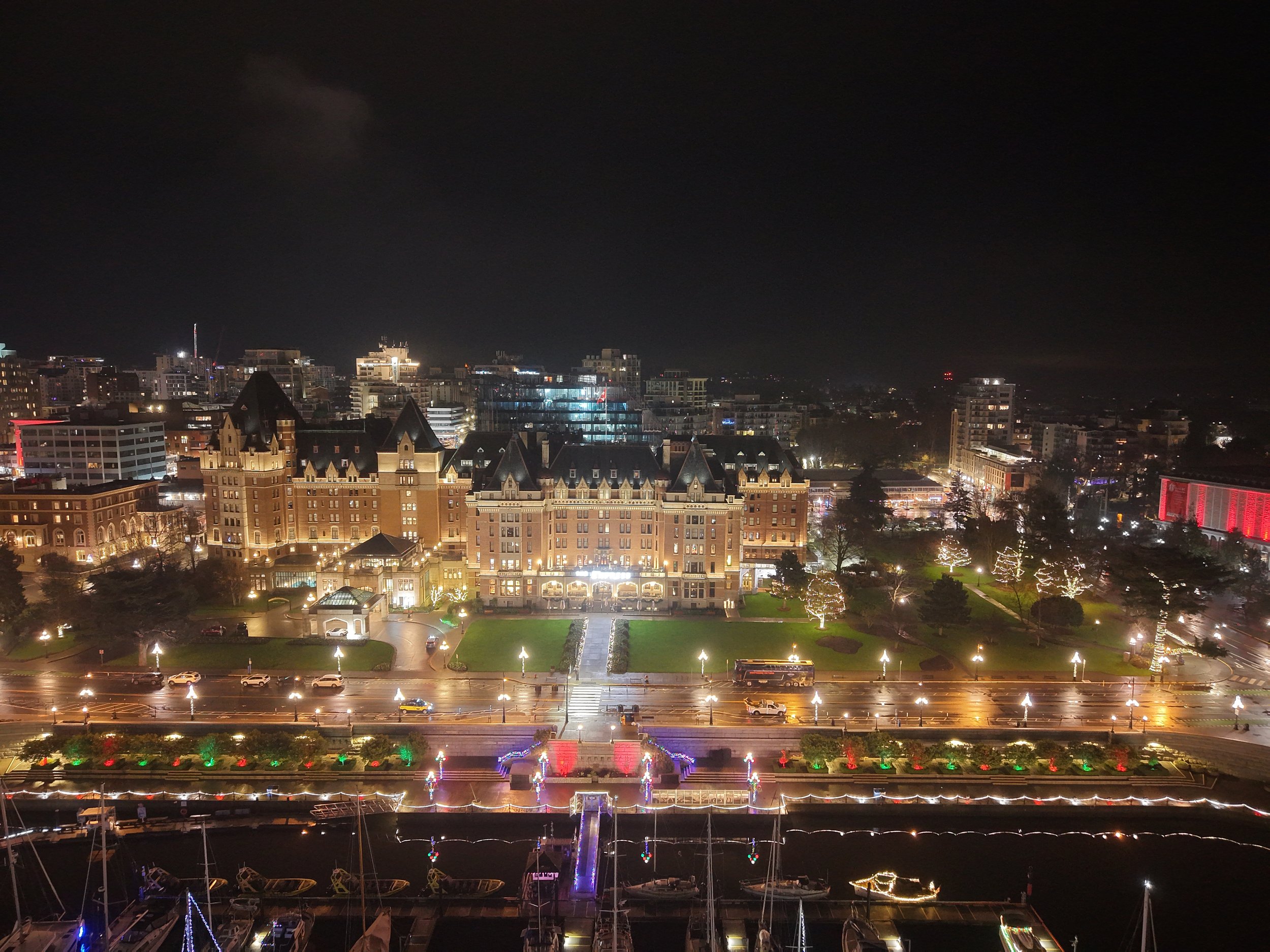
This Inner Harbor night flight took longer to happen than expected.
Between November and December, lining up permission, weather, and availability turned into a moving target. Anyone in British Columbia this year will understand. The rain has been relentless, with repeated atmospheric rivers and long stretches where flying simply wasn’t realistic or responsible. More than once, approvals were in place, but the weather just wasn’t.
When it finally came together, it meant heading downtown very early. The flight took place around 4:00 a.m., when the Inner Harbor is mostly empty and quiet, but not entirely. There were very few people around, which in some ways made it calmer, and in other ways made it a little more unsettling. At that hour, every sound carries, and you’re more aware of who else happens to be nearby.
I launched from near the Canada sign along the Inner Harbour, a spot that offered a clear line of sight while staying respectful of the space. Even with everything approved and planned, I was more nervous than I expected. It was my first night flight and my first downtown flight, and combining the two probably wasn’t the most relaxed way to ease into either. Still, once the aircraft was in the air and everything settled, that initial tension faded.
The Inner Harbor looks very different at night. The scale changes. The reflections take over. Familiar landmarks feel quieter and more contained, especially in low light and damp conditions. From above, the harbour becomes less about movement and more about shape, glow, and contrast. Boats sit almost motionless, light pools along the shoreline, and the city feels smaller and calmer than it does during the day.
Partway through the flight, I had a brief interaction with someone passing through who asked if I was flying a drone and whether I had a channel. He followed along on the spot and genuinely thought it was pretty cool to see the harbour being documented that way. It was a small moment, but a good reminder that even at odd hours, people notice and appreciate a different perspective on familiar places.
This flight wasn’t about pushing limits or capturing anything dramatic. It was about seeing a well-known location at an unfamiliar time and letting the conditions shape the result. Some stills came out of it, and the longer film captures that slow, reflective perspective that only really shows up in the early morning hours.
The full Inner Harbor night flight video is embedded below, and selected stills from the flight have been added to the portfolio. I’m glad I waited for the right moment rather than forcing it earlier in the season. This one feels less like a showcase and more like a record of place, timing, and a first step into a new kind of flying.
More From Vancouver Island Drones
Aerial Photography & Video in Victoria — Why Everything Starts With a Conversation
A look at how we approach real, human, conversation-first aerial work in Greater Victoria.
Aerial Photographer in Victoria — What to Know Before Hiring One
Key things locals should look for when choosing a drone photographer who’s compliant, safe, and storytelling-minded.
Aerial Videographer in Victoria — What Makes Footage Stand Out
A breakdown of what separates cinematic, meaningful aerial video from basic flyovers.
Seeing a Familiar Place a Little Differently: Six Mile Pub
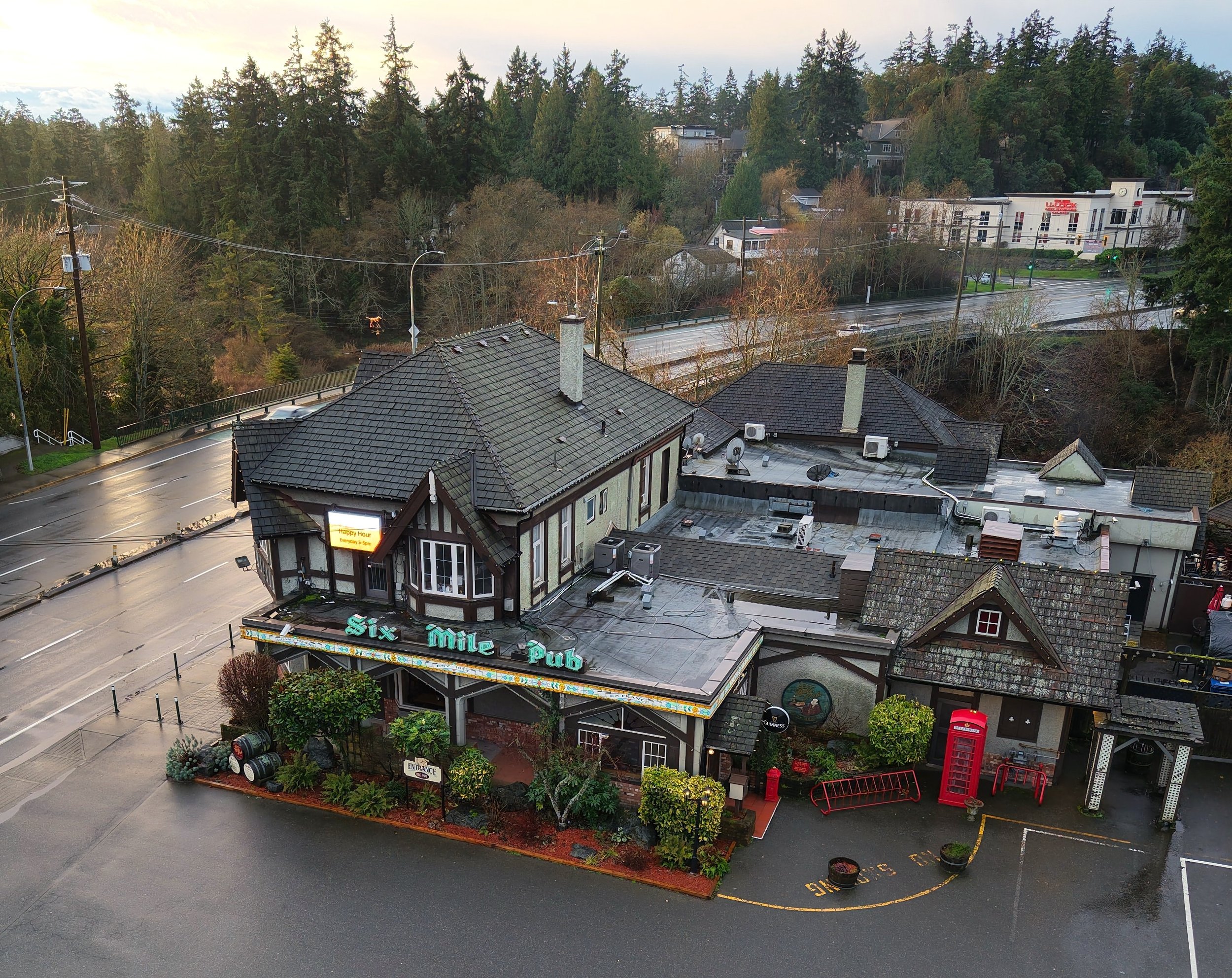
I’ve been going to the Six Mile on and off for close to 30 years now. It’s one of those places that’s just always been there — not trendy, not trying to reinvent itself, just solid food, familiar faces, and a setting that feels baked into the Westshore.
I’ve always liked the old Four Mile, Six Mile, Seventeen Mile naming idea around Victoria. It’s a small thing, but it hints at how long these places have existed and how they were originally thought of — measured points along the road, landmarks people used to navigate by.
Like most well-known spots, the Six Mile has been photographed endlessly. Food photos, patio shots, group selfies — all good, all familiar. But those images usually come from the same narrow perspective: eye level, standing in the parking lot or sitting at a table.
This shoot was about stepping outside that usual viewpoint.
On a quiet December morning, with the light doing something interesting for once, I took the opportunity to capture the Six Mile from above — not to make it flashy, but to show how it actually sits in the landscape. The relationship between the building, the bridge, the water, and the surrounding greenery becomes much clearer when you pull back a little.
I’ve seen this same shift happen with other local shoots — places like Four Mile and My Chosen Café. A different perspective doesn’t replace the usual photos; it complements them. It gives people something they don’t already have, and that tends to draw new eyes and quiet attention.
For established, iconic businesses, that matters. They don’t need hype. They just need to be seen clearly.
This project is a good example of how aerial photography and drone videography in Victoria can support local businesses — not by reinventing them, but by showing them honestly from a slightly different angle
More From Vancouver Island Drones
Aerial Photography & Video in Victoria — Why Everything Starts With a Conversation
A look at how we approach real, human, conversation-first aerial work in Greater Victoria.
Aerial Photographer in Victoria — What to Know Before Hiring One
Key things locals should look for when choosing a drone photographer who’s compliant, safe, and storytelling-minded.
Aerial Videographer in Victoria — What Makes Footage Stand Out
A breakdown of what separates cinematic, meaningful aerial video from basic flyovers.
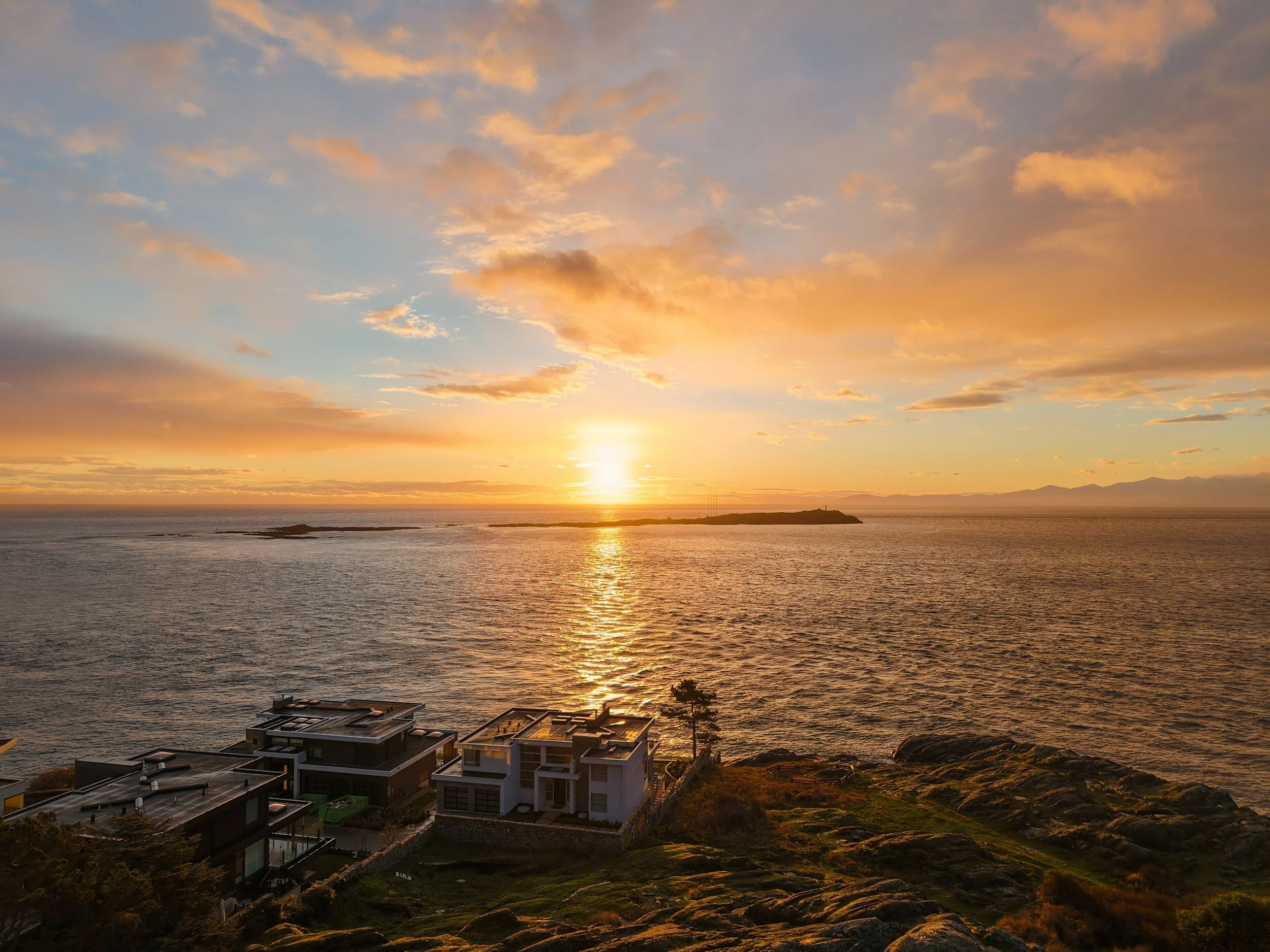
A Winter Morning from King George Terrace, Looking Out Toward Trial Island
Winter mornings like this are a bit of a gamble. The forecast looked bad, the radar looked worse, and the weather itself was doing exactly what winter on the south Island does best — cold, wet, and generally unpleasant. Still, there was a hint of light when I left the house, and sometimes that’s enough to at least go see what happens.
King George Terrace wasn’t the original plan, but it ended up being the right call. By the time I arrived, conditions were miserable. Rain, low cloud, and very little to suggest anything was about to improve. I stood there for a bit, half expecting to pack it in and head home, but instead I waited. Not because I was optimistic — more because I was already there.
Then, briefly, things shifted.
The rain backed off just enough. The sky opened in patches. Looking east, Trial Island came into view with soft winter light reflecting off the water. It wasn’t dramatic or explosive — just calm, quiet, and honest. The kind of light that doesn’t last long and doesn’t announce itself when it shows up.
Turning south, Gonzales Bay sat quietly below, still holding on to late-season colour along the shoreline. I spent a lot of time in this part of town years ago, and mornings like this always bring back memories I don’t expect until I’m standing there again. Familiar places have a way of doing that.
As quickly as it opened, the window started to close. A brief rainbow appeared through the mist toward Clover Point before the rain moved back in and the light flattened out again. That was it. No second act, no miracle turnaround — just a short, usable moment in an otherwise rough morning.
Those are often the mornings that stick with me the most.
This set of images came from standing in one place and letting the conditions do what they were going to do, rather than trying to force anything. Sometimes that’s all these winter outings are — showing up, waiting, and being ready when a small opportunity appears.
Esquimalt Lagoon: Coffee, Birds, and a Brief Ceasefire in the Rain
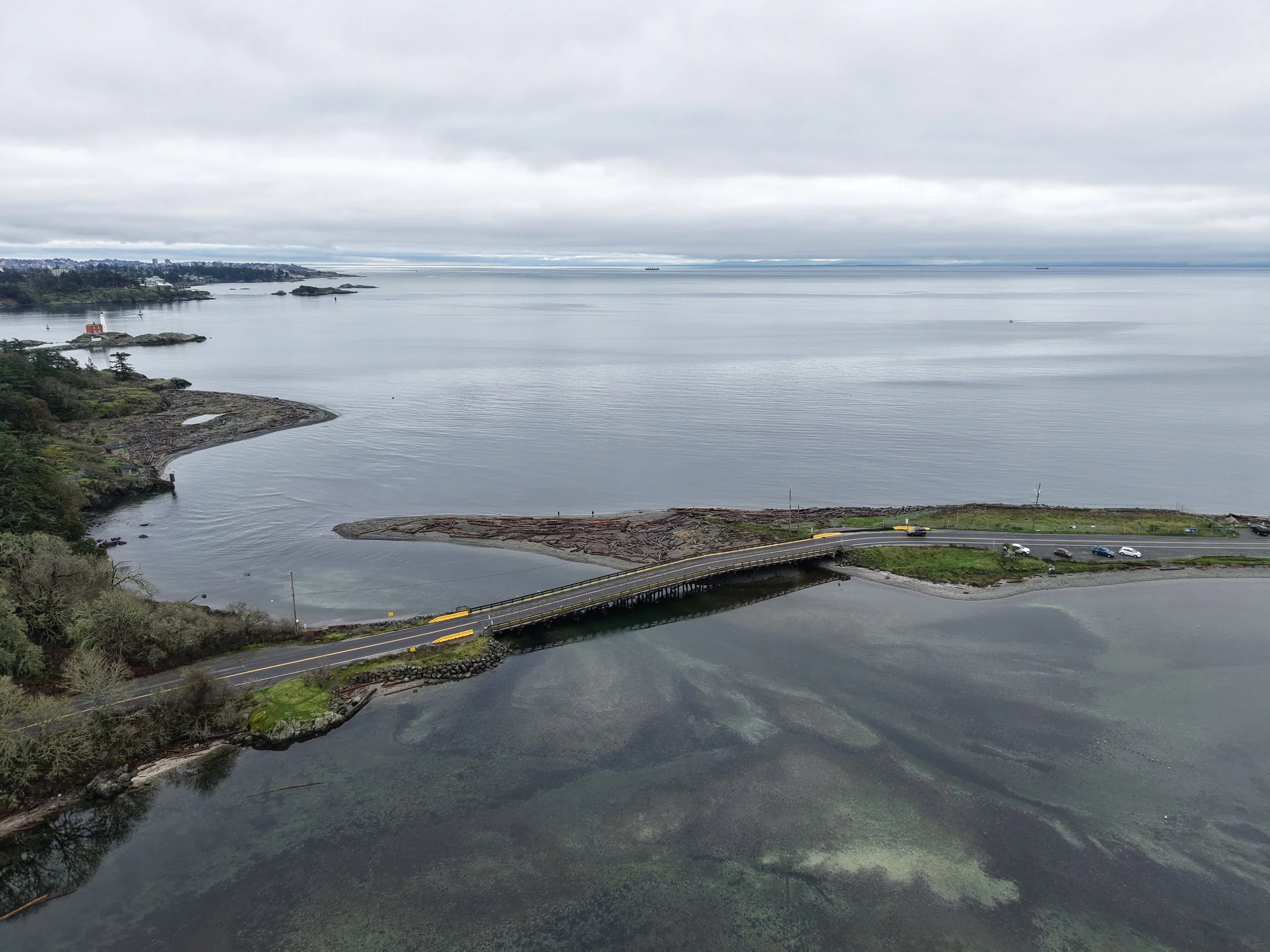
Esquimalt Lagoon Bridge
Esquimalt Lagoon is one of my go-to flight spots. It’s close to home, it’s absolutely gorgeous on even the most average day, and most importantly, there’s a Tim Hortons drive-thru on the way.
That last part matters more than it probably should, but let’s be honest — no good drone decision has ever been made without coffee.
Like most of Vancouver Island this fall and winter, we’ve been dealing with rain. Not normal rain. Not “grab a jacket” rain. I’m talking biblical, ark-building, forty-days-and-forty-nights rain. The kind where you start wondering if the ground is ever going to dry out again, or if this is just how things are now.
They’re calling them atmospheric rivers. I used to roll my eyes at that term and joke that it was just a fancy new way of saying “it’s raining hard.” But after this year… yeah. It’s a thing. A very wet, very real thing.
So when a break shows up — even a small one — you notice.
Lately, my first indicator isn’t the weather app. It’s the birds.
When the rain eases off, the trees around my house absolutely explode with noise. Birds everywhere, losing their minds, like someone rang a bell and announced a surprise party. I’ve started treating it as my unofficial “maybe you can fly a drone now” alarm.
I looked out the window.
No sideways rain.
Wind wasn’t terrible.
Birds were partying.
That was good enough for me.
I grabbed a coffee, tossed the drone in the truck, and headed down to Esquimalt Lagoon mid-afternoon. Not a golden sunrise shoot. Not cinematic perfection. Just a window — and sometimes that’s all you get.
The lagoon was doing what it always does: calm water on both sides of the road, subtle color shifts under the surface, and that quiet, wide-open feeling that makes you slow down whether you want to or not. It’s one of those places that doesn’t need big light or dramatic skies to work. It just is.
Below is a short film from that afternoon — a quiet flight over the lagoon and nearby shoreline, captured during one of those rare breaks between storms.
I got up, took my time, and grabbed a handful of shots I’ve been wanting for a while.
And right on cue — as I was landing — the rain came back.
Not a drizzle. Not a warning sprinkle. Full send. As if the weather itself was saying, “Alright, that’s enough joy for one afternoon.”
By the time I packed up and got back in the truck, it was already back to absurd, relentless rain. The kind that makes you laugh because getting mad about it feels pointless.
That’s Esquimalt Lagoon for me.
Close to home.
Easy to reach.
Reliable when the weather gives you even the smallest chance.
It’s not a destination shoot. It’s not a once-a-year trip. It’s my backyard escape — the place I go when the birds start screaming and the rain finally gives me a break.
And yes, the Tim Hortons on the way definitely helps.
More flights from Esquimalt Lagoon — and other favorite spots around Victoria and the Westshore — coming soon.
More Vancouver Island Stories
Cole Island at Sunrise — A Quiet Look at a Forgotten Place
A calm aerial film exploring one of Esquimalt Harbor’s most historic and overlooked locations.
James Bay Athletic Association — A Place That Formed Me
A personal, reflective story about a historic Victoria rugby club and the people who shaped it.
James Bay Athletic Association: A Place That Formed Me
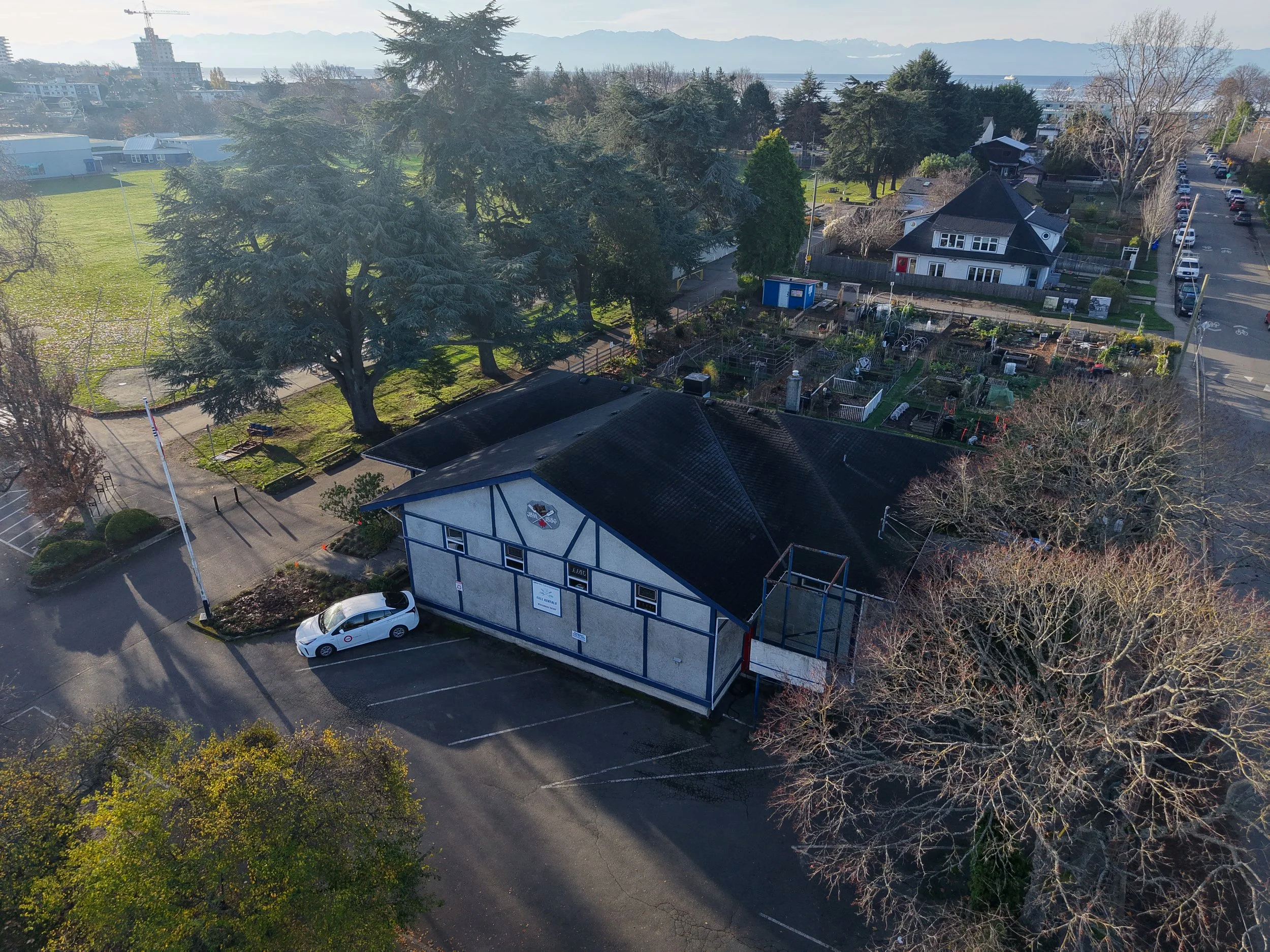
A high-angle aerial photograph of the James Bay Athletic Association field and clubhouse.
There are places you visit, and then there are places that quietly become part of who you are.
James Bay was never just a rugby club for me — it was a backdrop to my youth, and later, a cornerstone of my adult life.
I never played here.
Not once.
In high school and my early twenties, I was just one of the guys who hung around — watching games, having beers, shooting pool, and soaking up the atmosphere. It was a social hub, a place you drifted into without planning to.
Then in my late twenties, I came back to help out for what I thought would be one season.
One year managing the men’s first division team.
Straightforward. Temporary.
Fifteen years later, I was still there.
That’s how clubs like this work. You think you’re stepping in lightly, and suddenly it’s become part of your identity.
lot happens in fifteen years.
We won championships.
We toured.
We survived some legendary road trips.
We built friendships that outlasted seasons, jobs, even eras of our lives.
Some of the best moments of my life happened through this club.
Some of the hardest ones did too.
We lost people we loved — far too young, far too soon.
Those losses stay with you.
You feel them every time you walk through the clubhouse or see an old team photo.
And not every moment was glory.
Tuesday and Thursday practices at Beacon Hill Park were brutal — freezing wind, sideways rain, hands numb.
But the connections forged in that cold are still some of the strongest in my life.
This place isn’t just part of my story.
It is a piece of me.
My wedding reception was held in the Hall — just a simple fact, but it says plenty about how deep the roots go.
JBAA was founded in 1886, and somehow still feels like one of Victoria’s beating hearts.
Community-first.
Generational.
A place that’s kept kids, families, and rugby culture intertwined for nearly 140 years.
And now my four-year-old son plays here.
Nothing prepares you for how that feels — seeing your kid on the same field where you spent so many years managing, organizing, freezing, celebrating, grieving, laughing.
It’s surreal in the best way.
A quiet full-circle moment.
That’s why I wanted to film it.
I’ve flown over beaches, forests, coastlines, harbors — but this was different.
This was personal.
Seeing James Bay from above transformed it.
A place that once felt massive and chaotic suddenly looked calm, small, familiar, almost tender.
Time and perspective do that.
This film isn’t about rugby.
It’s about a place that helped form me — a place that shaped a significant chapter of my life and is now becoming part of my son’s.
A place full of friendships, stories, victories, heartbreaks, cold nights, warm gatherings, and memories I’ll carry forever.
Here’s the aerial perspective of a field and a Hall that have meant more to me than I ever expected — and hopefully a place my son will grow into just as deeply.
Thanks, JBAA.
Why Vancouver Island Is Perfect for Quiet, Cinematic Aerial Stories
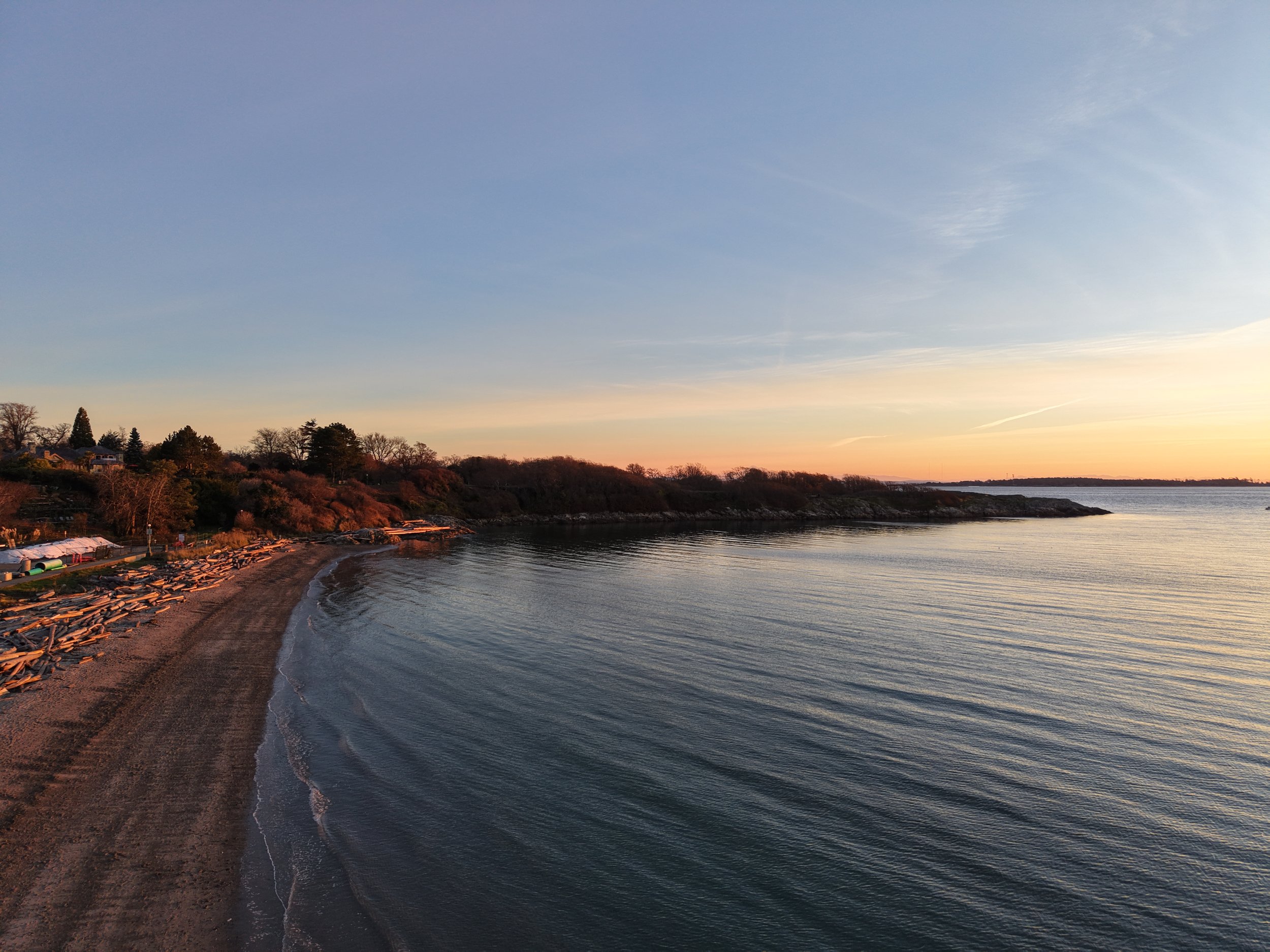
If you’ve watched any of my videos, you’ve probably noticed something about the locations: nothing is flashy. There are no neon skylines, no drone fly-throughs of city towers, no big cinematic set pieces. Just beaches. Heritage sites. Driftwood. Fog. Little pockets of the Island that most people drive past without a second thought.
That’s all on purpose.
Vancouver Island has a way of telling its own story — quietly, patiently, without needing you to force anything. And that’s exactly why it has become the heart of every cinematic piece I make.
Here’s what makes this place so naturally perfect for aerial storytelling.
1. The Island doesn’t rush
Some landscapes demand energy.
Vancouver Island invites you to slow down.
Whether I’m flying over Coal Island, walking onto Willows Beach before the day begins, or standing on damp sand in Parksville with the sun barely awake, the Island sets the pace. The shots come from being present rather than pushing for something dramatic.
That slower rhythm shows up directly in the footage.
It’s why my videos aren’t filled with fast cuts — the locations don’t ask for them.
2. Small places carry big stories
Most people think aerial cinematics are all about grand vistas.
Mountains. Skyscrapers. Waterfalls.
But some of the most meaningful shots I’ve ever taken have come from places you could miss if you blinked:
an old jetty half-covered in moss
a derelict building on a tiny island
a stretch of shoreline that only locals really know
the worn footpaths around Cattle Point
the quiet curve of a Westshore beach at sunrise
These aren’t the kind of places that end up in tourism commercials.
They’re lived-in. Familiar.
Real.
That’s where the good stories hide.
3. The weather creates its own atmosphere
On Vancouver Island, the weather is the cinematographer half the time.
Fog rolls in out of nowhere.
A calm sea suddenly starts to breathe.
Light hits the water in a way you couldn’t plan even if you tried.
Some mornings you get color.
Some mornings you get cloud.
Some mornings you get nothing but grey — and somehow that still works.
You don’t control the look.
You accept what the Island gives you.
That honesty is a big part of the aesthetic.
4. The Island is full of places people think they already know
Willows Beach.
Esquimalt Lagoon.
Dallas Road.
Cadboro Bay.
Saxe Point.
The Inner Harbor.
Everyone here has been to these places.
Everyone has a memory tucked into them somewhere — childhood beach days, family picnics, walks with friends, first dates, foggy dog walks, early-morning coffee runs.
Aerial footage doesn’t change those places.
It just lets people see them again, from a different angle — familiar, but new.
That’s why these spots resonate so strongly when you film them the right way.
5. Aerial storytelling fits the West Coast personality
People on Vancouver Island don’t respond to hype.
They respond to things that feel real.
Big dramatic drone moves and over-edited sequences don’t match the tone of the Island. The place itself is the story. The drone is just the tool that lets me share it.
The quiet drift of the Air 3S, the colour grading that leans toward natural, and the slow voiceovers all come from trying to match the character of the landscape — not overpower it.
When the footage feels calm, it feels like home.
6. I fly here because it feels like the right way to show the Island
There are days when I wish I had mountains or deserts or neon cities to film. But then I watch a sunrise at Willows or a fog bank creep over the Lagoon and I remember:
This is enough.
More than enough.
The Island gives you the kind of moments that don’t need explaining — they just need someone to show up with a drone, fly safely, and press record at the right time.
That’s the work I want to keep doing.
7. This is the direction going forward
Quiet, honest, cinematic pieces.
Father–son mornings.
Local history tucked into visual stories.
Heritage sites. Beaches. Lagoons.
Little places with big atmosphere.
No gimmicks.
No hype.
Just Vancouver Island — seen from above, but told from the ground.
If that’s your kind of thing, there will always be more on the way.
More From Vancouver Island Drones
Aerial Photography & Video in Victoria — Why Everything Starts With a Conversation
A look at how we approach real, human, conversation-first aerial work in Greater Victoria.
Aerial Photographer in Victoria — What to Know Before Hiring One
Key things locals should look for when choosing a drone photographer who’s compliant, safe, and storytelling-minded.
Aerial Videographer in Victoria — What Makes Footage Stand Out
A breakdown of what separates cinematic, meaningful aerial video from basic flyovers.
A Quiet Farewell to the Goldstream Inn (Ma Miller’s)
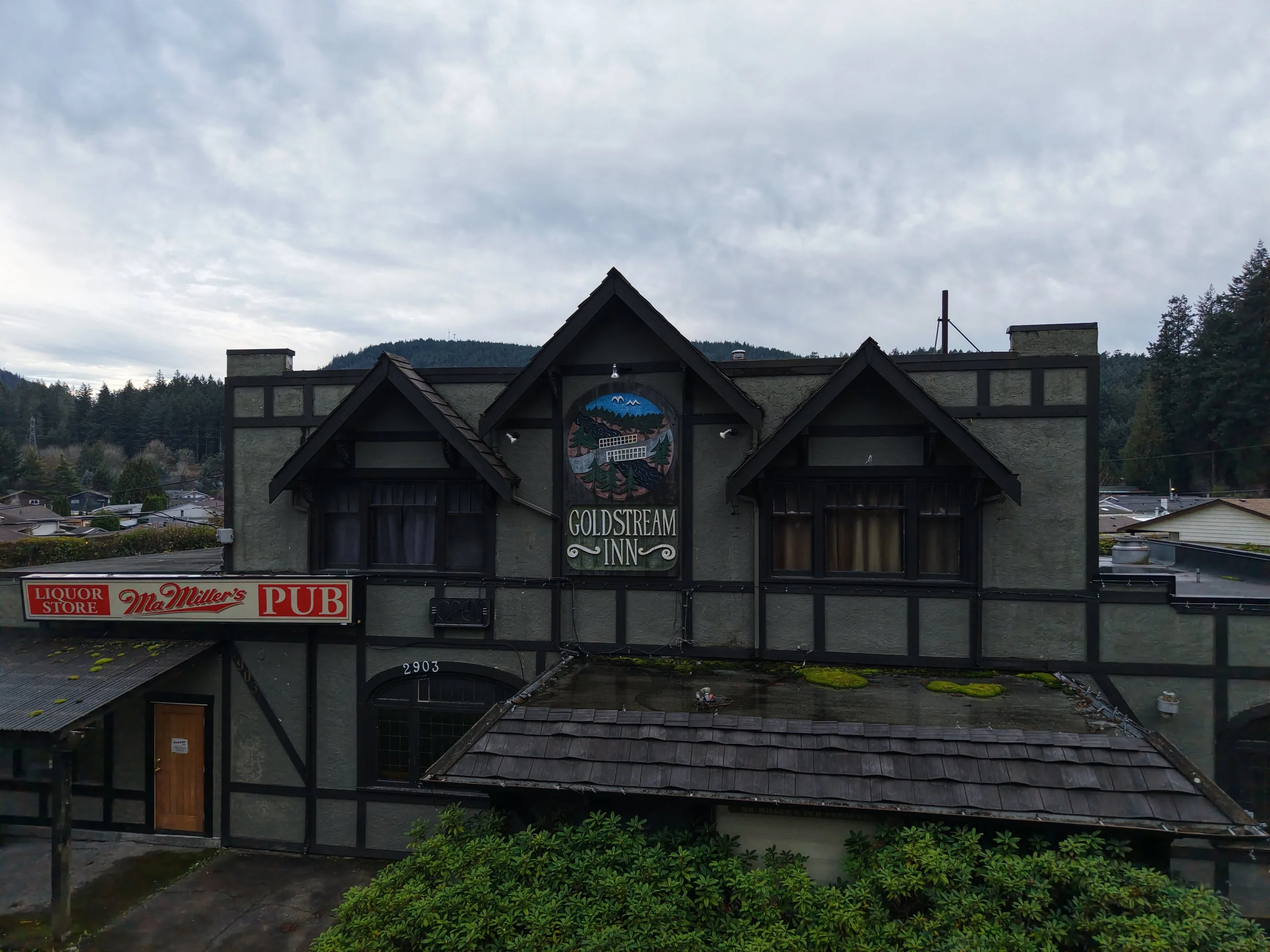
Ma Miller’s
Even if you didn’t grow up in the West Shore, chances are you still know this building. Anyone who’s lived around Greater Victoria long enough has driven past it, stopped in for a pint, or heard stories from someone who did. The Goldstream Inn — later known to nearly everyone as Ma Miller’s Pub — has been part of the Island’s landscape for more than a century.
The site first opened in 1864, making it one of the oldest pub locations in British Columbia. Back then it served travellers along early settlement routes. The name changed in 1923, when May “Ma” Greening-Miller took over and ran it with enough personality to stay etched into local memory. Over the decades it survived fire damage, rebuilds, and generations of regulars. And whether you were there for live music, fundraisers, family meals, or just a post-game beer, it was a familiar stop.
For me, it was usually a pit stop on the way home from rugby road trips — one of those “we always end up here somehow” places.
The pub closed in 2021, and the building has been sitting empty ever since. The roof is softening, the windows are boarded, and moss has taken over the signage. It’s slowly being reclaimed by the trees.
So I took the drone out for a short flight.
Not because the building is beautiful — it isn’t anymore — but because it’s part of local history. A lot of people have memories tied to this place, and it felt worth documenting from above before nature eventually erases it completely.
More Vancouver Island Stories
Cole Island at Sunrise — A Quiet Look at a Forgotten Place
A calm aerial film exploring one of Esquimalt Harbor’s most historic and overlooked locations.
James Bay Athletic Association — A Place That Formed Me
A personal, reflective story about a historic Victoria rugby club and the people who shaped it.
Thinking About Prints (And Maybe a Calendar)
Getting two photos selected for the 2026 and 2027 Colwood calendar — including the cover — was pretty surreal.
I don’t think of myself as a “calendar photographer,” but it was a reminder that people really do connect with shots of the place we all call home. Even the everyday corners of the Westshore get a second life when you see them from above.
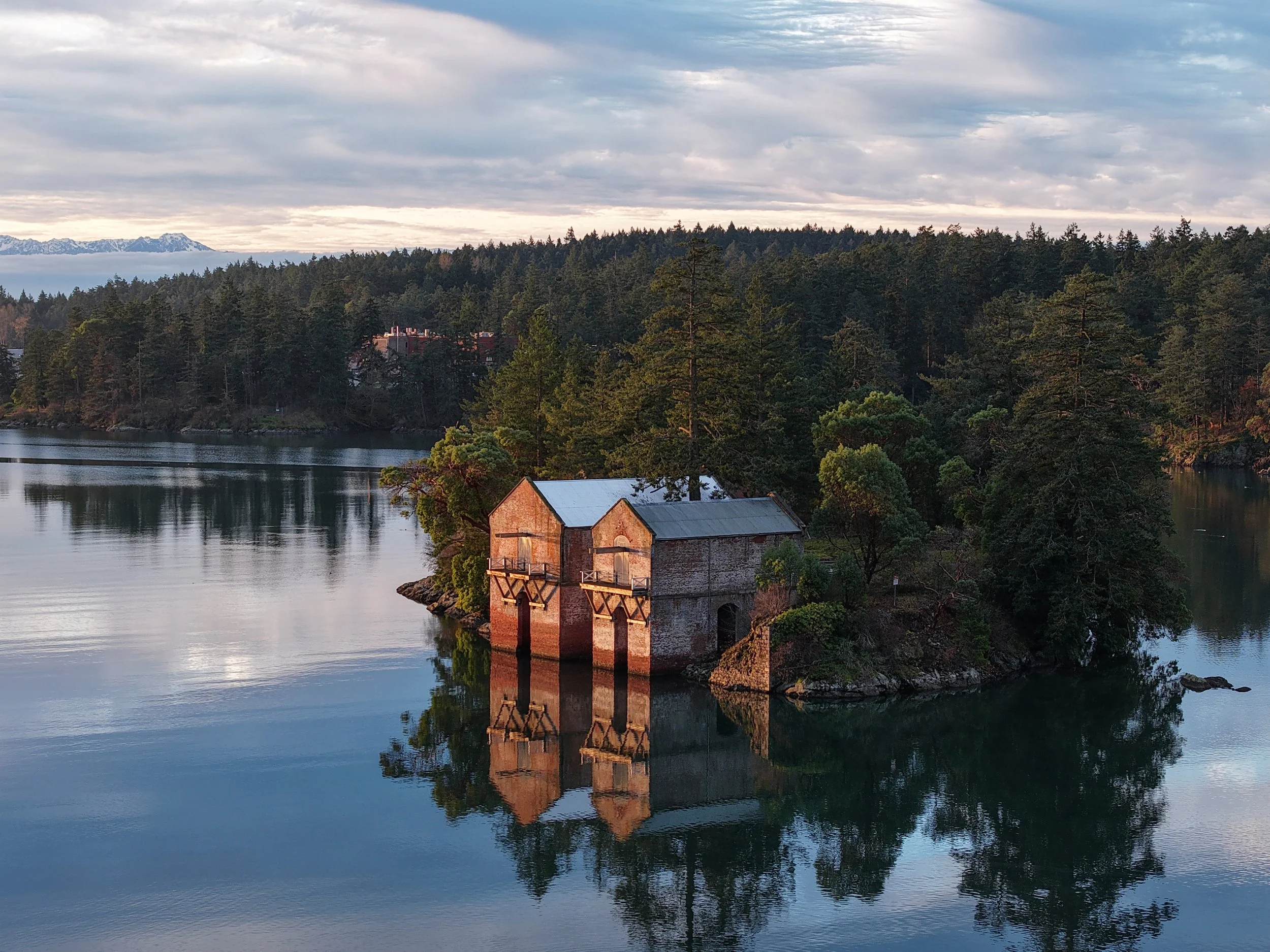
Cole Island
It also planted a little idea:
maybe we should make our own Vancouver Island calendar for 2027.
Nothing fancy — just the quiet, coastal, sunrise moments we’ve been filming and sharing anyway.
And maybe… prints, too.
I’ve been going through old footage and this photo from Cole Island stopped me cold. It’s the old brick boathouse just after sunrise — one of those scenes that looks like it hasn’t changed in a century. I’m printing this one for myself, and maybe for a couple of Christmas gifts.
It also feels like the kind of image locals might actually want on their wall.
So I’m testing the waters:
Would you ever buy a print like this?
Is a Westshore / Victoria calendar something people would want?
No pressure — I’m just curious what people think before putting real time into it.
Either way, I’m going to keep filming the spots that make this place feel like home.
More quiet Island stories coming soon.
Related Stories
Cole Island at Sunrise — A Quiet Look at a Forgotten Place
A calm, cinematic look at a historic Island location — part of the same ongoing historical thread.
Two Calendar Selections — One Very Familiar Sunrise Spot
The story behind the sunrise image selected twice for the Colwood community calendar, and the start of a quiet prints-and-calendar direction for Vancouver Island Drones.
Why I Fly at Sunrise: A West Coast Morning Ritual
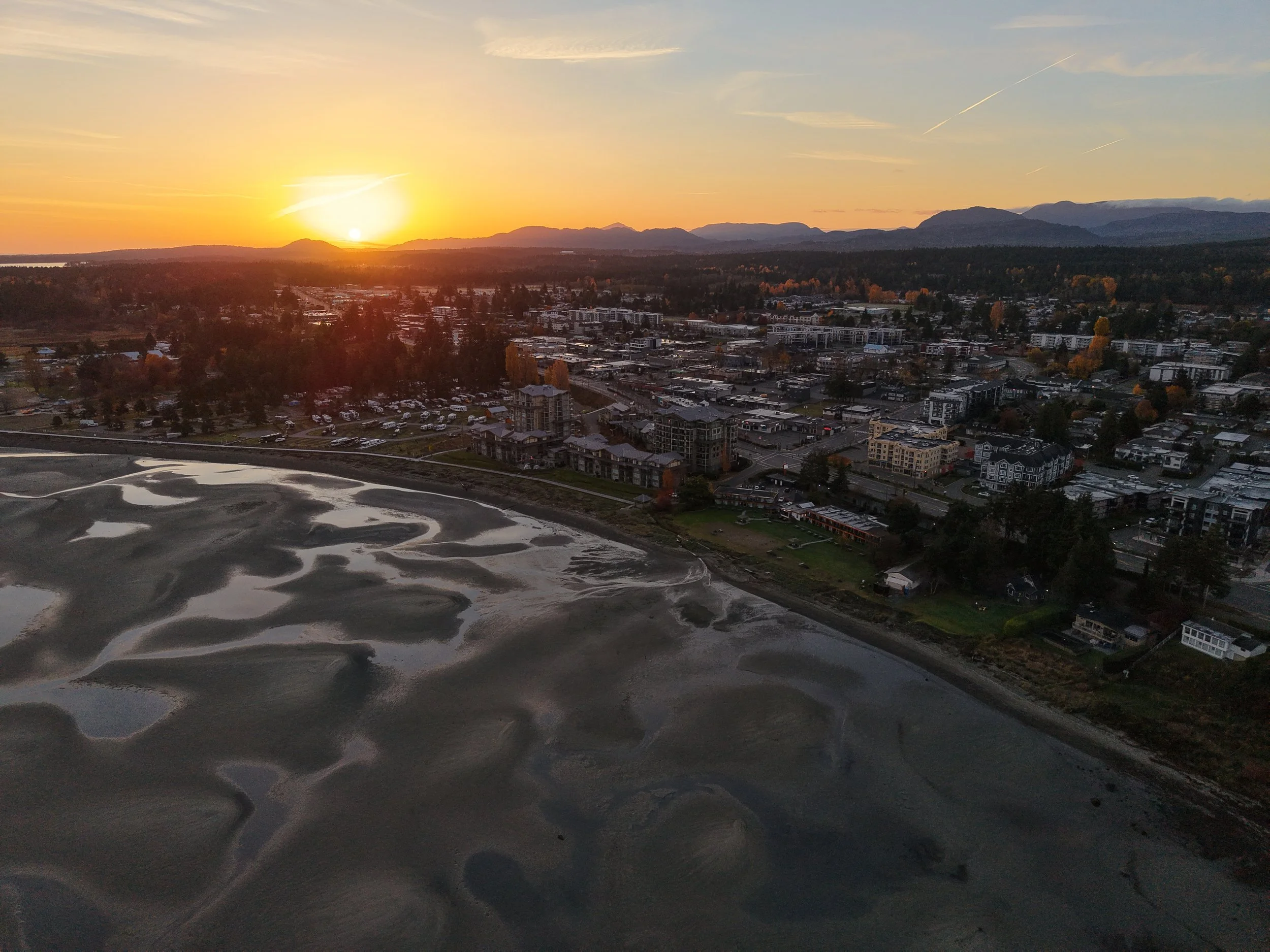
Sunrise over Parksville
There’s something about sunrise on Vancouver Island that keeps pulling me out the door, long before the city wakes up and long before most people would willingly stand on a cold beach with a drone in one hand and bad gas-station coffee in the other.
I don’t think I ever planned for sunrise flying to become my routine. It just happened over time — quietly, without fanfare — until one morning I realized it was the only part of the day that always felt right.
Here’s why I keep choosing sunrise, again and again.
1. The Island feels honest at sunrise
Sunrise is when Vancouver Island shows its real personality.
There’s no pretending, no dramatic filters, no curated moments.
Some mornings the sky is orange and soft; some mornings it’s a wall of fog; some mornings it looks like the sun pressed snooze five times and barely showed up.
Whatever it gives you — that’s the truth of the day.
That honesty is a big part of why I fly.
2. The rhythm of the morning makes flying easier
Early morning flying has its own tempo.
No beach crowds.
No foot traffic stepping into your shot.
No curious dog walkers who decide you need an unsolicited 20-minute conversation about “the big scary drone.”
Just you, the shoreline, and a little bit of space to breathe.
There’s nothing rushed about sunrise.
The light builds slowly, the wind behaves (usually), and the drone feels like it has room to stretch without stepping on anyone’s morning routine.
If you’re a pilot in Victoria, you know how rare that is.
3. It’s the safest, calmest moment of the day
Victoria’s airspace is complicated — we all know that.
Floatplanes.
Helijet.
Coast Guard.
Military red zones.
Weather that makes promises at ground level it has no intention of keeping at 100 feet.
But at sunrise, everything is quieter.
Aircraft are fewer, winds are lower, the city hasn’t started moving yet, and I can focus on getting a clean, respectful flight in without having to wedge myself between other people’s mornings.
It’s not just convenience — it’s safety.
4. Sunrise lets the Island’s beauty speak for itself
There’s a kind of light you only get at sunrise, where the coastline glows a little differently and the waves seem to hold their breath for a minute.
Willows Beach looks softer.
Esquimalt Lagoon feels bigger.
Coal Island feels older.
Parksville looks like it was designed for mornings.
I can get good footage at other times, of course.
But sunrise brings out the character of this place in a way nothing else does.
You don’t have to force the shot.
You just show up, launch, and let Vancouver Island do what it does.
5. It’s the only time the day really belongs to me
By mid-morning, life is already happening at full speed.
Work. Parenting. Errands. Weather closing in again.
Normal life stuff.
But sunrise?
That’s mine.
It’s a small window of calm before the schedule starts — a quiet moment I get to share with my son when he’s with me, or just enjoy alone on the shoreline when it’s one of those solo flights.
It’s a moment that resets things.
A reminder that the Island is still beautiful, still patient, and still here no matter what yesterday looked like.
6. It’s where my best footage lives
If you look through my videos — Willows, Coal Island, Parksville, the Westshore beaches — you’ll notice they all have something in common:
Most of them happened in the soft light of sunrise.
Not because I’m chasing some dreamy Instagram effect, but because that’s when the Island feels like itself. And that’s when the drone feels like it belongs there, not interrupting anything or anyone.
Sunrise is when the Island lets you film it without asking for anything in return.
7. Maybe that’s why sunrise has become my ritual
It’s peaceful.
It’s simple.
It’s honest.
It’s safe.
It’s cinematic.
And it feels like the right way to begin a day on Vancouver Island.
I don’t think I’ll ever get tired of it.
If you enjoy these quiet moments as much as I do, there will be plenty more — new sunrises, new beaches, new little stories from around the Island, all filmed before most people have finished their first cup of coffee.
Thanks for being here for them.
Related Flights & Articles
Why Vancouver Island Is Perfect for Quiet, Cinematic Aerial Stories
A reflection on why this coast, this light, and these landscapes lend themselves so well to calm, sunrise-first flying.
Drones in Victoria, BC – What You Need to Know Before You Fly
A practical, local look at rules, airspace, and what responsible flying actually means around Greater Victoria.
Aerial Photography & Video in Victoria – Why Everything Starts With a Conversation
How I approach thoughtful, safety-first aerial work for locals while keeping the same calm, West Coast storytelling style.
The Insta360 AntiGravity Drone: Fascinating Tech… Just Not for Me

Every now and then something shows up in the drone world that isn’t just another round of “slightly better camera, slightly better sensor, slightly better obstacle avoidance.” And don’t get me wrong — I love that stuff. I’m perfectly happy in DJI’s ecosystem, quietly upgrading my way through their lineup like the fanboy I probably am.
But the new Insta360 AntiGravity drone?
That’s a completely different direction.
It’s not just an upgrade.
It’s a shift.
Instead of taking the traditional formula — camera in front, pilot points the lens, everything happens within a predictable framing — Insta360 basically said:
“What if the camera sees everything?”
It’s a 360° camera, mounted to a drone you never see in the footage.
You fly it, but the direction you point doesn’t really matter.
Editing becomes the star of the show.
And honestly?
That’s fascinating.
You could be flying forward, minding your own business, and something interesting could happen:
off to the side
behind you
above you
below you
…and it’s all still captured.
All of it.
Every angle.
That’s genuinely cool, and I’m glad someone out there is pushing the boundaries instead of refining the same formula year after year. It’s good for the industry to have more than one company inventing things — even if I’ll probably spend the rest of my life comparing everything to DJI because, well… that’s who I am.
Price point?
Also reasonable.
This thing isn’t a wallet-destroyer.
But here’s the truth:
I don’t see a place for it in my world.
Not because it’s bad — it isn’t.
Not because it’s niche — although it is.
But because the way I fly drones — and the way I experience flying drones — doesn’t line up with this style at all.
For one, it leans heavily into the FPV universe.
And now we get to my “I’m old” rant:
What is the point of going to a beautiful beach on the west coast of Vancouver Island, stepping into fresh air, hearing the waves, watching the sun rise over the water…
…and then putting on a pair of goggles so it feels like you’re sitting in your mother’s basement playing a video game?
That’s not for me.
When I go out flying, half the joy is actually being there.
It’s looking around, breathing the air, sipping bad gas-station coffee at 6 a.m., and seeing the world the way it actually looks — not through a headset.
And I’m usually out with my son.
Father–son time plus goggles?
That’s not interactive — that’s me disappearing into a virtual world while he pokes at driftwood waiting for his dad to come back.
So, while I completely understand why people are excited about AntiGravity — and why FPV pilots and creative editors are already dreaming up crazy shots — it’s just not meant for our little two-drone fleet.
**Cool? Absolutely.
Innovative? Definitely.
Something I’ll buy? Probably not.**
But I’m happy it exists.
I’m happy there’s something fresh and strange shaking up the drone world.
And I’m especially happy that not everything has to be a DJI product for me to appreciate it.
If nothing else, this feels like a reminder that there’s still plenty of room for creativity and experimentation in the skies — even if I’ll be sticking to my quiet West Coast cinematics, no goggles required.
Related Articles
Chasing Down a DJI Neo 2 for Christmas — And Why This Drone Matters More Than I Expected
A story about hunting down the perfect starter drone for my son, and how a simple piece of tech turned into real father–son time.
DJI Neo 2 — Why This Little Drone Is About to Become My Four-Year-Old’s First Co-Pilot
A closer look at the Neo 2 and why its size, safety profile, and simplicity make it the ideal micro-drone for teaching kids to fly responsibly.
DJI Mini 5 Pro — If It’s Not a Micro-Drone… That’s the Point
A practical breakdown of why the Mini 5 Pro steps out of the micro-drone category — and why that matters for new pilots, kids learning the basics, and safe flying in Victoria.
Two Calendar Selections, One Very Familiar Sunrise Spot
Most mornings at Esquimalt Lagoon start the same way: too early, too quiet, coffee in hand, and the drone warming up while the first light hits the water. It’s become one of the places I fly the most — not because it’s convenient, but because the Lagoon never looks the same twice.
So it was a pretty great surprise to open my inbox and see a note from the City of Colwood saying that two of those sunrise flights have been selected for their community calendars, including one for the cover.
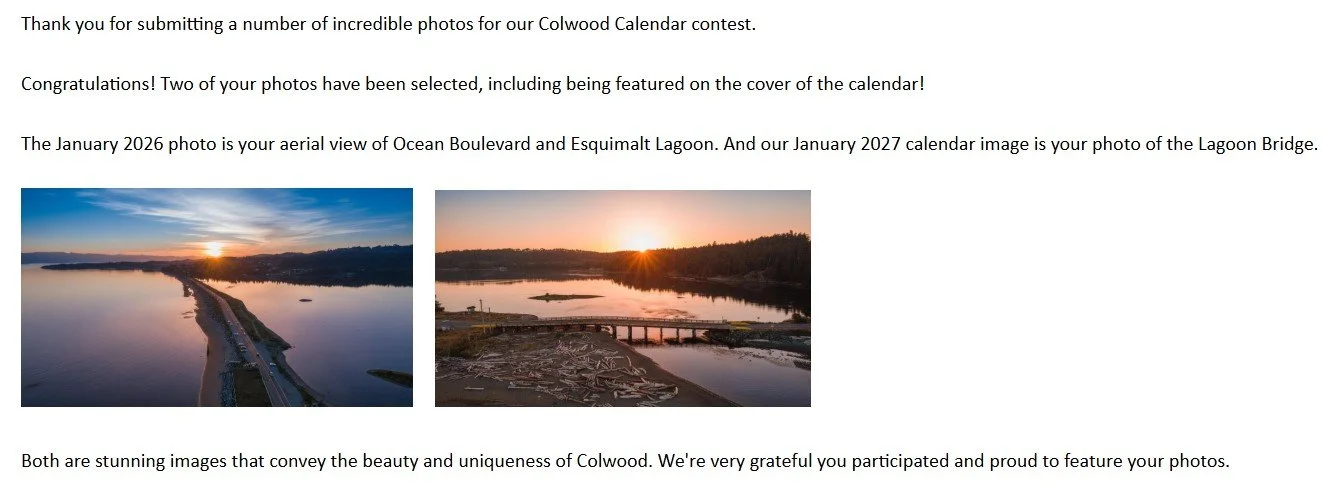
One image will represent January 2026, featuring the long stretch of Ocean Boulevard and the calm water on both sides.
The second will appear as the January 2027 calendar image — a quiet morning at the Lagoon Bridge with warm light spilling over the water.
These aren’t staged shots, or marketing pieces, or anything planned. They’re just the kind of mornings we keep showing up for in the Westshore: clean light, still water, and that moment where the sun finally edges over the treeline.
Why This Means Something
It’s not about awards or bragging rights. It’s about the fact that a place we fly constantly — a place locals love — is being shown through a perspective people don’t often see.
And honestly? That’s what Vancouver Island Drones is trying to do anyway:
show familiar places in new ways
slow things down
treat our region with a bit of care and curiosity
get up early so everyone else can enjoy the view later
Seeing two of those moments chosen to represent Colwood for consecutive years feels like a small nod that we’re on the right path.
A Westshore Story, From Above
We’re not a big production house. We’re a Westshore-based father-and-son operation chasing good coast light and trying to capture the Island the way it actually feels to live here. The Lagoon has become part of our routine, our archive, and our story.
And now a couple of those frames get to be part of Colwood’s story too.
Thank You, Colwood
Big thanks to the City of Colwood for choosing these images — and for continuing the tradition of showcasing local photography in a way that highlights our community, our coastline, and the places we return to again and again.
Related Flights & Articles
Why I Fly at Sunrise — A West Coast Morning Ritual
A look at why these early, quiet moments have become the heart of how I shoot — and why so many of my favourite frames come from first light.
Why Vancouver Island Is Perfect for Quiet, Cinematic Aerial Stories
A reflection on the rhythms, geography, and atmosphere that make this coast such a natural fit for calm, minimal aerial work.
Thinking About Prints — A First Step Into Sharing My Favourite Images
A short piece about experimenting with prints, learning what works, and leaning more intentionally into coastal imagery that translates beautifully to paper.
How to Teach Kids to Fly a Drone (Safe, Simple, and Actually Fun)
If you’re wondering how to teach a kid to fly a drone safely, you’re not alone.
It’s one of the most fun things you can do together — but it can also go sideways quickly if you don’t set it up right.
I’ve been teaching my four-year-old to fly using everything from a DJI Neo 2 to my Air 3S, and I’ve learned pretty quickly that this isn’t about creating a “pilot.”
It’s about keeping it fun, keeping it safe, and building good habits early.
Here’s what’s actually worked for us — and what I’d recommend if you’re getting started.
Can Kids Fly Drones in Canada?
Yes — but it depends on the drone and how you’re flying.
With micro drones (under 250g), things are a lot simpler. You don’t need a license, and the rules are more relaxed — which is exactly why they’re perfect for learning.
That said, “easier rules” doesn’t mean “no responsibility.”
Even with a small drone, the focus should always be:
staying clear of people
flying in open space
keeping the drone in sight
and knowing when to stop
For kids, the goal isn’t to memorize regulations — it’s to understand how to fly safely and respectfully.
1. Make it exciting, not intimidating
Kids learn best when they’re curious, not when they’re lectured.
That’s why the Neo 2 is perfect for Blake right now.
He doesn’t need to memorize menus or learn stick inputs. He can wave at it. He can talk to it. He can make a tiny machine lift off just by holding out his hand.
The joy shows up instantly.
And once he’s hooked, I can start layering in the important stuff — gently.
2. “Fun” is the door. “Responsibility” is what’s behind it.
Every time we fly, we talk about two things:
1. Drones are fun.
2. Drones can hurt people if you aren’t careful.
That’s the honest truth.
I don’t scare him with it, but I don’t hide it either.
He’s four — he understands more than most adults give kids credit for.
So I frame it like this:
We keep space around people because we don’t want to bonk anyone.
We don’t fly toward strangers.
We keep the drone in front of us so we always know where it is.
We don’t chase dogs, birds, or people (even if it would make a hilarious video).
These aren’t aviation rules to him — they’re just “being a good person rules.”
3. The first lessons are simple
When we practice, everything happens in small steps:
Lesson 1: Takeoff and landing on a palm.
It builds trust and shows him he’s the one in control.
Lesson 2: Hovering.
Just hold a position. No chaos yet.
Lesson 3: Move it toward you, then away.
It teaches spatial awareness.
Lesson 4: Stop when Dad says stop.
The most important rule for a kid, honestly.
None of this is about perfection.
It’s about building confidence and understanding without overwhelm.
4. Micro drone doesn’t mean micro responsibility
This is the part many adults get wrong.
A lighter drone is safer, yes — but it’s not a toy.
Blake sees me filing flight plans, checking weather, scoping out space, and making sure our flights follow the rules.
He doesn’t know the details, but he absorbs the behaviour.
Kids mirror what they see.
If they watch you take drones seriously, they take drones seriously — while still having fun.
5. Sunrise flights are the best learning environment
I fly at sunrise because it’s quiet, respectful, and safer in Victoria’s busy airspace. And it turns out… it’s also the best time for a kid to learn.
No crowds.
No distractions.
No dogs running under the drone.
No worrying about people thinking we’re filming them.
Just a calm space to practice.
When he’s with me on a morning flight, that’s when the “little lessons” stick the most.
6. Let them enjoy it — but teach them the why behind every rule
Kids don’t need the Canadian Aviation Regulations in their back pocket.
They just need to understand the spirit of the rules:
We keep drones away from people to keep them safe.
We fly where we have room.
We stop if something doesn’t feel right.
We respect the space around us.
We don’t fly when the wind is too strong (even if it looks calm on the ground).
We don’t push our luck.
Teaching why builds habits that last longer than teaching “because Dad said so.”
7. This is how I hope the hobby survives
Drones are getting smarter, safer, and easier every year.
But the people flying them still matter.
If a new generation learns early that drones are fun and require responsibility…
that’s how you keep the hobby alive, respected, and safe for everyone.
For us, it’s not about making Blake a drone pilot today.
It’s about showing him something cool and teaching him to treat it — and other people — with care.
And honestly?
These little moments together will matter way more than whatever footage we bring home.
If this kind of father–son flying, safe teaching, and West Coast drone storytelling is your thing, there’s plenty more coming — especially once the Neo 2 arrives and Blake decides he can fly better than I can.
Best Drone for Kids (The Honest Answer)
Most “best drones for kids” lists completely miss the point.
They’ll recommend something like the DJI Mini 3 — and on paper, that sounds reasonable.
But in real life?
It’s actually a terrible drone for a kid to start with.
Why the Mini 3 Doesn’t Make Sense for Kids
It’s still a full drone.
Which means:
a full controller (not small hands friendly)
no collision avoidance
no forgiveness when things go wrong
requires proper stick control
For an adult, that’s fine.
For a kid?
That’s how you turn something fun into something frustrating — or worse, something broken.
Why the DJI Neo 2 Is the Right Starting Point
The Neo 2 flips that entire experience.
It’s built for:
bumping into things without instantly ending the day
learning without pressure
actually having fun right away
And more importantly, it gives you options:
follow-me
gesture control
voice control
controller when they’re ready
FPV later if you want to level up
That flexibility matters a lot.
The Part Most People Get Wrong
A kid doesn’t need a “good drone.”
They need a drone that:
doesn’t punish mistakes
doesn’t overwhelm them
makes them want to keep using it
The Neo 2 does that better than anything else right now.
And the price point makes it a lot easier to hand over without stress.
What Happens Next
Once they’re comfortable?
That’s when something like a Mini 3 or Mini 4 actually makes sense.
But starting there?
That’s backwards.
Related Flights & Articles
DJI Lito X1 vs Mini 4 Pro: This Changes What Drone I Recommend in Canada
A closer look at how the Lito X1 stacks up against the Mini 4 Pro — and why it might be the better buy for most people now.
DJI Neo 2 After 3 Months — Still Worth It?What happens after the novelty wears off. Real use, real bumps, and why this thing still comes everywhere with us without even thinking about it.
Hiring a Drone Pilot in Victoria, BC — What It Costs and What You Get
Straightforward pricing, what’s included, and what the process looks like if you need aerial photos, video, inspections, or a better look at something from above.