
The Captain’s Log
Aerial stories, father–son adventures, and life on the edge of the Pacific.
DJI Addiction Anonymous #1 — Hi, My Name Is Ryan

DJI Addiction Anonymous — meetings at sunrise. Batteries charged.
Hi, my name is Ryan… and I have a DJI addiction.
It’s been about five months since my last relapse.
I’ve been staying strong. Going to the meetings. Taking it one sunrise at a time. Haven’t bought any DJI lately… unless you count the “DJI Neo 2 for my son” at Christmas, which obviously doesn’t count because that was for him.
Completely different.
This all started innocent enough.
My first beer was a DJI Mini 3.
Light. Easy. Fun. No consequences. Just a harmless little drone you take out once in a while, get some nice footage, and go about your life like a normal person.
That lasted about five minutes.
Because once you get a taste of it, you start thinking about it. Then you start looking at upgrades. Then you start justifying upgrades. Then suddenly you’re on DJI’s website at 11:30 at night like, “I mean… it’s basically an investment.”
Next thing you know, you’ve got a DJI Mic Mini, an DJI Osmo Nano, an DJI Air 3S, an DJI Osmo Mobile 6… and you’re pretty sure you’re forgetting something but at this point you don’t even want to know.
It’s not a hobby anymore.
It’s a situation.
And just when you think you’ve got it under control…
DJI drops something new.
Enter the Lito lineup.
Now, logically speaking, I don’t need another drone.
Not even close.
I’ve got everything I need. More than I need. I could probably go the rest of the year without buying a single thing and be perfectly fine.
So obviously the internal conversation goes like this:
“I don’t need it.”
“I don’t want it.”
“…do I want it?”
“No.”
“…maybe.”
“Yeah, okay, I want it.”
This is how it works.
You don’t go out looking for a new drone.
The drone finds you.
The worst part is how good they’ve gotten.
Back in the day, you could at least tell yourself you were upgrading because you needed something. Better camera, better features, whatever.
Now? Something like the Lito 1 shows up and it already has half the stuff that used to force you to upgrade in the first place.
So now you’re not upgrading out of necessity.
You’re upgrading because… well, because.
Because it’s better. Because it’s new. Because DJI knows exactly what they’re doing.
And that’s where the meetings come in.
You tell yourself you’re done. You say you’re going to sit this one out. You’ve got enough gear, you’re happy with what you’ve got, you’re not falling for it this time.
Then you see a review. Then another one. Then a comparison.
Then you’re on the product page again.
Look, I don’t have a problem.
You have a problem.
I’m fine.
I’m in control.
I can stop anytime I want.
…just not right now.
DJI Addiction Anonymous
Meetings are at sunrise.
Bring charged batteries.
Related Reads
Hiring a Drone Pilot in Victoria, BC — What It Costs and What You Get
Straightforward pricing, what’s included, and what the process looks like if you need aerial photos, video, inspections, or a better look at something from above.
DJI Lito X1 vs Mini 4 Pro: This Changes What Drone I Recommend in Canada
A closer look at how the Lito X1 stacks up against the Mini 4 Pro—and why it might be the better buy for most people right now.
DJI Neo 2 After 3 Months — Still Worth It?
What happens after the novelty wears off. Real use, real bumps, and why this thing still comes everywhere with us without even thinking about it.
DJI Lito 1 vs Lito X1: Which One Actually Makes Sense?

My first drone was a DJI Mini 3 and I thought it was the greatest thing I’d ever bought.
Like your first beer.
Tastes a little sweet, feels harmless, you’re sitting there thinking, “Yeah, this is nice. I don’t see what the big deal is.”
Fast forward a bit and now you’re hungover, making questionable decisions, and somehow convincing yourself you need another one.
That’s drones.
That’s exactly how this starts.
At the time, the Mini 3 was perfect. I wasn’t crashing it (much), the footage looked great to me, and I had no reason to upgrade.
Until I did.
Because once you get a taste of it, you start noticing things. Not big things. Just enough to annoy you.
You wish it tracked better. You wish it had obstacle avoidance so you weren’t flying like a nervous squirrel. You start seeing footage online that looks just a bit cleaner, a bit sharper, and now you’re wondering what the hell you’re missing.
That’s how DJI gets you.
You don’t wake up one day and decide to upgrade.
You slowly get addicted to that good, good DJI.
So yeah, I did the responsible thing and went from the Mini 3 straight to an Air 3S.
Totally reasonable. Very measured decision-making.
In my head, I had it all figured out. I was getting my Advanced license, I was going to do construction work, I needed something “more professional.” The Mini 3? Great drone… but let’s be honest, it still felt like a toy once you start telling yourself you’re doing real work.
The Air 3S felt like a step into the big leagues.
Prosumer. Legit. Justifiable.
That’s the story I told myself, anyway.
Now DJI drops the Lito 1, and this is where things get dangerous.
Because you look at it and go… hold on.
This thing already has a bunch of the stuff that got me hooked in the first place.
Tracking. Collision avoidance. The little automated shots. It’s not missing the obvious stuff anymore. This isn’t a “starter drone” in the old sense. This is already enough to get you into trouble.
So naturally the question becomes:
What the hell is the point of the Lito X1?
And here’s the honest answer.
It’s better.
The sensor jump is real. Bigger sensor, cleaner image, more flexibility. You will see a difference there. I didn’t think I cared about camera quality either until I saw what better actually looks like, and then suddenly it’s like, “Oh. Okay. Yeah… that’s better.”
But I’ll tell you what’s actually going to matter one day.
Not the sensor.
Not the dynamic range.
Not whatever marketing term DJI is using this week.
The internal storage.
Because one morning—and it will happen—you’re going to wake up early, grab a coffee, drive out for a sunrise shoot, feeling like you’ve got your life together for once…
…and then you go to launch and realize you forgot your SD card.
Now what?
Now you’re standing there with a drone that can do everything except record anything.
It’s like dropping a deuce and realizing there’s no toilet paper.
You’re already in it. There’s no clean way out. You’ve only got yourself to blame, and you’re immediately questioning how you got here.
That’s when that 42GB of internal storage suddenly becomes the greatest feature ever invented.
Not sexy. Not exciting.
But it’ll save your bacon one day.
Guaranteed.
So here’s the real takeaway.
The Lito 1 is your first beer. It’s good. It’s fun. And it’s way more capable than it has any right to be.
The X1 is better—but not in that immediate, “you’re an idiot if you don’t buy this” way.
It’s better once you’re already in deep.
And if you’re already thinking about upgrading from the Lito 1?
You’re probably not even looking at the X1 for long.
You’re doing exactly what I did.
You’re telling yourself you’re going “a bit more professional,” and next thing you know you’re staring at something like an Air 3S (or whatever DJI calls the next one) and convincing yourself it makes total sense.
Because at that point, you’re not upgrading for features anymore.
You’re upgrading because you’re hooked.
Also, just to make matters worse, I’ve now got my five-year-old flying a Neo 2 around like it’s nothing.
So this isn’t even just my problem anymore.
And if you’re sitting there trying to be responsible, this is probably where you should check the actual prices before the addiction fully takes over.
If you want the sensible first hit, check the latest DJI Lito 1 pricing on Amazon.
If you already know you’re the kind of person who will forget an SD card at sunrise and then swear at yourself in a parking lot, check the latest DJI Lito X1 pricing on Amazon.
And if you’re already telling yourself you “might as well get something more professional,” check the latest DJI Air 3S pricing on Amazon and admit where this is heading.
Because that’s how DJI gets you.
First it’s the cute little one.
Then it’s the better one.
Then suddenly you’re comparing camera sensors, wind resistance, controller bundles, and calling it “research.”
Welcome to DJI Addiction Anonymous.
Meetings are at sunrise.
Bring charged batteries.
Related Reads
Drone Accessories I Actually Recommend in Canada
You do not need 47 drone accessories. Just the practical stuff that keeps you flying longer, protects your gear, and saves you from ruining a flight before it even starts.
Which DJI Drone Should You Buy First: Neo 2, Lito 1, or Lito X1?
A practical, slightly biased look at the Neo 2, Lito 1, and Lito X1 — from the flying yellow Labrador to the first real drone and the one you’re least likely to outgrow.
Hiring a Drone Pilot in Victoria, BC — What It Costs and What You Get
Straightforward pricing, what’s included, and what the process looks like if you need aerial photos, video, inspections, or a better look at something from above.
DJI Neo 2 Review: The Best First Drone for Kids, Creators, and Wannabe Jedi
A tiny follow-me drone with palm launch, gesture control, prop guards, and just enough weird DJI wizardry to make you feel like you’re using the Force. Great for kids, creators, hikers, bikers, and anyone who wants a drone they’ll actually use.
DJI Lito X1 vs Mini 5 Pro — Are You Paying Double for Stuff You’ll Actually Notice?
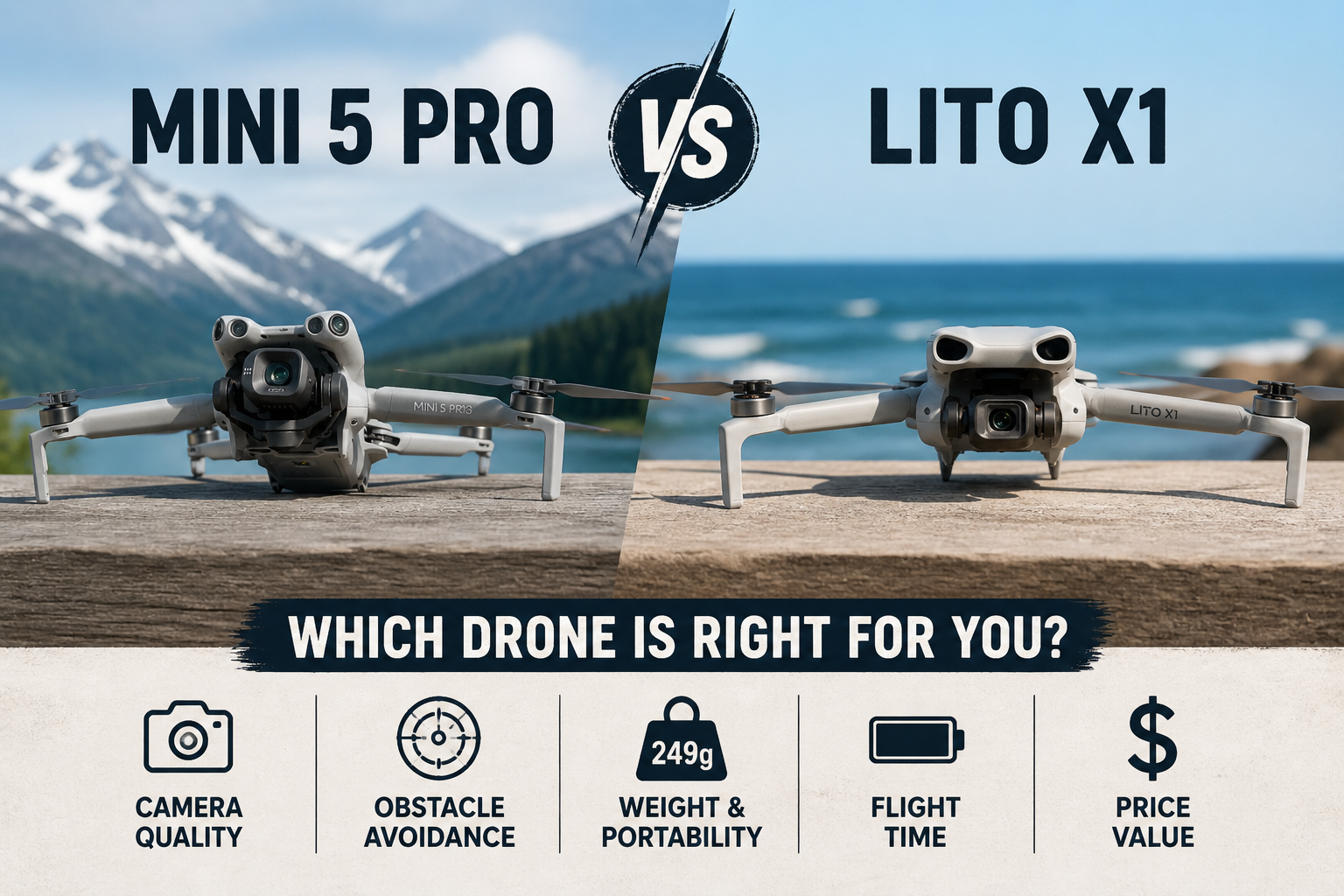
On paper, the Mini 5 Pro is the better drone. Better camera, more polished, more “pro” everything. That’s not really up for debate.
But that’s not the question most people should be asking.
The real question is whether any of that actually matters once you get out of spec sheets and into real-world use — especially in Canada, where the whole microdrone thing still decides whether you’re flying all the time or barely at all.
And this is where the Lito X1 gets interesting.
Because instead of trying to out-spec the Mini 5 Pro, it does something smarter. It simplifies things. Fewer components, a different approach to obstacle avoidance, and a price that doesn’t make you stop and think twice before bringing it with you.
DJI’s clearly experimenting with this new direction. The Neo 2 started it, the Lito line pushed it further, and now you’ve got a system that relies more on camera-based awareness and less on stacking sensors everywhere. And the weird part is… it works.
Not “technically better,” not “beats LiDAR in a lab test,” but in actual use? Close enough that most people won’t notice a difference. Sometimes even better, just because it seems to understand space in a more natural way.
That’s the shift.
The Mini 5 Pro still wins if you’re chasing the best image quality. Bigger sensor, better low light, more flexibility — if you’re shooting seriously or you care about squeezing every bit of quality out of your footage, it’s the better tool.
But for most people? It’s a lot of extra money for improvements you might not actually see once the footage is on your phone or Instagram.
And then there’s the awkward part.
The Mini 5 Pro sits in this weird middle ground. Depending on how DJI lands on weight and classification, it’s not quite the clean, no-thought-required microdrone the older Minis were. That matters more than people think. Once you step out of that category, everything changes — more rules, more planning, more friction.
The Lito X1 doesn’t have that problem. It stays simple. Light, easy to bring with you, and good enough at pretty much everything most people actually do.
That’s really what this comes down to.
The Mini 5 Pro is the better drone.
The Lito X1 is probably the better decision.
Not because it’s more powerful, but because it hits that balance properly. Price, performance, simplicity, and the kind of drone you’ll actually take with you instead of leaving at home.
And honestly, this is where it’s worth looking at the current pricing directly from DJI, because the gap between these two is a big part of the decision.
If you’re leaning toward the higher-end option, check the latest DJI Mini 5 Pro pricing on Amazon.
That price difference might answer the question faster than any spec sheet will.
Because if DJI keeps going in this direction — simpler systems, fewer components, smarter software — don’t be surprised if this ends up being where all of their drones head next, just with nicer versions layered on top.
For most people, that’s not a downgrade.
It’s exactly what they needed in the first place.
Related Reads
Drone Accessories I Actually Recommend in Canada
You do not need 47 drone accessories. Just the practical stuff that keeps you flying longer, protects your gear, and saves you from ruining a flight before it even starts.
Which DJI Drone Should You Buy First: Neo 2, Lito 1, or Lito X1?
A practical, slightly biased look at the Neo 2, Lito 1, and Lito X1 — from the flying yellow Labrador to the first real drone and the one you’re least likely to outgrow.
Hiring a Drone Pilot in Victoria, BC — What It Costs and What You Get
Straightforward pricing, what’s included, and what the process looks like if you need aerial photos, video, inspections, or a better look at something from above.
Canada’s Drone Rules Got More Complicated (Again) — Here’s What Actually Matters
If you’ve tried to look up drone rules in Canada lately, you’ve probably ended up ten tabs deep on the Transport Canada site wondering if you need a law degree just to take a photo of a beach. It’s not just you. The rules have always been a bit layered, but now with this newer “Level 1 Complex” stuff getting talked about, it’s starting to feel like there’s some secret next level you’re supposed to unlock.
So let’s just cut through it.
There are really three lanes now, whether Transport Canada wants to explain it that way or not. Basic, Advanced, and then this newer Level 1 Complex path that starts nudging into beyond visual line of sight territory. Sounds fancy. Sounds like the next logical step. It’s not that simple.
Basic is what most people start with, and honestly, for a lot of Canada it’s fine. You pass a cheap online test, register your drone, and you’re good to go in uncontrolled airspace as long as you’re not being an idiot. The problem is, if you live anywhere like Victoria, Basic is basically useless the second you look at a map. Controlled airspace everywhere, floatplanes doing their thing, people everywhere, and suddenly you’re boxed in before you even take off.
That’s where Advanced comes in, and this is the level that actually matters in the real world. You write the Advanced exam, you do a flight review with someone who knows what they’re doing, and now you can operate in controlled airspace with authorization, work closer to people with the right drone, and actually get things done. This is where you go from “guy with a drone” to “someone who can legally and reliably do work.” Most paid jobs live here. Construction, inspections, business stuff, real estate, all of it. This is the level that makes sense for 95 percent of people who want to do anything beyond messing around.
Now this is where things get interesting, because people start hearing about Level 1 Complex and think, “okay, that must be the next step.” It kind of is, but not in the way people think. This isn’t just another test you write on a Sunday afternoon so you can suddenly fly your drone kilometers away like you’re running some kind of mini air force. It’s a different category of operation entirely.
Level 1 Complex is tied into what Transport Canada calls lower-risk BVLOS, which is beyond visual line of sight. Sounds cool, and it is, but it comes with strings attached. You’re not just upgrading your license, you’re stepping into a more structured environment. You still need your Advanced knowledge, then you’re adding more training, more ground school, another exam, another flight review, and on top of that you’re not operating as just a guy anymore. You’re tied into an operation that has an RPAS Operator Certificate, proper procedures, and a drone that’s actually approved for that kind of work.
In other words, you’re not just flying further. You’re operating as part of a system.
And this is usually the point where some people realize they don’t actually want to deal with any of this. If you just need photos, video, or a look at something from the air, going down the licensing rabbit hole, figuring out airspace, and doing it properly can be more effort than it’s worth. That’s literally the kind of work I do locally. I handle the planning, airspace, and flying so you don’t have to think about it.
And that’s the part that gets missed.
So is it worth it?
For most people, no. Not right now.
And this is usually the point where some people realize they don’t actually want to deal with any of this. If you just need photos, video, or a look at something from the air, going down the licensing rabbit hole, figuring out airspace, and doing it properly can be more effort than it’s worth. That’s literally the kind of work I do locally. I handle the planning, airspace, and flying so you don’t have to think about it.
If you’re doing local jobs, taking photos, doing inspections, working with businesses, the jump from Advanced to Level 1 Complex doesn’t suddenly unlock a bunch of new opportunities. It adds complexity, cost, and requirements that don’t line up with the kind of work most small operators are actually doing. You’re not suddenly getting calls saying, “hey, can you fly five kilometers down a pipeline for me?” That’s a different market.
Where it does make sense is if you’re planning to step into that world. Infrastructure, large-scale mapping, working with companies that already understand and need BVLOS capability. Then yeah, it starts to make sense to look at it seriously. But that’s a decision to change the type of work you’re doing, not just level up your license.
And this is kind of the bigger takeaway with Canadian drone rules in general. They’re not trying to make your life easier. They’re trying to separate casual flying, professional local work, and higher-risk operations into different buckets. Once you see it that way, it actually makes more sense, even if it’s still a bit of a pain to navigate.
So if you’re sitting there wondering what you should do, it’s pretty simple. If you’re just flying for fun in open areas, Basic is fine. If you want to actually do work and not constantly run into walls, Advanced is where you need to be. And if you’re looking at Level 1 Complex, you should be asking yourself not “is this the next step,” but “am I actually trying to get into that level of operation?”
Because if you’re not, you’re probably just adding headaches for no real gain.
Canada didn’t create a new level for hobbyists to chase. They created a pathway for more complex operations to exist without everything going through special flight certificates. That’s a good thing overall, but it doesn’t mean everyone needs to jump on it.
Most of the time, the smartest move is still the same as it’s been for a while now. Get Advanced, learn how to operate properly, understand your airspace, and actually get good at flying. That’ll take you a lot further than chasing the next acronym.
And if you’re in a place like Victoria, where the airspace alone can make your head spin, you’ll figure out pretty quickly that knowing what you’re doing matters a lot more than what certificate you’ve got framed on the wall.
Related Reads
Hiring a Drone Pilot in Victoria, BC — What It Costs and What You Get
Straightforward pricing, what’s included, and what the process looks like if you need aerial photos, video, inspections, or a better look at something from above.
DJI Neo 2 After 3 Months — Still Worth It?
What happens after the novelty wears off. Real use, real bumps, and why this thing still comes everywhere with us without even thinking about it.
Teaching Kids to Fly a Drone (What Actually Works)
The basics that matter — where to start, what to avoid, and how to keep it fun without doing anything stupid, especially here in Canada.

Hiring a Drone Pilot in Victoria, BC — What It Costs and What You Get
Sunrise flight over Esquimalt Lagoon in Victoria, BC, heading out toward Fisgard Lighthouse.
If you’re looking to hire a drone pilot in Victoria, the first question is usually price. Most jobs are straightforward. A basic aerial photo session starts around $150. Photos and video together are usually in the $200-$300 range. Ongoing work or inspections tend to be about $150 an hour with a minimum callout. That’s real pricing, not guesswork.
What that looks like is simple. You send me what you need and where it is. I do a site survey, check the airspace, and make sure it’s actually flyable. If needed, I submit a flight plan through NAV CANADA so everything is handled properly before I show up.
Then it’s just a short visit. Get the shots, get what you need, and send it over. No dragging it out.
This makes the most sense for things like construction progress, roofing checks, inspections, or getting clean visuals of a business or property. A lot of the time it’s just a faster, safer way to see something without putting someone on a ladder or guessing from the ground.
Victoria isn’t wide open airspace. There are float planes, controlled zones, and areas where you can’t just throw a drone up. That’s why the planning matters. I’m Advanced-certified and insured, and every flight is done safely and legally.
If you’ve got something in mind, send me a quick email with what you need and where it is. I’ll tell you straight up if it makes sense and what it’ll cost. ryan@vancouverislanddrones.ca
Related Reads
DJI Lito X1 vs Mini 4 Pro: This Changes What Drone I Recommend in Canada
A closer look at how the Lito X1 stacks up against the Mini 4 Pro—and why it might be the better buy for most people right now.
DJI Neo 2 After 3 Months — Still Worth It?
What happens after the novelty wears off. Real use, real bumps, and why this thing still comes everywhere with us without even thinking about it.
Teaching Kids to Fly a Drone (What Actually Works)
The basics that matter — where to start, what to avoid, and how to keep it fun without doing anything stupid, especially here in Canada.
Is the DJI Lito X1 the Best Drone in Canada for 2026?
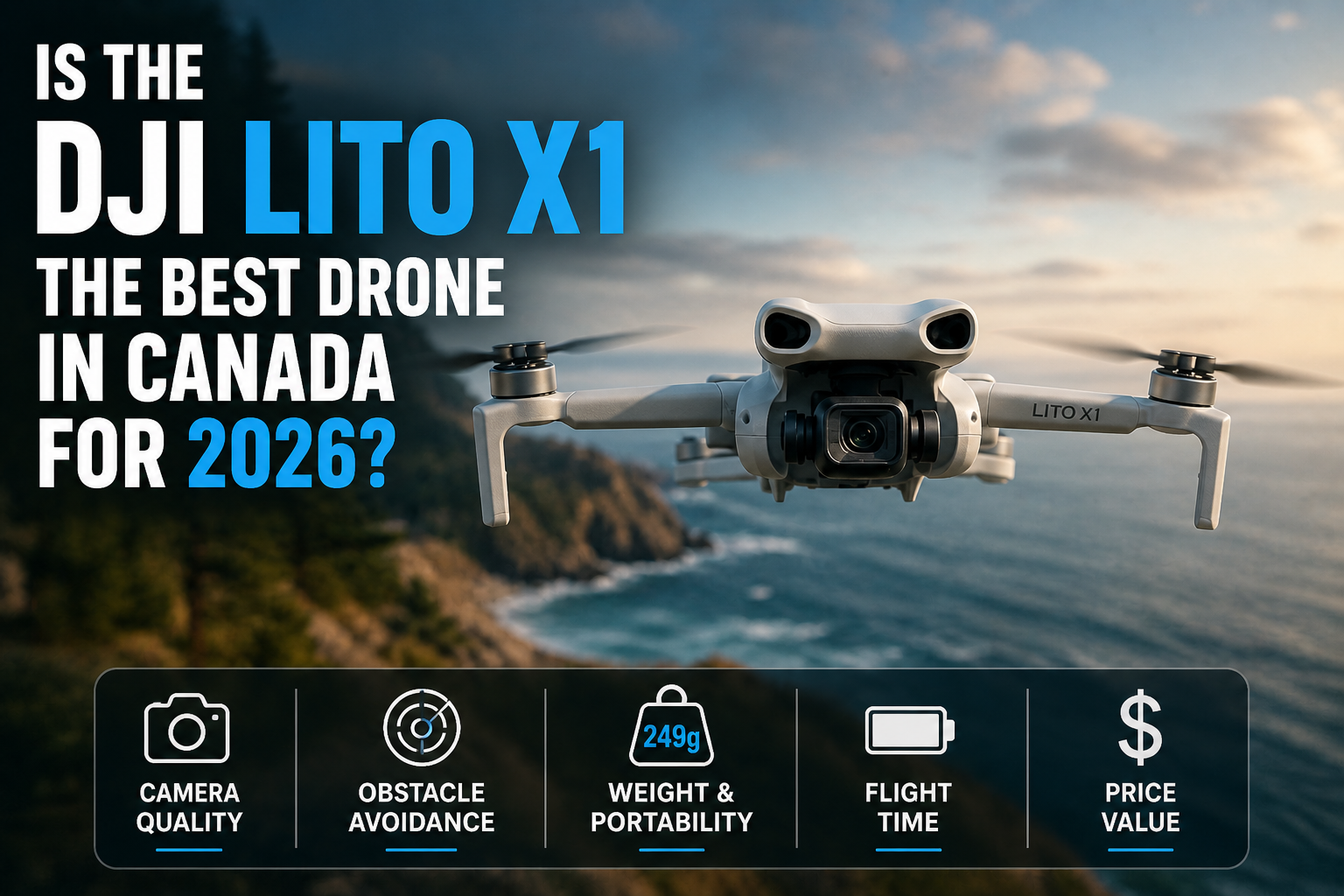
On paper, there are better drones.
Better cameras, more features, more “pro” everything. But in Canada, that’s not really what matters. The real question is what you’re actually going to use, and more importantly, what you’re actually going to bring with you.
That’s where something like the Lito X1 starts to make a lot of sense.
If you’re buying a drone here, you’re basically making one decision whether you realize it or not. Stay under 250 grams, or deal with everything that comes with going over it. Once you step out of that category, it’s licensing, more restrictions, more planning. For a lot of people, that’s the difference between using a drone all the time and barely using it at all.
The Lito X1 stays right where it needs to be. It’s light, it’s simple to live with, and it still does most of what people actually want. The camera is solid, tracking works properly, and the obstacle avoidance is good enough that you’re not constantly second guessing every move. It’s not trying to be a flagship, and that’s kind of the point.
The Mini 4 Pro is still a really good drone. If you already have one, there’s no reason to run out and replace it. It’s more polished, the camera is better, and it’s proven. But if you’re buying today, starting from scratch, the Lito X1 is easier to recommend. It’s cheaper, close enough in performance for most people, and it keeps the whole experience simple.
The Mini 5 Pro is where things get a bit weird. On paper it looks great, but if it’s not firmly staying in that true sub-250 category, it kind of loses the whole point of being a Mini in Canada. If you’re dealing with more rules anyway, you start asking why you wouldn’t just go to something like the Air 3S. It ends up in this middle ground where it’s a good drone, but not the obvious choice it should be.
The other one worth talking about is the Neo 2. Completely different kind of drone, but honestly one of the easiest recommendations right now. It’s quick to get in the air, tough, easy to use, and just fun. For travel, biking, kids, or just messing around, it’s hard to beat. It’s not replacing something like the Lito X1, but it’s filling a different role really well.
If you look at it simply, the Lito X1 is probably the best all-around micro drone you can buy right now, and the Neo 2 is the one you’ll end up using the most without even thinking about it.
So is the Lito X1 the best drone in Canada for 2026?
For most people, yeah, it probably is.
Not because it’s the most powerful, but because it hits the balance properly. It stays in the easiest category to fly, it does what most people actually need, and it’s priced in a way that makes sense. More importantly, it’s the kind of drone you’ll actually bring with you instead of leaving at home.
Check the DJI Lito X1 price on Amazon
And if you’re curious about the more “grab it and go” option, the Neo 2 is worth a look too:
Check the DJI Neo 2 price
Related Reads
DJI Lito Lineup vs Mini Series: The Minis Just Got Hard to Recommend
The Lito 1 and Lito X1 bring sub-249g weight, modern obstacle sensing, and strong features at prices that make the old Mini lineup a lot harder to recommend.
DJI Neo 2 After 3 Months — Still Worth It?
What happens after the novelty wears off. Real use, real bumps, and why this thing still comes everywhere with us without even thinking about it.
DJI Lito X1 vs Mini 5 Pro — Are You Paying Double for Stuff You’ll Actually Notice?
A real-world look at the price gap, the new collision avoidance approach, and whether the Mini 5 Pro is actually worth it for most people.
DJI Neo 2 After 3 Months — Still Worth It?
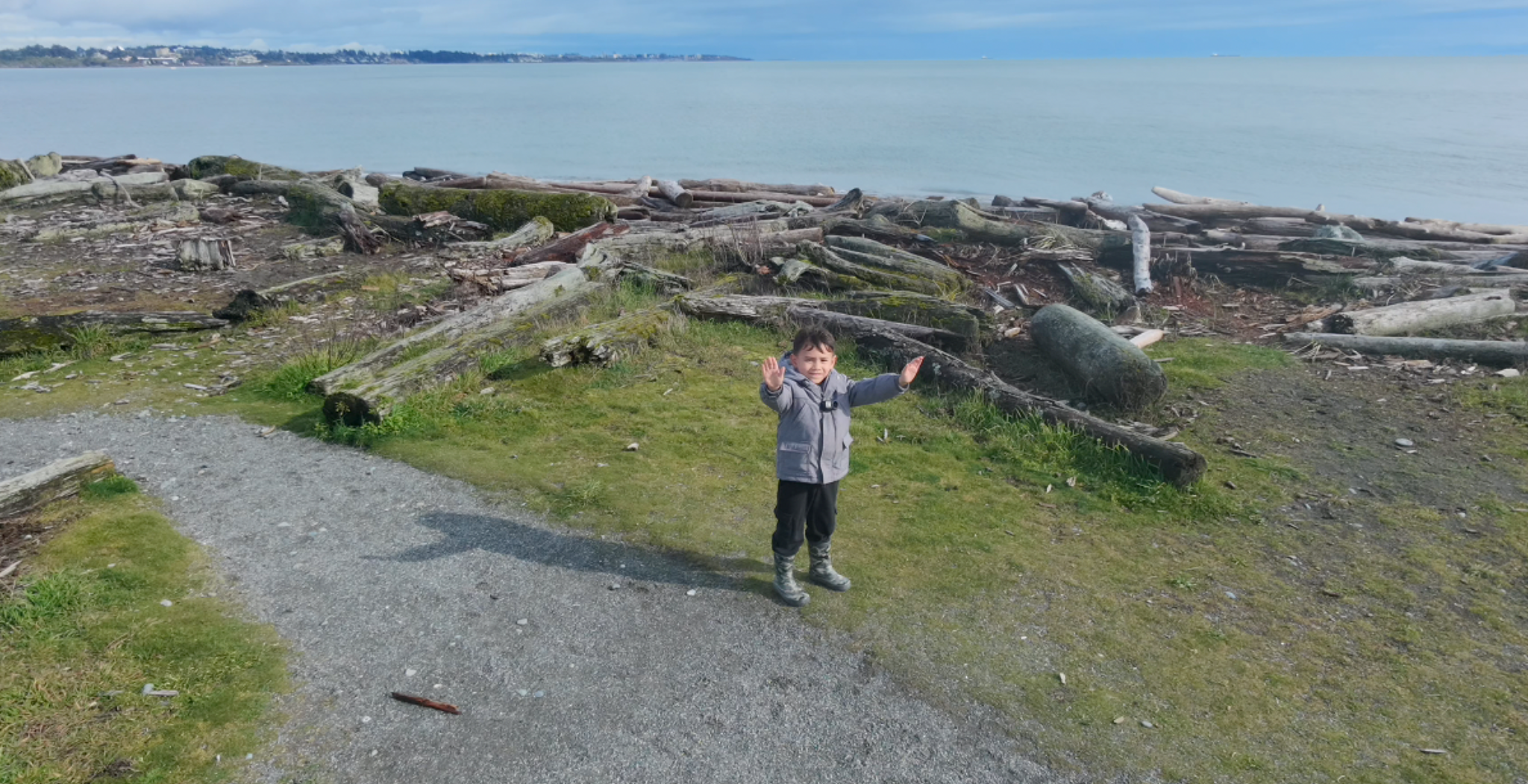
It’s still insanely easy to use… gesture controls work…
Short answer? Yeah. It’s still worth it. Easily.
Three months in, this thing hasn’t worn off at all. Blake still loves it, his friends love it, and it’s basically expected that it shows up now. Every time someone sees it for the first time, it’s the same reaction — what is that, how much is it, and then they’re blown away when you tell them.
If you’re curious what it’s going for right now, you can check the current price here on DJI.
The biggest thing is that it actually gets used. A lot of gear sounds cool and then sits at home because it’s a hassle. This isn’t that. You pull it out of your pocket or your bag, press a couple of buttons, and it’s in the air. No controller, no waiting around for satellites, no messing around. It just goes. Because of that, it comes everywhere with us — rugby practice, the bike park, the beach, wherever we’re headed.
It’s still insanely easy to use. Gesture controls work, tracking works, voice controls work, and you can reposition it on the fly without turning it into a whole production. If you want to get more serious, you can connect a controller. If FPV is your thing, it can do that too. Most of the time, you don’t need any of that, and that’s kind of the point.
Durability… I’m not going to call it indestructible, but I also haven’t found the limit yet. It’s taken hits, been grabbed, chased, landed badly, and generally treated like a toy by a group of kids, and it just keeps going. Pick it up, dust it off, send it back up.
It’s basically kid-proof, which still sounds ridiculous to say, but it’s true. My five-year-old uses it constantly, his friends use it, they chase it, try to land it, mess around with it, and it holds up. More importantly, it feels safe. It’s small, predictable, and not intimidating to people around it. Nobody’s nervous when it’s flying nearby — they’re curious.
The flexibility is underrated. This thing can be a follow-me camera, a handheld launch drone, something you fly with a controller, or something you control with gestures. Apparently you can connect a mic to it as well, which starts getting into portable videographer territory. For something this small and this cheap, that’s pretty wild.
The only real downside I’ve noticed is wind. You can see it working pretty hard even in a light breeze, and living on an island, that’s something you notice quickly. If you’re trying to get smooth, cinematic footage in less-than-ideal conditions, it’s not the right tool for that. But as a follow-me drone? It’s unbelievable.
It’s also one of those things that gets people into drones. Blake’s friends love it, and it’s sparked interest with pretty much everyone who’s been around it. If you’ve ever thought about getting a drone for travel, outdoor stuff, or just capturing moments without overthinking it, this is a pretty fun way to do it.
Three months in, it still gets used, it’s still fun, and it’s still one of the easiest pieces of gear to grab without thinking about it. For the price, it’s a no-brainer.
It’s not replacing a proper drone across the board. It’s not supposed to.
But for a lot of real-world use — hikes, bike rides, travel, anything where you just want to document what you’re doing without messing around — there’s a strong argument that it replaces more than you’d expect. If the alternative is bringing something like a Mini 4 Pro and dealing with the setup every time, this is just easier, and because of that, it actually gets used.
And that’s the whole point.
Related Reads
DJI Neo 2 Review: The Best First Drone for Kids, Creators, and Wannabe Jedi
A tiny follow-me drone with palm launch, gesture control, prop guards, and just enough weird DJI wizardry to make you feel like you’re using the Force. Great for kids, creators, hikers, bikers, and anyone who wants a drone they’ll actually use.
DJI Lito 1 vs Neo 2: Two Completely Different Drones (So Which One Makes More Sense?)
A real-world comparison between two very different drones at a similar price point—and which one actually makes sense depending on how you plan to use it.
Hiring a Drone Pilot in Victoria, BC — What It Costs and What You Get
Straightforward pricing, what’s included, and what the process looks like if you need aerial photos, video, inspections, or a better look at something from above.
Teaching Kids to Fly a Drone for the First Time
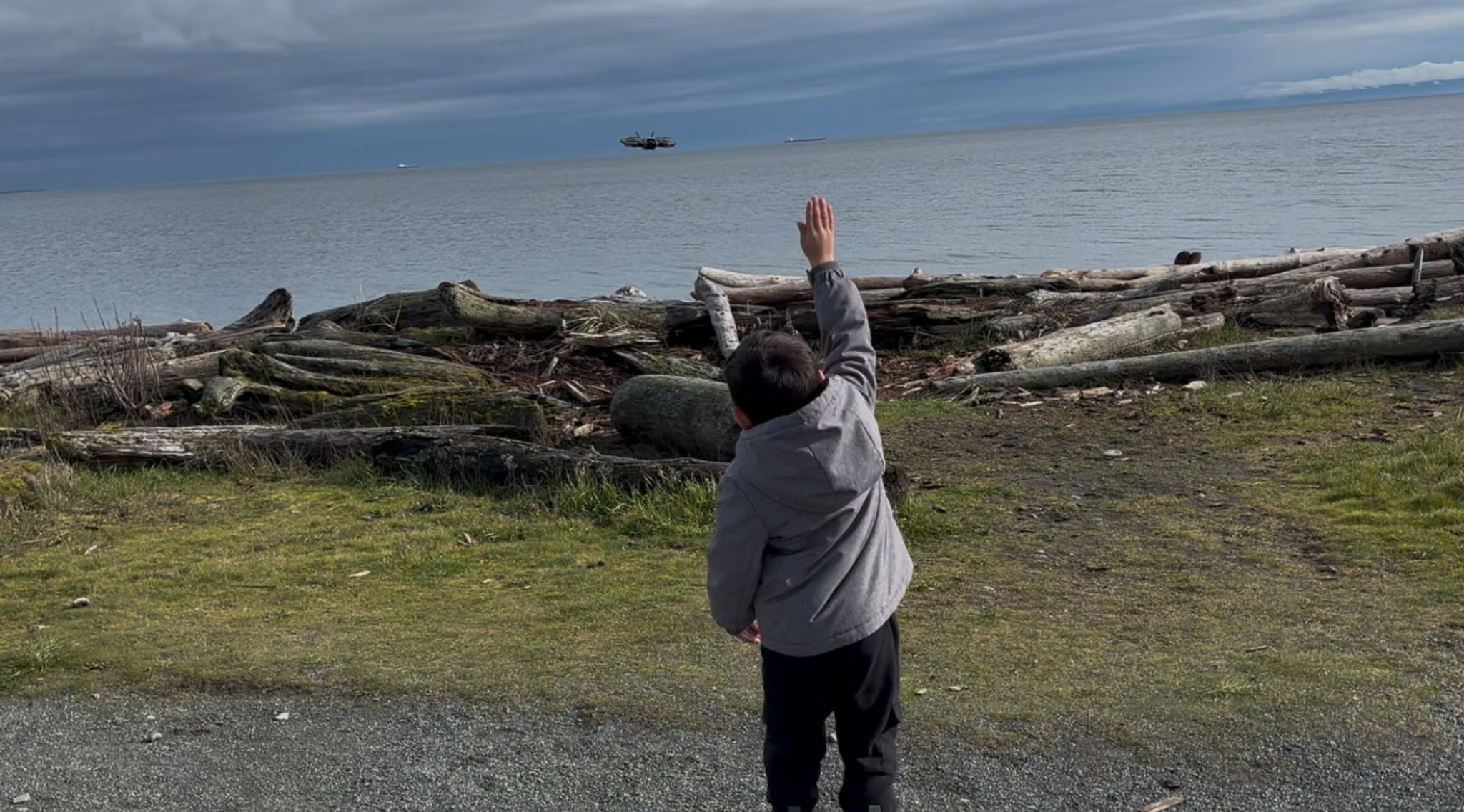
My son flying his DJI Neo 2
Everyone overthinks this.
If you’re teaching a kid to fly a drone, you don’t need a lesson plan—but you do need to know a few basics before you take off.
First—rules.
Even with a sub-250g drone like the Neo 2, you’re still responsible. Stay away from people. Stay away from crowds. Scheduled public events are a hard no—sports fields, festivals, anything like that.
Same goes for hospitals, accidents, forest fires, or anything with emergency services. If lights are flashing, don’t be flying there. Around here, add float planes and military areas to that list too.
You don’t need a license under 250 grams, but that doesn’t mean “do whatever you want.”
Alright—actual flying.
And this is where it splits a bit, depending on how you’re using the drone.
If you’re flying with a controller, keep it simple.
Take off. Hover. Get used to how it feels. Don’t go ripping around right away.
Once that feels steady, start moving it a bit. Small, controlled movements. Think simple shapes—boxes, circles—nothing aggressive. The goal here isn’t to be exciting, it’s to build control.
And the big one people don’t expect is perspective.
Flying with the camera facing away from you feels natural. Turn it around so it’s facing you, and suddenly everything feels backwards for a minute. That’s normal.
So practice both at the same time—simple movement, different orientations. That’s how you actually get comfortable.
If your kid plays video games, there’s a good chance they’ll pick this up faster than you think.
Keep it low. Keep it close. Land it, take off again, repeat it a few times. It’s not the most exciting part, but once it clicks, it clicks fast.
Now—if you’re using something like the Neo 2 as a follow-me drone, that’s a completely different experience.
You’re launching it out of your hand, hitting a mode, and it’s tracking you. At that point, honestly… just go.
They stay relatively close, they’re doing a lot of the work for you, and it’s a really fun way to get started without overthinking controls.
It’s not really “learning to fly” in the traditional sense—it’s more just using the drone and enjoying it.
Back to the basics—no matter how you’re flying, stay away from people. Not just because of the rules—it also annoys people, and you’ll have a better time if you’re not dealing with that.
As for the drone itself, this is exactly why I recommend something like the Neo 2.
The prop guards are huge when you’re learning. Otherwise, yeah—you’re replacing props at some point. It happens.
The Neo 2 can take a bit of a beating. You pick it up, dust it off, and keep going. That matters, especially with kids.
If you want to check current pricing or what comes with it, you can take a look here.
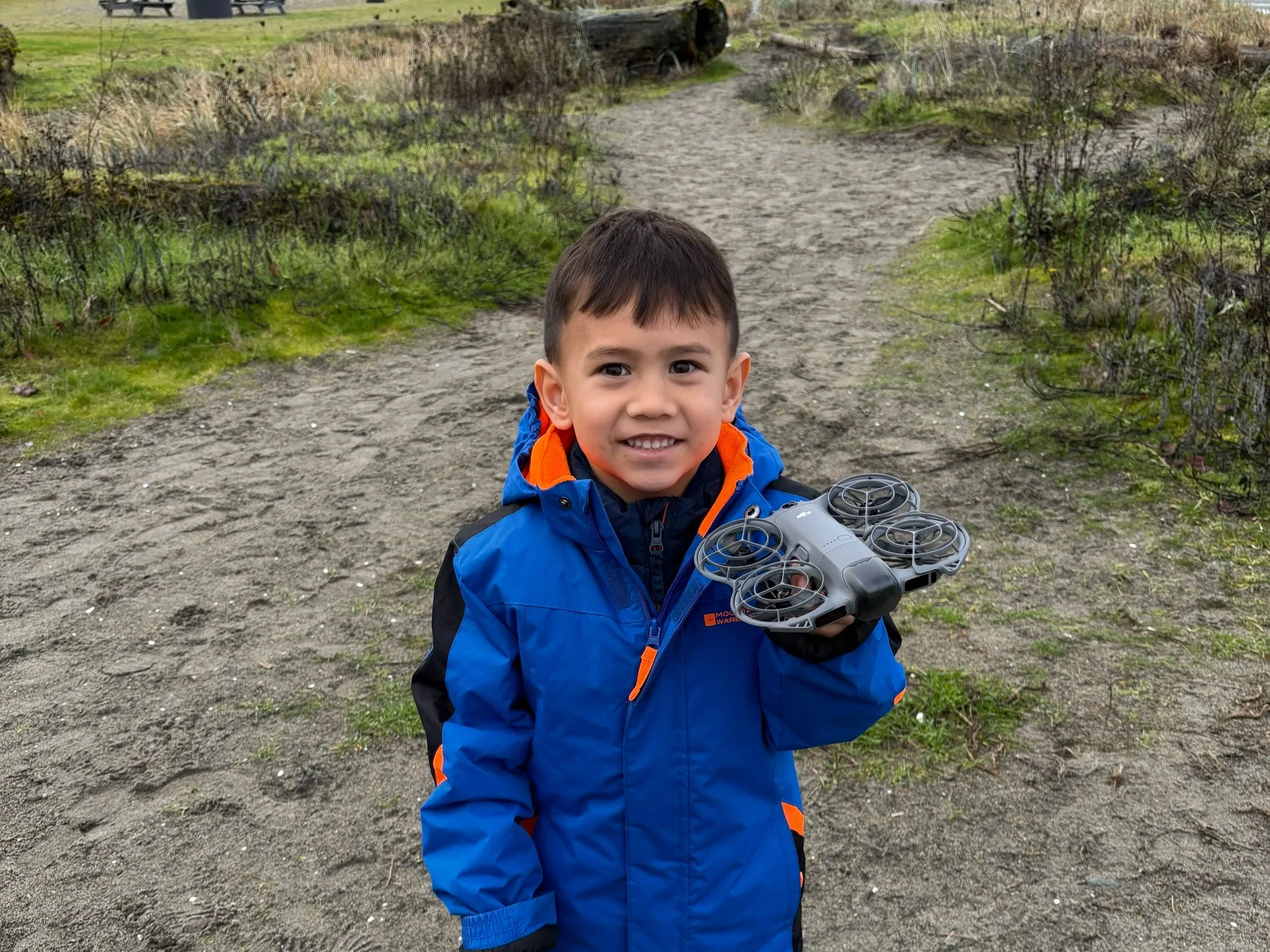
My five-year-old flew it right out of the box.
No drama. No crash course. Just up and flying.
And that’s really the whole point.
Now, if you’re looking at something a bit more “traditional,” DJI’s newer Lito lineup—like the Lito 1 or Lito X1—is also worth a look.
They’ve got more of the classic drone features—better camera, more stable flight—but the big one is collision avoidance.
And yeah… that matters.
My first drone didn’t have it.
I hit things.
Trees, mostly. Nothing catastrophic, but enough to learn the lesson the hard way.
Having sensors and some level of obstacle avoidance doesn’t make you a great pilot—but it does give you a bit of a safety net while you’re learning. Especially if it’s a kid on the sticks.
They’re a different experience, though. Less crash-and-go, more learn-it-properly. Not wrong—just depends what you want out of it.
Have fun with it—but be responsible.
The tech you’re getting now for the money is pretty wild. Between the Neo 2, the Lito 1 and X1, even the Minis, there’s not much you can’t do anymore without spending a fortune.
Just stay smart about where and how you fly, and you’ll be fine.
Related Reads
DJI Lito X1 vs Mini 4 Pro: This Changes What Drone I Recommend in Canada
A closer look at how the Lito X1 stacks up against the Mini 4 Pro—and why it might be the better buy for most people right now.
DJI Lito 1 vs Neo 2: Two Completely Different Drones (So Which One Makes More Sense?)
A real-world comparison between two very different drones at a similar price point—and which one actually makes sense depending on how you plan to use it.
Hiring a Drone Pilot in Victoria, BC — What It Costs and What You Get
Straightforward pricing, what’s included, and what the process looks like if you need aerial photos, video, inspections, or a better look at something from above.
Best Drone for Kids (2026): What I’d Actually Buy (and Why)
Every time this question comes up, people make it way harder than it needs to be.
“What’s the best drone for kids?”
You’ll see a bunch of articles talking about safety, specs, beginner modes, all that stuff… and yeah, some of that matters.
But honestly, most of it doesn’t.
Because the real question isn’t “what’s the best drone?”
It’s “what’s the best drone that my kid won’t immediately smash into something and make me regret buying it?”
That’s the decision.
So let’s not overthink it.
If you’re buying a drone for a kid, there are really only two directions I’d even consider. And one of them is the obvious answer.
The one I actually bought for my kid is the DJI Neo 2.
This thing is almost stupid in how easy it is to use.
You don’t even need a controller. Pull it out, press a couple buttons on the side, and boom—it’s following you around like a little flying puppy. It’ll chase your kid around the yard, the park, wherever you are, and just… work.
That’s the magic.
Because kids don’t want to stand still and carefully line up cinematic shots. They want to run around like lunatics and see what happens.
This lets them do that.
And the big thing—and this is the part people don’t talk about enough—you can crash it.
Not “you might crash it.”
You will crash it.
Fence, tree, bush, side of your truck, probably your own head at some point. And instead of that gut-punch feeling you get with a normal drone, you just walk over, pick it up, dust it off, and send it again.
That alone is why it makes sense.
If you’re flying it with a controller, same deal. It’s forgiving. You don’t feel like every mistake costs you a pile of money and your dignity.
And if you’ve got a couple extra batteries, you can keep a kid running around for a solid 30–45 minutes, which—let’s be honest—is a win in itself.
Now, if you’re sitting there thinking, “okay, but I want something a bit more like a real drone,” then yeah—you should look at the Lito 1.
For the price, it looks like it’s bringing a lot of what used to live in the Mini lineup into a more affordable package. Collision avoidance, proper controls, something that actually feels like a drone instead of just a flying camera.
If you want your kid to actually learn how to fly, not just have something follow them around, this is where it starts to make sense.
It’s more stable, more controlled, and you’ll get nicer-looking footage out of it if you care about that.
But it comes with a different reality.
You’re going to be a little more careful.
You’re not just handing it over and saying “have fun, see what happens.” Or maybe you are, but you’re definitely watching a little closer, ready to step in when it heads straight for something expensive.
And yeah, the Lito X1 exists too.
If the budget’s there, it’s kind of impressive what you get. Better sensing, more features, active tracking, quick shots—all the stuff that makes you feel like you know what you’re doing.
From a capability standpoint, it’s not bad at all.
But now you’re in that weird middle ground again. It’s not cheap and carefree like the Neo 2, and it’s not a full-on serious tool either. So you have to ask yourself if you actually need that, or if you’re just convincing yourself you do.
What I wouldn’t do is go buy some cheap toy drone.
They’re frustrating, they don’t fly properly, they break, and they usually end up sitting in a drawer after a week.
If you’re going to do it, do it once and do it properly.
Mini 4 Pro gets a shout out because it’s a great drone. Same with the Mini 5 Pro on paper. But I wouldn’t buy either one for a kid unless you’re planning on flying it more than they are.
They’re just too nice. Too capable. Too easy to turn into a stressful experience instead of a fun one.
And FPV… not for me.
That rhymed. Didn’t mean to.
No offense to anyone who’s into it, I get the appeal. But going out to a beautiful beach and then putting goggles on so I can’t actually see any of it? Yeah… that’s just not my thing.
Maybe if I was curious, I’d mess around with goggles on the Neo 2. But I’m not exactly rushing out to do that either. Call it a grumpy old man take.
So what would I actually do?
If you want something fun, easy, and basically impossible to screw up, get the Neo 2.
If you want something a bit more “real” that your kid can grow into, look at the Lito 1… maybe the X1 if you’re already stretching the budget and want the extra features.
And whatever you do, get DJI Care.
Because kids and drones is not a “maybe something happens” situation.
Something is going to happen.
The best drone for a kid isn’t the one with the best specs.
It’s the one they’ll actually use without getting frustrated… or you getting stressed.
And most of the time, that’s the one that can bounce off a fence and keep flying like nothing happened.
Related Reads
DJI Lito X1 vs Mini 4 Pro: This Changes What Drone I Recommend in Canada
A closer look at how the Lito X1 stacks up against the Mini 4 Pro — and why it might be the better buy for most people now.
DJI Neo 2 After One Month — Insane Value, Easy to Use, and Surprisingly Tough
Real-world use, bumps included, and why the Neo 2 ends up coming everywhere with us whether we plan for it or not.
Best Drone to Buy in Canada (2026): The Honest Answer No One Gives You
Why Canadian drone rules matter more than specs — and how that actually changes what you should be buying.
DJI Lito 1 vs Neo 2: Two Completely Different Drones (So Which One Makes More Sense?)
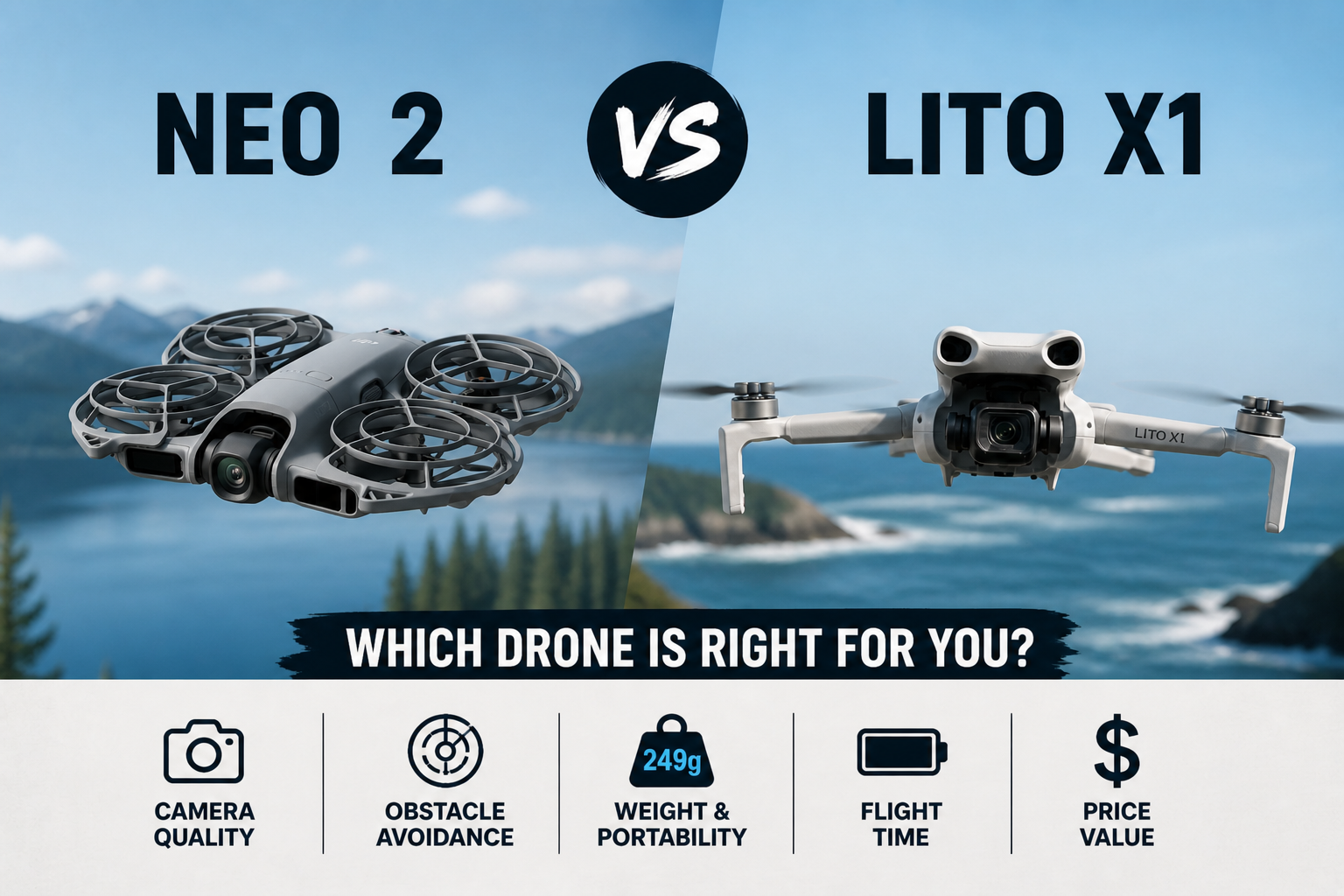
DJI’s made this confusing again, and not in a bad way. Just in that way where you look at two drones that cost roughly the same and go, “okay… what am I actually supposed to buy here?”
Because on paper, the Lito 1 and the Neo 2 end up in the same conversation.
In real life, they’re not even trying to do the same thing.
Before anything else, I’ll just say it—I love the Neo 2. Way more than I expected to. So yeah, there’s some bias here, but I’ll call it out where it matters.
The Neo 2 is basically a flying GoPro that doesn’t care about your plans. It’s the kind of drone you don’t baby. You crash it, you pick it up, you send it again. You bump into something, whatever. It’s fine. That changes how you use it. You stop flying like everything is fragile and expensive, and you start actually using the thing.
Where it really shines is follow-me stuff. That’s its lane. It’s great at tracking people, staying low, moving quickly, and capturing stuff that actually feels like something is happening. If you’re chasing your kid, riding a bike, messing around with a truck, whatever—it just works.
That’s why I keep grabbing it.
But yeah, it’s got limits. Wind pushes it around pretty easily. It’s not something I’m sending up high trying to get some perfect cinematic shot. You’re not hovering over a property thinking about composition and lighting with this thing. It lives low, it moves fast, and it captures action. That’s the job.
The Lito 1 is a completely different mindset.
I haven’t flown it yet, so I’m not going to pretend I know exactly how it feels, but it’s pretty obvious what it’s trying to be. It’s stepping into that old Mini 3 role—the “this is my first real drone” category.
Controller in your hands, thinking about your shots, actually flying with intention instead of just sending it and seeing what happens.
And honestly, for the price, what it looks like you get is pretty impressive compared to what that entry-level category used to be. If you were looking at a Mini 3 a while ago, this is basically the new version of that idea.
It’s going to be more stable, more controlled, and better suited to slower, cleaner footage. If your goal is to learn how to actually fly a drone properly and get something that looks a bit more polished, this is clearly the direction you go.
But it’s not competing with the Neo 2 on fun or ease.
That’s the part people are going to mix up.
The Neo 2 is the one you grab without thinking. The Lito 1 is the one you take out when you’ve decided you’re going to go fly.
Even though they’re both “micro” drones, they’re going to feel completely different. The Neo 2 is light, twitchy, and gets pushed around. The Lito 1 is going to feel more planted, more predictable, more like something you actually control instead of something you kind of just let loose.
So the decision really comes down to what kind of person you are, not what the spec sheet says.
If you just want something fun that you’ll actually use all the time, it’s the Neo 2. No question. It’s easy, it’s forgiving, and you won’t hesitate to take it with you.
If you want to learn drones properly, slow things down a bit, and get cleaner-looking footage, then yeah—the Lito 1 makes more sense.
And if you’re already leaning that way, you’re probably going to start looking at the Lito X1 anyway, because that seems to be where DJI is putting the more serious features now.
For me, I still lean Neo 2 most of the time.
Not because it’s “better,” but because it actually gets used. It leaves the house, it gets thrown in a bag, it gets handed to a five-year-old, it gets suction-cupped to the side of a truck, and it just keeps going.
The Lito 1 is the better drone.
The Neo 2 is the one you’ll probably use more.
And if you’re being honest about how you actually live with this stuff, that usually ends up being the decision that matters.
This is also where checking the current pricing helps, because these two are close enough that the better choice really depends on what you want it for.
If you want the more traditional “first real drone” experience, check the latest DJI Lito 1 pricing on DJI’s website.
If you want the fun little flying camera you’ll probably throw in a bag and use constantly, check the latest DJI Neo 2 pricing on DJI’s website.
And if you’re already looking at the Lito 1 and thinking, “yeah, but what about the better one?” — check the latest DJI Lito X1 pricing on DJI’s website too.
Because that’s usually how this goes.
You start by comparing two sensible little drones.
Then five minutes later you’re justifying the upgrade like it was your idea all along.
Related Reads
Hiring a Drone Pilot in Victoria, BC — What It Costs and What You Get
Straightforward pricing, what’s included, and what the process looks like if you need aerial photos, video, inspections, or a better look at something from above.
DJI Air 3S vs Mini 5 Pro in Canada: When Bigger Still Makes Sense
The Mini 5 Pro is seriously capable, but if it’s not comfortably a micro drone in Canada, the Air 3S starts looking a lot more interesting — especially with dual cameras, bigger battery life, and real confidence in coastal wind.
DJI Neo 2 Review: The Best First Drone for Kids, Creators, and Wannabe Jedi
A tiny follow-me drone with palm launch, gesture control, prop guards, and just enough weird DJI wizardry to make you feel like you’re using the Force. Great for kids, creators, hikers, bikers, and anyone who wants a drone they’ll actually use.
DJI Osmo Nano vs Your Phone: What I Actually Reach For
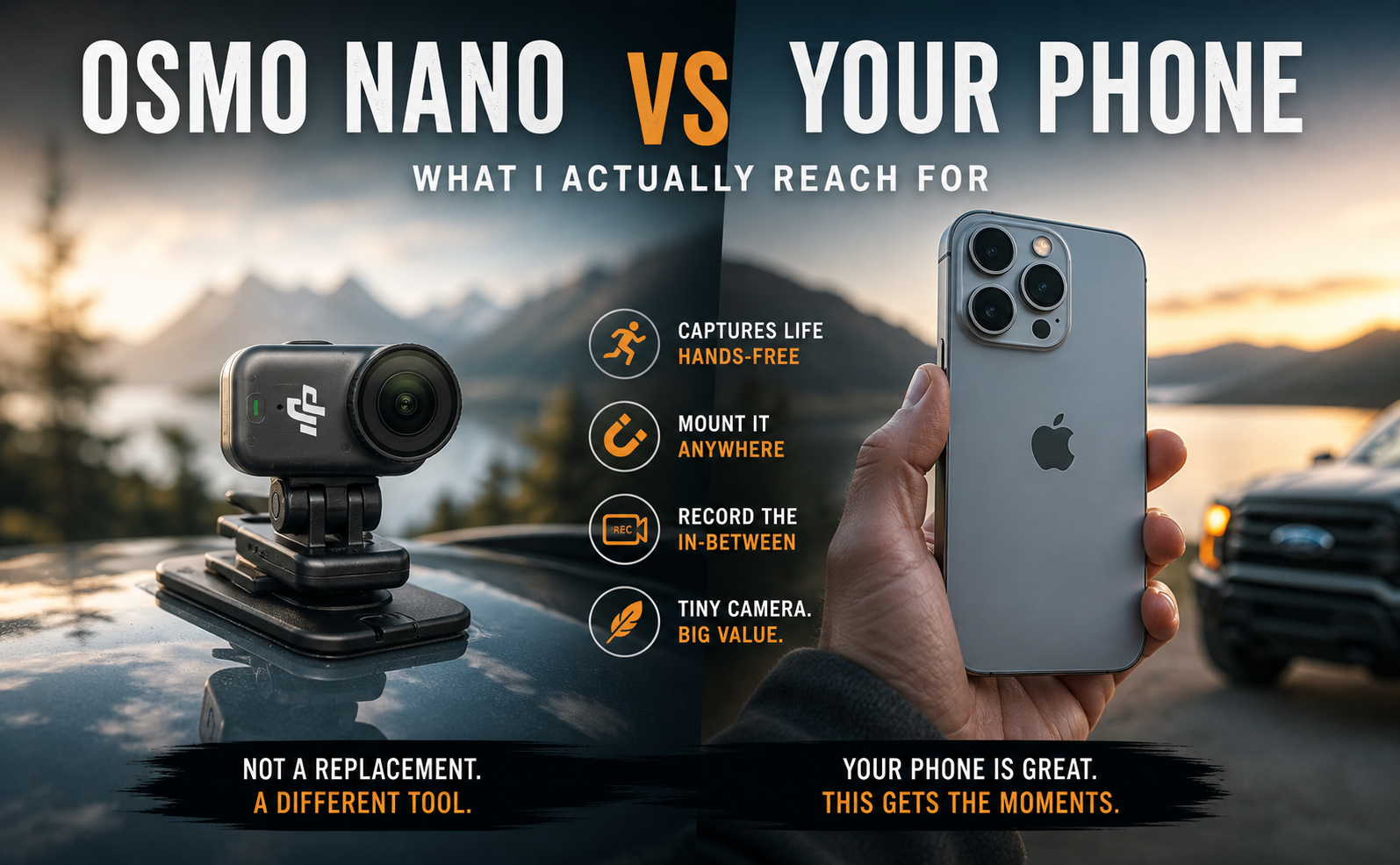
Everyone’s got a ridiculous camera in their pocket now, so let’s not pretend this thing replaces your phone.
It doesn’t.
Your phone is still better at a lot of stuff. Quick photos, zoom, texting something to someone right away—obviously you’re grabbing your phone.
So the real question is why you’d bother with something like the DJI Osmo Nano at all.
And for me, it comes down to one thing.
Your phone is great when you stop and decide to film something.
The Osmo Nano is better when you just keep doing whatever you were already doing and it captures it anyway.
That’s the whole difference.
I’ve got a five-year-old, and between Vancouver Island Drones and Rhyno & Son Co., I’m constantly doing stuff where I could film it… but I don’t feel like standing there holding a phone.
Working on the truck is the perfect example.
If I’m under the hood, wrenching on something, the last thing I’m doing is grabbing my phone, setting it up, checking angles, hitting record. It just doesn’t happen. Same thing if we’re out driving, or Blake’s messing around, or we’re doing something halfway interesting but not “worth filming” enough to stop everything.
That’s where this thing makes sense.
I’ll suction cup it to the hood, the roof, the side of the truck, wherever. Or clip it onto one of us. Or yeah—strap it to my kid and just let him go. That footage is never going to be perfect, but it’s always something. And most of the time, it’s better than the nothing I would’ve had otherwise.
That’s kind of the whole point.
It fills in the gaps.
Because realistically, most of the stuff you end up caring about later isn’t the perfectly framed shot. It’s the random moment where something actually happened. A comment, a reaction, a screw that didn’t come out the way it was supposed to, Blake saying something ridiculous while I’m trying to focus—whatever.
That’s the stuff this thing captures.
And for something this small, it’s actually pretty capable. The video’s solid, the onboard mic is decent, and if you’re already in the DJI ecosystem it’s stupid easy to add their mics without turning it into a whole production.
The mounting options are what make it useful though. Magnetic, suction, whatever—you can put it places your phone just doesn’t make sense. I’m not suction cupping my phone to the hood of my truck and hoping for the best. This thing? No problem.
The dock is one of those things that sounds gimmicky until you use it. Being able to have the camera somewhere else and still see what it’s seeing, start and stop recording, that kind of thing—it’s just easy. Especially if it’s mounted somewhere you can’t reach or, again, attached to a five-year-old who has zero interest in camera operations.
Your phone still wins most of the normal situations. If I want a quick shot, I use my phone. If I need something right now, I use my phone. If I don’t feel like dealing with another device, I use my phone.
But this thing gets used in all the situations where my phone would be annoying or I just wouldn’t bother.
And because of that, it ends up getting used more than you’d think.
It’s not replacing anything. It’s just capturing the stuff in between.
And honestly, that’s where most of the good stuff is anyway.
Check out the latest price on the DJI Osmo Nano here.
Related Reads
DJI Osmo Nano: A Tiny Camera We Take Everywhere (and Abuse Daily)
A more direct look at how the Nano fits into our actual kit and why it keeps ending up in the bag.
DJI Neo 2 After One Month — Insane Value, Easy to Use, and Surprisingly Tough
Another tiny DJI product that makes more sense once you stop comparing specs and start looking at what actually gets used.
Drone Gear I Use Or Recommend
The gear page for the drones, cameras, mics, and little gadgets that have actually earned
DJI’s Drone Lineup in 2026 (And Why It Feels So Weird Right Now)
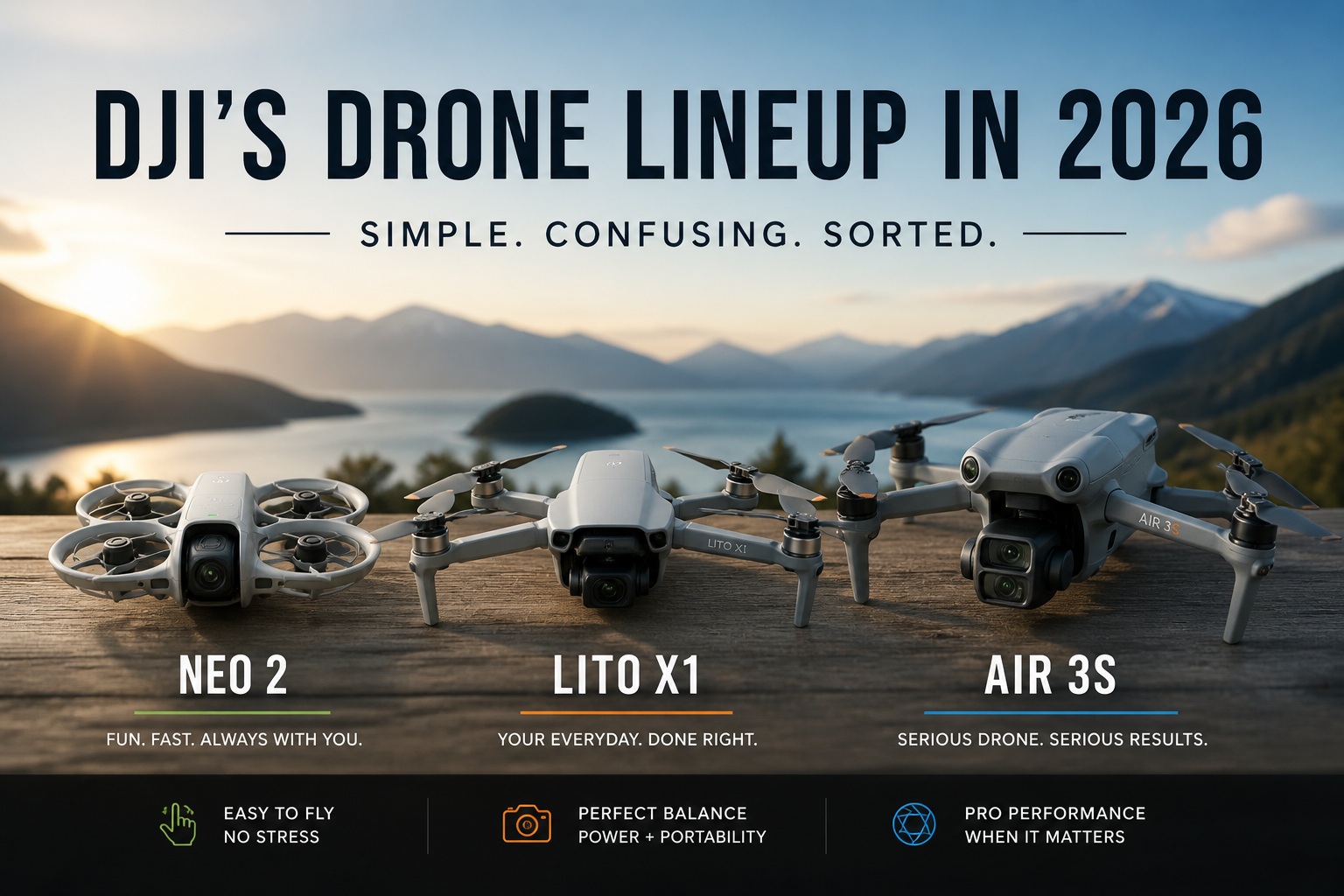
DJI’s drone lineup in 2026 is… not as straightforward as it used to be.
That’s not necessarily a bad thing. It just means you can’t look at it the way you did a couple years ago and expect it to make sense.
Because for a long time, it did.
You wanted something simple? You bought a Mini.
You wanted something better? You bought a Mini Pro.
You wanted something serious? You stepped up to the Air or Mavic line.
Done. Decision made. Go fly.
Now?
Now you’ve got the Neo 2, the Lito 1, the Lito X1, a Mini 5 Pro that may or may not still belong in the “mini” category depending on how it lands with weight, an Air 3S doing real work, and an Avata 360 off in the corner doing its own thing entirely.
So yeah… it’s a bit of a lineup shuffle.
Let’s start with the easiest one.
The Neo 2 is still the most obvious drone DJI makes. It’s not trying to be a traditional camera drone, and that’s exactly why it works. You pull it out, press a button, and it flies. No controller if you don’t want one, no waiting around, no overthinking it.
It’s the one that actually gets used.
And honestly, that matters more than specs.
Then we get into the Lito lineup, which is where things quietly changed.
Because I don’t think DJI added these drones.
I think they replaced something.
The Lito 1 feels like what the Mini 3 used to be. Entry-level “real drone,” decent camera, some smart features, and a price that doesn’t scare people off. Except now it’s got things like active tracking baked in, which wasn’t really a given at that level before.
So yeah, it’s better.
But here’s the problem — sitting right next to it is the Lito X1.
And the X1 looks like the drone most people should actually be buying. It’s under 249 grams, it’s got a proper camera, tracking, obstacle avoidance, and real flight time. It checks all the boxes most people care about, and it does it at a price that makes you stop and think.
This is the one that feels like it quietly stepped into the Mini 4 Pro’s spot.
Not perfectly. Not yet.
But close enough.
Which brings us to the Mini lineup… or what’s left of it.
The Mini 3 is basically gone, which makes sense. It had a great run, got a lot of people into drones — myself included — but it’s been replaced.
The Mini 4 Pro is still excellent. No complaints there. But if you’ve looked at DJI’s site lately, you’ll notice stock is getting thin. Fewer options, fewer bundles. That’s usually how this story ends.
It doesn’t feel like it’s being improved.
It feels like it’s being phased out.
And if the Lito X1 delivers even close to what it looks like on paper, that’s not surprising.
Then there’s the Mini 5 Pro.
And this is where things get a little… awkward.
Because if it’s not under 249 grams — especially here in Canada — then what’s the point?
The whole advantage of the Mini lineup was that it lived in that micro category. Fewer headaches, fewer restrictions, easier all around. If you lose that, you’re suddenly playing by different rules anyway.
And I’m certainly not in a position to start throwing stones about anything being overweight…
But when it comes to drones, that extra weight actually matters.
At that point, you might as well step up to something like the Air 3S and get the full capability.
Speaking of which, the Air 3S is exactly what you think it is.
This is where things get serious. Dual cameras, better image quality, more flexibility — and yes, Advanced certificate territory in Canada. This isn’t your “just in case I bring it” drone. This is the one you bring when you actually need to get something done.
And then there’s the Avata 360.
Which, to be fair, is doing something completely different.
This isn’t really competing with the Neo, the Lito, or even the Air series. It’s an FPV drone, but now it’s also pushing into that 360-style capture space. You’re not just flying a shot — you’re giving yourself more flexibility in how you use it afterward.
Looks like 360 sometimes. Definitely isn’t.
It’s cool. Probably very cool.
But it’s not what most people are looking for when they’re trying to figure out their first drone, or even their main drone. This is more of a creative tool than a “what should I buy?” answer.
So if you zoom out for a second, the lineup actually looks a lot cleaner than it first appears.
The Neo 2 is your “fun, low effort, always with you” drone.
The Lito X1 is your “this is my actual drone” drone.
The Lito 1 is there if you’re trying to hit a lower price point, but I’d personally stretch if I could.
The Mini 4 Pro is still great, but it feels like it’s on its way out.
The Mini 5 Pro sits in a weird middle ground depending on how it lands in Canada.
The Air 3S is your serious, get-it-done option.
And the Avata 360 is off doing creative FPV things for people who know they want that.
So yeah, DJI’s lineup in 2026 looks confusing at first.
But once you realize they didn’t just add more drones — they moved everything around — it starts to make a lot more sense.
They didn’t break the system.
They just reshuffled it.
Related Reads
DJI Lito X1 vs Mini 4 Pro: This Changes What Drone I Recommend in Canada
A closer look at how the Lito X1 stacks up against the Mini 4 Pro — and why it might be the better buy for most people now.
DJI Neo 2 After One Month — Insane Value, Easy to Use, and Surprisingly Tough
Real-world use, bumps included, and why the Neo 2 ends up coming everywhere with us whether we plan for it or not.
Best Drone to Buy in Canada (2026): The Honest Answer No One Gives You
Why Canadian drone rules matter more than specs — and how that actually changes what you should be buying.
DJI Lito X1 vs Mini 4 Pro: This Changes What Drone I Recommend in Canada
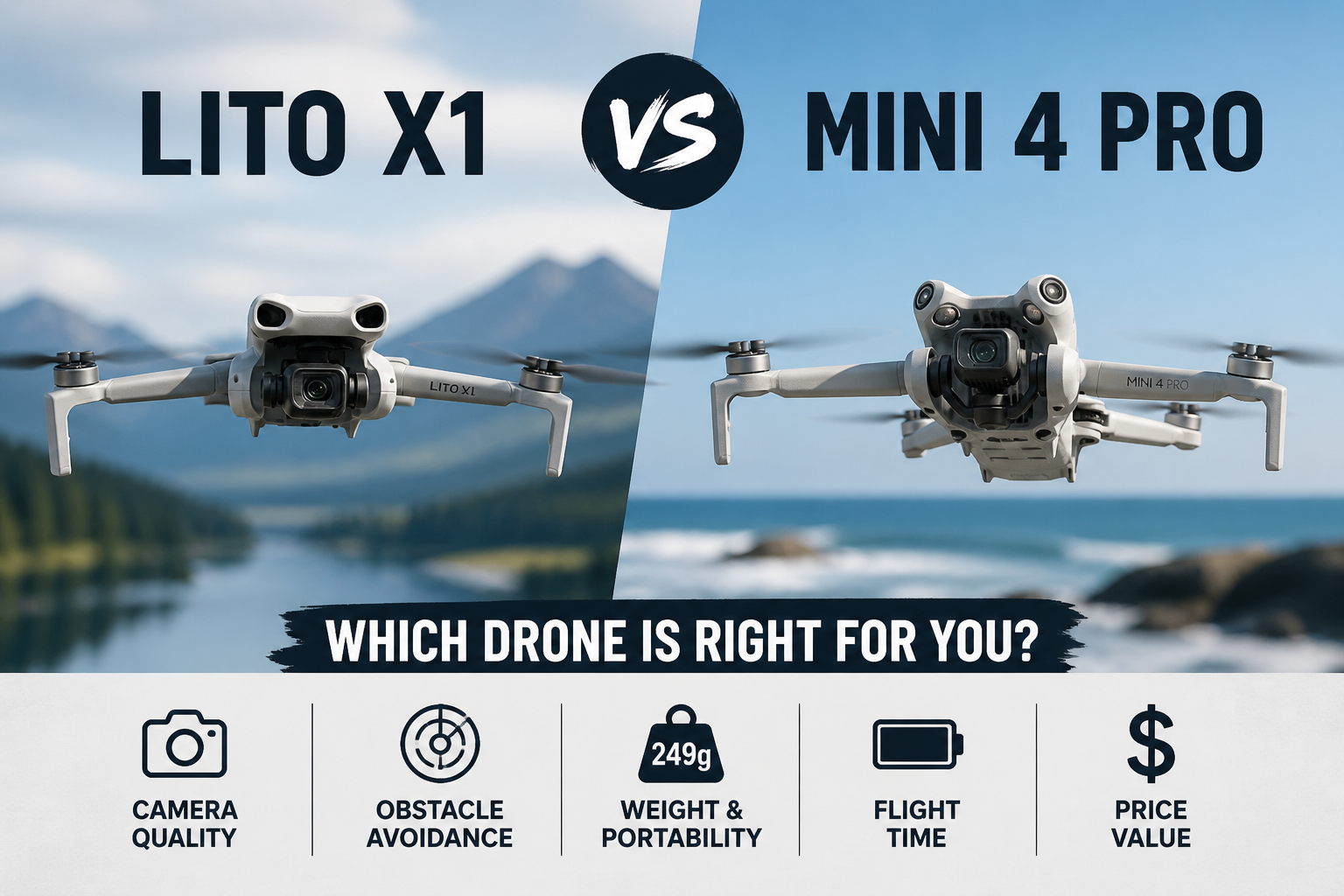
DJI’s lineup is getting… confusing.
And honestly, I think they did it to themselves.
For a while, it was simple. If you wanted something fun, you grabbed a Neo 2. If you wanted something serious but still under that 249g limit, you went Mini 4 Pro. And if you needed something that could actually do real work, you stepped up into the Air series.
That made sense.
Now we’ve got the Lito 1, the Lito X1, a Mini 5 Pro that doesn’t really behave like a micro drone anymore, and a bunch of overlap that didn’t used to exist. So instead of trying to decode DJI’s naming strategy, here’s what I’d actually tell someone if they asked me what to buy right now.
The Neo 2 is still the easiest recommendation on the board. It’s fun, it’s cheap, it’s tough, and more importantly, it actually gets used. There’s no setup, no waiting around — you pull it out, press a button, and you’re flying. If you’ve got kids, or you just want something you’ll actually bring with you instead of leaving it at home, this is still the move.
Then there’s the Lito X1, and this is where things get interesting.
Because on paper, it looks a lot like what the Mini 4 Pro was supposed to be. It’s under 249 grams, it’s got a solid camera, active tracking, obstacle avoidance, and real flight time. And it comes in cheaper. So unless I’m missing something — and I’ll leave that door open because this thing is new — it feels like the Lito X1 just stepped directly into the Mini 4 Pro’s spot.
Not perfectly. Not yet.
But close enough that for most people, it’s going to be hard to justify spending more.
And then there’s the Air 3S, which doesn’t really change anything. This is still where you go when you actually need to get something done. Dual cameras, better image quality, more flexibility, and yeah — the Advanced license requirement here in Canada. Different category entirely.
Where it gets messy is everything in between.
The Lito 1… I don’t really get it. Maybe it exists to hit a lower price point, maybe it’s there as a stepping stone, but if you’re already looking at this level of drone, I’d seriously consider scraping together the extra money for the X1. That’s the one that actually competes.
The Mini 3 will always have a bit of a soft spot for me. It was my first drone — or as I like to call it, my gateway drug… or my first beer. And like both of those things, it led to more. But at this point, it’s been replaced. There are just better options now.
The Mini 4 Pro is the interesting one. I don’t think it’s bad — far from it. It’s just in a weird spot now. If the Lito X1 delivers even 90% of what it does for less money, it stops being the obvious choice. It’s still the safer bet. Still the proven one. But not the no-brainer it used to be.
And then there’s the Mini 5 Pro, which still doesn’t make a lot of sense to me. If it’s not under 249 grams — especially in Canada — then what’s the point? You’re dealing with more restrictions anyway. And I’m certainly not in a position to start pointing fingers about anything being overweight… but when it comes to drones, that extra weight actually matters. At that point, you might as well step up to something like the Air 3S and get the full capability.
So if you don’t feel like overthinking it, here’s the simple version.
If you want something fun, get the Neo 2. If you want a capable all-around drone, the Lito X1 is probably the new move. And if you want something professional, you’re still looking at the Air 3S.
DJI didn’t just release a new drone here. They blurred their own lineup.
And honestly?
That’s probably good for buyers.
Because if the Lito X1 delivers the way it looks like it might, it forces everything else to justify itself again.
And honestly, that’s probably good for buyers.
This is also one of those articles where the current pricing matters more than the spec sheet. DJI’s lineup only really makes sense once you see the price gaps between these drones.
If you want the fun, easy, no-fuss option, check the latest DJI Neo 2 pricing on DJI’s website.
If you want the drone that probably makes the most sense for most people right now, check the latest DJI Lito X1 pricing on DJI’s website.
And if you’re stepping up into something more serious for better cameras, wind confidence, and real paid work, check the latest DJI Air 3S pricing on DJI’s website.
Because the best drone here isn’t necessarily the most expensive one.
It’s the one you’ll actually use.
Related Reads
Hiring a Drone Pilot in Victoria, BC — What It Costs and What You Get
Straightforward pricing, what’s included, and what the process looks like if you need aerial photos, video, inspections, or a better look at something from above.
DJI Air 3S vs Mini 5 Pro in Canada: When Bigger Still Makes Sense
The Mini 5 Pro is seriously capable, but if it’s not comfortably a micro drone in Canada, the Air 3S starts looking a lot more interesting — especially with dual cameras, bigger battery life, and real confidence in coastal wind.
DJI Neo 2 Review: The Best First Drone for Kids, Creators, and Wannabe Jedi
A tiny follow-me drone with palm launch, gesture control, prop guards, and just enough weird DJI wizardry to make you feel like you’re using the Force. Great for kids, creators, hikers, bikers, and anyone who wants a drone they’ll actually use.
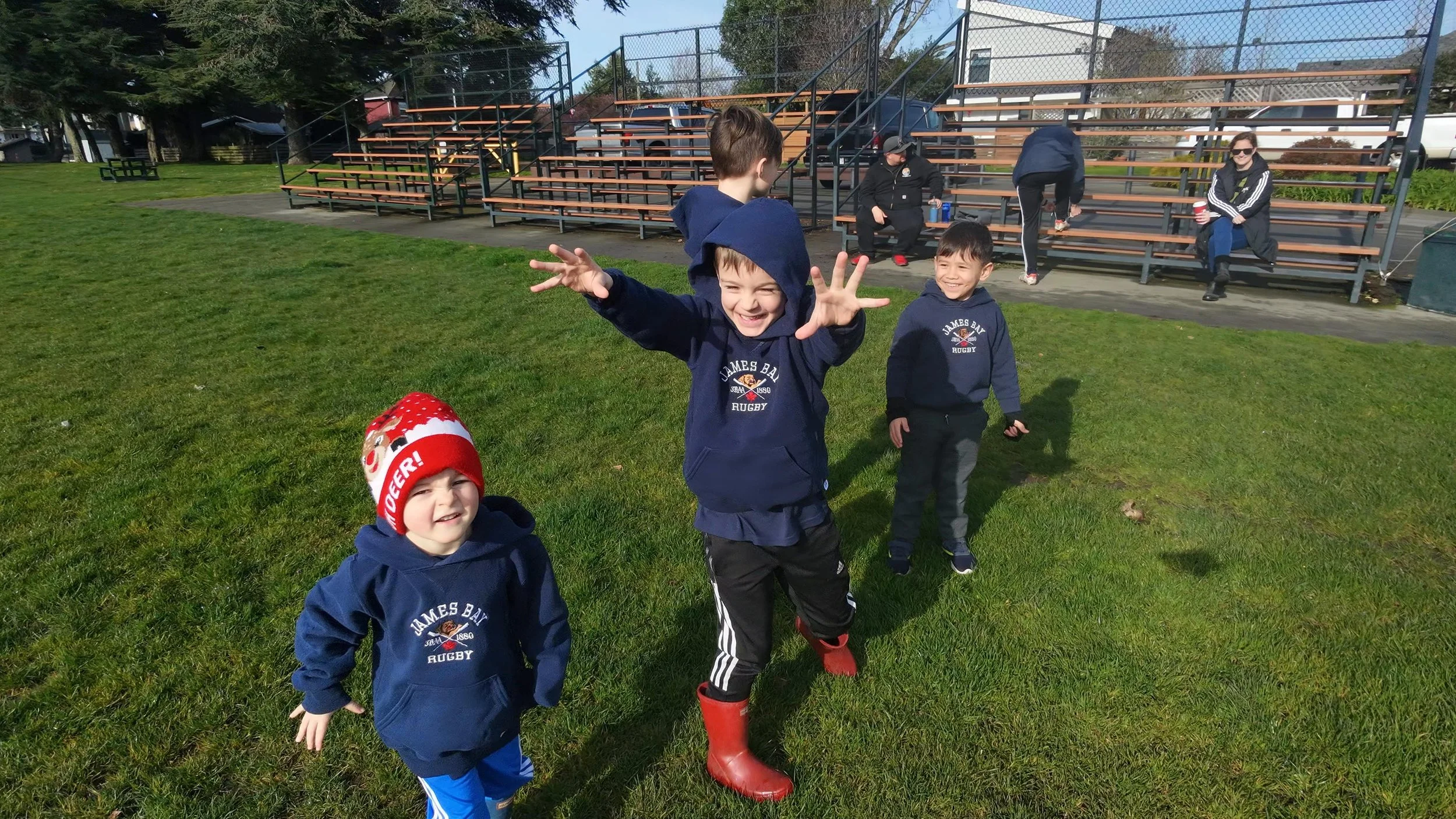
Brought a Drone to My 5-Year-Old’s Rugby Practice — Now It’s Expected
There are a few things you expect to see at kids’ rugby practice.
Cleats, water bottles, a bunch of kids half-listening while the coach is trying to get them organized.
What I didn’t expect the first time I brought the drone was a full-on pack of kids chasing it like it was the last ice cream truck on earth.
That part caught me off guard.
It started pretty simply. Blake brought the Neo 2 out and showed a couple of the kids how it works. Gesture controls, taking off from your hand, the basics.
That lasted maybe five minutes.
Then the coach’s kids got involved, then a couple more wandered over, then suddenly I’ve got a lineup of kids asking if they can try it, and I’m standing there thinking, “Alright… this escalated quickly.”
Now it’s just part of the routine.
We show up and I’ll get asked almost immediately:
“Did you bring the drone?”
And once it’s out, that’s it. Practice is still happening, technically, but there’s also a group of kids sprinting around trying to outrun it, wave at it, or convince it to follow them instead.
It turns into this weird mix of rugby practice and… I don’t even know… drone-based cardio.
The funny part is the drone is doing exactly what it’s supposed to do — tracking, following, keeping someone in frame — but I’m in the background messing with it on my phone.
Switching it from follow-behind to follow-in-front, changing the distance, adjusting the angle.
So from their perspective, it kind of looks like the drone has a mind of its own.
In reality, I’m just quietly stirring the pot.
Every kid wants to land it.
Every single one.
And honestly, that’s one of the best parts of the whole thing. Normally you’d be a bit hesitant handing a drone to a bunch of kids, but the Neo 2 is small, it’s got prop guards, and it can take a bump without turning into an expensive mistake.
So instead of constantly saying “don’t touch that,” it turns into “alright, let’s see what you’ve got.”
Some of those landings are… not textbook.
But they figure it out.
At one point I looked over at a couple of parents and said, “Is this a weird way to wear out my kid?”
Because I’ve got a couple spare batteries, and if I run through all of them, these kids will just keep going. Running, chasing, laughing the whole time.
And honestly, the best way I can describe it is this:
It’s basically the modern-day version of throwing a stick for a dog at the park.
Except instead of one dog, it’s a full pack of kids, all convinced the drone is following them specifically.
No one’s bored. No one’s asking for a screen. They’re just running around chasing a flying camera like it owes them money.
The reason it works is because there’s almost no friction to using it.
You don’t need to pull out a controller, wait for satellites, deal with menus, or kill the moment trying to get everything set up.
You pull it out, press a button, and it’s flying.
That’s the difference.
That’s why it actually gets used.
Now, it’s not perfect.
If there’s a bit of wind, you’ll see it working to compensate. And the collision avoidance is… let’s call it optimistic. You still need to pay attention.
This is not a “set it and forget it” situation.
It’s more like controlled chaos.
The unexpected bonus is the footage.
It’s not cinematic, it’s not perfect, but it’s real. Kids laughing, running, trying to outrun something that is very clearly faster than they are.
It’s the kind of stuff you actually want to keep.
At the end of the day, this thing has turned into something I didn’t plan on at all.
It’s part of rugby practice now. Kids are learning how it works, parents are asking questions, and everyone ends up a little more tired than they expected.
For something that costs what it does, and takes zero effort to get in the air, it’s kind of ridiculous how good it is at what it does.
There are better drones. Bigger drones. More capable drones.
But none of them come out this easily, get used this often, or turn into this much fun this quickly.
And none of them turn a rugby practice into a pack of kids chasing a flying camera across a field.
Related Reads
DJI Neo 2 After One Month — Insane Value, Easy to Use, and Surprisingly Tough
A real-world look at how the Neo 2 actually holds up after a month of constant use — bumps, bike rides, and all.
Can the DJI Neo 2 Keep Up With a Four-Year-Old?
What happens when you let a kid set the pace — and whether the Neo 2 can actually keep up with the chaos.
Teaching Kids to Fly a Drone (Safe, Simple, and Actually Fun)
A practical, no-BS approach to getting kids started with drones without turning it into a stressful experience.
Best Drone to Buy in Canada (2026): The Honest Answer No One Gives You
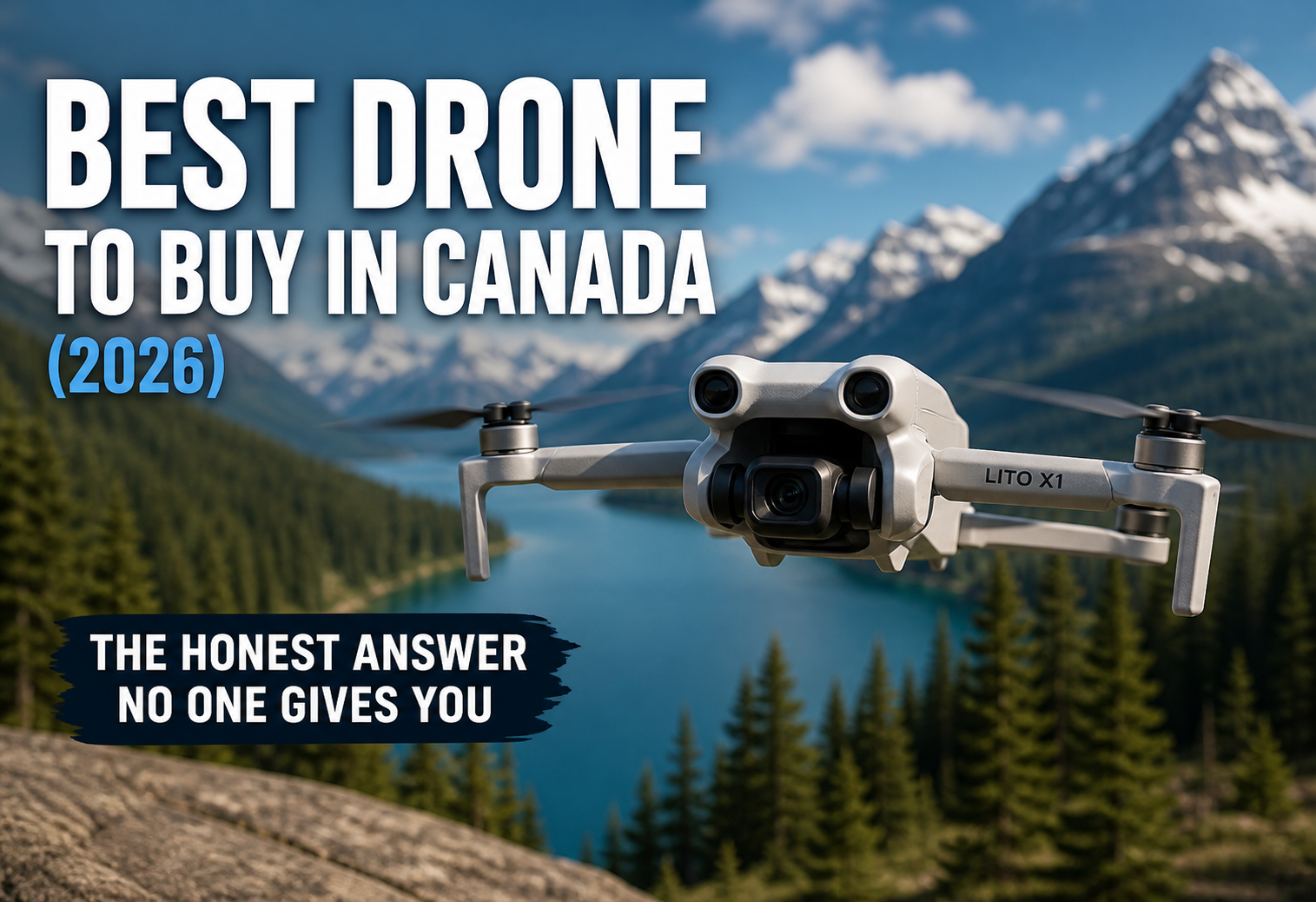
Everyone asks the same question:
What’s the best drone to buy in Canada right now?
And honestly, most of the answers out there aren’t that helpful.
Because they all focus on specs.
Camera this. Sensors that. Flight time. Range.
But in Canada, that’s not actually the decision that matters.
The real question is:
Do you want to deal with drone regulations, or not?
Because that one choice completely changes what the “best” drone actually is.
The Only Decision That Actually Matters in Canada
You can break this down really simply:
Micro drones (under 250g) mean way less hassle.
Everything else means more capability, but more rules.
That’s it.
That’s the fork in the road nobody explains properly.
If you want to keep things simple — early morning flights, staying low-key, not overthinking every takeoff — micro drones exist for a reason.
But here’s where things just changed.
The New Micro Drone Reality
For a long time, this was easy.
Buy a Mini.
Done.
Now?
DJI’s quietly reshuffled everything.
And the answer isn’t as obvious as it used to be.
Best Micro Drone (Keep It Simple)
DJI Lito X1 (The New Default)
This is the one that makes the most sense right now.
It’s under 249g, it’s got the features people actually want, and it’s priced in a way that makes you stop and think.
You’re getting:
a proper camera
active tracking
obstacle avoidance
real flight time
And you’re still staying in that low-hassle category.
If you’re buying your first “real” drone in 2026, this is probably where you land.
DJI Neo 2 (The One Nobody Talks About Enough)
This one is a bit of a wildcard.
But honestly, for a lot of people, this makes more sense than anything else.
Especially if you’ve got kids, or you just want something fun and easy.
It’s:
super easy to use
durable and forgiving
quick to get in the air
actually fun
This is the kind of drone you actually use, not just baby.
And that matters more than people think.
DJI Mini 4 Pro (If You Can Still Find One)
Still a great drone.
Still one of the best all-around micro drones ever made.
But it’s getting harder to find, and it doesn’t feel like DJI’s focus anymore.
If you can find one at a good price, it’s still a safe bet.
It’s just not the obvious choice anymore.
The Mini 5 Pro Problem
On paper, the Mini 5 Pro is awesome.
Better camera. Better sensors. More features.
But if it’s not firmly in that micro drone category…
what’s the point?
The whole appeal of the Mini lineup was:
simple ownership
fewer restrictions
just get out and fly
If you lose that, you end up in a weird middle ground where:
you’re dealing with more rules
but not getting the full benefit of stepping up
And at that point, the question becomes:
Why not just go bigger?
If You’re Willing to Get Licensed, Do It Properly
If you’re already thinking:
“I don’t mind getting my Advanced license”
Then don’t mess around in the middle.
Go straight to something that makes it worth it.
DJI Air 3S
This is where things start to make sense again.
dual lenses
better image quality
more stable in real conditions
feels like a real tool
If you’re playing by the rules anyway, you might as well get something that delivers.
DJI Mini 3
This is your first beer.
You’re not stopping at one.
It’s:
affordable
easy to fly
gets you hooked
And once you start using it regularly, you’ll probably upgrade.
That’s just how it goes.
So What Would I Actually Buy?
Simple.
Want zero hassle → Lito X1
Want fun and easy flying → Neo 2
Want a serious camera drone → Air 3S
Just getting started (budget) → Mini 3
Mini 4 Pro → still great if you find one
Mini 5 Pro → still a bit of a weird fit in Canada
Final Thought
The best drone isn’t about specs.
It’s about:
how often you’ll actually use it
how much friction is involved
whether it fits your life
Because the best drone is the one you actually take out of the bag.
Not the one that looks best on paper.
Related Blog Posts
DJI’s Drone Lineup in 2026 (And Why It Feels So Weird Right Now)
A breakdown of how DJI reshuffled everything — and why the Lito lineup changes the way you should think about buying a drone.
DJI Neo 2 After One Month — Insane Value, Easy to Use, and Surprisingly Tough
Real-world use, bumps included, and why the Neo 2 ends up coming everywhere with us whether we plan for it or not.
DJI Lito X1 vs Mini 4 Pro: This Changes What Drone I Recommend in Canada
A closer look at how the Lito X1 stacks up against the Mini 4 Pro — and why it might be the better buy for most people now.
Why I’ll Never Get Tired of Sunrise at Esquimalt Lagoon
It had been a while since I’d done one of my favourite Vancouver Island morning rituals.
Life’s been busy, work’s been busy, and if I’m being honest, I’d been spending a little too much time doing responsible adult things and not nearly enough time doing grab a coffee and drive to the ocean before sunrise things.
So last weekend, I fixed that.
Coffee in hand, still half asleep, I pointed the truck toward Esquimalt Lagoon while most sane people were still warm in bed making good life choices.
I, on the other hand, was chasing sunrise with a drone in the back seat like the sleep-deprived coastal goblin I apparently am.
And wow… what a payoff.
The kind of payoff that makes you laugh a little because it almost feels rude how beautiful this place can be.
The water was glassy, the sky started flexing before the sun even cleared the horizon, and Fisgard Lighthouse was sitting there in the middle of it all looking like it knew exactly how photogenic it was.
Some places just have that effect.
Esquimalt Lagoon is one of them.
Every time I go out there, it gives me something different. Some mornings it’s moody and dramatic, some mornings it’s all soft pastel calm, and sometimes it just decides to absolutely show off like it did last weekend.
This was one of those “okay fine, I guess I live in one of the most beautiful places on earth” mornings.
And honestly, I needed that reminder.
No rushing.
No forcing content.
No “I should probably be editing something.”
Just coffee, calm water, ridiculous skies, and a peaceful sunrise that made all the responsible-adult excuses from the last few weeks feel pretty silly.
The stills turned out beautifully, and I’ve got some really nice video from the morning still to come, which I’m pretty excited about.
But even beyond the footage, it was just good for the soul.
That’s the part I think gets lost sometimes when we turn hobbies into businesses or “content.”
Sometimes the whole point is just:
get out there
breathe the salt air
watch the Island wake up
remind yourself how lucky we are to call this place home
And if you happen to come back with gorgeous aerials, well, that’s a pretty nice bonus.
This is exactly why I still love doing this.
Not because every sunrise needs to become a Reel or a YouTube video.
But because every once in a while, Vancouver Island gives you one of those mornings that makes you stop, laugh, and think:
yeah… this place is ridiculous.
And thankfully, we get to live here.
Related Articles
DJI Neo 2 Real-World Use with Kids | Hands-Free Drone Filming in Everyday Settings
A parent’s real-world look at using the Neo 2 with a four-year-old — gesture control, ActiveTrack, and everyday family moments without the hype.
Flying a Drone in Victoria, BC | Local Rules, Airspace, and Practical Tips
A practical guide to navigating Victoria’s complex airspace, timing your flights, and flying respectfully in Greater Victoria.
Why Victoria Construction Companies Use Drone Photography
How local construction teams use aerial imagery for safer site visibility, progress tracking, and clearer documentation across active projects.
Why Parksville Beach Never Gets Old From the Air
Parksville is one of those places on Vancouver Island that somehow looks unreal no matter how many times you go back.
We head up there a few times a year as a family, and every single trip I end up doing the exact same thing: wake up stupid early, grab a coffee, sneak down to the beach, and send the drone up while most sane people are still in bed.
Honestly, it’s one of my favourite ways to start a day.
From the air, Parksville at low tide is just ridiculous. The beach turns into this giant maze of winding channels, smooth sandbars, and patterns that look like nature got bored and decided to show off a little.
It’s one of those places where the footage almost feels unfair because the location is doing half the work for you.
That said, Parksville isn’t one of those spots where you just roll up and go full send without thinking.
The airspace around there can be a little spicy thanks to Qualicum Beach Airport, so this is always a check NAV CANADA / NAV Drone first kind of flight for me.
Even if you’re flying a micro drone, I’ve never really subscribed to the idea that micro drone means micro responsibility.
No need to be the hall monitor of drone regulations, but at least know where you are, what’s nearby, and whether you’re about to accidentally become the main character in an airport incident.
The other part of it for me is just common courtesy.
I like to fly when the beach is quiet, mostly because it’s easier to get clean shots, but also because I genuinely don’t want to be that guy.
Nobody drove to Parksville for a peaceful beach morning just to listen to some dude’s drone buzzing overhead while they’re trying to enjoy their coffee and tide pools.
So I go with what I’d describe as a ninja assassin approach:
get in, get the shots, get out.
Although if we’re being honest, in my case it’s less ninja assassin and more Kung Fu Panda with a drone controller and a large coffee.
The nice thing about the DJI Air 3S is once it’s up a little ways, it’s quiet enough that it more or less disappears into the background. And even though I’ve usually got three batteries with me, I almost never burn through one full pack.
A few good passes over the sandbars, a nice coastal reveal, maybe a couple stills that make the place look as magical as it actually is, and that’s usually enough.
That’s kind of the beauty of Parksville.
You don’t need to force it. You don’t need a complicated shot list. The place is already spectacular.
For me, it’s less about “creating content” and more about documenting another beautiful Vancouver Island morning in a place my family keeps coming back to.
Coffee.
Quiet beach.
Low tide patterns.
A quick ninja mission.
Hard to beat that.
Related Reads
DJI Lito X1 vs Mini 4 Pro: This Changes What Drone I Recommend in Canada
A real-world look at how close the Lito X1 gets to the Mini 4 Pro — and why price and practicality might make it the easier recommendation for most people right now.
DJI Neo 2 After 3 Months — Still Worth It?
What happens after the novelty wears off. Real use, real bumps, and why this thing still comes everywhere with us without even thinking about it.
Teaching Kids to Fly a Drone (What Actually Works)
The basics that matter — where to start, what to avoid, and how to keep it fun without doing anything stupid, especially here in Canada.


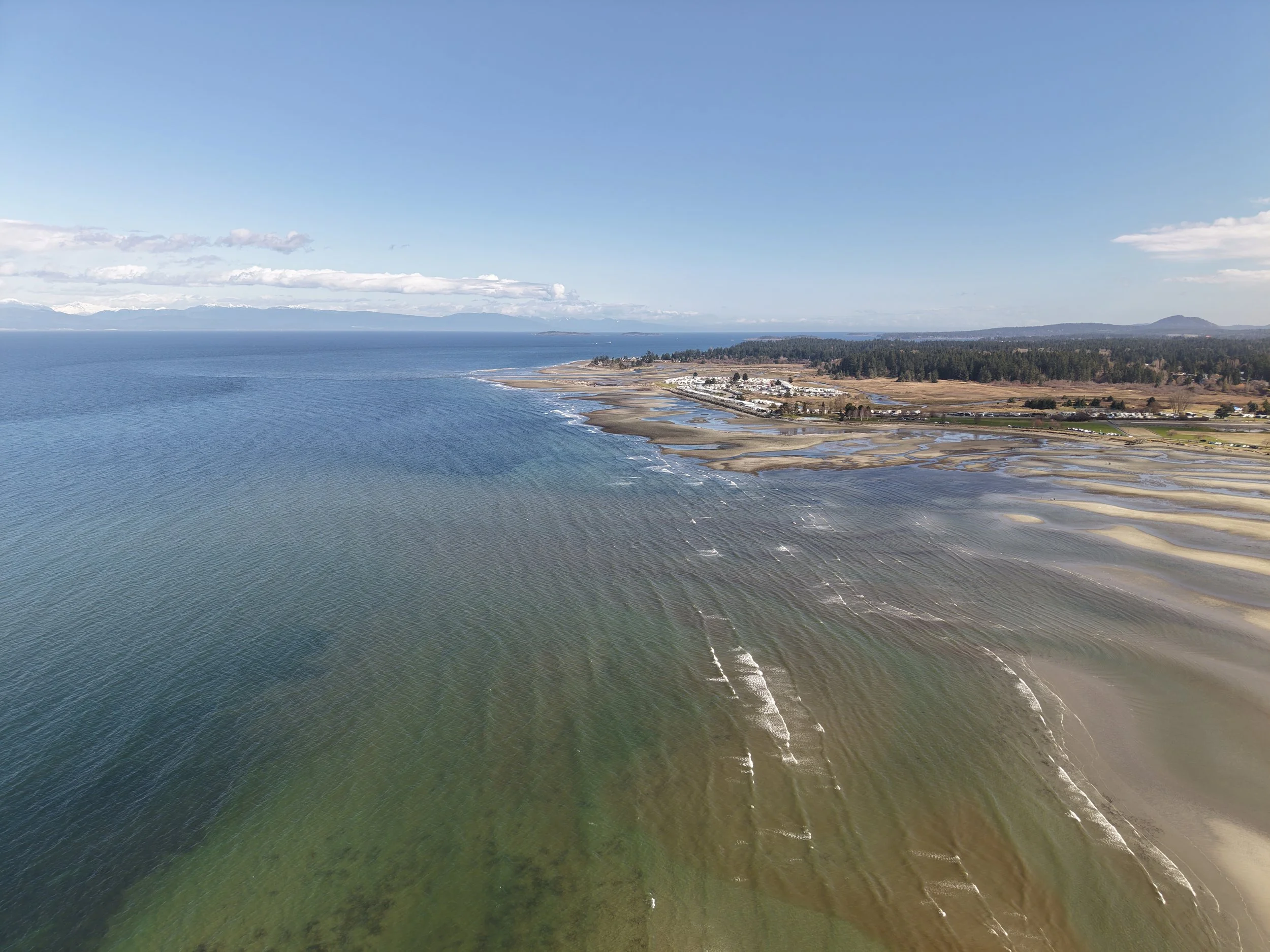
Teaching Kids to Fly Drones: Fun First, Safety Always
There’s no shortage of drone tutorials online.
Advanced certifications. Flight breakdowns. Endless gear reviews.
But teaching a four-year-old to fly?
That’s a completely different conversation.
When I take Blake out with a drone — whether it’s the Air 3S for a quiet sunrise shoot or the DJI Neo 2 tucked into my jacket pocket — the goal isn’t to turn him into a pilot.
Not yet.
The goal is simple.
Have fun.
Be safe.
Build good habits early.
That balance is everything.
Even a micro drone deserves respect. And if we want this hobby to stay welcome and respected in Canada, that foundation starts early.
Here’s how I approach teaching my four-year-old — in a way that keeps the joy alive while quietly building responsibility underneath it.
The Air 3S Is Dad’s Drone. The Neo 2 Is His.
Let’s be clear about something.
Blake does not fly the Air 3S.
The controller is still too big for his hands. When he’s “landed” it, I’ve already initiated Return to Home. He holds the controller while it descends, and he watches it touch down.
It makes him feel involved.
But the real flying?
That happens on the Neo 2.
And that’s intentional.
The Neo 2 fits his stage. No bulky controller. No satellite waiting. No complex menus. We can pull it out of a pocket, power it up, and be airborne in seconds.
Palm takeoff.
Gesture control.
ActiveTrack.
It feels like magic to a kid.
And because it’s small, protected, and tough, when it bumps something or tips over, it’s not a crisis. We reset and try again.
That completely changes the tone of learning.
1. Make It Exciting First
Kids don’t learn from lectures.
They learn from curiosity.
If the first experience feels complicated or stressful, you lose them.
The Neo 2 gives Blake immediate feedback. He sees it lift off. He sees it follow him. He sees himself on camera.
That spark matters.
Once he’s excited, I can layer in the important lessons naturally.
2. “Fun” Opens the Door. “Responsibility” Lives Behind It.
Every time we fly, we repeat two truths:
Drones are fun.
Drones can hurt people if you’re careless.
I don’t dramatize it. I don’t scare him.
But I don’t pretend it’s a toy either.
We keep space around people.
We don’t fly toward strangers.
We don’t chase dogs or birds.
We don’t buzz our friends.
We land immediately when asked.
To him, these aren’t aviation rules.
They’re just being respectful.
That framing works.
3. Keep the First Lessons Simple
We don’t try to do everything at once.
Lesson 1: Take off and land on your palm.
Lesson 2: Hover in one spot.
Lesson 3: Move toward you, then away.
Lesson 4: Stop when Dad says stop.
That last one might be the most important skill he learns for years.
It’s not about precision.
It’s about awareness.
4. Micro Drone Does Not Mean Micro Responsibility
In Canada, sub-250g drones come with fewer regulatory requirements.
That does not mean they’re toys.
Blake watches me choose quiet spaces.
He sees me check the environment.
He hears me talk about wind and airspace.
He doesn’t understand Transport Canada regulations yet.
But he absorbs the behaviour.
Kids mirror what they see.
If you treat drones seriously, they will too.
5. Sunrise Is the Best Classroom
Most of our flights happen early.
Sunrise is quiet.
There’s space.
Fewer distractions.
Less risk of irritating anyone.
That calm environment makes learning easier.
No chaos.
No crowd energy.
No dogs running under the drone.
Just space to practice and talk.
6. Managing Excitement Is the Real Challenge
The hardest part of teaching kids to fly isn’t the drone.
It’s the energy.
Especially when friends are around.
Excitement goes up.
Impulse control goes down.
That’s when we pause.
We reset.
We remind ourselves why we’re flying.
Safe.
Respectful.
Fun.
Not chaotic. Not annoying. Not disruptive.
If we can’t keep that balance, we pack it up.
That lesson matters more than any maneuver.
7. This Is How the Hobby Survives
Drones are getting smarter every year.
But technology doesn’t replace responsibility.
If kids grow up understanding that drones are creative tools — not toys to show off with — that’s how you protect the future of the hobby.
For us, it’s not about creating a four-year-old pilot.
It’s about sharing something cool together and building habits that will stick when he’s older.
The Neo 2 makes the entry point easy.
The values around it are what actually matter.
And honestly?
These quiet West Coast sunrise flights together will matter more than whatever footage we bring home.
Related Articles
DJI Neo 2 Real-World Use with Kids | Hands-Free Drone Filming in Everyday Settings
A parent’s real-world look at using the Neo 2 with a four-year-old — gesture control, ActiveTrack, and everyday family moments without the hype.
Flying a Drone in Victoria, BC | Local Rules, Airspace, and Practical Tips
A practical guide to navigating Victoria’s complex airspace, timing your flights, and flying respectfully in Greater Victoria.
Why Victoria Construction Companies Use Drone Photography
How local construction teams use aerial imagery for safer site visibility, progress tracking, and clearer documentation across active projects.
A “Freezing” February Sunrise — Mount Tolmie to Cadboro Bay




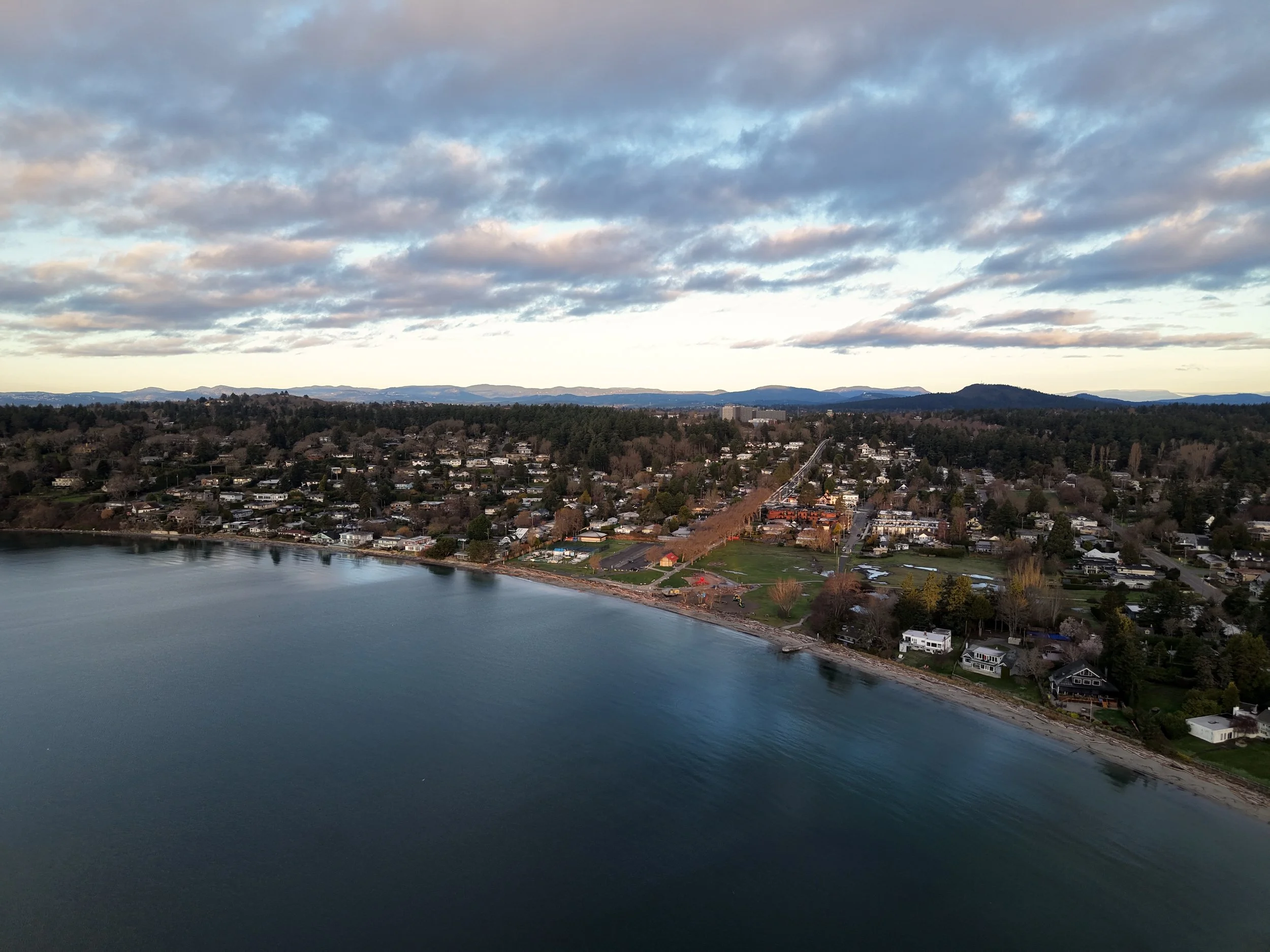
Let me be clear before the rest of Canada revokes my citizenship.
It was not actually cold.
It was Victoria cold.
Which means the temperature technically required a jacket and I dramatically considered gloves while the Prairies were probably measuring snowfall in metres and laughing at us.
But standing on Mount Tolmie at sunrise with a drone controller in your hands? That little coastal breeze suddenly feels personal.
I drove up early with a coffee, telling myself I grew up on the Prairies and therefore “know cold.”
Turns out, coastal living has softened me. Completely.
There’s a special kind of humility that comes from realizing teenage-you used to scrape frost off a windshield at -30, and present-day-you is grumbling at +4 because your fingers are chilly while flying a flying robot for fun.
That said — the sky showed up.
Mount Tolmie lit up in deep oranges over the Strait, light stretching toward the Gulf Islands, the city still half asleep below. That moment where you forget about your frozen fingers because the horizon is doing something ridiculous.
I’ve been coming up here since I was a teenager. Back then it was just a place to hang out, talk nonsense, and look at the lights. Now I come back with better coffee and more expensive hobbies.
Same view. Slightly more responsible human.
After grabbing a few shots up top (and regaining partial feeling in my hands), I drove down to Cadboro Bay — another place that’s been part of my orbit since my teens.
From the air, Cadboro in winter is calm and honest. Long reflections. Soft light over the water. Quiet neighbourhoods tucked along the shoreline. No drama. Just West Coast doing what it does.
There’s something about revisiting places you’ve known for decades and seeing them from a new angle. Same coast. Same memories. Different perspective.
Also — I need to learn to fly with gloves. That’s the takeaway here.
The Prairies version of me would be embarrassed by this entire paragraph. But February sunrises on Vancouver Island? Still worth “suffering” for.
And yes — before anyone asks — I survived.
Barely.
Related Blog Posts
A Drone, a Four-Year-Old, and a Lot of Curiosity
A real-world look at the DJI Neo 2 through the eyes of a four-year-old. No specs, no hype — just hand gestures, active tracking, bike rides, boardwalk runs, and a little drone that’s become part of everyday family life.
Flying a Drone in Victoria, BC: What You Should Know Before You Go
A practical, local-first guide to flying in Greater Victoria — from floatplanes and military traffic to early-morning timing and common-sense etiquette. Whether you’re flying a micro-drone or something larger, here’s what actually matters.
The DJI Drones & Accessories We Actually Recommend (and Why)
A curated list of the drones and gear we genuinely use — from the DJI Air 3S workhorse to the surprisingly capable Neo 2. No “top 10” nonsense, just tools that earn their place in real-world flying.
A Drone, a Four-Year-Old, and a Lot of Curiosity
Blake got a DJI Neo 2 for Christmas. He’s four. No controller, no screens — just hand gestures, active tracking, and a drone that’s happy to follow him around like a very patient flying cameraman.
Over the last couple of months, we’ve been messing around with it in low-key ways. Blake riding his bike, running along boardwalks, showing off his dance moves, and generally treating the Neo 2 like it exists purely to document his daily adventures. And honestly, that’s where this little drone shines.
This video is a collection of those moments. No spec breakdowns, no dramatic claims — just real-world use, in real places, by a kid who’s more interested in seeing himself on screen than worrying about flight modes.
From a parent’s perspective, what stood out most is how approachable it is. The Neo 2 isn’t intimidating. It doesn’t feel like “dad’s expensive drone.” It feels like a toy — but one that quietly does some impressive things in the background.
We’re not affiliated with DJI in any way, and this isn’t a review in the traditional sense. It’s just an honest look at how this little drone has fit into our lives since Christmas, and how tech like this can be fun, creative, and a bit magical when you strip away the hype.
Video below 👇